I met C.A. Suleiman online as I was working on this Best of Modern Arabian fantasy series. While Colin is not the only person of Middle Eastern descent I’ve interviewed, he is the first to appear.
A writer, musician, and game designer, Colin has built many worlds and milieus, many of which are inspired and informed by his Middle Eastern heritage. It was fascinating to discuss modern Arabian fantasy with a modern Arab-American.
Read on to hear his thoughts on this increasingly popular subgenre.
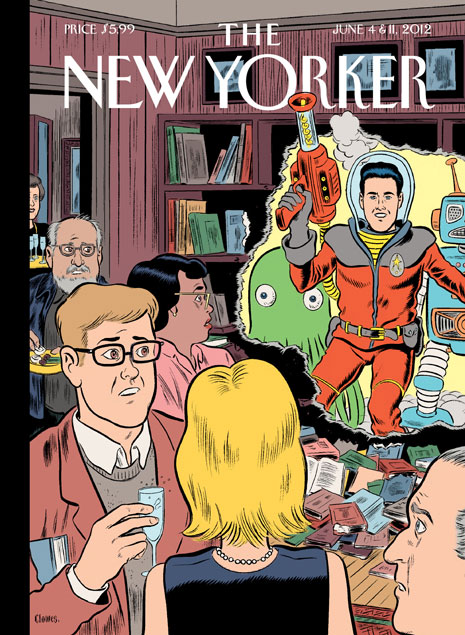
This week’s issue of The New Yorker (yes, The New Yorker!) is a science fiction issue, featuring fiction by Jonathan Lethem, Jennifer Egan, and Junot Diaz, among others.
Here’s the complete table of contents. Now you can have your science fiction fix and feel literary about it at the same time.
This Week’s Bargain SF & Fantasy Books at Amazon.com
It’s good to be the editor. For example, I pretend I do a weekly bargain books update, and no one corrects me — even though the last one was in April. Thank you for indulging me in my shared fantasy.
Let’s get down to business: Bargain Books. I’m the expert, and I’m here to share my knowledge with you. It’s what I do.
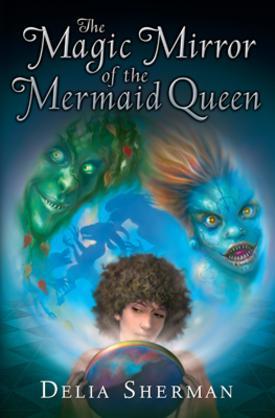
This week (ha!) the list contains books by Delia Sherman, Stephen Baxter, Sara Douglass, J.R.R. Tolkien, Stephen R. Donaldson, L.E. Modesitt, Jr, William Gibson, R.A. Salvatore, E.E. Knight, and many more.
All discounted between 60% and 80%. As always, quantities on these bargain books are very limited. All are eligible for free domestic shipping on orders over $25. Most of last week’s (ha!) discount titles are still available; you can see them here.
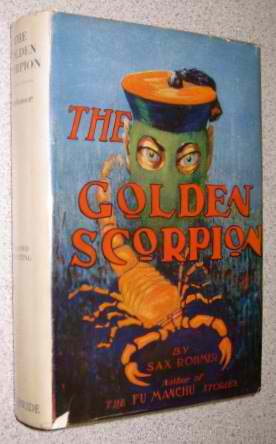
Blogging Sax Rohmer’s The Golden Scorpion, Part Two – “The Statement of M. Gaston Max”
Sax Rohmer’s The Golden Scorpion was first printed in its entirety in The Illustrated London News Christmas Number in December 1918. It was published in book form in the UK the following year by Methuen and in the US in 1920 by McBride & Nast. Rohmer divided the novel into four sections. This week we shall examine the second part of the book, “The Statement of M. Gaston Max” which comprises nine chapters.
Rohmer chose to follow the formula he utilized successfully with The Yellow Claw (1915) by starting the narrative at a crucial early stage before revealing the principal character’s earlier involvement in the plot and then unexpectedly bringing Gaston Max into the proceedings and having him relate, over the course of several chapters, a lengthy background story that helps connect the dots for both reader and protagonist.
Max’s account begins some months earlier when he was serving as head of security to the Grand Duke Ivan during his visit to Paris. The French detective became concerned with the Grand Duke’s torrid affair with the exotic Egyptian dancer, Zara el-Khala, while staying in Paris. Surveillance work uncovers her connection to a mysterious individual known as The Scorpion. Max is unable to learn anything else of significance about the dancer’s background. After she unexpectedly fails to turn up for her performance one night, the detective learns she has suddenly left Paris. That same night, Grand Duke Ivan is struck ill and dies.
There’s almost nothing as cool as getting an exclusive — unless it’s an exclusive from an up-and-coming film maker.
When one considers that every director who ever created a blockbuster was once a struggling artist thrashing about in the low-budget trenches, one imagines that when said directors finally hit the big time, they’ll remember those who recognized genius and encouraged them in their leaner years, then invite those people to high-power lunch meetings and red-carpet events which steadfast supporters can only daydream about today.
Right, Wyatt?
Wyatt Weed from Pirate Pictures, along with his colleagues at State of Mind Productions, are the creative force behind the new indy short-film project Outpost 13 and they’ve granted an exclusive screening to Black Gate readers before the film is released to the wider viewing audience.
Yes, that’s right. An exclusive. Which ranks Wyatt Weed above Ridley Scott, who only sends us the trailers about five minutes before everyone else gets them.
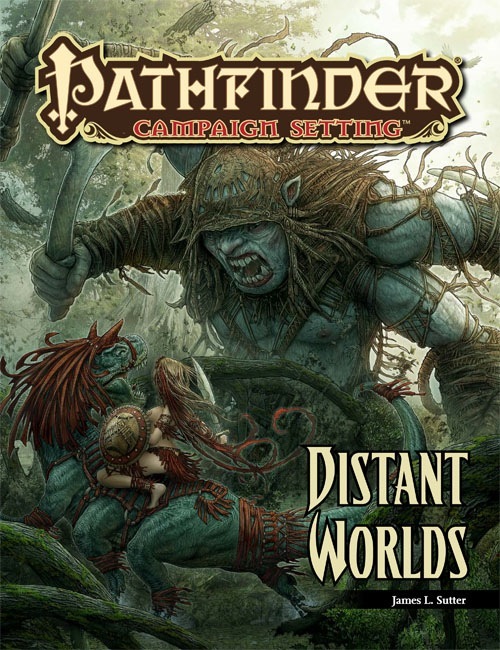
Distant Worlds, or as I like to call it, 'Pathjammer!'
So as you may have seen last week, I was on my annual pilgrimage to Indiana for a full week of hardcore gaming with my boys. The ‘Week 2012’ included several games like AD&D 1E, Deadlands D20, Stars Without Number, and even a go at Pinnacle’s Savage Worlds: Tour of Darkness, which was outstanding.
My responsibility during the week was to DM what is considered our ‘super campaign’ which will take up to five full days of gaming. At a bit over 14 hours a day, that equates to roughly 70 hours behind the DM screens (this week I was enticed to do 6 days and 84 hours). To do this I’ve got to come up with an original idea, typically something that will throw the players for a loop, and certainly hold their attention as we move through an epic tale of adventure.
This year, as I sat staring at my shelves of RPG books, I couldn’t help but keep coming back to the old AD&D 2nd Edition campaign setting, Spelljammer. Now Spelljammer was an interesting and inherently simple idea, take D&D and put it in space. To do this, the development team found a way to make fantasy ships fly through space while they explored worlds around the base worlds TSR had created through the 1980s like Krynn, Greyhawk, and the Forgotten Realms.
Back in the day, I’d played Spelljammer no more than three or four times on mini-adventures with my most famous elven thief, Sefron Silvershoe. Thus, my DM, Mark, dubbed the game ‘Sefron in Space’ to be funny. Because of our devotion to Forgotten Realms and other science fiction games like Paladium’s Robotech, Spelljammer didn’t stick and we quickly went back to other things.
Before getting into Men in Black Part the Third, I must retract a promise made in an earlier post, where I vowed to review eighteen of this summer’s genre movie releases. But the blame rests with Paramount, not with me. In a move that can best be described as a vote of “less-than-zero confidence” in their own product, Paramount has delayed the release of G.I. Joe: Retaliation from next month to March 2013. With only a month to go before its originally slated release, and with a promotional campaign already going full throttle, G.I. Joe just got banned from the summer leagues. The excuse: “3D conversion.” Uh huh. I can’t imagine how terrible the film must actually be if Paramount chose to ditch it this late and swallow a few million bucks of promotion. I estimated that The Amazing Spider-Man would viciously pound G.I. Joe in its second frame, and Paramount apparently decided that G.I. Joe’s first frame would be so poor that they didn’t want to go through the embarrassment. I wonder how much Hasbro’s Battleship flop affected Paramount’s decision to drop the toy company’s other movie of the summer?
Anyway, Men in Black 3, a.k.a. MIIIB, pronounced “Mieb” and known on Arrakis as “Mi’i’d.” The film that, whatever else it may achieve, has the distinction of taking down The Avengers from the #1 box-office slot after reigning for three weeks.
The original Men in Black was a minor miracle in the summer of 1997. (Keep in mind, this was the same summer as Batman and Robin; we were desperate.) It was compact, clever, breezy, and crackled with the chemistry between Tommy Lee Jones and Will Smith at the height of his comic powers. It also looked like ideal sequel material, but when Men in Black II arrived and stunk in 2002, the first film began to look like a perfect one-off: nothing more was needed.
Men in Black 3 is a large improvement over Men in Black II, and even though it runs more than fifteen minutes longer — the longest of the three films — the second sequel moves faster and gets back some of the click of the ’97 movie. However, the first Men in Black still seems like a one-off. Men in Black 3 is a bland film at worst, and somewhat enjoyable at its select best.
The May issue of Clarkesworld is currently online. Featured fiction: “Prayer” by Robert Reed, “Synch Me, Kiss Me, Drop” by Suzanne Church and “All the Things the Moon is Not” by Alexander Lumans. There are also audio versions of all three stories, read by Kate Baker. Non fiction by Aletha Kontis, Jeremy L.C. Jones and Elizabeth Bear. The cover art is by Jessada Suthi.
All of this is available online for free. However, nothing is really free. The magazine is supported by “Clarkesworld Citizens” who donate $10 or more. There’s also a Kindle edition.
One personal reaction to Bear’s very funny essay, “Another Word: Dear Speculative Fiction, I’m Glad We Had This Talk”: I agree that Lenny Bruce didn’t get funnier when he got angrier (his drug problems certainly didn’t help), but I found George Carlin to be more interesting the angrier he got. Maybe he wasn’t quite as funny, but his anger certainly resonated with me. Sometimes having your “face pressed down into a trough of human misery until the bubbles stop” is necessary to remind people that life is not a television sitcom. At least the ones who haven’t already drowned.
Someone else who got less interesting when he started taking himself too seriously (and, once again, the drugs didn’t help) was Philip K. Dick. Simon Critchley examines Dick’s metaphysical worldview as expressed in Exegeiss, a posthumously published series of philosophical ramblings. While I tend to think all this stuff really is the result of a bad acid trip, Critchley as a professor of philosophy for the most part keeps a straight face. Some of you may laugh out loud not only at the source material, but the attempt at exegesis.
Sax Rohmer’s The Golden Scorpion was first printed in its entirety in The Illustrated London News Christmas Number in December 1918. It was published in book form in the UK the following year by Methuen and in the US in 1920 by McBride & Nast. Rohmer divided the novel into four sections which is how we shall examine the book over the next four weeks. “The Cowled Man” is the title Rohmer selected for the first part of the book and comprises the first eleven chapters.
Despite featuring several characters from Rohmer’s 1915 novel, The Yellow Claw, The Golden Scorpion marked a return to the style and feel of Rohmer’s Fu-Manchu thrillers which had concluded the previous year with the publication of The Si-Fan Mysteries (1917). Rohmer maintained the more realistic Limehouse crime novel approach of The Yellow Claw for his contemporaneous Red Kerry detective series which started with Dope (1919), but chose to fashion The Golden Scorpion from the same Yellow Peril weird menace cloth that made his reputation as an author. The key difference from the Fu-Manchu thrillers is that Rohmer maintains a third person narrative voice (as he had in The Yellow Claw) rather than recreating the frantic paranoia that marked Dr. Petrie’s first person narratives.
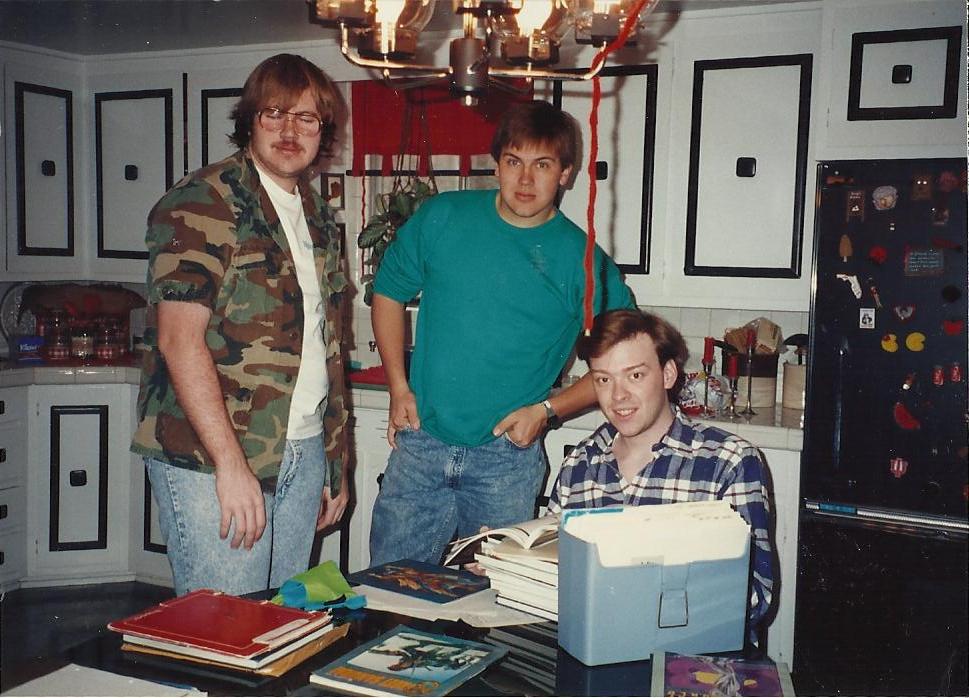
Me at right, Murph in middle, and my personal DM Mark to left, circa 1990 as we prepare for a Shadowrun adventure.
Yes, it’s true, I’m posting a day late on my Art of the Genre blog, but hey, when you’ve been the Gamemaster for six straight days of 14 hour gaming, I think even the great John O’Neill can cut me a little slack. I’m mean, this is my vacation after all, so I think having anything, even this odd article, to post should show how much I love my readers!
Still, it was kind of tough, amid all the chaos of gaming, to settle in on a subject for this week’s AtoG. However, the more I sat around the gaming table, the more I began to understand the Art of being a Gamemaster and how that translates into something cool.
I mean, I’ve been doing this since I was a tween… well actually before the word tween even existed. Even early on I would sit at a table, screens before me, and paint pictures with words that are vivid enough to keep my friends coming back for more. And when I say coming back for more, I mean really, truly, coming back, no matter from where, for more story spinning than I’ve the right to foist on you here.
I’ve gamed with the same group of friends since middle school, and it’s not like we all live three minutes from one another. Nope, we are now stretched from Maryland to California, but one week a year, we make a sojourn back to the Midwest to roll dice like we did when we were twelve. …



 Before getting into Men in Black Part the Third, I must retract a promise made in an earlier post, where I
  The May issue of Clarkesworld is currently
  ramblings. While I tend to think all this stuff really is the result of a bad acid trip, Critchley as a professor of philosophy for the most part keeps a straight face. Some of you may laugh out loud not only at the source material, but the attempt at exegesis.