Browsed by
Category: Blog Entry

Exploring the Defenses of Tangier

Exploring the Defenses of Tangier

DSC_0095

This past Christmas vacation, my wife and I headed down to Tangier so I could write a travel series for Gadling.

While walking the labyrinthine alleyways of this Moroccan port, I took note of the defenses that had been built up over the years. Tangier has changed hands numerous times between the Moroccans, English, French, Spanish, and Portuguese. Because of its strategic importance on the southern end of the Strait of Gibraltar, it’s always needed to protect itself. The old town is surrounded by high walls, emplacements for sea batteries can still be seen, and high up on the hill overlooking the city stands the Casbah, where the Sultan once lived with his family and entourage, and which has fortifications of its own.

[Click on any of the images in this article for larger versions.]

DSC_0187

Read More Read More

“Classic Sword & Fantasy”: Tangent Online on Vaughn Heppner’s “The Pit Slave”

“Classic Sword & Fantasy”: Tangent Online on Vaughn Heppner’s “The Pit Slave”

oracle of gogLouis West at Tangent Online reviews Vaughn Heppner’s swords & sorcery short story, “The Pit Slave,” published here on Sunday, February 2:

A classic sword & fantasy tale. Lod had urged the last of the human soldiers, who worship the god Elohim, to rise up and rebel against the conquering Nephilim giants since “it was better to die on your feet than live on your knees.”

But all the soldiers were killed or captured. Now Lod is prisoner of the Nephilim, slated to die in the arena as a pit slave…

“The Pit Slave” is a 7,000-word short story offered at no cost. It is the sequel to “The Oracle of Gog” (from Black Gate 15), and part of Lost Civilizations, a six-book series. A slightly different version of “The Pit Slave” appears in The Lod Saga, available now at Amazon.com and Barnes & Noble.com.

Read the complete story here, and Louis’s review at Tangent Online here.

The complete catalog of Black Gate Online Fiction, including stories by E.E. Knight, Jason E. Thummel, Gregory Bierly, Mark Rigney, C.S.E. Cooney, Judith Berman, Howard Andrew Jones, Dave Gross, Harry Connolly, and others, is here.

Blogging Sax Rohmer’s The Bride of Fu Manchu, Part One

Blogging Sax Rohmer’s The Bride of Fu Manchu, Part One

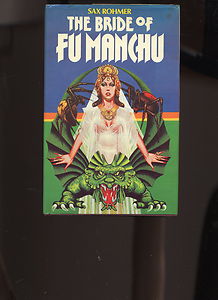
bride-fu-manchu-sax-rhomerBride of Fu Manchu2Sax Rohmer’s The Bride of Fu Manchu was originally serialized in Collier’s from May 6 to July 8, 1933 under the variant title, Fu Manchu’s Bride. It was published in book form later that year by Cassell in the UK and Doubleday in the US. The US edition retained the original magazine title until the 1960s, when the UK book title was adopted for the paperback edition published by Pyramid Books. Under any title, it is without a doubt the finest book of the series in terms of prose and plotting.

The Bride of Fu Manchu introduces readers to a new narrator/hero in the form of the young botanist, Dr. Alan Sterling. As the book opens, Sterling is in France along with Dr. Petrie. They have both been called in to investigate a strange new epidemic that has stricken the Riviera.

Sterling comes ashore on Ste. Claire and discovers a beautiful girl on an otherwise deserted beach. The introductory scene is a long and evocative one and will be instantly familiar to James Bond fans as a clear influence on Ian Fleming. The girl is called Fleurette and likens herself to the goddess, Derceto. She is the property of the mysterious Mahdi Bey, who owns the great house on Ste. Claire. A strange sonic trumpet sounds and Fleurette rushes back to her master’s home, leaving Sterling both smitten and frustrated by their brief but tantalizing encounter.

Read More Read More

Goth Chick News – Crawling Out of the Underground Bunker and Into a Little Fantasy

Goth Chick News – Crawling Out of the Underground Bunker and Into a Little Fantasy

image002As a devotee of dark subject matters, I still make no apologies for being a Harry Potter fan.

Magic has always been an appealing subject; combined with an enchanted world that exists in parallel with our own, it almost feels like the stories could possibly… maybe… have an element of truth to them.

It’s the idea that somewhere the magic really exists…

But this is precisely why pure fantasy has been on the peripherals of my literary leanings.  Though I have often been ultimately glad to have struggled through a tale that requires a glossary of terms or at least a nearby notebook to keep straight (George R. R. Martin, I’m looking at you), I admittedly don’t care to work that hard for my entertainment.  My willing suspension of disbelief tends to go a little stale if I can’t go with you without packing a guidebook.

However, on February 19th, I and my fellow fantasy philistines may have a reason to rethink our positions.

Pierre Grimbert, a native of France who has won the Prix Ozone for best French language fantasy novel as well as the Prix Julia Verlanger for best science fiction novel, finally earns the right to launch his popular Secret of Ji series in English.

The Secret of Ji: Six Heirs represents book one of the fourteen-installments-tale and sets the stage for the characters and premise of the series.

Read More Read More

Teaching and Fantasy Literature: The Strange and Mysterious Unit

Teaching and Fantasy Literature: The Strange and Mysterious Unit

I’m secretly haunting an 8th grade English class at Hammarskjold Middle School. I tutor some students who are in the same class, so I get to see their teacher’s assignments, comments on student writing, and most recently, study guides for midterm exams. I glimpse the teacher through the fog of my physical absence from the classroom–I even forget from week to week whether the teacher is a man or a woman–but traces of my spectral influence may be detectable in my students’ work.

Did the teacher allow himself a moment to enjoy the name he gave his last series of assignments? Every time I looked at his study guide and saw his sentences about “the strange and mysterious unit,” it cracked me up. Of course, he was referring in a straightforward, lower-case-letters way to a packet of short stories by Poe, Asimov, and Lovecraft that centered around strange and mysterious incidents. I, however, pictured a battered, much photocopied document that emanated a cloud of green miasma and the wail of a theremin, with voiceover narration: No middle school teacher would ever be the same after she attempted to teach…the Strange and Mysterious Unit! Cue thunder and lighting.

I don’t know whether the Strange and Mysterious Unit has affected the way anybody else thinks about fiction, but it’s clarified my thinking about conflict in tales of the fantastic.

Read More Read More

New Treasures: Introducing Garrett, P.I.

New Treasures: Introducing Garrett, P.I.

Introducing Garrett P.I.-smallWhen I started reading fantasy, I wanted every book I read to be The Lord of the Rings. High stakes, epic in scope, and at least one guy had to have a bitchin’ magic ring.

That’s the only decent explanation I can come up with for why I steadfastly ignored Glen Cook’s Garrett, P.I. novels for so many years. And that took some doing, too — in the 24 years since Sweet Silver Blues appeared, Cook has written no less than thirteen, with one more on the way. I’d probably still be ignorant of this highly readable and fast paced series if the charming Tina Jens hadn’t discovered this glaring omission in my fantasy education at Worldcon, and arrived at our booth the next morning with a brand new copy of Sweet Silver Blues, inscribed to me by Glen Cook.

Long story short, it wasn’t long before I was a fan. So you can imagine how delighted I was to open my mail yesterday and find a review copy of Garrett For Hire, a handsome omnibus collection of Deadly Quicksilver Lies, Petty Pewter Gods, and Faded Steel Heat, novels 7, 8, and 9 in the series.

I know what you’re thinking. Who does an omnibus of novels 7, 8 and 9? Unless…

A quick Internet search proved what I should have been able to figure out for myself: there are two previous collections. Introducing Garrett, P.I. was published August 2011, and Garrett Takes the Case in February 2012. Not sure how the hell I managed to miss them both. Clearly my detection skills are no match for my new hero, Garrett. Well, at least I’ve got one thing figured out: what books I’m going to be tracking down and reading this weekend.

Read More Read More

The Pop Culture Class of 1960 – 1969: Marvel Firsts: The 1960s

The Pop Culture Class of 1960 – 1969: Marvel Firsts: The 1960s

Marvel Firsts The 1960s-smallI remember the first time I read Origins of Marvel Comics, Stan Lee’s seminal 1974 anthology collecting the first appearances of the Fantastic Four, the Hulk, Spider-Man, Thor, and Doctor Strange. It was memorable because, for one thing, Stan’s bombastic introductions were frequently more entertaining than the comics themselves, and for another… the comics sure looked old.

Stan knew that, and he also knew a collection of first issues didn’t necessarily reflect Marvel Comics at its best. So alongside each origin story he also reprinted a tale that did showcase what made these characters special, including the FF’s epic battle with the Silver Surfer (from issue #55), Spider-Man’s tussle with the Shocker (issue #72), and others classic stories from the late 60s.

It made for a terrific book — and a great seller. Stan followed it a year later with Son of Origins of Marvel Comics, and then Bring on the Bad Guys; all told Marvel produced a total of 24 different books in similar format with publishing partner Fireside Books.

Origins of Marvel Comics hasn’t been in print in nearly three decades (ignoring the oddity with the same title released last May, which condenses the origin of each of the Marvel’s most popular characters into a single page), which is a shame. However, Marvel finally rectified this oversight late in 2011, kicking off an ambitious program to collect the first appearances of virtually every one of its major and minor characters.

This is a massive undertaking, and while I miss the partner tales Stan included alongside his selections, it’s an understandable sacrifice for the sake of completeness. While another reprinting of The Fantastic Four #1 or Amazing Fantasy #15 wouldn’t normally get me to crack open my wallet, an omnibus volume that also collects The Rawhide Kid #17 (from 1955), Daredevil #1 (1964), Western comic The Ghost Rider #1 (1967) and numerous others was definitely worth a look.

Read More Read More

New Treasures: Children of the Night by Dan Simmons

New Treasures: Children of the Night by Dan Simmons

Children of the NightDan Simmons wrote two of my favorite horror novels, Carrion Comfort and Summer of Night, and the audio version of his novel, The Terror, kept me riveted for many weeks during the long winter commute between Champaign and St. Charles last year. When Simmons talks horror, I listen.

Children of the Night was originally published in 1992, when Communist states were collapsing all across Europe and the airwaves were filled with stories of the desperate last days of Communist dictators. Romania, home to the classic fears of Transylvania, became synonymous with horror of a very different kind when western film crews entered bleak Romanian orphanages to expose the cruelty and neglect there. In Children of the Night, Simmons married modern horror and a far more ancient terror:

In a desolate orphanage in post-Communist Romania, a desperately ill infant is given the wrong blood transfusion — and flourishes rather than dies. For immunologist Kate Neuman, the infant’s immune system may hold the key to cure cancer and AIDS. Kate adopts the baby and takes him home to the States. But baby Joshua holds a link to an ancient clan and their legendary leader — Vlad Tşepeş, the original Dracula – whose agents kidnap the child. Against impossible odds and vicious enemies– both human and vampire – Kate and her ally, Father Mike O’Rourke, steal into Romania to get her baby back.

Children of the Night was published on December 11, 2012 by St. Martin’s Griffin. It is 464 pages in trade paperback, priced at $15.99 ($9.99 for the digital edition), and this edition features a brand new introduction by the author.

You can see all of our recent New Treasures articles here.

Rue Morgue Magazine’s 200 Alternative Horror Films You Need to See

Rue Morgue Magazine’s 200 Alternative Horror Films You Need to See

Rue morgues magazine's 200 alternative horror filmsI had a clever title in mind for this post, something about a book you need to see, but the name of the book was so long nothing else would fit. Rue Morgue Magazine’s 200 Alternative Horror Films You Need to See. See what I mean? Damn near had to start a new paragraph just to say it again.

200 Flicks (which we’ll be calling it going forward) is a marvelous little treasure I found on the B&N magazine rack while digging around for the latest issue of Fantasy & Science Fiction. I’m vaguely aware of Rue Morgue magazine (and should probably be moreso, granted), but that wasn’t what caught my eye. No, it was the title, and the fact that this perfect bound “magazine” is an impressive 162 pages.

I flipped through it, and was sold instantly. This is the kind of invaluable reference work I’ll be drawing on for years. It’s packed to the brim with text, with plenty of color stills and crisp reproductions of 200 movie posters and DVD covers. The heart of the book is the carefully-selected collection of well written and informative reviews of overlooked horror films.

A quick check showed many of my favorites are here, including a guilty pleasure or two: Session 9, Let the Right One In, Psycho II, Something Wicked This Way Comes — and plenty more that I’m not familiar with. And isn’t the joy of discovery the true reason you lay your money down for this kind of thing?

The entries are organized alpahbetically, but it’s really something you browse rather than read cover-to-cover. It has numerous lists: 10 Made for TV Terrors You Need to See, 10 Foreign Zombie Films You Need to See, plus lists covering vampire flicks, foreign zombie movies, family fright fests, gore films, slashers, and many more. There are also interviews with directors and film personalities like Guillermo del Toro, Tobe Hooper, Roger Corman, Fred Dekker, Larry Cohen, Stuart Gordon, and others.

The book is so inexpensive (a criminally low $9.99, or $4.99 for the digital version) and so packed with content that the only way it can possibly be a money-making venture is if it’s primarily recycled material from Rue Morgue magazine. Which is fine by me — if the magazine is a fraction as interesting and entertaining, I’ll be getting a subscription.

Read More Read More

MAKE THIS TRUE OR HARVEY SMASH! Planet Hulk to Come after Avengers 2

MAKE THIS TRUE OR HARVEY SMASH! Planet Hulk to Come after Avengers 2

HulkPlanetHulkHCHULK SMASH MARVEL STUDIOS FOR SENDING HULK INTO SPACE!

Maybe he will and maybe he won’t, because that is how “scoops” work, and in this case we are dealing with a scoop for a film quite a few years out.

However, Latino Review and their esteemed El Mayimbe have a long history of accuracy with breaking movie news, so when El Mayimbe says that Marvel wants to make a movie version of Planet Hulk as a follow-up to 2015’s upcoming The Avengers 2, it bears serious consideration.

And, if true, damn I’m psyched and ready to Hulk-out. You should be too.

(Caution that El Mayimbe’s video may be considered mildly “spoilery” about the possible end of The Avengers 2. My comments below may also infer bits about Avengers 2.)

Planet Hulk is a long 2006 arc from The Incredible Hulk comic book (with tie-ins) by writer Greg Pak and illustrator Carlo Pagulayan. The gist: A small group known as the Illuminati, composed of the most powerful heroes on Earth, decide that the Hulk is simply too dangerous for the planet, so they shut him in a spaceship and blast his green butt off into space to land on a peaceful planet to spend the rest of his days. Only… this is a comic book and such a development would be boring. Nobody wants to see Hulk traipsing through a shady copse, smiling, and picking up alien daisies. TRA-LA-LA, HULK NO SMASH! HULK LOVE RHODODENDRONS!

Instead, the Hulk’s ship goes through a wormhole, and he crashes on the violent planet of Sakaar. What follows is basically a sword-and-sorcery epic with the Hulk playing a Robert E. Howard hero who battles his way from gladiatorial slavery all the way to becoming the ruler of the planet. Trust me, it’s awesome — breaking away from the traditional “Hulk vs. General Ross” storylines on Earth and fulling embracing the Leigh Brackett and ERB style of muscular planetary romance. (Try to imagine Hulk as the star of The Sword of Rhiannon!) And the whole enormous thing is available digitally from Amazon.

Our own Bill Ward did an excellent write-up of the comic in 2009 if you desire more details.

Read More Read More