Browsed by
Category: Blog Entry

Return of the Master Cheeser: The Disappearing Dwarf by James P. Blaylock
Return of the Master Cheeser: The Disappearing Dwarf by James P. Blaylock

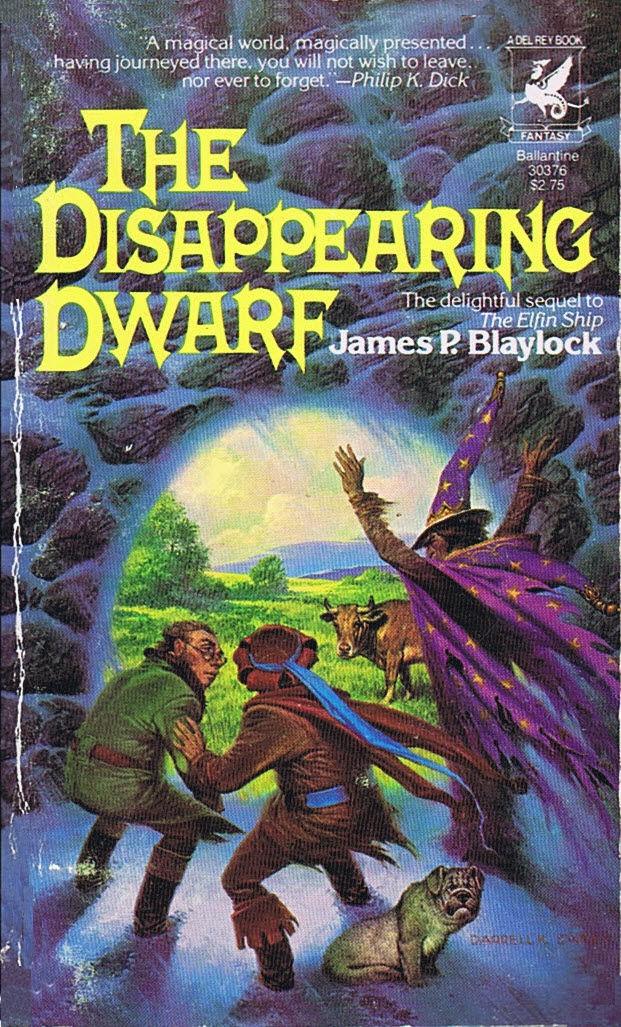
The Disappearing Dwarf-smallPublished in 1983, The Disappearing Dwarf is James P. Blaylock’s second novel, the sequel to his first, The Elfin Ship. Along with The Stone Giant (1989) they form the Balumnia Trilogy. If you have any love for Kenneth Grahame’s The Wind in the Willows, or mouth watering descriptions of all sorts of food and drink, then these books are for you.

The Elfin Ship (reviewed here last year) is filled with constant comical digressions and expends pages on delightful, superfluous details. It’s filled with oddball characters and deliriously silly escapades. The plot is wonderfully complicated. The Disappearing Dwarf has all of those things — save the plot. It’s not that it doesn’t have a plot, it’s just not much of one.

Bored with his new life as man of leisure (allowed by the success of his travels in the previous volume), Jonathan Bing, master cheesemaker, agrees to take a trip down the Oriel River with Professor Wurzle to explore the abandoned castle of their foe, Selznak the dwarf. The castle, they quickly learn, is not empty — and definitely not safe.

From there they meet Miles (pronounce Meelays), the Magician who is hunting Selznak. He tells them that their old nemesis has reappeared, and is certainly up to no good. The magician suspects the dwarf is looking to steal a great magical orb from their friend, Squire Myrkle. Upon reaching the squire’s estate, they discover that he has vanished through a magical door that appeared in his library. The next thing we know, Jonathan, the Professor, and Miles (along with Ahab the dog), are back on board the elfin airship and headed for a doorway to the parallel world, Balumnia.

Narrative drive is nearly absent in The Disappearing Dwarf. Jonathan’s goals switch from one thing to another several times throughout the book. The adventurers spend much of the book traveling from one place to another without ever really knowing what they’re trying to achieve, other than their rather vague plan to find the squire before he falls into Selznak’s clutches. Balumnia has its own villain, a mysterious figure called Sikorsky, but as with the rest of the characters, we never get a clear sight of him or what he’s actually up to. Several characters fade away. One vanishes only to suddenly reappear with little explanation. The book moves haphazardly from one incident to another. Fortunately, most of those incidents are terrific fun.
Read More Read More

The Top 50 Black Gate Posts in March

The Top 50 Black Gate Posts in March

Great-Way-Final-Cover-eBook-3-copyI keep hunting for themes when I tabulate the most popular articles on this website every month. But you Black Gate readers, you’re inscrutable. One month you want all the secrets of writing fantasy trilogies, the next it’s all about the origins of Dungeons and Dragons. Seriously, I’d love to know what articles I should be planning for this blog… but after seven years like this, I give up.

Well, I suppose it’s good that you have diverse interests, anyway. And you sure have great taste in writers and books.

Take last month for example. The number one article for the month was a guest post from author Harry Connolly, author of “The Whoremaster of Pald” and Game of Cages, examining Attack Novels — those story ideas that a writer can’t stop thinking about.

Number two on the list was M Harold Page’s review of Campaign Cartographer 3 Plus, a terrific new fantasy cartography tool for creating your own magical kingdom.

And the number three article at BG last month was M Harold Page’s look at history as the bedrock of fantasy: “The History Manifesto and Sweeping Histories.”

Fourth on the list was our report on a recent attempt to reboot SSI’s famed Gold Box games using Kickstarter, followed by Thomas Parker’s heartfelt remembrance of a great American actor, “Leonard Nimoy Saved My Life.” And sixth was Elizabeth Cady’s detailed look at the new film Jupiter Ascending, “Capitalism Ascending.”

Read More Read More

Thrift Shop Adventures 1: Wherein I Find Fantasy Treasures in Secondhand Stores (Greyhawk Classics and More!)

Thrift Shop Adventures 1: Wherein I Find Fantasy Treasures in Secondhand Stores (Greyhawk Classics and More!)

photo 3-2

“I’m gonna pop some tags / Only got twenty dollars in my pocket / I — I — I’m hunting, looking for a come-up / This is ******* awesome”
— Sir Macklemore of the Order of Thrift

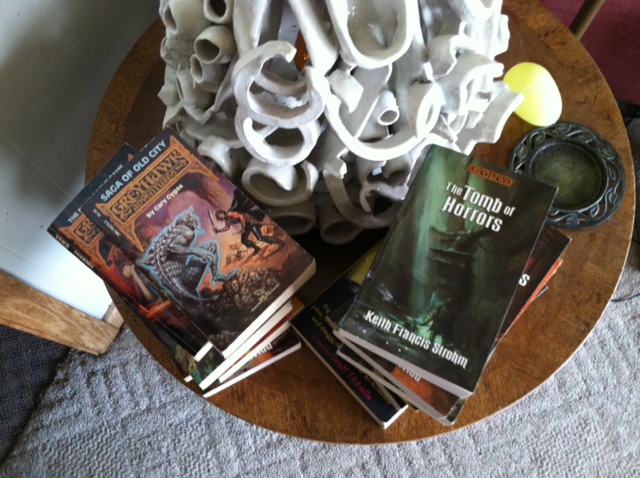
When I go into town — to the nearest keep on the borderlands, say — I find it hard to pass up a quick pop-in to a thrift store. Last Friday I did my rounds in the city, hitting the trifecta: Salvation Army, Savers, and Goodwill. As with any type of hunting excursion — for instance, my single days hunting for a date at the college bars — there are highs and lows, ups and downs, mind-blowing flights of rapture and soul-crushing disappointments.

First up was Salvation Army. I always make a beeline for toys first, then books. I’ve never had much luck with toys in this particular outlet, although I did come close to a good score once: an elderly lady came up behind me at the check-out line carrying a vintage SIX FOOT LONG rubber jiggler snake! It had just been stocked on the shelf somewhere in between the time when I had looked and when I was checking out, so I’d missed it by mere minutes. It was tagged $1.99, and I immediately offered the lady ten bucks for it. She shook her head. “No, I want this. I’m thinking of putting it in my garden to keep kids out.” She actually said that.

The thought flashed through my mind “Are you crazy? That thing will be a kid magnet!” But I did not persist, just politely demurred, mentally accepting defeat. Some consolation was the fact that I had one already (they do come up on eBay occasionally, typically fetching about $20-$30).

Strike up the old Army Marching Band, though, because today was going to be a thriftastic day. Mostly thanks to a coloring book (which I’ll get to in a bit), but that wasn’t all: I was also about to unearth a tomb-full of Greyhawk.

Read More Read More

The Public Life of Sherlock Holmes: What Story Should You Read First?

The Public Life of Sherlock Holmes: What Story Should You Read First?

FirstStory_LionsMane
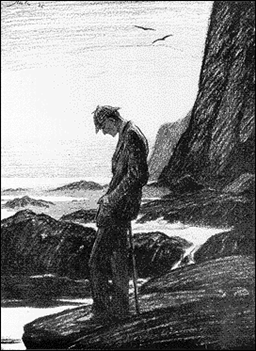
One of my favorites: Frederic Dorr Steele for The Lion’s Mane

Recently a post in a Holmes Facebook group caught my eye. A woman was a fan of one of the current TV shows (I don’t recall if it was Elementary or BBC’s Sherlock), but she loved it and wanted to read the stories. She wondered where to start.

First, I think it’s a bit interesting that there are Holmes fans that have never read Sir Arthur Conan Doyle’s stories. They only know the detective through television shows set in the modern day. I suppose this also happened a bit with the first Robert Downey Jr. movie, but that had a shorter shelf life. Anyhoo…

There’s a bit of a divide in the Holmes community these days between the ‘old school’ and the newer generation. One characterization is between those who study the stories and those who write speculative fan fiction that has little to no relationship with Doyle’s actual writings. To some extent, there’s always been an old guard/new fans distinction, but social media has exploded it.

While I’ve long been a fan of Holmes pastiches and enjoy most movies and films, I do look askance at all the doey-eyed swooning over Benedict Cumberbatch as Holmes. And they’ll pry my calabash pipe from my cold, dead hands before I recognize merit in this Sherlock Meta stuff.

But moving off the grumpy old man ruminations, the question the woman asked was a good one. The initial responses seemed to go with the standard ‘read them in the order they were written.’ That’s logical. But I don’t think it’s the best way to go.

Read More Read More

A Gemmel-esque Adventure in a World of Sand: Hugo Nominee Timothy C. Ward’s Scavenger: Evolution

A Gemmel-esque Adventure in a World of Sand: Hugo Nominee Timothy C. Ward’s Scavenger: Evolution

Scavenger Evolution
“Gemmel-esque”

Tim Ward, along with the rest of the Adventures in SciFi Publishing podcast team, just got a Hugo Nomination for best Fancast.

Like his colleagues, he’s not just a fan, he’s a writer. Just in case you were wondering, How good? here’s a quick review of his debut novel Scavenger: Evolution: (Sand Divers, Book One).

First, let’s get something out of the way — we don’t want a sad-pandas-at-the-Black-Gate-gate!

Tim and I have been friends since he interviewed me. We chat online from time to time. We beta-read each other’s material — he’s saved me from handing in a duff manuscript at least twice! — and both belong to that community of aspiring authors breaking into, or just starting to get established in, the profession.

However, part of the reason we’re friends is mutual professional respect. I like his work. Here’s why.

Read More Read More

Vengeful Specters, Vampires, and Monster Worms: Night Terrors: The Ghost Stories of E.F. Benson

Vengeful Specters, Vampires, and Monster Worms: Night Terrors: The Ghost Stories of E.F. Benson

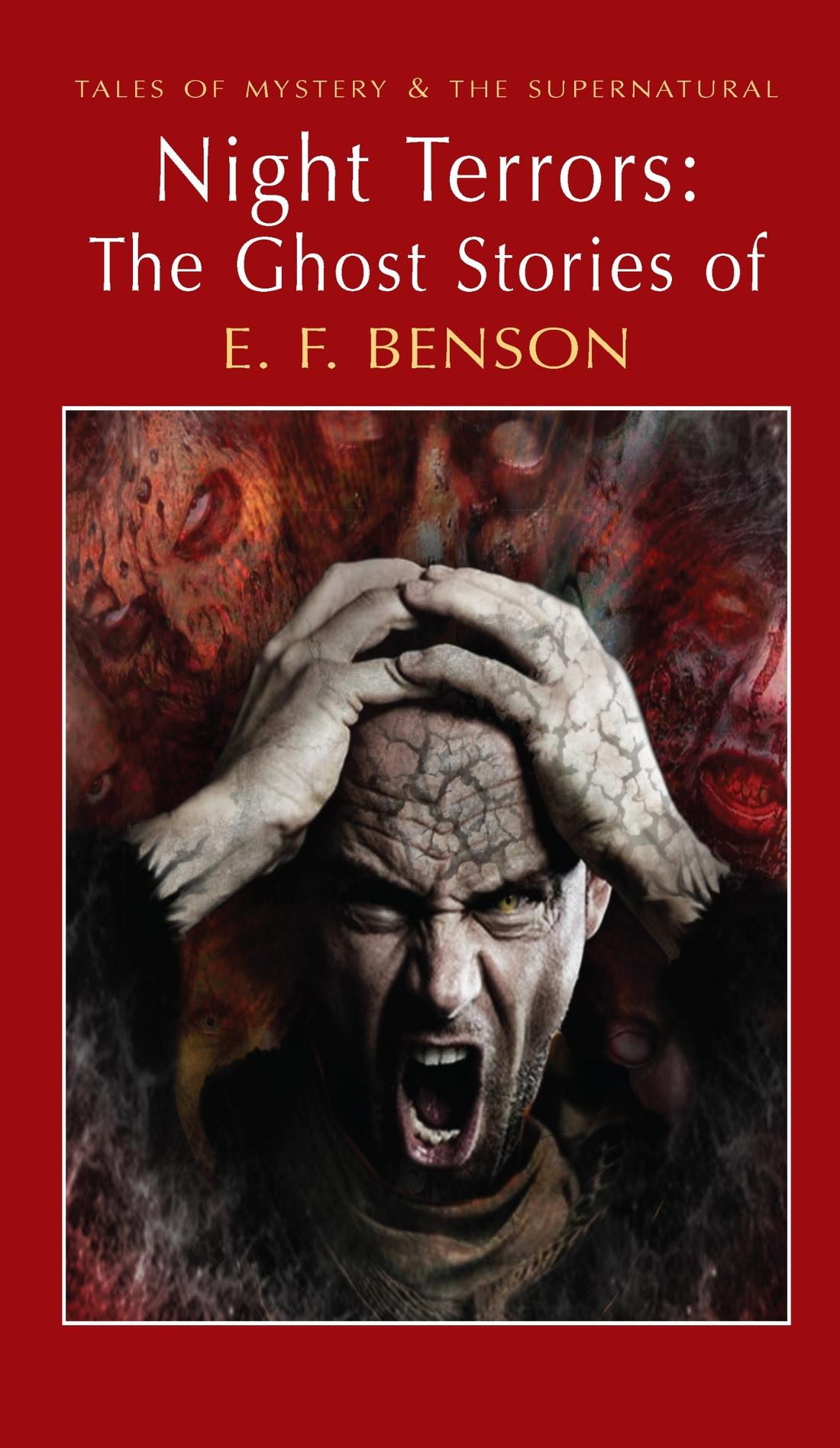
Night Terrors the Ghost Stories of E.F. Benson-smallWordsworth’s Tales of Mystery And The Supernatural volumes (or, as we like to call them, TOMAToS) have been a virtual graduate course in British horror for me, introducing me to a host of classic Nineteenth and Twentieth Century ghost story and supernatural fiction writers. But I have to admit I was a little relieved to come across Night Terrors: The Ghost Stories of E.F. Benson, since at least I’ve heard of E.F. Benson.

Benson (July 24, 1867 – February 29, 1940) was an English archaeologist and novelist who published over 60 novels between 1883 and 1934. Today he is chiefly remembered for his ghost stories, collected in The Room in the Tower and Other Stories (1912), Visible and Invisible (1923), The Horror Horn (1923), Spook Stories (1928), and Old London (1937), among others.

Unlike many of the subjects of the Wordsworth collections — who’ve been sadly neglected by modern readers — Benson is still fondly remembered. His work has seen many modern collections, including the Panther edition of The Horror Horn (1974), Desirable Residences and Other Stories (1991), The Collected Ghost Stories of E. F. Benson (1992), Fine Feathers and Other Stories (1994), and the five-volume The Collected Spook Stories from Ash-Tree Press (1998 – 2005), which collects all of his supernatural fiction.

H.P. Lovecraft thought highly of Benson’s work, especially “The Horror-Horn,” “The Man Who Went Too Far,” and “The Face,” calling him an important contributor to the weird short story. If you’re interested in a nice one-volume introduction to his work Night Terrors is an excellent option. It collects 54 of his best-known stories, and an introduction by David Stuart Davies, in a handsome and economical 718-page paperback.

Read More Read More

Galaxy Science Fiction, August 1952: A Retro-Review

Galaxy Science Fiction, August 1952: A Retro-Review

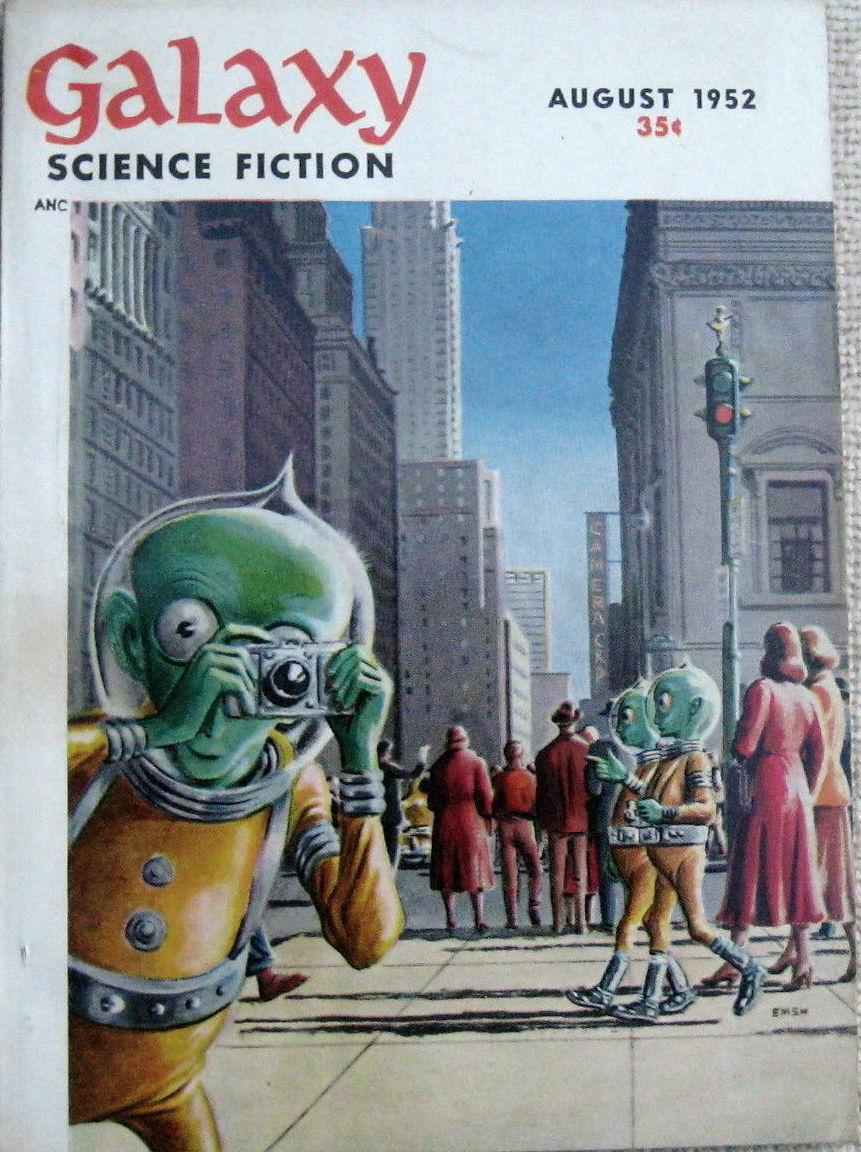
Galaxy Science Fiction August 1952-smallThis is an issue I had looked forward to for a long time. One of my first steps toward reading Galaxy was listening to an X-Minus One radio broadcast titled “Surface Tension,” based on the story with the same title by James Blish in Galaxy’s August, 1952 issue. My wife had gotten this one for me early on, but I hadn’t made my way to it until now.

“Surface Tension” by James Blish — Humans explore the galaxy, seeding adaptations of themselves on any Earth-like planets. Hydrot is all water and marshes, and the crew of La Ventura has only a short time before they die, stranded because their ship wrecked. So they create microscopic versions of themselves (but not with their memories) that can survive in water, hoping they can compete for survival without dominating the other lifeforms on the planet.

This was considerably different from what I remember of the radio broadcast. But it’s a well-told story that’s highly inventive.

“Proof of the Pudding” by Robert Sheckley — One man survives the final war on Earth by taking a ship into space. He returns to the desolate planet and discovers he has the power to create anything he imagines.

I had difficulty relating to the protagonist. Not to spoil too much, but the story picked up considerably with the introduction of a second character.

“Yesterday House” by Fritz Leiber — Jack Berry is a biology student working in Maine for Professor Kesserich.  Jack takes a boat past where he was told to go, and he discovers an island. As he explores it, he comes to a fence and climbs over. He meets a young woman who lives in a house, but she’s convinced it’s 1933 rather than 1951. Her aunts keep her on the island throughout the year, never allowing her to go to the mainland. He wants to prove the truth to her, if he can, without arousing her aunts’ suspicion.

Read More Read More

Ode to the Sacrificed On the Battlefield (Or Before. And After)

Ode to the Sacrificed On the Battlefield (Or Before. And After)

I started planning this post by thinking: Hey, Good Friday, awesome time for a post on sword and sorcery crucifixion. That evolved into: okay, that might be in poor taste (that’s personal growth, that right there). How about just on hero sacrifice, then? They bring us lessons by sacrificing stuff, right?

I am He-Mullet!
I am He-Mullet!

Yes, right. And the stuff (or people, whatever) they sacrifice is often forgotten by the time we’re screaming cheers and profanities during the final battle. We feel that something good has been accomplished and we forget everything that was left behind. Well, no more. Today, let us take a moment to ponder these sacrifices.

Hair
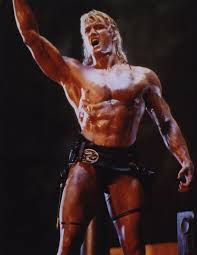
Let’s just start this with an important one, with a view to the 80s movies boom of S&S (sounds kind of Fifty Shade-ish when it’s put like that. Ha.) A mullet covered in lice is just not an easy look to pull off. Sadly much hair was sacrificed in the name of victory.

Weapons
So many weapons are cast aside. They’re special for one scene, then they get stuck in a rib cage and game over. Just abandoned like it never mattered. Let us remind the swords that yes, they did matter.

Rib Cages
On the same line, with the sword stuck in them and all. Perhaps if it had been protected by more than a bikini, the story could have ended differently .

Read More Read More

Amazon.com Returns to 1999 for April Fool’s Day

Amazon.com Returns to 1999 for April Fool’s Day

Amazon.com April Fools 2015-smallAmazon.com has turned back the clock to 1999 for April Fool’s Day.

The world’s largest online retailer has re-formatted its main page to precisely mirror the look and feel it had on April 1, 1999. It’s not just a snapshot of the page from sixteen years ago — it has replaced everything on the page, including the links on its top Books, Music and Videos, with April Fools-themed products.

The Amazon 100 Hot Books, for example, is topped by these three titles:

April Fool’s Day, Nancy Drew and the Clue Crew, by Carolyn Keene
The Practical Joker’s Handbook, by Tim Nyberg
April Foolishness, by Teresa Bateman

All the titles are real. None of the links function, however (clicking anywhere on the page will dump you back to the 2015 version of the Amazon home page).

As someone who used to shop regularly at Amazon in 1999, this page really takes me back. I love the prominent link to “VHS Top Sellers” in the bottom right. All of Amazon’s regular services — such as your cart, wish list, and the search functions — operate normally. It’s just the main page that’s been pranked.

Visit the Amazon home page here.

Presumably, Amazon’s home page will return to normal by the end of the day. Click on the image at right for a screen capture of the full page.

Metal on Metal: Swords of Steel edited by D.M. Ritzlin

Metal on Metal: Swords of Steel edited by D.M. Ritzlin

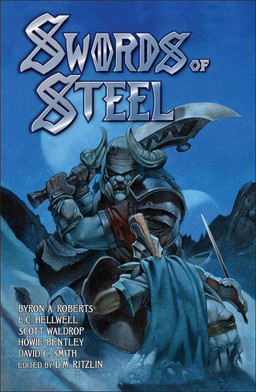
oie_3111058UFfTOs2zWhen John O’Neill posted a few weeks ago about Swords of Steel, edited by D.M. Ritzlin, I knew I had to read it. The hook was simple: swords & sorcery stories written by members of metal bands. Tons of heavy bands — Uriah Heep, Iron Maiden, Manowar, Metallica, Megadeth, to name several — have drawn on the themes of heroism, monster-fighting, and sorcery for lyrics and look. Sometimes they lift stuff directly from favorite authors, like the UK band called Conan, or Texas band The Sword with the song “Beyond the Black River.”

When I read Tolkien I hear folk music in my head; when I read Karl Edward Wagner I hear Black Sabbath. So although I recognized the name of only one band represented in the collection, I was stoked to dive in. With an amazingly cool cover by Martin Hanford and its back cover claim that it’s “NOT FOR WIMPS!,” I was expecting great things from Swords of Steel. It came tantalizingly close.

Set in England during the reign of Elizabeth I,”Into the Dawn of Storms” by Byron A. Roberts (vocalist, Bal-Sagoth) gets the book off to a solid start. Captain Blackthorne is plagued with dreams of death and magic and seeks help from the legend-shrouded scholar, John Dee. It’s billed as the first chapter in an ongoing saga and I’ll be keeping my eyes open for Chapter Two.

From the author bio (and there’s a nice one included for everybody), I learned that Roberts has developed a mulitverse that forms the foundation of his band’s music. This story, with references to past exploits and multiple worlds, is set there as well.

“The Riddle Master” by Ernest Cunningham Hellwell (bassist, Hellwell) is one of the best stories in the collection but, sadly, not S&S at all. A nameless writer narrates his run-in and bet with a demon, made to ensure eternal fame.

Read More Read More