Browsed by
Author: Matthew David Surridge

Fantasia 2017, Day 14, Part 1: 78/52

Fantasia 2017, Day 14, Part 1: 78/52

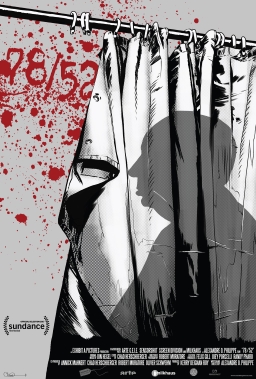
78/52On Wednesday, July 26, I watched three movies at the Fantasia Film Festival. The first, which I’ll write about here, was a documentary about film itself. Or, more precisely, a single movie. Or, even more precisely, a single scene of a single movie. Directed by Alexandre Philippe, 78/52 is a 91-minute film that takes an in-depth look at one of the most famous sequences in cinematic history: the shower scene in Hitchcock’s Psycho.
Opening with a quote from Edgar Allan Poe — “The death of a beautiful woman is unquestionably the most poetical topic in the world” — the movie examines the scene from all angles. We hear about its place in film history, in the context of 1960, in Hitchcock’s career. We hear about its structural significance in Psycho, about its symbolic significance. We learn about the technical processes by which the scene was put together, its edits and sound cues and of course the soundtrack music. We hear an analysis of the acting. And we learn about the reaction of the first audiences to what was one of the most startling moments in film history.

The conceit of the black-and-white film is that we see interviewees in different greenscreen-composited rooms of the Bates Motel discussing different aspects of the scene. I didn’t find that really worked — the lack of interaction between the rooms and interview subjects means there’s no sense of connected space between them — but the material’s strong enough to make up for it. 78/52 presents an in-depth analysis of its subject without being dry or pedantic. Without making too many overstated claims, it effectively establishes the importance of the shower scene. Different perspectives bring out the subtexts at work. The complexity of the scene’s established, and also a sense of mystery, a sense that it has a kind of depth that can’t really be explicated however much it’s talked about.

Read More Read More

Fantasia 2017, Day 13: Death Note: Light Up The New World

Fantasia 2017, Day 13: Death Note: Light Up The New World

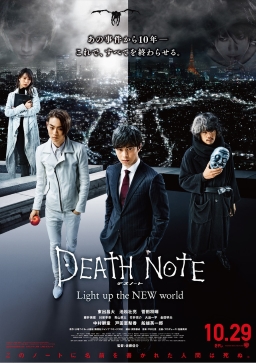
Death Note: Light Up the New WorldOn Tuesday, July 25, I watched two movies at the Fantasia Film Festival. One was Atomic Blonde, which I’ve already written about. Right before that, though, I was able to see Death Note: Light Up the New World (Death Note – Desu nôto: Light Up the New World), the latest installment in the live-action Japanese Death Note film series. The movies are of course based on the best-selling manga by writer Tsugumi Ohba and artist Takeshi Obata; three movies have preceded this one, 2006’s Death Note and Death Note: The Last Name along with spin-off Death Note: L Change the World in 2008. There have been anime adaptations, light novels, TV mini-series, and, infamously, a Netflix remake. I cannot claim to be familiar with the source material of the Death Note franchise, but I found myself curious about the film and decided to see how this movie worked as an introduction to the story.

Light Up the New World is the first Death Note film directed by Shinsuke Sato, who helmed the wonderful adaptations of the Library Wars novels. You can see a similar visual sensibility in the lighting and sets, a near-future feel that helps make the fantastic aspects of the story more credible — precisely because the story isn’t grounded in everyday realism, it’s easier to believe. The movie starts with a quick introduction: the lord of death sent a notebook into the world that commands a Reaper, an angel of death named Ryuk (voiced by Shidô Nakamura); Ryuk would kill anyone whose name was written in the book. Pleased with the results of this ploy, Death now sends six books into the world, and awaits results. Which come to a boil some time later, as the movie begins.

There’s a prologue in Russia, then a chase scene in Japan, following a woman running through a crowd scribing names and slaughtering people. This leads to a discussion of the current situation: years after the original Death Note, when a youth named Light Yagami (Tatsuya Fujiwara, reprising his role from the earlier movies) built a false identity as ‘Kira’ and drew a crowd of followers by killing powerful evildoers, someone claiming to be Kira is back at work. Is it really Yagami, returned from the dead, or is someone acting in his name? The Death Note Task Force is reconstituted, and the police set to work desperately trying to track down the new Kira.

Read More Read More

Scintillation Coming To Montréal In 2018

Scintillation Coming To Montréal In 2018

Montreal science fiction

Yesterday, multiple-award-winning writer Jo Walton took a Kickstarter campaign live to fund a new science fiction convention in the city of Montréal. The convention, to be called Scintillation, will focus on literary (written) science fiction and run from October 5 to 7, 2018. The campaign was funded after less than nine hours, and is currently looking to reach its stretch goals, which include a reading and workshop track and an extra night of programming.

Jo Walton’s written over a dozen novels, as well as poetry, essays, and role-playing game manuals, and among her many honours are the John W. Campbell Award, the Mythopoeic Award for Adult Literature, the Tiptree Award, the Locus Non Fiction Award, the World Fantasy Award (for her novel Tooth and Claw), the Nebula Award for Best Novel, and the Hugo Award for Best Novel (both for her 2011 book Among Others). She’s also experienced at running a convention, having organised a single-track con, Farthing Party, from 2006 to 2014.

She’s already lined up a strong array of guests for Scintillation, including Ada Palmer, Greer Gilman, and Sherwood Smith — about whom Black Gate editor-overlord John O’Neill said in 2012: “If you’re not reading Sherwood Smith, you’re missing out on one of the most gifted and versatile fantasy authors at work today.” There’ll also be a concert by singing group Sassafrass. Having attended Farthing Party in the past, I can personally attest to Jo’s ability to organise and run a fun-filled and thoughtful convention that boasts deep discussion about fantasy, science fiction, and the history of both. I’m already looking forward to Scintillation. Check it out!

Fantasia 2017, Day 12: Junk Head

Fantasia 2017, Day 12: Junk Head

Junk HeadI had two events on my Fantaisa Festival schedule for Monday, July 24. First, I planned to see a stop-motion film from Japan called Junk Head. Then, I’d go to see a presentation by author Grady Hendrix of his book Paperbacks From Hell, about the boom of horror paperbacks in the 70s and 80s. I’d end up speaking briefly with Hendrix after his presentation, which led to my interviewing him for Black Gate; you can see that interview here. So in this post I’ll be talking about Junk Head, an astonishing achievement in science-fiction that well deserves an article to itself.

Junk Head was written and directed by Takahide Hori, who also edited the film, created the soundtrack music, and handled sound effects. He also, with only one or two others (principally Atsuko Miyake), animated the film, did the voice work, and made the puppets and props and sets. By any measure the film’s an accomplishment, and as a near-one-man labour of love, it’s spectacular. Hori uploaded an early version of the film, when it was a half-hour long, to YouTube; you can see it here. The version I saw at Fantasia went on for another hour and 24 minutes, and whether he ends up adding more to it or not — I heard different things, all at second- or third-hand — it tells a complete story. (Thanks to a heads-up from Sandro Forte of Cinetalk.net, I can add that Hori and his team are working on a prequel they’re funding through Kickstarter; I strongly recommend checking the campaign out.)

Title cards at the start of Junk Head give us the background: it’s the far future, when human beings have become effectively immortal by making their bodies inorganic, but as a result cannot reproduce. And now a terrible plague is striking down the world’s population. There’s only one hope. Someone has to be sent into the abysses upon which this future civilization’s built, a labyrinth of tunnels and spaces long since abandoned to clones once used for labour. In the centuries since, the clones have mutated in strange ways, and built their own cultures among the concrete of the lower levels. To save humanity, genetic material from the clones has to be recovered — but how to get genetic material from the seemingly sexless clones? And how are beings not designed to reproduce accomplishing the feat, anyway?

Read More Read More

Paperbacks From Hell: An Interview with Author Grady Hendrix

Paperbacks From Hell: An Interview with Author Grady Hendrix

Grady HendrixGrady Hendrix is a man who knows his horror. I saw him speak about horror paperbacks from the late 60s through the early 90s at the Fantasia International Film Festival, where he previewed his then-upcoming book Paperbacks From Hell. His passion and knowledge were clear at once. So was his wit — he clearly took these books seriously, but also knew when to take them lightly. His presentation was a powerful and slightly manic guide to a weird world of which I’d known nothing: a paperback world of mutilated dolls, of killer clowns, of diversely-talented skeletons, and, of course, of Nazi leprechauns. I had to know more about his book, and spoke with him after the show, asking if I could interview him for Black Gate. He agreed. Since then, Paperbacks From Hell has officially been published, and you can buy it now at Amazon.com. The book presents a striking new angle on horror fiction in the late twentieth century, and I hope the following interview further whets your appetite for Paperbacks From Hell.


I’ll start at the beginning, I guess: How did the idea for the book develop? You write a bit about how you feel in love with horror paperbacks, but how did you get from collecting them to writing about them and publishing a book?

I’ve always been a reader, but my first huge enthusiasm was for movies. And in film fandom there’s a proud tradition of wandering out into the wilds and bringing back the most obscure and strangest films you can find. I didn’t see that tradition so much with books, and yet there were these vast used bookstores containing a wilderness of paperbacks, and all I wanted was a map so I could start exploring. Turns out I had to make one myself. Other people will do a better job, but I’m hoping I’ve given them a place to start.

Read More Read More

Fantasia 2017, Day 11: Finding Forms (The H-Man, Bastard Swordsman, and Gintama)

Fantasia 2017, Day 11: Finding Forms (The H-Man, Bastard Swordsman, and Gintama)

H-ManSunday, July 23, I was down at Fantasia’s De Sève Theatre before noon to see a screening of the 1958 film The H-Man (Bijo To Ekatai-Ningen). I intended to follow that up with another vintage movie, the Shaw Brothers–produced 1983 film Bastard Swordsman (Tian can bian). Finally, I’d wrap up the day with a contemporary movie, the manga adaptation Gintama, which promised a mix of action and comedy. I liked the variety the films seemed to represent, and I was especially curious about The H-Man, which had been directed by Ishiro Honda, director of Godzilla.

It was preceded by a talk about Honda’s life given by Ed Godziszewski, who had co-written (with Steve Ryfle) Ishiro Honda: A Life in Film, from Godzilla to Kurosawa. The book comes out on October 3, with a foreword by Honda fan Martin Scorsese. It was clear that Godziszewski knew his stuff, though he had so much material he ran out of time before the film had to start. Nevertheless, what he had to say was fascinating. Without wanting to replicate Honda’s Wikipedia entry (which is relatively sparse, anyway), I want to mention some of the more interesting points Godziszewski raised.

Godziszewski began by recalling how his book came about, with the assistance of Honda’s family, and how he and Ryfle were able to see Honda’s entire body of work, including films never seen outside of Japan and rarely inside. Honda had done a lot of realist movies, especially in the 50s, that had been lost to the public for a long time and were only now beginning to show up again. Godziszewski talked about the experience of seeing 25 films he’d known nothing about, and how they demonstrated that Honda was a versatile, wide-ranging filmmaker.

Read More Read More

Two Films on Netflix: Enter the Void and Kagemusha

Two Films on Netflix: Enter the Void and Kagemusha

Enter the Void-small

On September 7, for various reasons, I decided to treat myself to two movies on Netflix I’ve wanted to see for ages but had never found the time to watch. The first was Gaspar Noé’s Enter the Void. It’s about a drug addict who gets shot and has an extended dream/out-of-body experience. There are tons of digital effects, shots spliced together, weird angles, cameras gliding through walls, tricky lighting, all kinds of stuff.

And it’s … all less involving than it should be. Because it’s an out-of-body experience shown from a first-person perspective, we don’t really get to see much of the actors’ faces, only the tops of their heads. The story’s non-linear, but a lot of scenes aren’t needed. Dialogue’s improvised, and feels it. Overall, I thought it was an example of talent without genius or taste; good ideas, some breathtaking moments, and largely uninvolving.

Read More Read More

Fantasia 2017, Day 10, Part 2: Inevitable Precisions (Born of Woman 2017 and A Day)

Fantasia 2017, Day 10, Part 2: Inevitable Precisions (Born of Woman 2017 and A Day)

Un peu après minuitIn 2016, the Fantasia International Film Festival created a showcase of short films by women directors: Born of Woman. It was a very real success, a collection of intriguing and often powerful films, and it travelled as a collection to several other festivals. 2017 saw a new iteration of the showcase, boasting nine shorts from seven countries. Born of Woman 2017 played Saturday, July 22, and I was eager to see what was in store this year. Afterward I planned to go on to see a feature film, a Korean thriller called A Day (Haru) built around the Groundhog Day–like device of a man repeatedly living the same day. First, though, would be Born of Woman.

The program began with “A Little After Midnight,” (“Un peu après minuit,” also translated “Just After Midnight”) a 22-minute piece co-written and co-directed by France’s Anne Marie Puga and Jean-Raymond Garcia. It deals with a blind teacher (India Hair), witchcraft, and the interpretation of the world. If Hair’s teacher begins the film reliant on men’s sexualised tellings — a scholar who gives a fevered reading of one of Niklaus Mannuel Deutsch’s paintings of witches; later another man (Rémi Taffanel) who, at her request, tells her a pornographic story — then by the end of the story that’s changed as she finds a new source of power. There’s a subtext here, I think, deriving from Freud and his essay “The Uncanny,” in which he suggests the loss of the eyes is a symbolic castration. So in this movie there’s much to do with what is seen and what is hidden and the power that comes from seeing things — from identifying things and defining them. Visual art has resonance here, as do costumes that both hide and reveal. The film’s shot very nicely, with a dark, brooding feel that works well with the plot. The story’s not over-hurried, but the atmosphere’s the point, I think. If you can get into the feel of the thing, it’ll work; if not, perhaps not.

Read More Read More

Fantasia 2017, Day 10, Part 1: Welcome to the Future (Napping Princess and Welcome to Wacken)

Fantasia 2017, Day 10, Part 1: Welcome to the Future (Napping Princess and Welcome to Wacken)

Napping PrincessOn Saturday, June 22, I reached Fantasia’s Hall Theatre before noon to see a screening of the anime Napping Princess (Hirune Hime: Shiranai Watashi no Monogatari), a story about dreams, technology, and the 2020 Olympics. After that, I had a short film showcase to see, then another feature. But before either of those, I planned to pass by the Fantasia Samsung VR 360D Experience, which, as the name implies, gives people the chance to experience VR by watching one of a selection of short films. I’d tried out the technology last year with a number of short fiction films; this time out there was something a little different, a half-hour documentary called Welcome to Wacken, about the legendary annual German metal festival. I wanted to see how the technology would handle the documentary form, especially since I had all the respect in the world for the filmmakers — it was directed by Sam Dunn, whose previous work included the seminal metal documentaries Headbanger’s Journey and Global Metal.

First, though, was Napping Princess (which, according to Wikipedia, is also known as Ancien and the Magic Tablet). Written and directed by Kenji Kamiyama, it begins in a dieselpunk otherworld called Heartland, where a daring princess named Ancien (voice of Mitsuki Takahara) seeks to regain her magic tablet with the help of an animated toy bear called Joy (Rie Kugimiya). A monster called the Colossus threatens Heartland, and Ancien’s father, whose palace is an enormous car factory like something out of Fritz Lang’s Metropolis, has ordered her confined to a tower. But she escapes, meets a rebellious motorcycle-riding mechanic named Peach (Yôsuke Eguchi), and joins with him to counter the mysterious plot of the king’s sinister adviser (Arata Furuta) and the giant Colossus that emerges from the sea.

Until Ancien wakes up. In the world we view as real, a Japanese schoolgirl named Kokone is dreaming Ancien’s adventures. It’s 2020, and the Olympics are about to take place in Tokyo; Kokone and her father, Momotaro, a mechanic in the southern town of Okayama, wonder whether the autonomous cars Japan’s promised as a major part of the opening ceremonies will be ready on time (note that Okayama’s the setting for the original legend of Momotaro). But then Momotaro’s arrested and accused of corporate espionage against Shijima Motors, the company building the autonomous vehicles. Kokone has to escape Shijima’s representative, who bears an uncanny resemblance to the evil adviser of the king of Heartland, and work out the secrets contained in her father’s old tablet computer. What secret in his background has emerged? And how does it connect to the story of Heartland?

Read More Read More

Fantasia 2017, Days 7 to 9: The Laplace’s Demon

Fantasia 2017, Days 7 to 9: The Laplace’s Demon

The Laplace's DemonAfter two days off, I returned to Fantasia on June 21 fit, trim, and rested. Randomness defines my festival schedule — it happened that the previous two days had nothing I wanted to see. But that Friday afternoon I was looking forward to one of the most intriguing movies listed in Fantasia’s catalogue: The Laplace’s Demon, directed by Giordano Giulivi.

A team of scientists has worked out how to calculate the complexities of glass shattering. Their mathematics imply a deterministic universe, if the code can be more fully cracked. The movie begins with them on their way to a mysterious island, summoned to the mansion of a reclusive genius. There, in his empty mansion, they find the terrible truth — their host, speaking to them by videotape, is playing a terrible game. He’s gone further than them, pushed the math beyond human sanity. Now the researchers are elements in a vaster experiment: the horrific mechanisms in the isolated house will eliminate them, one by one, if the equations are correct. Can they find a flaw in the math and save themselves? Is there room in the universe for free will?

Watching the film play out I saw science-fiction and mystery and horror blend in a classic plot framework. The movie feels like an artifact from Hollywood’s Golden Age, some previously-unknown Val Lewton piece, a forgotten film by James Whale. It’s shot in a heavily-shadowed black and white, much of it in one elaborately-furnished room filled with dark corners and rich art-nouveau details. Close-ups and odd foreshortening adds to an air of unreality, fostered by an unusually tasteful use of CGI. The characters here are caught in a metafictional plot, which can be predicted but not evaded. Clever, well-crafted, it evokes Halloween frissons of delicate horror, surprising while generating a sense of inevitability, moving to a creaky but effective plot climax that resolves its themes with the bleakness of a death’s-head inevitable grin at a deterministic universe.

Read More Read More