Browsed by
Author: Matthew David Surridge

The Pre-Raphaelite Barbarian

The Pre-Raphaelite Barbarian

The first thing you notice about Barry Windsor-Smith’s Conan comics is their beauty.

Starting in 1970, Smith drew almost two dozen of the first issues of Marvel Comics’ translation of Conan into a monthly color comic book, and added a few more stories in the oversized black-and-white companion magazine Savage Tales. Scripts for those stories, often direct adaptations of Robert E. Howard tales, were by Marvel veteran Roy Thomas, but Smith has stated that he had a prominent role in the plotting of the comics, sometimes even providing dialogue.
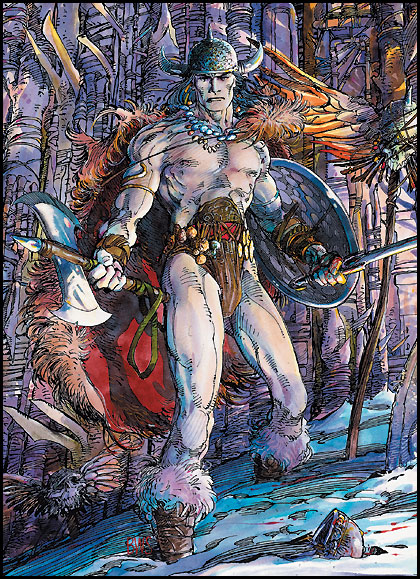
barry-conanSmith’s work has an elegance and power to it unusual in comics, then or now. His line-work is detailed, expressive, and precise: the right marks in the right places. Compositionally, his work is always clear, always energetic.

And it’s alive, because his characters are alive; they move through three-dimensional space, they have realistic body language — more than that, their forms express what they feel and think.

Perhaps above all, Windsor-Smith’s design — of clothes, swords, balustrades, towers, armour, even ships and stone walls — is constantly inventive, deriving from the organic forms of art nouveau and the near-hallucinatory realism of the Pre-Raphaelite Brotherhood.

This has the crucial effect of building a world for Conan and his adventures, a setting with texture and, implictly, a history. We see the shining kingdoms and the jeweled thrones about to be trodden under sandalled feet, and we believe in them.
…

Read More Read More

An Introduction

An Introduction

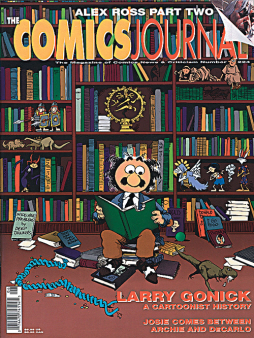
comics-journal2It’s only polite to introduce yourself properly, and as this is my fourth posting on this blog, a proper introduction is really overdue. So: Who am I, and what am I doing here?
I’m a writer. I’ve had two short stories published so far, including “The Word of Azrael” in the most recent issue of Black Gate (previewed here), and I’m working on a novel. Several novels, actually, but at the moment only one is actively ongoing.

I also write non-fiction, most notably articles for Old News magazine, short biographies telling true stories from the past. I’ve written criticism and journalism for places including The Comics Journal and the Montreal Gazette. Oh, and I helped cover the 2009 Worldcon for the Gazette (you can find my blog posts about the convention here, along with posts by my colleague, Claude Lalumière, who wrote a comic column for Black Gate a few years back).

I’m also a reader. Like, I’d imagine, most people around these parts, I read a lot, and I love browsing book fairs and used book stores looking for an oddity, a novelty; trawling through the past, magpie-like, looking to pick out glittering fragments that would otherwise be lost in the ocean of published texts.

My sporadically-updated personal blog, Hochelaga Depcta, is mostly a record of what I’ve read, a venue to put down the thoughts that strike me. I’m hoping to do something a bit more focused here.

…

Read More Read More

Torg and Marvel Super Heroes: The shared vocabulary of stories

Torg and Marvel Super Heroes: The shared vocabulary of stories

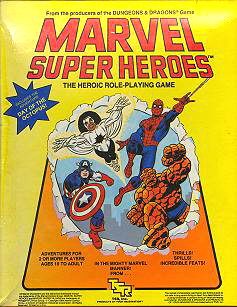
marvel-supers-4John O’Neill’s editorial in Black Gate 14 touched on gaming, on wargaming and role-playing, and on the way these things shaped the way friends interact. It hit home for me, because I recognised in my life much the same sort of phenomenon John described in his own.
I didn’t play Nova, the game he and many of his friends played as a sort of long-form creative wargaming campaign. I did play, and in one case referee, long-running role-playing campaigns that gave everybody who took part a special vocabulary, a shared set of touchstones and references that (I think) acquired a particular power from being our own: our own stories, independent from the culture at large, shaped by us and our choices.

I was about seventeen when I met a group of role-playing gamers who’d created their own world for the Marvel Super-Heroes role-playing system. I think the game had been going on for something like eight years at the point I met them, and it’s still going today. (Jeff Grubb has a thoughtful reminiscence on the secret origins of MSH here.)

The world, as such, was not and is not stable; it has been re-invented several times over, as campaigns and storylines begin and end (and, this being a super-hero game, occasionally lead to a reboot of the timeline in the course of play), sometimes incorporating actual comic-book characters and sometimes not, but always using many of the same heroes and villains created by our group of gamers.

The characters were, are, the essence of the game; not their histories, but their concepts, and if you played in that world you could add something to it that would become a part of the ongoing tale.

…

Read More Read More

Grey Maiden: The Story of a Sword Through the Ages

Grey Maiden: The Story of a Sword Through the Ages

grey-maiden4I have a habit of buying books — a compulsion, really. Older books, mostly, from book fairs and small used bookstores. Things that look unusual, and which, in the absence of an immediate reason on my part to read them immediately, often sit on my shelves for some time before I get around to them.
So I don’t remember now exactly when and where I picked up a collection of Arthur D. Howden Smith’s Grey Maiden stories, only that it was some time ago. I wish I knew now, because I’d like to go back for more, if there are any.

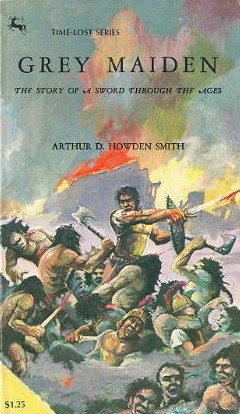
Arthur D. Howden Smith (1887-1945) was an early pulp writer; the collection Grey Maiden (Centaur Press, 1974) has four out of seven — or nine, depending on what reference you look at — of his stories about the Grey Maiden, the first sword ever forged from iron.

Each tale follows a different wielder, each in a different time and place, as the blade’s won and lost among battles and wars and the rise and fall of empires. All were originally published in the pulp magazine Adventure.

The four tales in the collection I have (there was at least one other collection, with more of them) include a story of betrayal and revenge among the soldiers of Alexander the Great, an account of a group of Phoenicians retreating across Italy, a story of the ebbing of Roman power in Britain, and an imagining of the first collision between the Byzantine Empire and the followers of Islam.

The stories are bleak, violent, and possessed of a dark energy that makes them utterly compelling. The history perhaps couldn’t always stand up to intense scrutiny, but is used in such a way as to make the most exciting and brutal tale possible.

…

Read More Read More

The Art of Storytelling and The Temple of Elemental Evil

The Art of Storytelling and The Temple of Elemental Evil

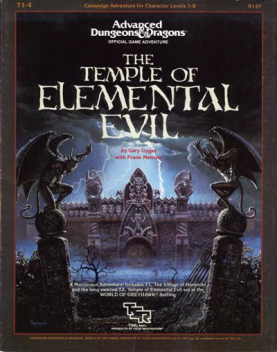
toee2Role-playing games have always interested me because, at heart, they’re about stories. They’re ways to tell stories that you don’t know in advance, ways to bring people together to create something unpredictable but still structured in a narrative form. Now, that said, the question is: how do you go about doing that? If you’re writing a module, an adventure, that referees are going to pick up off a store shelf (or download from a web site), what do you give them to help create that story with their players?

The traditional first edition Dungeons & Dragons answer to this was: you give them a dungeon. You give them a sandbox, an area to explore filled with monsters and treasure, and maybe a few adventure hooks. What will the players do with it? Who knows?

For a long time, probably starting in the mid-80s at about the point where I started seriously playing D&D, this approach was in disrepute. A dungeon with a bunch of monsters isn’t a story, the argument ran. A story should have a structure, and ideally different moods, maybe even different settings. It should end in a different place than it began. You could see this philosophy settle in at TSR with the Dragonlance series of modules, taking firmer hold with second edition D&D.

Nowadays, though, at least a few people are beginning to swing back to the first approach. Structuring stories out ahead of time kills the spontaneity of the game, one might argue. Let the players and referee develop the story at the table, not by going through the motions worked out ahead of time by some designer. Don’t railroad the players; give them the situation, and see what they do on their own. (I’m vastly simplifying all these positions, and only presenting some of the arguments. I think I’m getting at the essence, though.)

I’ve come around to that last argument. I want to explain why, because I’ve recently wrapped up a First Edition game in which I was fascinated to see a story I never anticipated arise out of a module that features little in the way of pre-structured narrative: The Temple of Elemental Evil by Gary Gygax and Frank Mentzer (TSR, 1985).

…

Read More Read More