Browsed by
Author: John ONeill

Vintage Teasures: To Keep or Kill by Wilson Tucker

Vintage Teasures: To Keep or Kill by Wilson Tucker

To Keep or Kill-smallWilson Tucker is a fascinating author. Although he wrote several acclaimed SF novels, including the Hugo and Nebula nominee The Year of the Quiet Sun (1970), and was even inducted into The Science Fiction and Fantasy Hall of Fame in 2003, he’s remembered today chiefly for his tireless contributions to fandom. Well, that and his habit of putting his friends into his novels — so much so that the literary term for this practice now bears his name: tuckerization. Truth be told, I probably wouldn’t even know who Wilson Tucker is today if it weren’t for the huge impact he had on modern fandom.

But I do know who he is, and as part of my journey through the rich history of our genre, I thought it was high time to try one of his novels. But which one? The post-apocalyptic adventure The Long Loud Silence (1952), which Damon Knight called “phenomenally good… as near perfection as makes no difference”? His famous time-travel novel The Lincoln Hunters (1958), which Stephen King referenced in 11/22/63? His underrated fiction collection, The Best of Wilson Tucker (1982)?

I’m kidding, of course. I knew which one I wanted to read the instant I laid eyes on it: To Keep or Kill, Tucker’s second Charles Horne mystery. Horne is a small town detective from Central Illinois who reliably runs afoul of the kind of femme fatales and crooked mobsters that I thought only showed up in L.A, not right here in my home state.

Read More Read More

New Treasures: The Golem and the Jinni by Helene Wecker

New Treasures: The Golem and the Jinni by Helene Wecker

The Golem and the Jinni-smallI always find it interesting when mainstream publishers like Putnam, Harper, and Grove Press decide to publish a fantasy novel. Usually they do it badly, producing something that both fantasy fans and the general public scorn. Every once in a while they hit a home run, though — as Pocket did with Mark Helprin’s Winter Tale, for example, one of the most cherished fantasy novels of the 80s, or Grove Press accomplished just last year with G. Willow Wilson’s Alif the Unseen, which won the World Fantasy Award in October.

So I was intrigued enough to plunk down 15 bucks for Helene Wecker’s first novel, The Golem and the Jinni, a literary fantasy that blends Jewish and Arabian folklore in a tale of a chance meeting between two mythical beings in turn-of-the-century New York. The reviews have been kind, and it seems to be achieving a measure of early success.

Chava is a golem, a creature made of clay, brought to life to by a disgraced rabbi who dabbles in dark Kabbalistic magic and dies at sea on the voyage from Poland. Chava is unmoored and adrift as the ship arrives in New York harbor in 1899. Ahmad is a jinni, a being of fire born in the ancient Syrian desert, trapped in an old copper flask, and released in New York City, though still not entirely free.

Ahmad and Chava become unlikely friends and soul mates with a mystical connection. Marvelous and compulsively readable, Helene Wecker’s debut novel The Golem and the Jinni weaves strands of Yiddish and Middle Eastern literature, historical fiction and magical fable, into a wondrously inventive and unforgettable tale.

The Golem and the Jinni was published by Harper Perennial on December 31, 2013. It is 512 pages, priced at $15.99 in trade paperback and $10.99 for the digital edition.

See all of our recent New Treasures articles here.

Vintage Treasures: Night Monsters by Fritz Leiber

Vintage Treasures: Night Monsters by Fritz Leiber

Night Monsters-smallNight Monsters is an interesting case study in book collecting, as least for me.

It was originally published in 1969 as part of an Ace Double set, with a moody but otherwise fairly unremarkable cover by Jack Gaughan (see below). The subtitle Ace put on the collection was “A new collection of the weird, the wonderful, and the macabre,” which was certainly accurate, if a little pedestrian.

I bought a copy 25 years ago. Never read it. It shared a spine with Leiber’s early novel The Green Millennium (here’s John Schoenherr’s cover, just because I have a thing about uploading paperback covers), which I found a little more interesting. To be honest, after a few years I kinda forgot about the book on the back side of The Green Millennium.

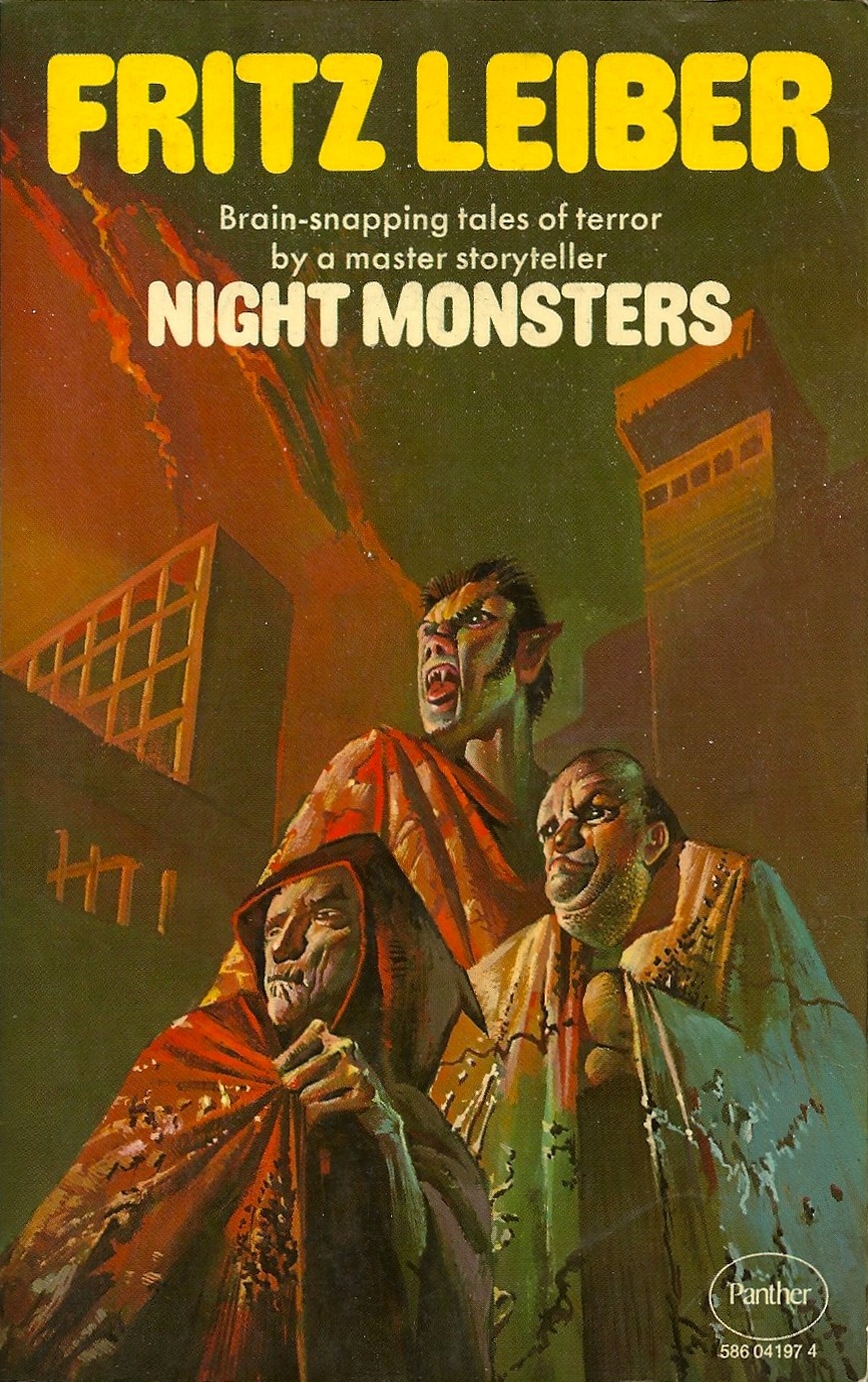
Fast forward to early 2013. I’m surfing eBay and I stumble on a copy of Fritz Leiber’s Night Monsters, a Panther paperback published in the UK in 1975. I have no immediate recollection of a Fritz Leiber collection called Night Monsters, but that’s not necessarily a big deal; it could be a re-titled version of one of his collections I do remember.

What is a big deal is that I recognize the cover artist. There’s no doubt in my mind that it’s the work of the great Bruce Pennington, who provided some of the finest covers for Black Gate, for BG 12 and BG 14.

I’m a huge Pennington fan. Part of it is simple gratitude — the man was enormously gracious to me when I called him up in 2007, hoping to buy the rights to two of his paintings. He had no idea who I was, calling him from America with nothing more than high spirits and a meager budget. He very politely asked to see “a copy or two” of my little magazine, before making up his mind.

Twenty-four hours later I had two sample issues in the mail bound for England, with an enthusiastic hand-written note telling Bruce how much I admired his work. About a month later I received a marvelous letter from him, saying he had been very impressed with the issues, and that he would be delighted to provide us the art we wanted — and at the price I had offered.

Read More Read More

Win a Copy of M. Harold Page’s The Sword is Mightier and Blood in the Streets

Win a Copy of M. Harold Page’s The Sword is Mightier and Blood in the Streets

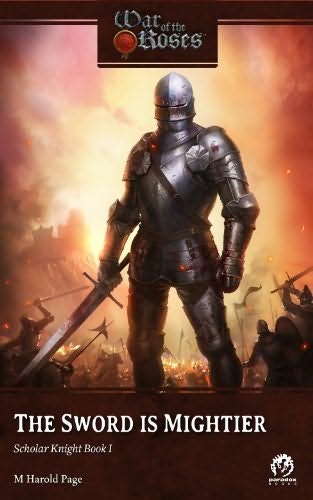
The Sword is Mightier-smallIt’s January 7th already and we haven’t given away any books this year. Time to fix that.

Here at Black Gatewe like to reward faithful readers with the finest in free fantasy and that tradition continues this month with the exciting Scholar Knight novels of M. Harold Page: The Sword is Mightier and Blood in the Streets. Here’s the description for the first, The Sword is Mightier:

The blade sheared through padding, collar bone, ribs, and came out the other side. Head, arm and shoulder thudded to the ground. The remainder of the corpse still stood, sheared torso like a bucket of steaming offal.

England AD 1454, the chaotic eve of the Wars of the Roses.

Jack Rose would rather be a scholar than a knight. However, when a brutal landowner steals his family estates and plans to evict the tenants, Jack must take up the sword and win back his inheritance by force of arms. As he wades through increasingly lethal encounters, it becomes clear that War is in his blood. Now he must decide who he really is…

How do you enter to win? Simple — just send an e-mail to john@blackgate.com, using as the subject the name of the first Master Strike in the German School of Fencing (we’ll even give you a clue: it’s “Zornhau”), and we’ll enter you in the drawing.

Entries must be received by Friday, January 31, 2014. One lucky winner will win both books. The winner will be contacted by e-mail and books will be delivered in digital format.

All entries become the property of New Epoch Press. No purchase necessary. Must be 12 or older. Decisions of the judges (capricious as they may be) are final. Terms and conditions subject to change. Not valid where prohibited by law. Eat your vegetables. And good luck!

Terror in the Heroic Age: Lovecraft and Culbard’s At the Mountains of Madness: A Graphic Novel

Terror in the Heroic Age: Lovecraft and Culbard’s At the Mountains of Madness: A Graphic Novel

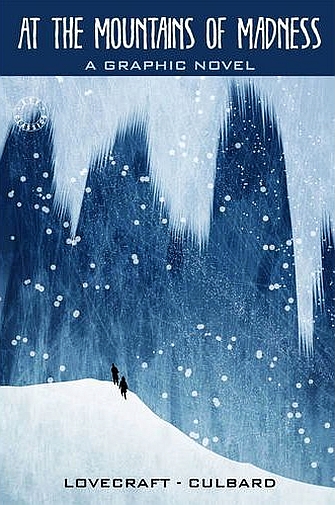
At the Mountains of Madness Culbard-small“At the Mountains of Madness” is one of my favorite Lovecraft tales. It was originally serialized in the February, March, and April 1936 issues of Astounding Stories; I was first exposed to it through the brilliant audio adaption from Dark Adventure Radio Theatre, which I listened to during a snowy commute through lonely back highways in Illinois in the winter of 2010. Marvelous stuff.

So in November, I was very intrigued to read James Maliszewski’s review of a recent comic adaptation by I.N.J. Culbard. Here’s James:

In 124 pages, Culbard succeeds in re-telling one of Lovecraft’s best tales in a fashion that’s both engaging and true to its source. That’s harder than it sounds…

Culbard deftly pares the story down to its essentials, in terms of action, dialog, and exposition. The story thus moves along at a fairly brisk pace, something that cannot be said of the novella, love it though I do. Second, the artwork, which, to my mind, recalls Hergé’s Tintin series, contributes greatly to a sense of narrative motion, which is vitally important in an adaptation of a long and complex story like this one. Furthermore, the artwork suits the subject matter perfectly, recalling as it does (at least to me) stories of late 19th and early 20th century exploration in the still-dark corners of the globe… Even though I already knew the plot intimately, I found Culbard’s strong, clear, almost innocent, illustration style gave it new life, something I didn’t think possible.

Sold! I especially enjoyed James’s description of artwork that recalled “stories of late 19th and early 20th century exploration in the still-dark corners of the globe.” I asked for the Culbard’s graphic novel version for Christmas and my lovely bride was kind enough to deliver.

Read More Read More

Black Gate Online Fiction: Sword Sisters by Tara Cardinal and Alex Bledsoe

Black Gate Online Fiction: Sword Sisters by Tara Cardinal and Alex Bledsoe

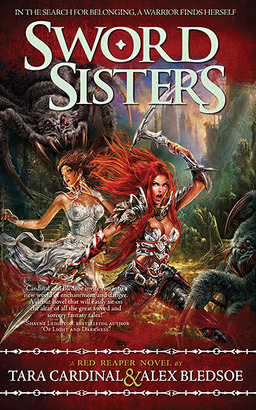
Black Gate is very pleased to offer our readers an exclusive excerpt from Swords Sisters, the new novel of heroic fantasy from Tara Cardinal and Alex Bledsoe.

Cast aside by her mother, tormented (literally) by her father, feared by humans and despised by most of her own kind, Aella is determined not to care. Not to care what they think, not to care if they like her, not to care about anything or anyone. Just so long as no one tries to touch her or imprison her again, Aella couldn’t care less.

Until… he pulled an arrow from Aella’s back and kissed her cheek. Until… she carried Aella home and stood between her and a giant spider. And a rioting mob. Until… they came to Aella looking for help. Aella, daughter of demon and witch, must find herself and forge her own route to a destiny she doesn’t want to believe and others simply don’t want. At first a heroine in name alone, Aella discovers she has the strength and the heart to control her demonic lineage and truly wear the title — hero. She also finds something even more valuable: friendship. Amelia, her Sword Sister, isn’t just worth dying for. She’s worth living for.

Tara Cardinal wrote, produced, and starred in the feature film Legend of the Red Reaper. She writes non-fiction for IndependentCritic.com and NerdRemix.com. Alex Bledsoe is the author of the Eddie LaCrosse novels (The Sword-Edged BlondeBurn Me DeadlyDark Jenny, and Wake of the Bloody Angel), the novels of the Memphis vampires (Blood Groove and The Girls with Games of Blood), and the Tufa novels (The Hum and the ShiverWisp of a Thing, and the forthcoming Long Black Curl). He is a regular blogger for Black Gate.

The complete catalog of Black Gate Online Fiction, including stories by E.E. Knight, Vaughn Heppner,  Howard Andrew Jones, David Evan Harris, John C. Hocking, Michael Shea, Peadar Ó Guilín, Aaron Bradford Starr, Martha Wells, Nina Kiriki Hoffman, C.S.E. Cooney, and many others, is here.

Sword Sisters was published by Rogue Blades Entertainment on December 11, 2013. It is 200 pages and currently available in trade paperback for $10.00 (or $6.00 for the digital version). Learn more at Rogue Blades Entertainment and in Jason Waltz’s recent article Sword Sisters: A Partnership, a Prequel, a Picture Show, and a Print Run right here at Black Gate.

Read a complete sample chapter of Sword Sisters here.

Universal Labels 47 Ronin a Flop less than 24 Hours After Release

Universal Labels 47 Ronin a Flop less than 24 Hours After Release

47 Ronin poster-smallUniversal Pictures announced it would take a writedown on its $175 million fantasy epic 47 Ronin on December 26th, the day after the film entered wide release on Christmas Day.

While it’s routine for studios to write off projected losses for underperforming films, it’s highly unusual for one to announce that such a major project is a bomb so early in the film’s run, virtually killing what little hope it had to defy expectations and turn things around.

My teenage sons, oblivious to wider industry news, saw the trailer — packed with gorgeous fantasy landscapes; pirates; dark dungeons; and life-and-death swordfights against samurai, monsters, and flying dragons — and were sold immediately.

For myself, I wasn’t expecting a masterpiece, but I was astounded that Universal had dismissed the film so cavalierly, and my curmudgeonly nature immediately made me assume they were idiots. So we caught a matinee showing yesterday, in a nearly empty theater.

And you know what? It wasn’t bad. Rinko Kikuchi does a marvelous job as the (literally) scenery-chewing, shape-shifting witch and veteran actor Hiroyuki Sanada (most recently seen in The Wolverine and the TV shows Lost and Revenge) carries the film as the leader of the legendary band of 47 disgraced samurai who avenges the death of their noble lord, against the direct orders of the Shogun.

Even Keanu Reeves delivers an entirely serviceable performance as Kai, the half-breed who leads the weaponless ronin into a demon-infested forest and wins them some cool samurai ordnance. The marketing has portrayed Reeves as the lead, but it’s really Sanada who has the most screen time.

The tale of the original 47 ronin, whose 18th century graves still stand today at Sengaku-ji in Japan, is perhaps the most famous example of bushidō, the samurai code of honor, in Japanese history, and is considered by some the country’s “national legend.”

Read More Read More

January/February Magazine of Fantasy & Science Fiction now on Sale

January/February Magazine of Fantasy & Science Fiction now on Sale

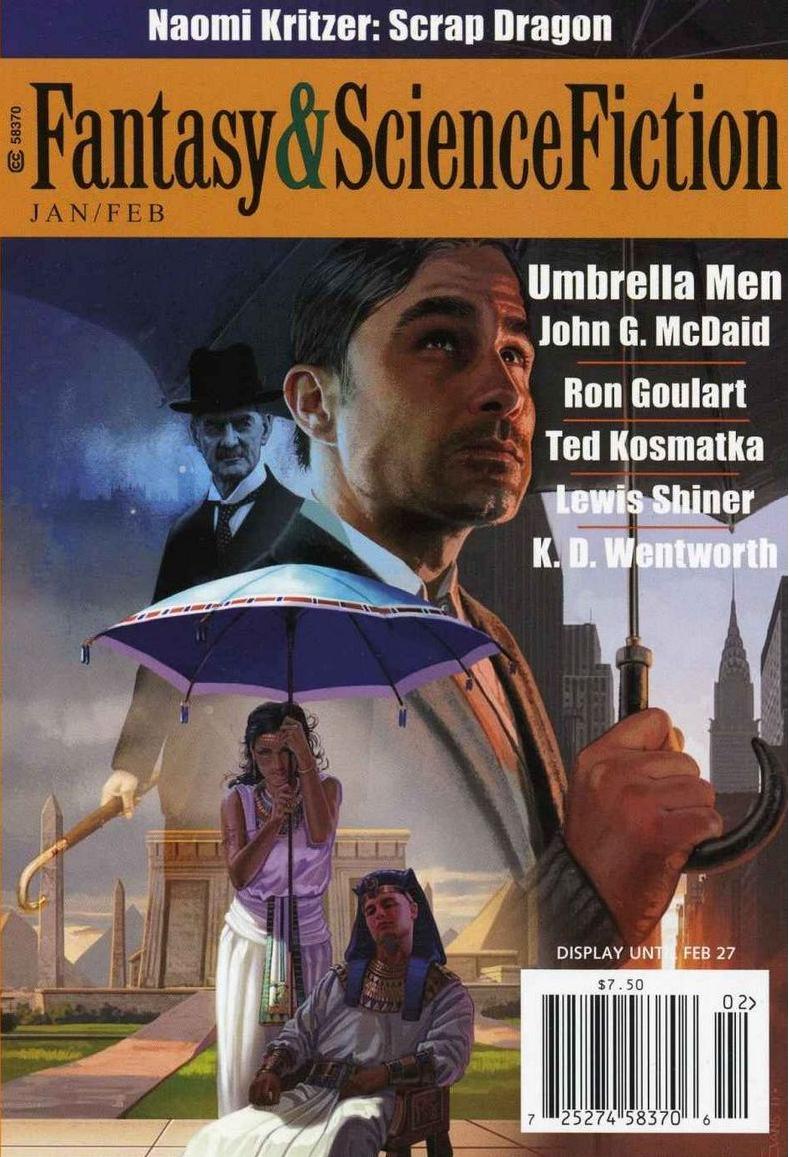
F&SF Jan-Feb 2014-smallJust how excited I am by the arrival of F&SF every two months is probably unfairly influenced by the cover.

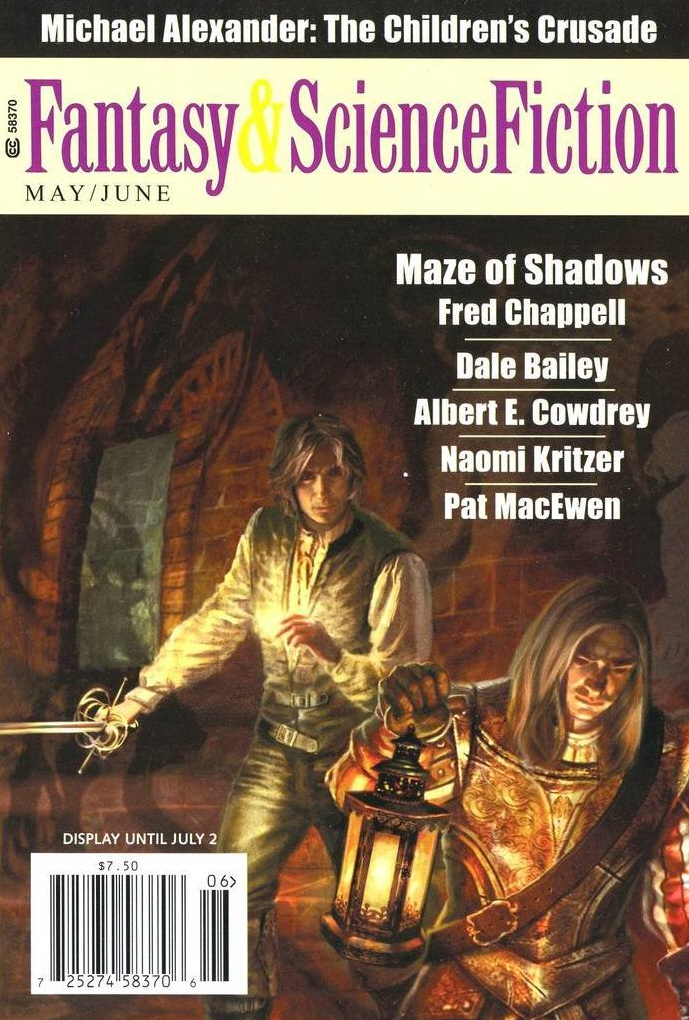
I can’t help it — I’m just a sucker for good cover art. Some of my favorite recent covers have been Max Bertolini’s marvelous down-in-the-dungeon piece for May/June 2012, Maurizio Manzieri’s enigmatic alien egg for July/August 2011, and our own Mark Evan’s first cover for F&SF, the 2012 Jan/Feb issue.

Of course, all the best magazine covers feature space ships, intrepid humans exploring foreboding alien landscapes and — especially! — robots. Which is why I was especially taken with the cover for the January/February 2014 issue, by the great Ed Valigursky.

Valigursky, who painted covers for IF, AmazingFantastic, and many others (not to mention many of my all-time favorite vintage paperback covers, like Space Viking and The Cosmic Computer), died in 2009, so I’m not sure how editor Gordon van Gelder managed to get his hands on a cover I’ve never seen before, but he did. Valigursky’s piece pays tribute to the classic look of F&SF from the 50s and 60s, and still somehow manages to look modern and fresh. That’s no small feat.

Chuck Rothman reviews the issue for Tangent Online, including Oliver Buckram’s novelette “The Museum of Error.”

Sometimes a wonderful conceit is more than enough to hold a story together. “The Museum of Error” is one of these: a museum that features various scientific mistakes –- the “Rounding Errors Through the Ages” exhibit, robots who insist they’re human, the Never-Right Clock, and Pete the Petrified Cat. Herbert Linden is the Assistant Curator for Military History, and is called to find out what happened to Pete, who may have been stolen by their competitors, the Science Institute. Oliver Buckram’s story is filled with imagination, and is very cleverly constructed, with a mishmash of what seem to be one-liners [that] all come together in the end.

This issue contains stories from C.C. Finlay (whose novella “The Nursemaid’s Suitor” appeared in Black Gate 8), Albert E. Cowdrey, Robert Reed, Alex Irvine, and others.

Read More Read More

New Treasures: Old Mars, Edited by George R.R. Martin and Gardner Dozois

New Treasures: Old Mars, Edited by George R.R. Martin and Gardner Dozois

Old Mars-smallI heard George R.R. Martin and Gardner Dozois were doing a new science fiction anthology about Mars and I thought, “Eh, Mars. It’s just no fun anymore. Too bad they don’t write stories about Mars the way they used to — like Clark Ashton Smith’s brilliant “The Vaults of Yoh-Vombis,” or Leigh Brackett and C.L. Moore’s fabulous tales of decadent civilizations and inscrutable alien mysteries. No one has that much imagination any more. Bah! I think I’ll go yell at the kids to get off the lawn.”

Then Old Mars finally arrived and it thawed my mean old heart. Martin and Dozois have rallied some of the finest writers in the industry — like Michael Moorcock, Joe R. Lansdale, Ian Mcdonald, Howard Waldrop, Matthew Hughes, Phyllis Eisenstein, and many others — to write brand new tales of Mars in the classic pulp tradition. Here’s the marvelous book description:

Burroughs’s A Princess of Mars. Bradbury’s The Martian Chronicles. Heinlein’s Red Planet. These and so many more inspired generations of readers with a sense that science fiction’s greatest wonders did not necessarily lie far in the future or light-years across the galaxy but were to be found right now on a nearby world tantalizingly similar to our own — a red planet that burned like an ember in our night sky… and in our imaginations.

This new anthology of fifteen all-original science fiction stories, edited by George R. R. Martin and Gardner Dozois, celebrates the Golden Age of Science Fiction, an era filled with tales of interplanetary colonization and derring-do. Before the advent of powerful telescopes and space probes, our solar system could be imagined as teeming with strange life-forms and ancient civilizations — by no means always friendly to the dominant species of Earth. And of all the planets orbiting that G-class star we call the Sun, none was so steeped in an aura of romantic decadence, thrilling mystery, and gung-ho adventure as Mars.

Join such seminal contributors as Michael Moorcock, Mike Resnick, Joe R. Lansdale, S. M. Stirling, Mary Rosenblum, Ian McDonald, Liz Williams, James S. A. Corey, and others in this brilliant retro anthology that turns its back on the cold, all-but-airless Mars of the Mariner probes and instead embraces an older, more welcoming, more exotic Mars: a planet of ancient canals cutting through red deserts studded with the ruined cities of dying races.

Martin and Dozois may well have produced my dream anthology. You don’t know how thrilled I am to see this kind of open-hearted embrace of the genre’s pulp roots from a major publisher.

Read More Read More

Vintage Treasures: Sorcerer’s World by Damien Broderick

Vintage Treasures: Sorcerer’s World by Damien Broderick

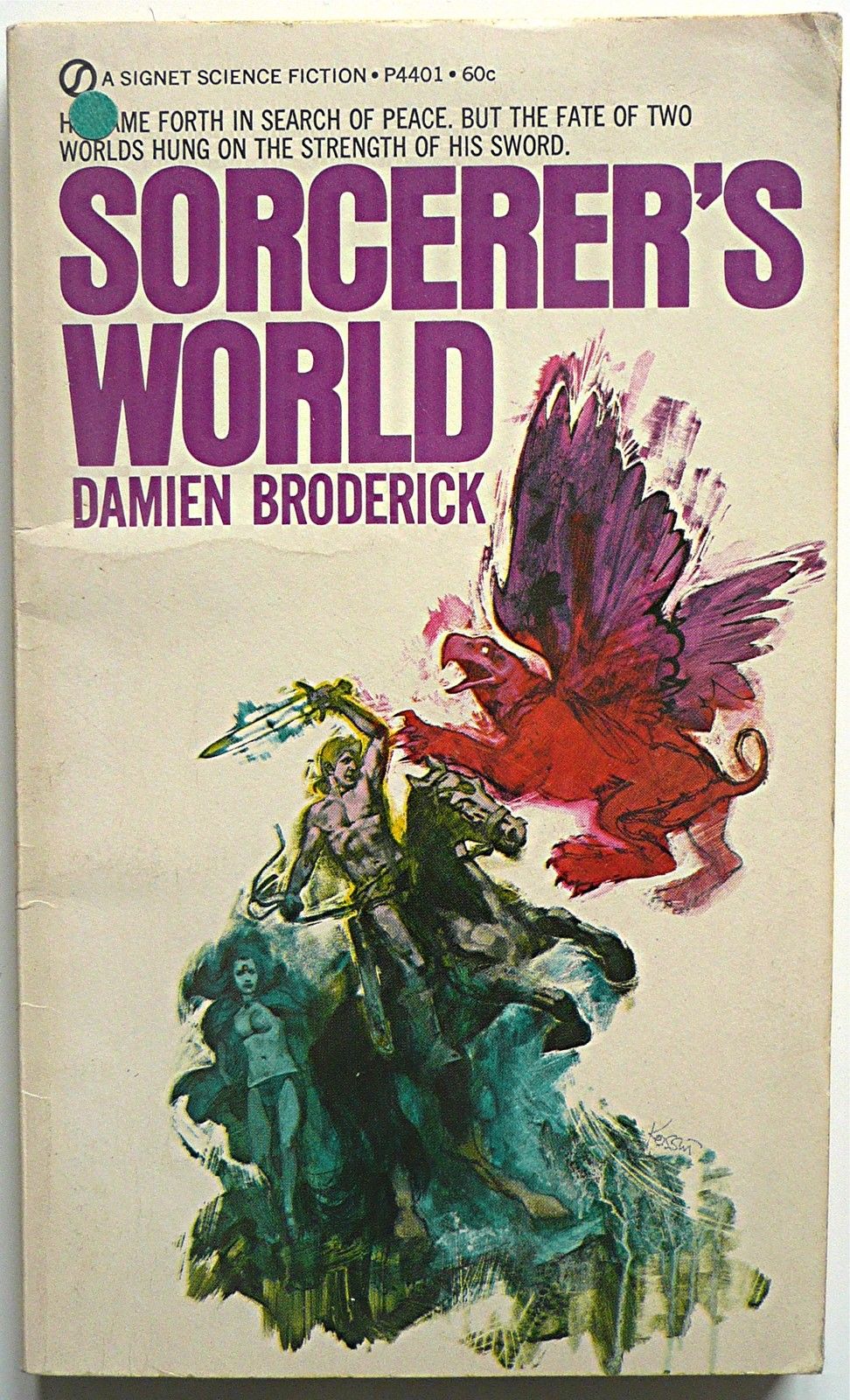
Sorcerer's World Damien Broderic-smallI think of Australian science fiction author Damien Broderick chiefly as a modern writer. He got a Locus Award nomination back in May for his non-fiction book Science Fiction: The 101 Best Novels 1985-2010 (edited with Paul Di Filippo), just as an example, and Rich Horton reported on his brand new three-volume survey of the vintage UK SF magazines Science Fantasy, New Worlds, and Science Fiction Adventures (all written with John Boston) for us in March.

So I admit I was a little surprised to find one of his books tucked away in a collection of vintage 50s and 60s paperbacks I purchased online a few weeks ago. Sure, it was published right at the tail end of those decades (1970) and it was his first novel. But Sorcerer’s World made me realize that Broderick has been contributing steadily to the field for well over four decades — and shows no signs of stopping.

Through the Time Barrier

Klim Xaraf, son of a nomadic chief, awoke from his monumental fall to find himself the prisoner of time — trapped a thousand years in the future. Around him was a dying world. Its incredible power sucked by necromancers through a hole to the past… its cities preserved in stasis, awaiting his liberation, or their final doom.

Yet Klim could neither meet this world’s challenge, nor conquer the wizards of his own, until the powers primed him for the battle. For with their knowledge, they would erase his memory and plunge him in a nightmare training ground… where all the wonders of tomorrow were the forgotten souvenirs of an ancient yesterday.

Ah, for the days when fantasy novels had characters named “Klim Xaraf.” These days, everyone sounds like a D&D character, rather than an extra from Krull. Broderick wrote a few other fantasy novels, including The Dreaming Dragons (1980), The Black Grail (1986), and The White Abacus (1997), but nowadays he’s chiefly known for his science fiction, especially Striped Holes (1988), Godplayers (2005), K-Machines (2006), and Transcension (2007).

Sorcerer’s World was published in October, 1970 by Signet. It is 144 pages, originally priced at 60 cents. It has never been reprinted, and there is no digital edition. See all of our recent Vintage Treasures here.