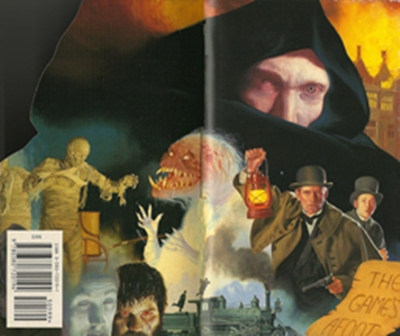
Mark Frost made the news not too long ago with the announcement that he and David Lynch will be making a new Twin Peaks series for Showtime. Yay! Twin Peaks came to an abrupt end in 1991: just after its second season. Frost apparently wasn’t one to let grass grow under his feet, as only two years later, The List of 7 hit bookshelves.
John O’Neill wrote about (mostly the cover…) this book last year.
Frost is absolutely a fan of Sherlock Holmes. Not only is the novel’s protagonist none other than Arthur Conan Doyle and bits of his life are scattered throughout, but there are Holmes-isms aplenty. Thus, this book is a type of pastiche, though darker than any straight Holmes tale I’ve read.
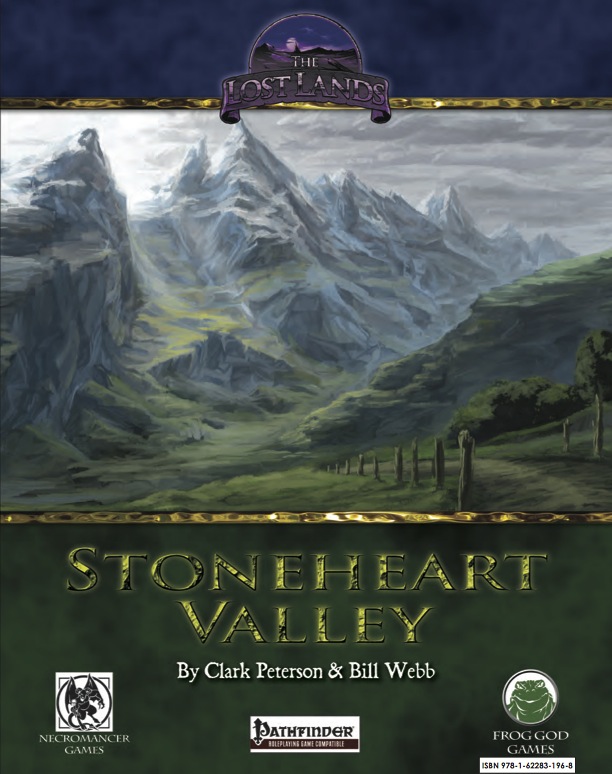
On the opening day of Gen Con 2000, Third Edition Dungeons and Dragons was unveiled. That same day, Necromancer Games released The Wizard’s Amulet, more or less the second OGL/D20 adventure (that’s another discussion).
Necromancer, working with other companies such as White Wolf, Judges Guild, and Kenzer and Company, became one of the most successful d20 companies. Their mega dungeon, Rappan Athak, is one of the best known Third Era adventures.
However, the advent of Fourth Edition spelled doom for Necromancer. Co-founder Bill Webb founded Frog God Games, a clear successor to Necromancer, and they published products for Paizo’s Pathfinder. Frog God produced new items and also updated old Necromancer goods as well, Pathfinderizing them.
With the advent of Fifth Edition D&D, Frog God is now publishing for both lines (in addition to retro-clone, Swords & Wizardry). Necromancer and Frog God adventures and supplements had loosely been connected in that they took place in Webb’s personal campaign world.
Frog God is currently putting out that campaign world under the moniker The Lost Lands. It is going to incorporate nearly everything produced by Necromancer and Frog God Games. Some products, such as their Judges Guild updates and the Hex Crawl Chronicles, belong to other folks and won’t be included. But if you look at the long list of products, there’s an awful lot, including Gary Gygax’s under-appreciated Necropolis.
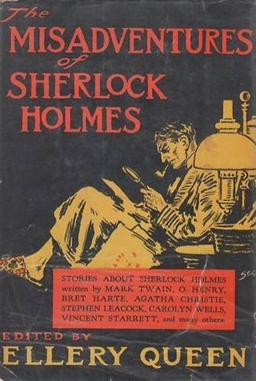
You’ve probably heard the name ‘Ellery Queen,’ but you may not know that it’s actually the name for joint efforts by cousins Frederic Dannay and Manfred Lee. They were important players in the mystery field for decades, with Dannay being a notable Sherlockian.
In 1943, Dannay planned The Misadventures of Sherlock Holmes, an anthology of parodies and pastiches. Unlike today, Holmes anthologies were unheard of back then. Due in large part, as we’ll see, to the management of the Doyle Estate by Sir Arthur Conan’s sons, Adrian and Dennis.
The book, by Ellery Queen, was unveiled at a Baker Street Irregulars gathering in 1944. I gave a taste what dealing with Doyle’s two sons could be like in my post on “The Man Who Was Wanted.” There’s more of the same in this tale.
Adrian heard about the collection and went off in his usual rage, telegramming his brother Denis (also a wastrel) in Spain. Denis cabled the Estate’s law firm and instructed them to demand that Queen and the publishers, Little, Brown and Company, stop publication and withdraw all copies. They were also to be sued for damages.
To quote Denis’s cable to the lawyers: “It is obviously a flagrant example of that very sort of piracy, striking at the very roots of the literary value of the property which my father left to his family, against which we have fought together in the past…books which will completely devaluate and ruin the whole value of the Holmes property, including films, radio and stage.”
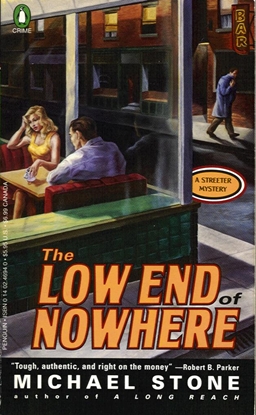
Just after I moved to Colorado Springs, a Denver private investigator named Michael Stone released his first book about Streeter, a bounty hunter in the Mile High City. The Low End of Nowhere had a very cool cover by Owen Smith, who would provide three more for A Long Reach, Token of Remorse, and Totally Dead.
Then, nothing: After four very good novels, Stone simply quit writing. It was as if he’d suddenly passed away. Over the years, I tried to find some news of him on the web but came up empty. He just seemed to lose interest in being a writer in 1999.
That’s a shame, because the Streeter books are quite good. They are very much in the style of the old pulpsters, but with a light touch. Stone clearly appreciated those who had gone before him, like Hammett and Nebel. But his character was no Mike Hammer or Race Williams. There’s finesse in the writing that reminds me of Joe Gores and his DKA novels.
Steeter (we never learn any other name) is physically imposing, having played football at a small division one school for two years before a fight with tragic consequences derailed that life plan. He was working as a bouncer and an accountant (how many of those have you read about?) when he ended up getting a job as a bounty hunter.
He lifts weights daily, fighting a slowly losing battle against the aging process. He even buys some hair-restorer but promptly puts it in a bathroom drawer, afraid to use it. Streeter isn’t a superhero: he’s a guy who works hard at working hard.
In 1897 or 1898, Arthur Conan Doyle decided to “revive” Sherlock Holmes, who had gone over the ledge at the Reichenbach Falls in 1893. He wrote the first draft of a play starring the detective.
Since he already had scored a hit with his non-Holmes play, A Tale of Waterloo, Doyle must have figured that the public would ring up the cash register in seeing their favorite detective again: this time on the stage.
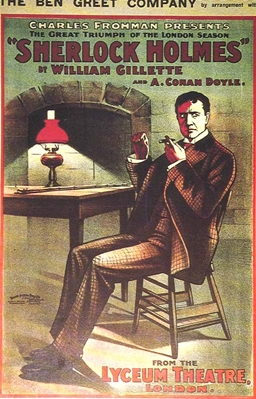
Doyle lost interest in the project, but his agent sent the five-act play off to noted Broadway producer and agent Charles Frohman. Frohman, who died aboard the ill-fated Lusitania, felt that the play was not commercial enough as it was and told Doyle that popular American actor William Gillette should revise and then star in it.
The uninterested Doyle gave his permission and Gillette transformed Holmes into more of a melodrama star and less of a stodgy British detective.
Gillette read all of Doyle’s original stories, took four weeks off from his current tour for the popular Secret Service and rewrote the play. That November, a fire in San Francisco’s Baldwin Hotel destroyed all of the scenery and sets of Secret Service; and also the only script of Sherlock Holmes!
It’s Elementary – Gillette asked Doyle if he could marry Holmes for the play. Doyle’s reply via telegram has become famous: “You may marry him, murder him or do anything you like to him.”
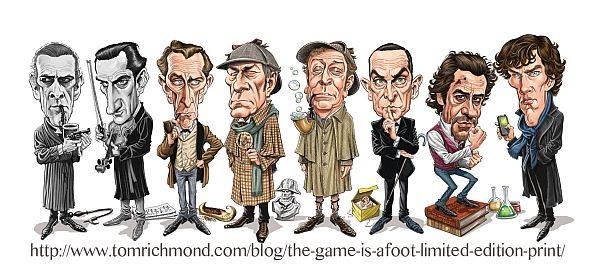
An awesome print by Tom Richmond of Holmes on screen over the years. I own print #7 of 450
Surprisingly, The Public Life of Sherlock Holmes has now made it to thirty posts. While I’m sure the dedicated reader types ‘Public Life of Sherlock Holmes’ in the search field to call up all the posts in the series, I said to myself (I talk to myself a lot), “Bob, there’s got to be an easier way for someone to bask in the entirety of your writings so far.”
And there is! Below is an index with links to all the posts, followed by some topics likely to come.
In 1929, Clive Brook’s The Return of Sherlock Holmes ushered in the era of ‘talkies’ featuring the great detective. Although it was also released as a silent film, likely because many theaters had not yet converted to sound system projectors.
The movies went crazy over Holmes, with three big screen efforts in 1931:The Speckled Band (Raymond Massey), The Sleeping Cardinal (Arthur Wontner), and The Hound of the Baskervilles (Robert Rendel).
Cardinal was released in the US as Sherlock Holmes’ Fatal Hour. Rendel’s film was thought lost for years, with a print but no soundtrack. However, one was found and the two were merged. I’ve yet to see (and hear) that one.
Three more movies followed in 1932: The Missing Rembrandt and The Sign of Four (both with Arthur Wontner) and Sherlock Holmes(Clive Brook again). In Brook’s second turn as Holmes, his Watson was Reginald Owen, who would achieve success as Ebenezer Scrooge.
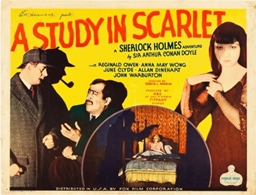
1933 saw only one Holmes movie, and it was Owen moving up to the starring role in a version of A Study in Scarlet. Well, sort of.
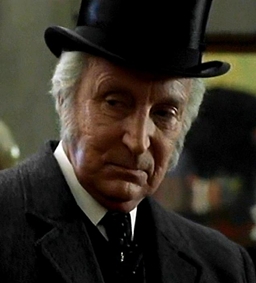
One of my favorite Holmes’ also played Joseph Bell
Apologies for this post running a bit long. While I’m a devoted Sherlockian, I’m not particularly a great fan of Conan Doyle himself. However, I find this tidbit from his life to be pretty interesting. So…
Biographers and devotees of Sherlock Holmes have written much regarding who the detective was modeled after. Joseph Bell is widely regarded as the primary inspiration, a belief bolstered by Sir Arthur Conan Doyle’s own words more than once.
In his autobiography, Memories and Adventures, Doyle said, “I thought of my old teacher Joe Bell, of his eagle face, of his curious ways, of his eerie trick of spotting details. If he were a detective he would surely reduce this fascinating but unorganized business to something nearer to an exact science.”
Add another comment, “Sherlock Holmes is the literary embodiment… of my memory of a professor of medicine at Edinburgh University.”
Now, it has been asserted that one can find bits of Doyle himself in the great detective. His second wife said that her husband had the Sherlock Holmes brain, solving mysteries that puzzled the police.
Son Adrian Conan Doyle vehemently (even militantly) argued that his father was Holmes. Seemingly more likely is that the stolid, patriotic Doctor Watson drew in great part from his creator.
But can we examine one of the sixty Holmes tales and discover biographical pieces of Conan Doyle? As a matter of fact, we need look no further than “The Adventure of the Resident Patient”and Dr. Percy Trevelyan.
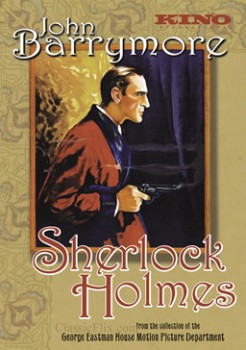
Back in May, I wrote about Eille Norwood’s turn as the silent film era’s finest Holmes. Now, just about any discussion concerning who the greatest actor of the silent era was will involve the name John Barrymore, who was known as “The Great Profile.”
So, it’s natural that he would make a film about a character that over a hundred years after his creation can still be readily identified by his profile.
By 1922, John Barrymore was an established star in both the US and Great Britain and had made a hugely successful version of Dr. Jekyll and Mr. Hyde just two years before. Actor/director Albert Parker was determined to make a Holmes film with the forty year-old Barrymore in the lead role.
Of course, there was a minor snag, as Stoll Pictures (starring Norwood) had locked up the rights to Doyle’s original stories, with Sir Arthur’s own assistance. So Parker had an actor and an idea, but no script. The man was certainly energetic, and he rushed to Chicago and met with the great William Gillette, who was touring with his own play, Sherlock Holmes (subject of a future post).
Parker bought the rights to film the play (which had already been done in 1916 starring Gillette himself: sadly, no known print exists of that one) and arranged a deal with Samuel Goldwyn. This would easily be the most lavish and well-financed Holmes film to date.
There are 60 original Sherlock Holmes stories written by Sir Arthur Conan Doyle: 56 short stories and 4 novels (novellas, really). He also wrote two very short Holmes “bits” that are not included in the official Canon, though all acknowledge they are his works.
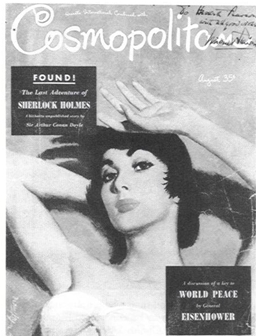
In August of 1948, the Doyle Estate added a 61st story to the official list when Cosmopolitan proclaimed “FOUND! The Last Adventure of SHERLOCK HOMES, a hitherto unpublished story by Sir Arthur Conan Doyle.”
Included in that issue was “The Man Who Was Wanted,” a long lost Holmes tale from the pen of Doyle himself. Five months later, London’s Sunday Dispatch serialized it in three installments during January of 1949.
Rumors of the story’s discovery had started in 1942 and Hesketh Pearson, the man who found it while working on an authorized biography of Conan Doyle, had printed the beginning of the story and commented on it in Conan Doyle: His Life and Art.
Notable Baker Street Irregulars such as Edgar Smith, Vincent Starrett, and Anthony Boucher raised a hue and cry for the story to be published. For Sherlockians, this was on a par with the discovery of a Homeric account of the first nine years of the Trojan War!
 Mark Frost made the news not too long ago with the announcement that he and David Lynch will be making a new Twin Peaks series for Showtime. Yay! Twin Peaks came to an abrupt end in 1991: just after its second season. Frost apparently wasn’t one to let grass grow under his feet, as only two years later, The List of 7 hit bookshelves.