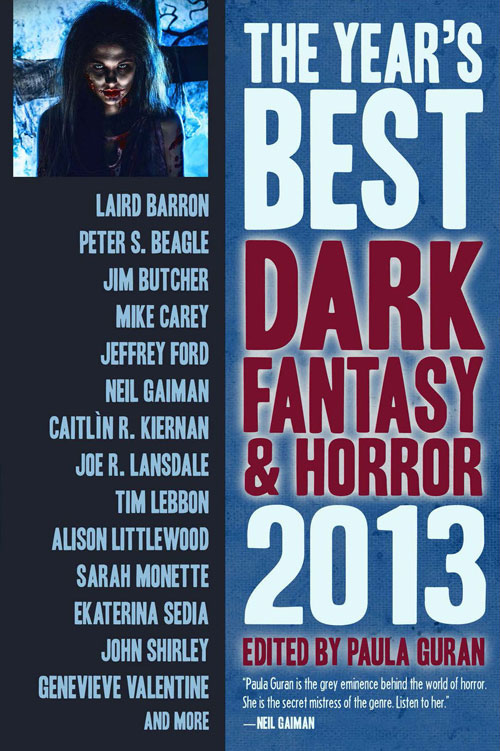
New Treasures: The Year’s Best Dark Fantasy & Horror 2013, edited by Paula Guran
 You don’t have time to keep up on all the great work produced in the fantasy and horror fields, year after year.
You may think you do. But trust me, you don’t. There are fantastic new novelists emerging all the time — folks like Laird Barron, Theodora Goss, Genevieve Valentine, and Ekaterina Sedia — and new masters of the short story, like Karen Tidbeck, Ken Liu, Rachel Swirsky, Mike Carey, and many others. How are you going to keep up?
Believe it or not, that’s not a rhetorical question. I have the answer right here: Paula Guran’s indispensable annual collection The Year’s Best Dark Fantasy & Horror. It’s like a cheat sheet covering all the exciting new — and established — writers in the genre. Read it every year, and I guarantee you’ll be talking intelligently about the latest literary trends in dark fantasy at your next party. (You’re on your own picking out what to wear, though. Just remember: no white after Labor Day.)
Paula Guran doesn’t provide the lengthy annual summary typical of some Year’s Best collections. Instead she gives the space over to fiction — over 500 pages of the best short stories of 2013, culled from magazines like Beneath Ceaseless Skies, Postscripts, Cemetery Dance, F&SF, Clarkesworld, Subterranean, Lightspeed, Apex, and Shimmer, and anthologies like The Book of Cthulhu 2, Hex Appeal, Shotguns v Cthulhu, Dark Tales of Lost Civilizations, Black Wings II, and many others.
This is the fourth volume of The Year’s Best Dark Fantasy & Horror, but the first one I’ve gotten around to. In our defense, we’ve at least covered several of Paula’s other recent anthologies, including Season of Wonder and Weird Detectives.
Here’s the book description.
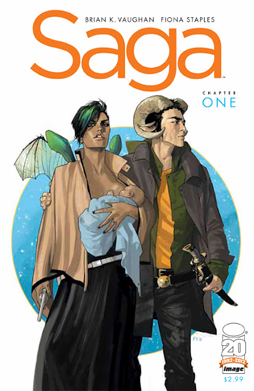 A few months ago, the 2013 Hugo Award for Best Graphic Story was given to Saga, Volume 1, the first trade paperback collection of the ongoing Saga comic book. Written by Brian K. Vaughan, with art by Fiona Staples (and lettering and design by the Fonografiks studio), the book deserved the win. It’s the first chapter in a promising story and manages to establish a simple and powerful basic situation for the main characters, while also creating a complex world, backstory, and array of subplots. If it sometimes seems overbroad, too accessible and glib, it also has a deep and original sense of history to its setting, and a design sense that makes that setting live.

 A little while ago, I followed a retweeted link to