Fantasia 2016, Day 7: Immiscible Propaganda (Momotaro, Sacred Sailors; The Alchemist Cookbook; and Library Wars: The Final Mission)
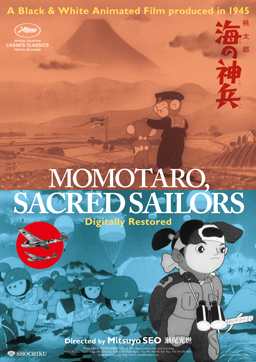 As I’ve said before, sometimes the movies I see at Fantasia on a given day have a common theme. And sometimes they don’t, however much it might look like they ought to. On Wednesday, July 20, I’d go downtown to the Hall Theatre to watch an oddity: a restored Japanese propaganda cartoon from World War II, Momotaro, Sacred Sailors (Momotaro, Umi No Shinpei). Then I planned to head across the street to the De Sève and watch an independent American horror film, The Alchemist Cookbook. I hoped to make it back to the Hall after that in time to watch the second in a series of Japanese science-fiction action movies, Library Wars: The Last Mission (Toshokan Sanso: The Last Mission). It looked like a packed day, and I wondered how the movies would play off of each other.
Momotaro was written and directed by Mitsuyo Seo, and released in 1945. Seo was apparently told by the Japanese Ministry of the Navy to make a propaganda film for children, and given Disney’s Fantasia as an example of what the Ministry had in mind. Seo, who’d already made a 37-short retelling the bombing of Pearl Harbour, produced the 74-minute Momotaro. It was believed lost during the American occupation, until a VHS copy turned up in Japan in the 1980s. Recently the original negatives were found, a 4K restored version was made, and Momotaro screened at Cannes in the Cannes Classics section.
Momotaro’s a mashing-up of the war in the Pacific with the Japanese legend of the peach boy Momotaro. The basic story of the tale has an elderly couple finding a boy in a peach that washes downstream past their house; when Momotaro grows up he sets out to defeat an island of demons, or oni, and does so with the help of various animal companions. Seo’s mapped that story onto the Japanese war effort in the Pacific. The movie begins with a group of anthropomorphic animals on leave from the Japanese navy and returning to their village to be celebrated as heroes. Various knockabout gags follow, and the animals join forces to save a child from falling over a waterfall. They rejoin their unit, and we see them at a navy base working and taking classes.
…


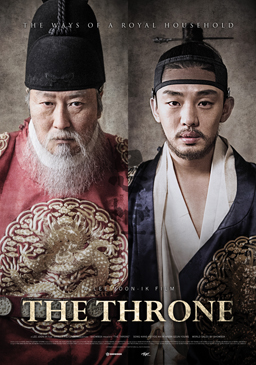 Sometimes the movies I get to see on a given day at Fantasia have an obvious common theme. Sometimes not. Sometimes there’s a commonality binding two otherwise different movies, but it’s tenuous. So it was that on Tuesday, July 19, I watched a Korean historical drama called The Throne (originally Sado), and followed it with a Polish musical-fantasy-tragicomedy called The Lure (originally Córki dancingu). They’re both films based on older stories, in the first case recorded history from the eighteenth century, and in the second Hans Christian Andersen’s fairy tale “The Little Mermaid.” As you might imagine from those two very different source materials, these are very different movies in very different genres. But it also seemed to me that the process of retelling the stories was very different as well.



 I had only one movie on my schedule for Monday, July 18, but thanks to the good offices of the people at the Fantasia Film Festival and at Oscilloscope Laboratories, I ended up able to catch another film first. The Love Witch was a movie that I’d been unable to watch in its theatrical showing at Fantasia due to a scheduling conflict. After seeing it Monday, I’d go on to the Hall Theatre for The Wailing (Goksung), a two-and-a-half hour Korean horror film. The movies made for an odd contrast. In both cases I greatly appreciated them but came away fairly sure I wasn’t part of their primary audience. But movies play to whoever sees them, and perhaps writing about these films will bring them to the attention of people with better perspectives than my own.