80s Fantasy and Master of the Five Magics
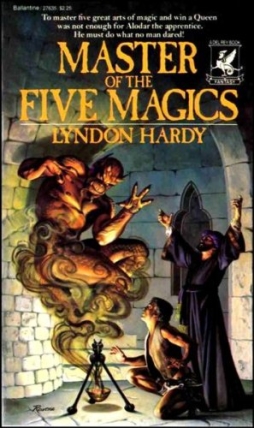 I’ve been thinking lately about fantasy in the 1980s. More specifically, about the wave of fantasy fiction that began to be published in the late 70s, in the wake of The Sword of Shannara and the first Thomas Covenant books, and which over the following years developed into fantasy as we know it now. So far as I can learn, it seems that this was when fantasy really took root as a novel category — that is, when fantasy novels stopped being relatively rare events and began to flourish as a genre. As a result, I think, it was a time when the idea of fantasy broadened; new ideas and forms and voices were tried, even if certain assumptions (like a quasi-medieval-European setting) were often unquestioned. What I wonder is whether certain things tried then and since almost forgotten are in fact worth revisiting.
It sometimes seems like that generation of books is either ignored, or remembered only for its most popular examples — the big sellers, or the series which started then and are still going. I can’t find much thoughtful criticism of 80s fantasy fiction as a whole, or even much discussion about the relevance of the books of that time to contemporary fantasy writing. This is annoying, as I think it increases the possibility of good work slipping through the cracks. I don’t mean to suggest that there’s a mass of neglected masterpieces, but I do suspect that some of those 80s fantasies have elements to them which might be worth re-examining, or which might speak to contemporary ideas in fantasy.
Take, for example, Lyndon Hardy’s three-book sequence Master of the Five Magics, Secret of the Sixth Magic, and Riddle of the Seven Realms.
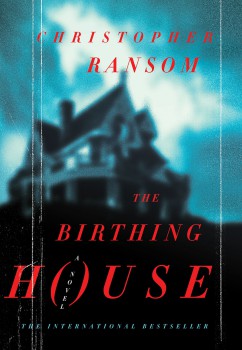 The Birthing House
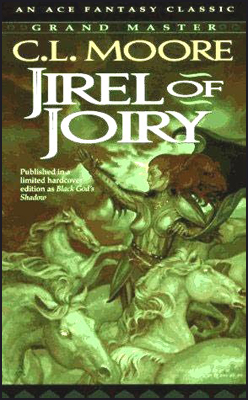 Due to an unfortunate (or perhaps I should say, “fortuitous”) comment I let slip in an email, Howard Andrew Jones discovered I had no idea who C.L. Moore was.
 I’ve contributed book reviews to the

 Not to beat the subject, like Fingon, to death, but neither writer is trod into the mire by a comparison to the other. The shortest distance between these two towers is the straight line they draw and defend against the dulling of our sense of wonder, the deadening of our sense of loss, and the slow death of imagination denied.
 “The 25th anniversary edition of The Last Starfighter.”
 Julian Comstock: A Story of 22nd Century America