Godzilla & Rodan & Mothra & Alice: Destroy All Monsters on Blu-ray!
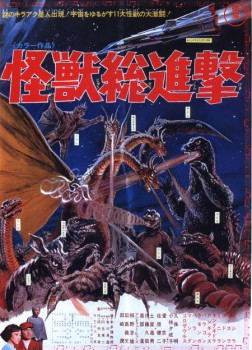 Last month, the second Godzilla film to reach Blu-ray in North America made its thundering, skyline-flattening debut, courtesy of Media Blasters: the 1968 science-fiction monster mash Destroy All Monsters (Japanese title: Kaiju Soshingeki, “Charge of the Monsters” or “Monster Invasion”). The only Godzilla movie to beat it onto Blu-ray is the 1954 original, which will get a re-release as part of the Criterion Collection in January 2012. (The Criterion Collection! Godzilla has gained a well-deserved highbrow victory and sits on the same shelf with Kubrick and Bergman!) Later this month will see the third Godzilla Blu-ray release, 1973’s Godzilla vs. Megalon. This is arguably the worst movie of the long series, but I welcome it onto Hi-Def nonetheless: three cheers for glittering mediocrity!
But Destroy All Monsters is anything but mediocre: like Universal’s House of Frankenstein over twenty years before, it pulls together all the science-fiction candycorn goodness available to give audiences a mad monster party for the ages. The plot is simplistic, the characters even more so, but the movie pops with color and spectacle of a bygone age of entertainment without irony. It isn’t the best of the Godzilla series, but until 2004’s Godzilla: Final Wars, no monster movie could boast a larger monster cast. Eleven of Toho Studio’s stable of big beasts crowd into its hundred minutes, and the result is a giddy confection no ten-year-old or ten-year-old at heart can resist. If geekdom has a defining film, here it is.
Destroy All Monsters was one of the first of Japan’s giant monster films to reach DVD in North America. At the time it seemed like a miracle to have a Godzilla film available in a letterboxed edition. However, the 1999 disc from ADV Films is the textbook example of a barebones release: the only language option is the inferior of the two English dubs (I’ll explain the dubbing situation later), the picture isn’t enhanced for widescreen TVs, and the disc doesn’t even have a menu. As better quality Godzilla DVDs came out in the 2000s, Destroy All Monsters became a black hole on collectors’ movie shelves. ADV re-released the movie to DVD in 2004 packaged with a soundtrack album as part of Godzilla’s Fiftieth Anniversary, but the movie disc is exactly the same.
The Media Blasters/Tokyo Shock Blu-ray fixes all these problems: not only is the film in glorious Toho Scope 1080p, but the disc contains both English dubs, the original Japanese mono soundtrack, a 5.1 lossless re-mix, and commentary from two Japanese fantasy film scholars, Steve Ryfle and Ed Godziszewski, who have done informed and lively commentaries for previous Godzilla DVD releases.
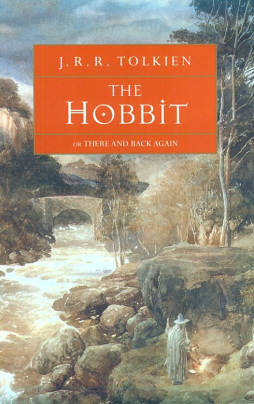 Nearly every night, I read aloud to my boys. For Evan, my seven-year-old, I have lately been reading The Hobbit. Two nights ago, no sooner had I begun than Evan interrupted, saying, “It’s funny how they spell ‘Smaug.’”

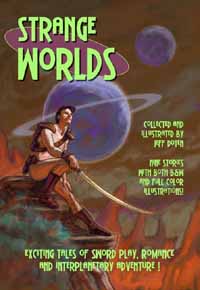
 This week concludes Black Gate‘s interview with author and editor James L. Sutter with a discussion of the pros and cons of media-tie in fiction, the Before They Were Giants anthology which collects the first sale short fiction of many big name writers, and a look at what James is working on now. Be sure to check out parts

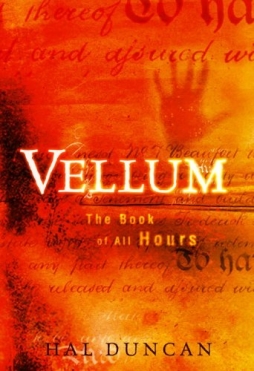 Hal Duncan’s The Book of All Hours is a dazzling, fascinating, frustrating work. A duology consisting of 2005’s Vellum and 2007’s Ink, it plays with structure and story in powerful ways, while also seeming to fall back too easily into black-and-white absolutes and traditional forms. The oddity of the book is that although in some ways it appears radically new, in other ways, as one reads further into it, it comes to feel more and more familiar.