Meeting Your Heroes: David Kyle
 There are a handful of people whom I credit with introducing me to science fiction.
The first was my classmate John MacMaster, who brought me two science fiction novels when I was bedridden for a few days in the seventh grade. The second was Jacques Sadoul, whose 2000 A.D.: Illustrations From the Golden Age of Science Fiction Pulps turned my early curiosity into a full-fledged obsession with early SF and fantasy magazines. The third was Isaac Asimov, whose pulp anthology Before the Golden Age and Foundation Trilogy thoroughly captured my young imagination.
The man who cemented that early interest, and who brought all my young obsessions together — monster movies, pulps, magazines, comics, Star Wars, and even Isaac Asimov — and showed me that they were all aspects of the rich branch of art and literature known as Science Fiction, was David Kyle.
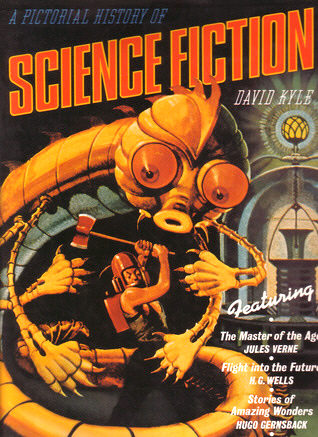
He did this through two magnificent books that I read over and over again as I lay in bed much too late on school nights: A Pictorial History of Science Fiction (Hamlyn Publishing Group, 1977) and The Illustrated Book of Science Fiction Ideas & Dreams (Hamlyn, 1977).
Both books were very popular in the 70s, especially following the release of Star Wars and the surge of interest in all things science fiction. Deluxe oversize hardcovers copiously illustrated with pictures of early SF writers, pulp art, and numerous books cover and movie stills, they were immaculately designed and gorgeous to look at. But it was Kyle’s text that really drew me in. Here was a man who had been a part of science fiction since its earliest days — a Futurian who attended the first Worldcon in 1939 and a founder of Gnome Press in 1948 with Martin Greenberg — and who still spoke of it with wonder and deep appreciation.
It’s through Gnome Press that David made perhaps his most significant contribution to science fiction, publishing nearly a hundred of the most important books in the genre — including first editions of Robert A. Heinlein’s Sixth Column and Methuselah’s Children, The Coming of Conan and Conan the Conqueror by Robert E. Howard, I, Robot and Foundation by Isaac Asimov, Clifford D. Simak’s City, C.L. Moore’s Judgment Night and Shambleau and Others, Two Sought Adventure by Fritz Leiber, plus Arthur C. Clarke, Edward E. Smith, L. Ron Hubbard, Leigh Brackett, Murray Leinster, A. E. van Vogt, and many others. He kept the most important writers in the field in print at a time when they appeared only in magazines, and is directly responsible for introducing them to a whole new generation.
I first met David Kyle at the World Fantasy convention in 1984, in my home town of Ottawa, where I was able to shake his hand and say a few words of appreciation. But it was at Worldcon three weeks ago that I had a chance to talk with him at length, and really get to know one of the most important early writers and publishers in the industry. It was one of the highlights of the con for me.
 While SF Signal’s Patrick Hester was at Worldcon a few weeks back, he went on a whirlwind series of adventures. Seriously, starting from his long drive from the western United States until his long return, I’m not sure he got in more than a few hours of sleep every night.
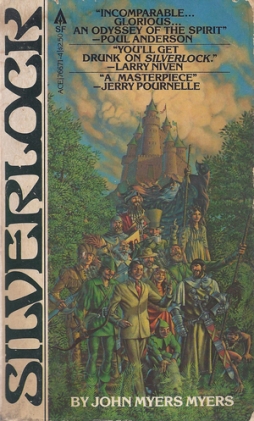 It’s been said that this is the age of the mash-up: of art formed from the fusion of other works of art. A film like The Avengers blends together characters from five other movies. Fan-fiction interrogates texts we thought we knew, crossing characters from one tale over into another. At an extreme, a work like Alan Moore’s League of Extraordinary Gentlemen imagines a world where every character derives from some other source, comes from some other story; imagines a world where all stories overlap and so make a strange collective setting. In fact, though, this is really nothing new. Crossovers, it has been said, date back to Homer writing of heroes coming together to fight the Trojan War. And League of Extraordinary Gentlemen-style mash-ups have precedents as well; I have not read Philip José Farmer’s Riverworld books, nor have I read John Kendrick Bangs’ Associated Shades novels, which date back to the 1890s, but I have read John Myers Myers’ 1949 novel Silverlock, and came away from it with a few thoughts.
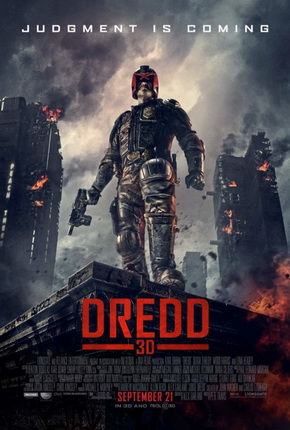 The Charge: Attempting to re-start a film franchise about a classic comic book character.