Zenna Henderson’s The Anything Box
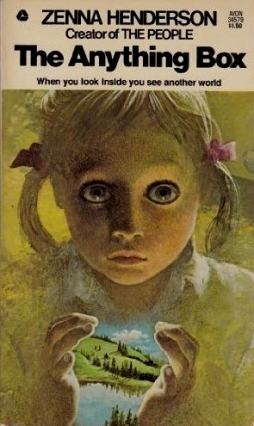 As so often happens, I was at a book fair the other week when, again as so often happens, I stumbled on a book by a writer I’d heard of at some point and about whose work I was vaguely curious. In this case, the writer was Zenna Henderson and the book was a collection of sf and fantasy short stories called The Anything Box. Which, upon reading, I found to be quite intriguing.
Henderson was born in 1917 and died in 1983. Most writing I’ve found about her online (including her homepage, her SF Encyclopedia entry, and this excellent appreciation by Bud Webster) mention some or all of the following things: that she was a Mormon, that she taught Japanese-Americans in an internment camp during World War Two, and that she was one of the few women writing sf in the 1950s under an obviously female first name. Her work has influenced Orson Scott Card, Lois McMaster Bujold, and Connie Willis.
Henderson seems to be best known for her stories about the People, refugee aliens trying to make lives for themselves on Earth. None of those pieces are in The Anything Box. These stories stand alone; most, but not all, focus on teachers, children, and domestic life. Their technique is mainly simple and direct: straight-ahead narrative prose, eschewing tricks of chronology or unreliable narrators. “Things” uses alien vocabulary extensively, and “Turn the Page” borders on a Bradbury-like expressionistic lyricism, but on the whole the book is good solid 50s commercial prose. Which does some unexpected things.
 Typically in these blog posts, I write about some work of fantasy, science fiction, or horror; of fantastika. I’m not sure whether the book I want to write about this time round can be described as any of those things. It’s not always, in fact, easy to distinguish what is fantastic and what is not. Does the distinction lie in what the writer has in mind, or in how the reader interprets the text? If a man who believes himself to be a magician writes about magic, is that fantasy or mimetic fiction? The author describes the world as the author understands it. The reader, reading, then sees the world as the author does: so writing is perhaps inherently magical, a possession. All words are magic words. All stories are true.
 Together again,