Did Entertainment Weekly Reveal that Benedict Cumberbatch is Playing Khan?
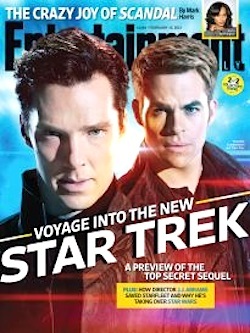 In a sharp-eyed bit of investigative reporting, Tor.com has reproduced screenshots from the Entertainment Weekly Back Issues store that name the villain in the upcoming J.J. Abrams film Star Trek Into Darkness as Khan.
As we reported back in December, speculation has been rampant around just whom Benedict Cumberbatch will be playing in the new film. IMDB originally listed his character as Gary Mitchell, the Enterprise officer who becomes an all-powerful psychic loonie in one of the show’s earliest and best episodes, “Where No Man Has Gone Before.” Rumors that he was playing Khan, the genetically-engineered supervillain originally portrayed by Ricardo Montalban in the episode “Space Seed” and the film Star Trek II: The Wrath of Khan, eventually led the otherwise tight-lipped Cumberbatch to deny it.
As shown by Tor.com however, screen captures for the February 15 cover-dated issue of Entertainment Weekly allow you to select one of two covers, the “Spock & Kirk” cover, or the “Kirk & Khan” version.
EW hastily deleted the notations, and the latest version of the page gives no such identifiers.
In its current cast list, IMBD now lists Cumberbatch as playing “Khan (rumored),” and Alice Eve as playing Dr. Carol Marcus, Kirk’s ex-flame and baby mama from Star Trek II.
The latest Super Bowl TV trailer for the film has been posted on YouTube. Star Trek Into Darkness is directed by J. J. Abrams, and is set for release on May 17, 2013. As we reported in January, Abrams was also selected as the director for the next Star Wars film.
Meanwhile, there’s no truth to the rumor floating in fan circles that J.J. Abrams will also be tapped as the new pope.
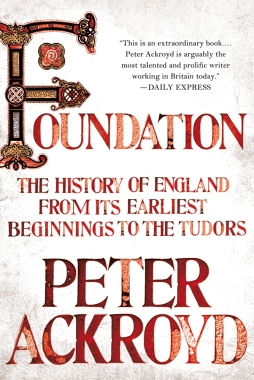 I’ve been reading Peter Ackroyd’s writing for almost twenty years now, and I’m frankly beginning to fall behind. It’s hard to keep up with the man: he’s produced poetry, fiction, biographies, creative nonfiction, and, most recently, narrative history. One of his nonfiction books, Albion, was subtitled ‘the English Imagination,’ and was an essay or set of essays investigating exactly that; in fact, much of Ackroyd’s work can be seen as an investigation of, or a struggle with, the nature of English literary, historical, and imaginative traditions — especially as manifested in the history of London. And so his current project (or one of them) is an ambitious six-book history of England. Two have been published so far; as I say, I’m behind, and have only just completed the first, Foundation, examining the past of England from prehistory to the end of the Wars of the Roses.