Nalo Hopkinson’s Brown Girl in the Ring
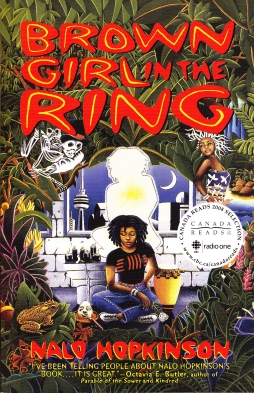 Published in 1998, Nalo Hopkinson’s debut novel was Brown Girl in the Ring, the first winner of the Warner Aspect First Novel Contest. It went on to be shortlisted for the Philip K. Dick Award and the James Tiptree Junior Award, to win the Locus Award in the First Novel category, and to help Hopkinson (who had already published several short stories) win the John W. Campbell Award for Best New Writer. She’s gone on to write five more novels, along with two collections of short stories, as well as editing and co-editing several anthologies.
Born in Jamaica, Hopkinson has lived in Toronto since 1977, and a near-future version of that city is the background to Brown Girl in the Ring. In this dystopian imagining, the core of the city’s been abandoned by all levels of government. A young mother named Ti-Jeanne lives in the community that’s sprung up; she’s the granddaughter of one of the community’s leaders, Gros-Jeanne, a healer with apparently magical powers — and Ti-Jeanne herself has begun to see strange visions. When elements of the Ontario government reach out to a local boss, asking him to supply a human heart for an emergency organ transplant, both Jeannes become involved in the resulting violence.
The novel deserves the acclaim it got. On one level, it’s a strong adventure story with a fast-moving plot. But the book’s also notable for its language — specifically the dialogue, largely written in a Caribbean English. And for the story’s use of both science fiction and fantastic elements; as it works through a powerful family tragedy, played out in a dark future through the invocation of spirits and gods, it convincingly evokes the mythic.



 Paul Kearney’s piece on large-scale battle scenes is just what I hoped it would be. You know all the familiar gripes about fantasy warfare that fails the suspension-of-disbelief test: the army never seems to eat or excrete, never needs to get paid, charges its horses directly into walls of seasoned enemy pikemen, and so on. “So You Want to Fight a War” addresses all those mundane things an author must get right if the fantasy elements of her story are to feel real to the reader, and then Kearney pushes past the gripes into solutions that any conscientious author can learn to implement. It’s that last bit that I found truly refreshing — many discussions of military verisimilitude get bogged down in griping. Kearney assumes throughout that it’s possible for his reader to get this stuff right, with enough good models, research, and practice.