Vintage Treasures: The List of 7 by Mark Frost
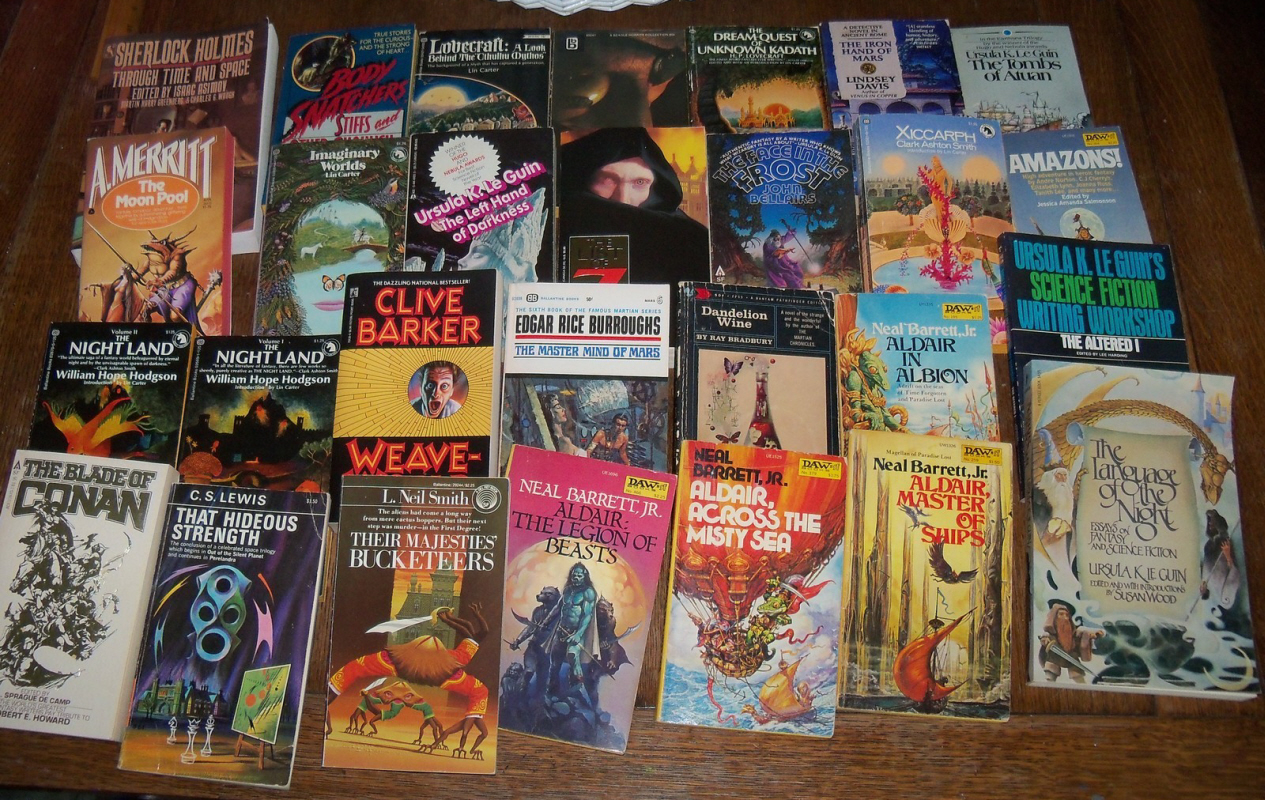
I love buying paperback collections. Like this one, which I found online last week. Just look at at all those gorgeous vintage paperbacks. Seriously, click on that link and look at them. I’ll wait.
Twenty-eight volumes in terrific shape, for less than twenty bucks. Including four early volumes from Neal Barrett, Jr; three vintage Lovecraft collections (one of them The Dream Quest of Unknown Kadath); both Ballantine volumes of William Hope Hodgson’s The Night Land; one of Lin Carter’s better fantasy collections, Imaginary Worlds; A. Merritt’s The Moon Pool; a smattering of Ursula K. LeGuin, plus C.S. Lewis, Clark Ashton Smith, Ray Bradbury, Edgar Rice Burroughs, John Bellairs, and half a dozen more. There’s even a beautiful copy of Sherlock Holmes Through Time and Space, which I’ve lusted after ever since Violette Malan teased me with the cover in her article on science fiction mysteries last month.
Man, I could just lay these babies down on the floor and roll around in ’em. Except that would probably dog ear the covers.
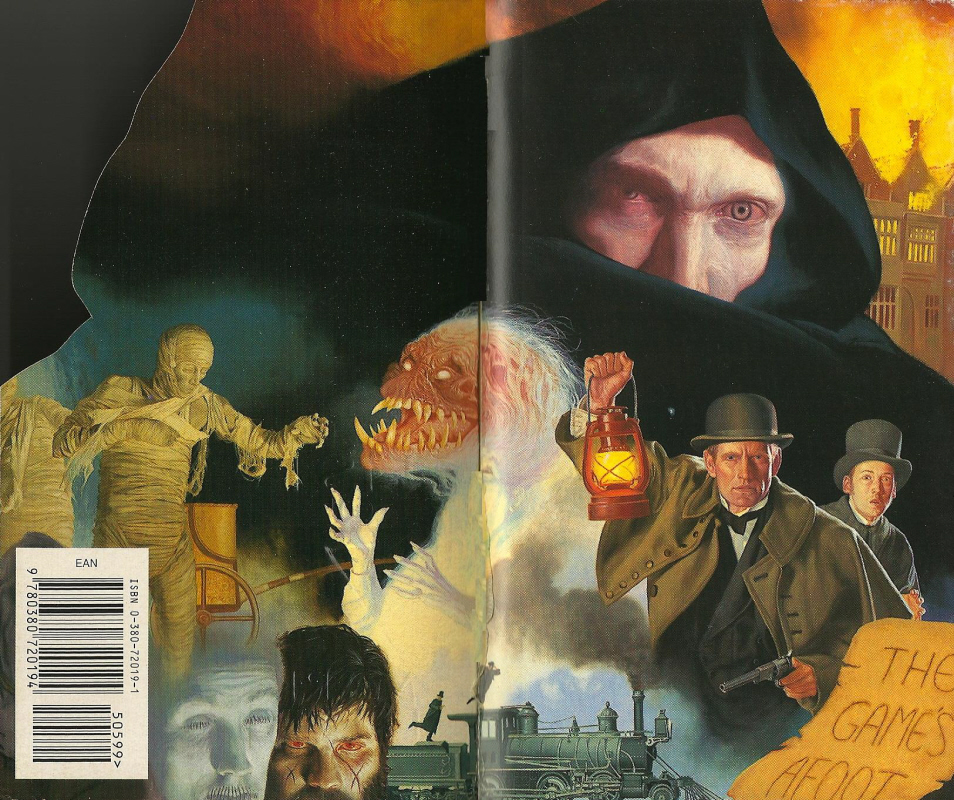
They finally arrived today, carefully packed in tightly wrapped plastic, and I gently unwrapped them and settled in to examine my new treasures. Many clamored for attention, but the one that practically jumped into my hands was The List of 7, by Mark Frost. That’s the inside front cover above, complete with mummies, gruesome spectres, ghosts, a train chase, and — speaking of Sherlock Holmes — the words “The Game’s Afoot” scrawled on parchment (click for a bigger version).


 It’s not uncommon for writers of fictions called ‘literary’ to use science-fictional or fantastic elements in their work. And it’s not uncommon for sf readers to suggest that they’re using those elements wrongly, with a lack of understanding of the material they’re working with — usually, depending on the specific case, either because the writer didn’t understand the history of the way the element in question has been treated in prior (genre) works, or simply because they haven’t thought the logic of what they’re doing through in a rigorous way. Personally, I find this is rarely a problem in the fantastic ‘literary’ works that I read. And, intriguingly, when it is a problem, it’s not necessarily a significant problem.