Browsed by
Category: Vintage Treasures

One Week Left to Win a copy of Thunder in the Void from Haffner Press!

One Week Left to Win a copy of Thunder in the Void from Haffner Press!

thunder-in-the-voidWe’ve received some great entries in our Thunder in the Void giveaway, which we announced last week. Here are some that came in today:

  • Midnight in the Robot Graveyard
  • The Cult of the Broken Sun
  • Message from the Haunted Asteroid

Doesn’t that sound like fun? You could be part of it — all you have to do is submit the title of an imaginary Space Opera story.

What’s at stake is the latest archival quality hardcover from Haffner Press, Thunder in the Void, a massive collection of 16 Space Opera tales by Henry Kuttner. The most compelling title — as selected by a crack team of Black Gate judges, renowned experts in quality pulp fiction all — will receive a free copy, complements of Haffner Press and Black Gate magazine.

Thunder in the Void gathers classic pulp fiction from Planet Stories, Weird Tales, Super Science Stories, and even rarer sources, including “War-Gods of the Void,” “Raider of the Spaceways,” “We Guard the Black Planet,” “Crypt-City of the Deathless Ones,” and the previously unpublished “The Interplanetary Limited.”  Most appear here in book form for the first time.

One submission per person, please. Submissions must be received by May 31st, 2012. Winner will be contacted by e-mail, so use a real e-mail address maybe. All submissions must be sent to john@blackgate.com, with the subject line Thunder in the Void, or something obvious like that so I don’t randomly delete it.

All entries become the property of New Epoch Press. No purchase necessary. Must be 12 or older. Decisions of the judges (capricious as they may be) are final. Employees of New Epoch Press are ineligible to enter. Not valid where prohibited by law. Or anywhere postage for a hefty hardcover is more than, like, 10 bucks. Seriously, this book is heavy and we’re on a budget.

Thunder in the Void is 612 pages in high-quality hardcover format, with an introduction by Mike Resnick and a cover price of $40. Cover art is by Norman Saunders. It is available directly from Haffner Press.

Win a copy of Thunder in the Void from Haffner Press!

Win a copy of Thunder in the Void from Haffner Press!

thunder-in-the-voidContests! I love contests. It’s because we love to give away stuff, like Santa Claus.

In this case, it’s stuff you really, really want: the latest archival quality hardcover from Haffner Press, Thunder in the Void, a massive collection of 16 Space Opera tales by Henry Kuttner. It’s scarcely been on sale two weeks, and it’s already almost sold out, so act fast.

Thunder in the Void gathers classic pulp fiction from Planet Stories, Weird Tales, Super Science Stories, and even rarer sources, including “War-Gods of the Void,” “Raider of the Spaceways,” “We Guard the Black Planet,” “Crypt-City of the Deathless Ones,” and the previously unpublished “The Interplanetary Limited.”  Most appear here in book form for the first time.

How do you win? Now pay attention, this is the fun part. You must submit the title of an imaginary Space Opera story. The most compelling pulp title — as selected by a crack team of judges including Howard Andrew Jones, C.S.E. Cooney, and John O’Neill — will receive a free copy of Thunder in the Void in the mail, complements of Haffner Press and Black Gate magazine.

One submission per person, please. Submissions must be received by May 31st, 2012. Winner will be contacted by e-mail, so use a real e-mail address maybe. All submissions must be sent to john@blackgate.com, with the subject line Thunder in the Void, or something obvious like that so I don’t randomly delete it.

All entries become the property of New Epoch Press. No purchase necessary. Must be 12 or older. Decisions of the judges (capricious as they may be) are final. Employees of New Epoch Press are ineligible to enter (including the judges — sorry, Howard and C.S.E.) Not valid where prohibited by law. Or anywhere postage for a hefty hardcover is more than, like, 10 bucks. Seriously, this book is heavy and we’re on a budget.

Thunder in the Void is 612 pages in high-quality hardcover format, with an introduction by Mike Resnick and a cover price of $40. Cover art is by Norman Saunders. It is available directly from Haffner Press.

New Treasures: Henry Kuttner’s Thunder in the Void

New Treasures: Henry Kuttner’s Thunder in the Void

thunder-in-the-voidThis weekend here in Chicago was the 12th annual Windy City Pulp and Paper Convention, one of my favorite local shows. I met fellow BG bloggers Jason Waltz, Joe Bonadonna, and David C. Smith on Saturday, as well as Bill “Indy” Cavalier, Morgan Holmes, and the always engaging Bob Garcia. Late on Sunday I heard someone call my name and turned to discover none other than William Patrick Maynard, our distinguished Friday blogger, who was selling his new novels The Terror of Fu Manchu and The Destiny of Fu Manchu at an impressively-stocked table. Despite having worked together for years it was the first time we’d ever meet, and I really enjoyed our conversation. He’s a fascinating fellow, and I kept him until well after the show had ended.

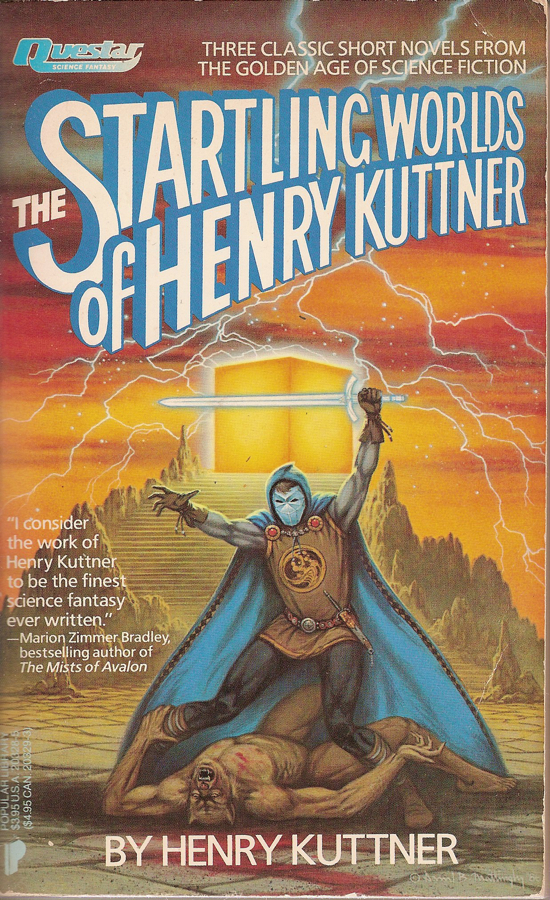
But the highlight of the show is always seeing the new titles at the Haffner Press booth, and this year didn’t disappoint. Stephen Haffner’s archival quality hardcovers are works of art, and his taste is excellent. He has published the definitive short fiction collections of many of the finest early pulp writers, including Leigh Brackett, Edmond Hamilton, Jack Williamson, C.L. Moore, and Henry Kuttner.

Still, Stephen may have outdone himself with his newest release, Henry Kuttner’s Thunder in the Void, a massive collection of 16 Space Opera tales from Planet Stories, Weird Tales, Super Science Stories, and other classic pulps. Before Kuttner married C.L. Moore in 1940, he wrote blood-n-thunder Space Opera in the style of one of his favorite authors, Edmond Hamilton — with winning titles like “Raider of the Spaceways,” “We Guard the Black Planet,” and my favorite, “Crypt-City of the Deathless Ones” — all of which are collected here.

The book looks terrific, even by the high standards of Haffner Press. Most of the these tales are appearing in book form for the first time. Also included is a previously unpublished story, “The Interplanetary Limited,” and an introduction by Mike Resnick.

Stephen mention to me that Thunder in the Void may be the fastest-selling book he has ever printed. It was released on April 4th in a printing of 1000 copies, of which only 200 are left. If you want a copy, I urge you to act fast. Thunder in the Void is 612 pages in a high-quality hardcover, with a cover price of $40. Cover art is by Norman Saunders. It is available directly from Haffner Press.

Previous Haffner releases covered here include Kuttner and Moore’s Detour to Otherness, Henry Kuttner’s Terror in the House: The Early Kuttner, Volume One, and the upcoming The Complete John Thunstone, by Manly Wade Wellman.

New Treasures: Goodis: Five Noir Novels of the 1940s & 50s

New Treasures: Goodis: Five Noir Novels of the 1940s & 50s

goodis-five-noir-novels1Let’s take stock for a minute. Been a busy week, and it’s only Tuesday. Is it time for another installment of New Treasures already?

Let’s see, let’s see… what did we cover last time? Been so long I barely remember. Well look at that — it was a handsome pair of novels from The Library of America. By coincidence, The Library of America also published the book I want to talk about today: Goodis: Five Noir Novels of the 1940s & 50s.

Or maybe it’s not coincidence. Maybe The Library of America is just that cool. Here’s the back cover copy for today’s omnibus collection of five classic crime novels by David Goodis — you decide.

In 1997 The Library of America’s Crime Novels: American Noir gathered, in two volumes, eleven classic works of the 1930s, 40s, and 50s — among them David Goodis’s moody and intensely lyrical masterpiece Down There, adapted by François Truffaut for his 1960 film Shoot the Piano Player. Now, The Library of America and editor Robert Polito team up again to celebrate the full scope of Goodis’s signature style with this landmark volume collecting five great novels from the height of his career. Goodis (1917-1967) was a Philadelphia- born pulp expressionist who brought a jazzy style to his spare, passionate novels of mean streets and doomed protagonists: an innocent man railroaded for his wife’s murder (Dark Passage); an artist whose life turns nightmarish because of a cache of stolen money (Nightfall); a dockworker seeking to comprehend his sister’s brutal death (The Moon in the Gutter); a petty criminal derailed by irresistible passion (The Burglar); and a famous crooner scarred by violence and descending into dereliction (Street of No Return). Long a cult favorite, Goodis now takes his place alongside Raymond Chandler and Dashiell Hammett in the pantheon of classic American crime writers.

No, it’s not fantasy or science fiction. But it’s a complete noir library in one attractive package, and it has thumbnail pics of five pulp paperbacks from the 40s & 50s right on the cover wrap. Good enough for me.

Goodis: Five Noir Novels of the 1940s & 50s is 848 pages in hardcover. It was published March 29, 2012, and retails for $35.

“What’s Become of Screwloose?” and Other Great Short Fiction by Ron Goulart

“What’s Become of Screwloose?” and Other Great Short Fiction by Ron Goulart

whats-become-of-screwloose1Ron Goulart has written more than 70 novels, most of them science fiction or fantasy, as well as over a dozen non-fiction titles, including Comic Book Culture and the classic history of the pulps, Cheap Thrills: An Informal History of the Pulp Magazines.

I saw his name countless times in the paperback racks where I hunted for science fiction as a teen, on slender DAW volumes like Calling Dr. Patchwork, The Panchronicon Plot, and Big Bang. He had a reputation for light comedy, not something that appealed to me at the time, and I pretty much ignored Goulart for years.

In fact, I truly discovered Ron Goulart for the first time five days ago, shortly before midnight last Wednesday.

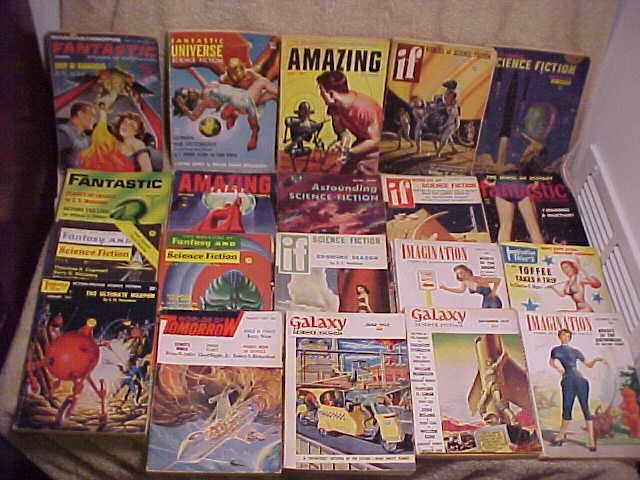
I was bagging a collection of Worlds of IF, a science fiction digest that folded in 1974, which I’d gradually accumulated over several weeks on eBay. I was casually flipping through the April 1970 issue when I stumbled on the short story “Swap,” by Ron Goulart, with this editorial teaser:

What happens when you swap love partners — and win a hot, curvy bundle of hate?

As a student of short fiction teasers — I’ve written a few hundred for Black Gate — I know a winner when I see one. I pulled the lever to recline the couch and, surrounded by nearly a dozen stacks of aging science fiction magazines, settled back to enjoy a 42-year old science fiction story.

Read More Read More

Doug Draa looks at Frank Belknap Long

Doug Draa looks at Frank Belknap Long

rim-of-the-unknown2Doug Draa has kicked off a new blog dedicated to the golden age of Horror Anthology Paperbacks. His first subject is the much-overlooked pulp master Frank Belknap Long:

I’ve enjoyed Mr. Long’s stories since the middle 70s when I first read “The Space Eaters” in Tales of the Cthulhu Mythos, Volume 1. He was a correspondent of Lovecraft’s and wrote several stories incorporating HPL’s Cthulhu Mythos. His attempts at Mythos writing were successful enough that his “Hounds of Tindalos” are more or less accepted as canon.

His stories are pure pulp and crazy enough to stand above the normal horror fare of the 30s and 40s. I find “The Space Eaters” to be one of the very best non-HPL penned Mythos tales ever. It tells of an invasion from beyond (actually from outside and between) in such a cold hearted and nonchalant manner without any of HPL’s typical histrionics that it is truly unsettling without ever being “over the top”. Hats off to the man! But as far as craziness goes, how can you not love such titles as “The Flame Midget,” “The Man with a Thousand Legs” or “The Horror from the Hills”?

Indeed. Frank Belknap Long published a host of stories in the pulps and several fine collections, including The Early Long, Odd Science Fiction, The Hounds of Tindalos, The Rim of the Unknown and Night Fear.

He wrote nearly 30 novels, including Space Station 1 (1957), Mission to a Distant Star, Mars is My Destination (1962), The Horror from the Hills (1963), Monster From Out of Time (1970), and Survival World (1971).

I don’t see a lot of blogs devoted to vintage horror anthologies, but if all the entries are as informative as this one, I’ll be a regular visitor.

You can find Doug’s blog, Uncle Doug’s Bunker of Horror, here.

New Treasures: The Library of America’s A Princess of Mars and Tarzan of the Apes

New Treasures: The Library of America’s A Princess of Mars and Tarzan of the Apes

a-princess-of-marsSo yeah, I saw John Carter. And I liked it. Liked it enough that I went twice, actually. Been a while since I did that.

Still looks like it’s going to be the biggest box office bomb of the year, but these things happen. Doesn’t mean it’s not a good movie. And let’s face it — it’s helped introduce a whole new generation to the classic science fantasy of Edgar Rice Burroughs.

And not just all those young punks playing video games who don’t read books anymore.  I’m talking about a great many supposedly well-read science fiction and fantasy readers who never bothered to give ERB the time of day.

People like, y’know, me. For instance.

Sure, I’m fairly well read in SF and fantasy. And I have a (nearly) complete set of Edgar Rice Burroughs Mars books in paperback, picked up here and there at garage sales because I liked the covers. But Burroughs just never really appealed to me in my youth, and I never bothered to read them.

I loved the colorful action-adventure of the great pulp serials, but the mid-1930s was about as far back as I went.  Give me Asimov, van Vogt, Clifford D. Simak, Charles Tanner, H.P. Lovecraft. But if you appeared before they did — if your name was H.G. Wells, Jules Verne, or Edgar Rice Burroughs, for example — then you were just old.

Well, it’s never to late to correct past mistakes. Especially when The Library of America is making it easy with two beautiful keepsake volumes celebrating the centenary of Burroughs’ most famous creations: Tarzan of the Apes and John Carter of Mars.

Read More Read More

Vintage Treasures: The Bantam Giant Novels of Lawrence Schoonover

Vintage Treasures: The Bantam Giant Novels of Lawrence Schoonover

golden-exile3Who the heck is Lawrence Schoonover?

I had no idea. At least until I found myself in an unexpected bidding war for a beautiful collection of Bantam Giant paperbacks on eBay, including two by Mr Schoonover: The Golden Exile and The Burnished Blade (cover here).

Don’t know much more about him. I’m sure a trip to Wikipedia would tell me lots about Schoonover but, really, his covers tell me pretty much everything I need. Apparently he wrote big fat adventure novels featuring dudes with swords, exotic settings, and women who had little use for clothing. I’m a fan.

And it certainly doesn’t hurt that his novels were published as Bantam Giants.

There’s just something about the Bantam Giants that really brings out the collector in me. If you’re any kind of paperback aficionado, you know what I’m talking about.

The first Bantam Giants appeared in 1951, during the tenure of the legendary Ian Ballantine. I don’t believe they were numbered separately from Bantam’s usual sequencing, which makes cataloging them somewhat problematic, but their ranks included James Michener, Emile Zola, Harold Robbins, Sinclair Lewis, Robert Wilder, C. S. Forester and many, many more.

Some of the best literature of the 20th Century appeared in paperback as Bantam Giants, such as Robert Penn Warren’s All The King’s Men and Ernest Hemingway’s For Whom the Bell Tolls.

They also included a superb assortment of classic adventure novels from Rafael Sabatini, Thomas R. Costain, John Masters, John Dickson Carr, and even some dude named Lawrence Schoonover.

If you're the one who outbid me for this eBay lot, you should be ashamed of yourself.

There was also a smattering of science fiction and fantasy, such as Aldous Huxley’s Brave New World, Ray Bradbury’s classic anthology The Circus of Dr. Lao and Other Improbable Stories, John Collier’s Fancies and Goodnights, and novels by Bradbury and Jerry Sohl.

I think a large part of the appeal of Bantam Giants is their sheer size. They promise a lot of reading for your 35 cents. And dang, they look good don’t they? Just check out that beautiful eBay lot at left (click for bigger version.)

‘Course, I’d know a lot more about Schoonover if I’d just managed to win that damn auction. Since I didn’t, I was forced to hunt down virtually every single title in the set individually on eBay. I finally managed to complete that daunting task late last week. It’s okay, I’m sure the kids didn’t really need that college fund.

And before you ask which I’m going to read first, I think that should be fairly obvious. I’m curious about all of them, but before anything else I have to find out just what the Great Folly of that young lady in the bottom right is.

Even though I think I have a pretty good idea.

All Hail the Barbarian Prince

All Hail the Barbarian Prince

barbarian-prince-256One of the great things about having a blog is that you get to celebrate all things cool. Books, movies, comics, games… if it keeps you up late at night, after your spouse has gone to bed wearing lingerie and a disappointed look, it’s usually worth at least a few paragraphs here.

Of course you need to take things a little more seriously when talking about the real classics, the enduring masterpieces that define our very culture. And that goes double when we turn our attention to the supreme achievement of Western Civilization, the pinnacle of some three billions years of planetary evolution, Arnold Hendrick’s Barbarian Prince.

Howard Andrew Jones did just that in his splendid post Return of the Barbarian Prince this week. It’s a terrific article and interview, capturing much of the fun of this sublime solo mini-game, except for his obvious lies about being able to win.

You can’t win at Barbarian Prince. The game is an existential commentary on the nihilistic underpinings of modern evolutionary thought. I thought that was obvious. All games end in ignoble death, usually in the form of a starving goblin tribe that beats you to a pulp and steals your fur-lined booties.

Listen, I’ve owned the game for nearly 30 years. Spent many evenings rolling dice and moving my lead miniature around the little map, befriending elves and exploring ancient crypts, and I have never won. Barbarian Prince is the beautiful girl I lusted after in high school.  She hangs out and flirts like a Vegas show girl, but there’s no way she’s going out with me.

At least I’m in good company. The distinguished John C. Hocking has never won the game. None of my friends have ever won. Only my false friends like Howard, who called last week to tell me he won a game on the first turn. Dude, if you’re going to fib, at least make it believable.

Well, the good news is that now you can experience the timeless agony of Barbarian Prince for yourself. Now you too can spend your evenings cursing up a blue streak and throwing the map across the room. The original Dwarfstar boxed edition is unspeakably rare (most copies were destroyed in a blind rage, presumably), but you can download the complete game here, and Todd Sanders’ new revised version is available here.

Howard tells me he’s mailing me a deluxe copy of the revised Sanders version, hand-made with carefully crafted components, which I anxiously await. Maybe a little of his luck will rub off on me. Maybe I’ll discover he’s adjusted the rules to make the game winnable. Maybe Todd’s revisions will clarify things just enough to lead me to victory. Or maybe there’s another tribe of starving goblins in my future, waiting to take my last copper piece and turn my skull into a drinking cup.

Time will tell.

M.A.R. Barker, Nov 3 1929 – March 16, 2012

M.A.R. Barker, Nov 3 1929 – March 16, 2012

manofgoldWhile I was at the games auction at Gary Con on Sunday, Luke Gygax solemnly paid tribute to those industry giants we lost in the last year, including Jim Roslof and Jean Wells, both early and influential TSR employees.

But I was startled when Luke added that M.A.R. Barker, the grand old man of role playing, had died last week at the age of 82.

M.A.R (Muhammad Abd-al-Rahman) Barker is not particularly well remembered today. He wasn’t especially prolific as an author, with five novels to his credit — the last three published by obscure small press publishers. But everyone who paid attention to TSR in the heady early days of role playing knew M.A.R. Barker, the creator of Empire of the Petal Throne and the fantasy world of Tékumel.

Barker created Tékumel in the decades from 1940 to 1970. Wholly unique, Tékumel was a science fantasy setting inspired by Indian, Middle Eastern, Egyptian and Meso-American mythology, a world colonized by humans and alien species some 60,000 years in the future. Perhaps most intriguing, Tékumel was largely free of Tolkien’s influence as it was well established long before the publication of The Lords of the Rings — the only major RPG setting of the 20th Century that could make that claim.

In the early 1970s Barker met one of the original Dungeons & Dragons playtesters, Mike Mornard, and was introduced to the game. It didn’t take long to realize the potential of the D&D ruleset, and he quickly adapted it for his own use and self-published Empire of the Petal Throne in 1974. One of his occasional players was D&D co-creator Dave Arneson, who called Barker his favorite Game Master — and EPT his favorite RPG.

Read More Read More