Browsed by
Category: Vintage Treasures

Vintage Treasures: They Fly at Çiron by Samuel R. Delaney

Vintage Treasures: They Fly at Çiron by Samuel R. Delaney

They Fly at Ciron-smallSamuel R Delaney is justly famous as a science fiction writer. As I noted during my days as a bookseller at places like the Chicago Printer’s Row book fair (in my article “Selling Philip K. Dick“), Delaney is one of a handful of classic SF authors for whom there is still a constant demand. During that hot weekend in July in 2012 — just like at numerous SF conventions over the years — I did a brisk business selling old Samuel R. Delaney paperbacks to readers asking for him by name.

He’s less well known as a fantasy writer, even though his Nevèrÿon books — Tales of Nevèrÿon (1979) and Neveryóna (1983), and the two collections Flight from Nevèrÿon (1985), and The Bridge of Lost Desire (1987) — have their fans. Personally I found Tales of Nevèrÿon beautifully written, but very slow, and had no real interest in trying the next three.

But the Nevèrÿon volumes aren’t Delaney’s only fantasy. In 1993 he revised and expanded a novelette he’d written with James Sallis and published in The Magazine of Fantasy and Science Fiction in 1971, releasing it as They Fly at Çiron, and I’ve always been curious about it.

Çiron is a quiet village, troubled only by the strange black Winged Ones who inhabit the skies overhead. Until the army of Myetra arrives, led by the brutal prince Nactor, and the villagers find themselves enslaved and treated as beasts. Rahm, a village youth, escapes and form a desperate alliance with the fearsome Winged Ones, finally finding a way to resist the Myetran’s advanced weaponry.

They Fly at Çiron turned out to be Delaney’s last genre novel. Since 1993 he has focused exclusively on literary novels such as The Mad Man (1994), Dark Reflections (2007) and Through the Valley of the Nest of Spiders (2012). They Fly at Çiron was published in a limited edition by Incunabula in 1993, and in hardcover by Tor in 1995. The Tor edition is 224 pages, with a handsome cover by Thomas Canty, and is readily available online.

See all of our recent Vintage Treasures here.

The Science Fiction and Fantasy of Mick Farren

The Science Fiction and Fantasy of Mick Farren

The Novels of Mick Farren-small

First time I heard of Mick Farren was when I opened a box of review copies from Tor in 1996 to find his novel The Time of Feasting, a dark fantasy concerning a hidden colony of vampires living underground in New York City. I flipped to the bio, where I read that Mick was the writer and singer for the punk band The Deviants, and that he also had several solo hits.

This was pretty cool. Here was a successful rock musician making a mid-career transition to dark fantasy writer. This just re-affirmed what I already knew: there were plenty of glamorous professions out there, but nothing as awesome as being a fantasy novelist.

Read More Read More

Vintage Teasures: To Keep or Kill by Wilson Tucker

Vintage Teasures: To Keep or Kill by Wilson Tucker

To Keep or Kill-smallWilson Tucker is a fascinating author. Although he wrote several acclaimed SF novels, including the Hugo and Nebula nominee The Year of the Quiet Sun (1970), and was even inducted into The Science Fiction and Fantasy Hall of Fame in 2003, he’s remembered today chiefly for his tireless contributions to fandom. Well, that and his habit of putting his friends into his novels — so much so that the literary term for this practice now bears his name: tuckerization. Truth be told, I probably wouldn’t even know who Wilson Tucker is today if it weren’t for the huge impact he had on modern fandom.

But I do know who he is, and as part of my journey through the rich history of our genre, I thought it was high time to try one of his novels. But which one? The post-apocalyptic adventure The Long Loud Silence (1952), which Damon Knight called “phenomenally good… as near perfection as makes no difference”? His famous time-travel novel The Lincoln Hunters (1958), which Stephen King referenced in 11/22/63? His underrated fiction collection, The Best of Wilson Tucker (1982)?

I’m kidding, of course. I knew which one I wanted to read the instant I laid eyes on it: To Keep or Kill, Tucker’s second Charles Horne mystery. Horne is a small town detective from Central Illinois who reliably runs afoul of the kind of femme fatales and crooked mobsters that I thought only showed up in L.A, not right here in my home state.

Read More Read More

Vintage Treasures: Night Monsters by Fritz Leiber

Vintage Treasures: Night Monsters by Fritz Leiber

Night Monsters-smallNight Monsters is an interesting case study in book collecting, as least for me.

It was originally published in 1969 as part of an Ace Double set, with a moody but otherwise fairly unremarkable cover by Jack Gaughan (see below). The subtitle Ace put on the collection was “A new collection of the weird, the wonderful, and the macabre,” which was certainly accurate, if a little pedestrian.

I bought a copy 25 years ago. Never read it. It shared a spine with Leiber’s early novel The Green Millennium (here’s John Schoenherr’s cover, just because I have a thing about uploading paperback covers), which I found a little more interesting. To be honest, after a few years I kinda forgot about the book on the back side of The Green Millennium.

Fast forward to early 2013. I’m surfing eBay and I stumble on a copy of Fritz Leiber’s Night Monsters, a Panther paperback published in the UK in 1975. I have no immediate recollection of a Fritz Leiber collection called Night Monsters, but that’s not necessarily a big deal; it could be a re-titled version of one of his collections I do remember.

What is a big deal is that I recognize the cover artist. There’s no doubt in my mind that it’s the work of the great Bruce Pennington, who provided some of the finest covers for Black Gate, for BG 12 and BG 14.

I’m a huge Pennington fan. Part of it is simple gratitude — the man was enormously gracious to me when I called him up in 2007, hoping to buy the rights to two of his paintings. He had no idea who I was, calling him from America with nothing more than high spirits and a meager budget. He very politely asked to see “a copy or two” of my little magazine, before making up his mind.

Twenty-four hours later I had two sample issues in the mail bound for England, with an enthusiastic hand-written note telling Bruce how much I admired his work. About a month later I received a marvelous letter from him, saying he had been very impressed with the issues, and that he would be delighted to provide us the art we wanted — and at the price I had offered.

Read More Read More

Vintage Treasures: Sorcerer’s World by Damien Broderick

Vintage Treasures: Sorcerer’s World by Damien Broderick

Sorcerer's World Damien Broderic-smallI think of Australian science fiction author Damien Broderick chiefly as a modern writer. He got a Locus Award nomination back in May for his non-fiction book Science Fiction: The 101 Best Novels 1985-2010 (edited with Paul Di Filippo), just as an example, and Rich Horton reported on his brand new three-volume survey of the vintage UK SF magazines Science Fantasy, New Worlds, and Science Fiction Adventures (all written with John Boston) for us in March.

So I admit I was a little surprised to find one of his books tucked away in a collection of vintage 50s and 60s paperbacks I purchased online a few weeks ago. Sure, it was published right at the tail end of those decades (1970) and it was his first novel. But Sorcerer’s World made me realize that Broderick has been contributing steadily to the field for well over four decades — and shows no signs of stopping.

Through the Time Barrier

Klim Xaraf, son of a nomadic chief, awoke from his monumental fall to find himself the prisoner of time — trapped a thousand years in the future. Around him was a dying world. Its incredible power sucked by necromancers through a hole to the past… its cities preserved in stasis, awaiting his liberation, or their final doom.

Yet Klim could neither meet this world’s challenge, nor conquer the wizards of his own, until the powers primed him for the battle. For with their knowledge, they would erase his memory and plunge him in a nightmare training ground… where all the wonders of tomorrow were the forgotten souvenirs of an ancient yesterday.

Ah, for the days when fantasy novels had characters named “Klim Xaraf.” These days, everyone sounds like a D&D character, rather than an extra from Krull. Broderick wrote a few other fantasy novels, including The Dreaming Dragons (1980), The Black Grail (1986), and The White Abacus (1997), but nowadays he’s chiefly known for his science fiction, especially Striped Holes (1988), Godplayers (2005), K-Machines (2006), and Transcension (2007).

Sorcerer’s World was published in October, 1970 by Signet. It is 144 pages, originally priced at 60 cents. It has never been reprinted, and there is no digital edition. See all of our recent Vintage Treasures here.

“A Fighting Fantasy Gamebook In Which YOU Are The Hero!”: The Warlock of Firetop Mountain

“A Fighting Fantasy Gamebook In Which YOU Are The Hero!”: The Warlock of Firetop Mountain

The Warlock of Firetop MountainIt’s a time for looking back, as the old year ends. Now so it happens that on a Boxing Day sale I picked up a book I loved as a child; and therefore it seems fitting to write a little about it, now, glancing back down the vanished days of this and other years, and to try to again see the pleasure I once had. Will it come again, as I work through the text? If I work on the text, then no. Because this text, more than most, is not made for working. It is a thing to be played.

This is not a story I once loved, except in a way it is. There’s no strong central protagonist, except that in a way there is that as well. It’s a book-length riddle. It’s a maze through which you must find your way, filled with wrong turnings and frustrating locks. It is a story you can shape with a pencil and two dice: you are a hero with a sword, who must explore a wizard’s underground lair, before finally defeating the great mage in battle and taking his treasure. You choose your own adventure, flipping from one numbered section to another depending on the decisions you take faced with a given situation. More than most novels, the reader must shape the story; for the reader is the hero. This is The Warlock of Firetop Mountain, written by Steve Jackson and Ian Livingstone. First published in 1982, it was the first of what became a line of several dozen gamebooks, as well as a full-fledged role-playing game. Warlock inspired direct sequels, a computer game, and even several non-interactive novels. You can learn more about the books at their web site.

Not long ago, Black Gate’s redoubtable Nick Ozment looked at The Warlock of Firetop Mountain and several other of the Fighting Fantasy gamebooks. Nick remembered playing other Fighting Fantasy books, but not this one specifically. My experience roughly mirrored his: it was relatively easy to get to the end of the book, but incredibly difficult to actually win a complete victory. Nick liked the art — Firetop’s profusely illustrated by Russ Nicholson (you can see some of these pictures below) — but found the conception of the book’s dungeon improbable. I agree with both points. But I found myself wondering if there wasn’t something else to say about the book. I remembered playing through it in the early 80s, drawing out maps, trying again and again to make it through to the end. Why was I held so deeply in the book’s spell? Does it hold up?

Read More Read More

Vintage Treasures: Parlainth: The Forgotten City, an Earthdawn Campaign

Vintage Treasures: Parlainth: The Forgotten City, an Earthdawn Campaign

parlainth-smallMany years ago, when I was unemployed and trying to get a new website off the ground, I made a lot of calls to publishers large and small. I’d introduce myself, talk fast about how many readers there were on the web, and try and sound a lot bigger than I was.

Didn’t usually work. This was the mid-90s, and there were lots of publishers who didn’t even have a website. But occasionally one would take a chance, and agree to send me some sweet review copies.

One such publisher was FASA, one of the leading RPG game makers of the day. I’ll always remember opening the first box they sent me, and gaping in surprise at the contents: every single Battletech supplement in print — nearly 1,000 bucks worth of premiere product. A treasure trove far beyond my expectations.

And a textbook bittersweet moment, because what I was really hoping for was material for Earthdawn.

Earthdawn was a fantasy role-playing game designed by Greg Gorden and first released by FASA in 1993. Over the next few years they produced 20+ supplements, all with gorgeous cover art by folks like Janet Aulisio, Brom, Les Edwards, and many others. Set on the same world as Shadowrun, but thousands of years earlier, the key theaters were where the nations of Russia and Ukraine exist today, in the gorgeously detailed land of Barsaive.

Read More Read More

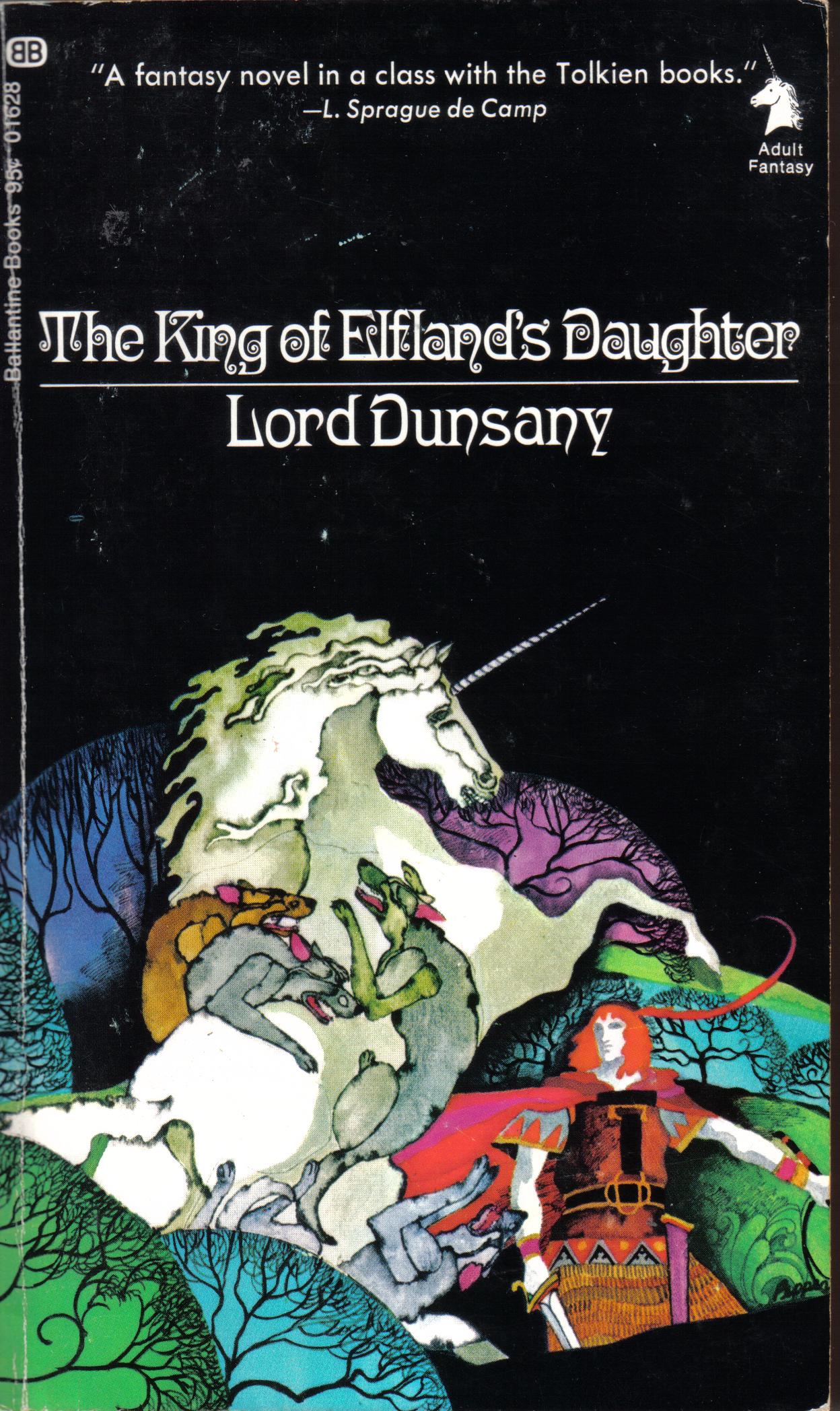
Lord Dunsany, Philip José Farmer, and Appendix N: Advanced Readings in D&D

Lord Dunsany, Philip José Farmer, and Appendix N: Advanced Readings in D&D

Over the Hills and Far Away-smallI’m still enjoying the Appendix N surveys by Tim Callahan and Mordicai Knode at Tor.com, as they read through every author Gary Gygax cited as an influence on Dungeons and Dragons, even though I’ve found lots to disagree with in their recent columns.

So I’m happy to continue with these re-caps here. Especially since I don’t have a lot emotionally invested in their next two subjects: Lord Dunsany and Philip José Farmer.

I have a lot of respect for Lord Dunsany, but that chiefly stems from the many fine writers who have cited him as an influence. I’ve read only a handful of his shorter works and, while I’ve enjoyed what I’ve read, he’s mostly an untapped natural resource for me.

It’s much the opposite with Philip José Farmer. I was a huge fan of his Riverworld books when I first read them decades ago. But they didn’t really hold up on re-reading 15 years later, for me.

So Farmer is a writer I largely lost interest in years ago, although I have to admit I haven’t really given fair attention to his many fantasy novels. I know his work is highly regarded, and in fact both Cynthia Ward and Christopher Paul Carey made excellent cases here for why I should pay a lot more attention to his Gods of Opar and Tales of the Wold Newton Universe series, for example.

So let’s say I have more of an open mind with both Lord Dunsany and Philip José Farmer, and I’m willing to be influenced.

With that out of the way, let’s see what Tim and Mordicai have to say.

Read More Read More

Space 1999: The Fantasy in Your Mirror May Be Closer Than It Appears

Space 1999: The Fantasy in Your Mirror May Be Closer Than It Appears

Space 1999When I was a kid, hurling rocks at dinosaurs and running away, there were not many otherworldly shows on TV. Battlestar Galactica ran for two years and then Buck Rogers for about the same, with some incomprehensible Land of the Lost or Dr. Who thrown in at seeming random. Saturday mornings were a rich source of imagination, with Tarzan, Space Academy, Jason of Star Command and Flash Gordon, but unfortunately, in my day, Saturday mornings were only on Saturdays.

Every so often though, I’d find Space 1999 in the TV Guide; it was pretty cool. The sets and ships were pretty different from the sleek models in every other scifi show, and the space suits and the Moon seemed so alien. Twenty-five years later, armed with a couple of science degrees, I ordered a season for nostalgia’s sake.

O. M. G.

It was awful. Aside from the terrible writing and passive characters, and the apparent scattering of Caucasian British humans throughout the cosmos, I could do nothing but choke on the science and toss this drivel into a corner (actually, I think I left the boxed set in Havana, but that’s a story for another time…).

Read More Read More

Galaxy Science Fiction, July 1951: A Retro-Review

Galaxy Science Fiction, July 1951: A Retro-Review

galaxy science fiction July 1951-smallWith a colorful, 4th of July holiday-appropriate cover, the July issue of Galaxy hit newsstands (or arrived in your mailbox if you were a subscriber), much to the delight of its readers (or so I imagine). The issue felt very full — as though H. L. Gold used some undetectable device to cram extra fiction into the folds. Or perhaps it was the anticipated conclusion of “Mars Child” and the absence of any science article. At any rate, I think this was one of the better issues.

“Venus is a Man’s World” by William Tenn — Ferdinand is the only boy on a rocket filled mostly with young women on a journey to Venus. That world offers a better opportunity of finding a suitable husband than Earth, where the population is mostly made up of women. Not that Ferdinand cares about any of that. He just wants something to do, so he explores the ship, including restricted areas, like one of the lifeboats. Except that someone’s already in the lifeboat — a stowaway who calls himself Butt. And Butt knows all kinds of things that Ferdinand’s sister never talks about. If only he’d let Ferdinand hold his gun…

I absolutely loved this story, and it was easily my favorite of the issue. The narration is told in first-person from Ferdinand’s point of view, and it is hilarious and engaging. Butt’s character is outstanding. This is also a piece that stands the test of time. It was eventually collected in William Tenn’s third collection, The Square Root of Man (1968).

“Common Denominator” by John D. MacDonald — As humanity begins to study another advanced race in the galaxy, they discover that the aliens have a crime rate and insanity rate of nearly zero. Charting the past millennia reveal that it all improved eight thousand years in the past. Lambert, Chief of the Bureaus of Racial Maturity, has the chance to speak with one of them and to try to understand how such a change was possible.

While the story itself is written well, I found the premises simplistic and absurd. But I’m not going to reveal the reason for the alien race’s rise in peace and safety because that is part of the bite of the story. I’m starting to see more of this trend in some of Galaxy’s fiction, though, where an author will envision what humanity (or a variety of humanity) might look like if X or Y was subtracted or added. And that utopia is but one tweak away.

Read More Read More