Browsed by
Category: Vintage Treasures

The Three Phases of Marvel’s Adam Warlock, Part Two: The Magus Saga

The Three Phases of Marvel’s Adam Warlock, Part Two: The Magus Saga

Warlock Madness MonsterRead The Three Phases of Marvel’s Adam Warlock, Part One here.

My 10-year old son saw my Warlock comics (the ones showing the clowns and the Madness Monster I’ll discuss in this post) this morning and asked who Warlock was and why his villains were so weird. Then, of course, being ten, he asked if I could get him some Warlock comics. And I explained to him that he might not like them.

Warlock is a very sad hero, I explained. He tries to be good, and tries to make good choices, but all that ever happens is that people around him get hurt or he fails. I think that’s a good way to start this post.

I should also note that this post is constructed entirely of spoilers. 100%, wall-to-wall spoilers of a thirty-year old story. Embrace the spoilers.

In my last segment, I looked at the hero Adam Warlock, from his synthetic birth as “Him” in the 1960s to his rechristening as a messiah figure in 1972 and 1973 and eventual cancellation. This first period was an important start to what I said to my son. Adam Warlock tried to save Counter-Earth and ultimately, he could not expunge the evil in men and he left for the stars.

The second phase of the saga is the Jim Starlin as writer/artist era, which I measure from 1975 until the hero’s death in 1977. Jim Starlin produced two classic stories in this phase, the Magus arc and the Thanos arc. These are big and original for the comics of the time, so I’m going to cover the Starlin period in two posts. Today is the Magus saga.

Read More Read More

There Will be Blood Books

There Will be Blood Books

Huff PriceThe great thing about the people in Tanya Huff’s Blood Books is that they act like… well, like people. This is remarkable for two reasons. First, not all of them are people; second, not all authors allow their characters to act like themselves all the time. Huff insists on it. Even when it makes writing the story difficult.

Let me qualify. All the characters in the Blood Books are people. Not all of them are human. They do act like themselves all the time, which isn’t to say that they act the way you expect them to. Not at all. More often than not, they’ll surprise you. But they’ll surprise you in a way that makes you go “Oh! Wow!” And not in a way that makes you go “Huh? What?”

The human protagonist, Vicky Nelson, was an extremely successful police detective, the kind who doesn’t suffer fools, and therefore doesn’t make a lot of friends among her peers. When she develops night blindness, she has two options, take a desk job, or leave the force. Being who she is, she chooses to leave the force and start her own detective agency. She’s stubborn, arrogant, and strong – exactly the kind of person you’d need if you were in trouble. Immanent blindness doesn’t change that.

The vampire protagonist, Henry Fitzroy, is the Duke of Richmond, the bastard son of Henry VIII. He doesn’t act like a young man living at the end of the 20th century. He acts like the son of a king, who’s been around for 450 years, has actually lived through all the changes that took place in those years, and who subsequently knows how to pretend that he’s a man living in the 1990’s. He’s a vampire, but he’s also the son of a powerful king, so for him, “territory” always has two meanings.

Read More Read More

The Ballantine Adult Fantasy Series: Dragons, Elves, and Heroes edited by Lin Carter

The Ballantine Adult Fantasy Series: Dragons, Elves, and Heroes edited by Lin Carter

Dragons Elves and HeroesDragons, Elves, and Heroes
Edited by Lin Carter
Ballantine Books (277 pages, October 1969, $0.95)
Cover art by Sheryl Slavitt

It’s been a while since my last post, and no, I haven’t fallen off the face of the Earth, run away to join the circus, or been abducted by aliens. Although there have been times I’ve considered that circus thing. Or maybe gypsies.

No, I’m just overloaded this semester (my day job is in academia), which hasn’t left a lot of opportunity to read at a time when I’m not likely to fall asleep after a few pages.

And I wanted to take my time and do this one right. Dragons, Elves, and Heroes is the first of a two volume set in which Carter collects heroic fantasy imaginary world stories, beginning with a selection from Beowulf. This volume ends in the 1800s, although the most recent selection isn’t the last. The companion volume, The Young Magicians, will pick up where this one left off.

Anyway, this book looked like it would take some concentration, so I tried to read it when I would have time to devote to it. But enough about what happens to the well laid plans of mice and men.

I found the selections on the whole to be thoroughly enjoyable, with a few exceptions. I used the word “selections” intentionally, because other than a handful of poems, most of the stories Carter selected were excerpts. The one notable exception was the entire text of The Princess of Babylon by Voltaire was included. I wish Carter had stuck to his practice of using excerpts, but I’m getting ahead of myself.

Read More Read More

Sex and Violence in Poul Anderson’s Rogue Sword

Sex and Violence in Poul Anderson’s Rogue Sword

Zebra Heroic Fantasy. Another ghastly cover. I guess that’s some Byzantium-esque architecture in the background. But who’s ever seen “armor” or a sword like that?

As in The Golden Slave (and to lesser degrees in Three Hearts and Three Lions and in Virgin Planet) the major textures of Poul Anderson’s Rogue Sword sketch a love triangle. But at first our hero Lucas Greco’s love is not confined to only two women. No, he is a philanderer, a gallant, and the prologue establishes this as Lucas escapes the rage of Gasparo Reni, a jealous husband. This also shows Anderson’s impressive ability to construct symmetrical plots, for Gasparo and another in the prologue, Ser Jaime, shall be around for the duration of the novel.

The first chapter jumps ahead fourteen years. Lucas, with his friend Brother Hugh de Tourneville, surprise encounters Gasparo again, this time in the streets of Constantinople. Exhibiting rage apparently beyond all reason, Gasparo orders his men to fall on Lucas and to slay him on the spot. But, assisted by Brother Hugh, Lucas defends himself and escapes. During his escape, however, Gasparo’s slave woman, a woman who had been destined for a lord’s harem, joins herself to Lucas.

This slave, Djansha, becomes Lucas’s first love. It is notable that Lucas is not aware of this at first. He takes for granted Djansha’s complete faithfulness and service to Lucas. Lucas perhaps thinks that she is so into him because he is kind and supportive of her needs. Perhaps he believes that she would behave the same for any man who treated her in this manner. He also probably takes her for granted because she is a slave. Lucas cannot be blind to the strict social classes of 1306 A.D. (using Anderson’s signifier for era). And, naturally, he aspires for the heights. He actively pursues this state when he meets the lady Violante, a sensual and cunning member of the aristocracy married to the savage warrior Asberto.

Before briefing the reader on this third part of the triangle, however, we should pause a moment to focus on Anderson’s initial description of Djansha. I am struck now how, in a number of novels, Anderson has presented the reader with two female body “types.” What we read about Djansha also could describe Alionara from Three Hearts and Three Lions and perhaps Barbara from Virgin Planet and of course Phryne from The Golden Slave. Generally, this type is slim, childlike, and “boyish.” Here’s a description of Djansha.

Read More Read More

Vintage Treasures: Sturgeon is Alive and Well… by Theodore Sturgeon

Vintage Treasures: Sturgeon is Alive and Well… by Theodore Sturgeon

Sturgeon is Alive and Well-small Sturgeon is Alive and Well Pocket-small

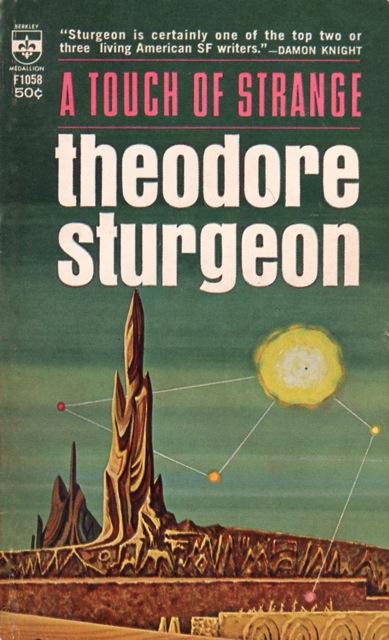
Sturgeon is Alive and Well… was Theodore Sturgeon’s fourteenth short story collection. It was first published in 1971, and came following a five-year gap after Starshine (1966). As I mentioned in my write-up on that book, Starshine went through nearly a dozen printings in as many years. But Sturgeon is Alive and Well… had only three: a hardcover in 1971, a paperback reprint the same year from Berkley Medallion (above left, cover by the great Paul Lehr), and a Pocket reprint in 1978 (above right, artist unknown.)

It’s now been out of print for 37 years, and there is no digital edition.

The title is… unusual. It probably made more sense in 1971, when Jacques Brel is Alive and Well and Living in Paris was an unexpected smash hit off-Broadway. Sturgeon touches on what a five-year gap between collections meant for a writer who made a living on short stories in his introduction.

Read More Read More

Return of the Master Cheeser: The Disappearing Dwarf by James P. Blaylock

Return of the Master Cheeser: The Disappearing Dwarf by James P. Blaylock

The Disappearing Dwarf-smallPublished in 1983, The Disappearing Dwarf is James P. Blaylock’s second novel, the sequel to his first, The Elfin Ship. Along with The Stone Giant (1989) they form the Balumnia Trilogy. If you have any love for Kenneth Grahame’s The Wind in the Willows, or mouth watering descriptions of all sorts of food and drink, then these books are for you.

The Elfin Ship (reviewed here last year) is filled with constant comical digressions and expends pages on delightful, superfluous details. It’s filled with oddball characters and deliriously silly escapades. The plot is wonderfully complicated. The Disappearing Dwarf has all of those things — save the plot. It’s not that it doesn’t have a plot, it’s just not much of one.

Bored with his new life as man of leisure (allowed by the success of his travels in the previous volume), Jonathan Bing, master cheesemaker, agrees to take a trip down the Oriel River with Professor Wurzle to explore the abandoned castle of their foe, Selznak the dwarf. The castle, they quickly learn, is not empty — and definitely not safe.

From there they meet Miles (pronounce Meelays), the Magician who is hunting Selznak. He tells them that their old nemesis has reappeared, and is certainly up to no good. The magician suspects the dwarf is looking to steal a great magical orb from their friend, Squire Myrkle. Upon reaching the squire’s estate, they discover that he has vanished through a magical door that appeared in his library. The next thing we know, Jonathan, the Professor, and Miles (along with Ahab the dog), are back on board the elfin airship and headed for a doorway to the parallel world, Balumnia.

Narrative drive is nearly absent in The Disappearing Dwarf. Jonathan’s goals switch from one thing to another several times throughout the book. The adventurers spend much of the book traveling from one place to another without ever really knowing what they’re trying to achieve, other than their rather vague plan to find the squire before he falls into Selznak’s clutches. Balumnia has its own villain, a mysterious figure called Sikorsky, but as with the rest of the characters, we never get a clear sight of him or what he’s actually up to. Several characters fade away. One vanishes only to suddenly reappear with little explanation. The book moves haphazardly from one incident to another. Fortunately, most of those incidents are terrific fun.

Read More Read More

Thrift Shop Adventures 1: Wherein I Find Fantasy Treasures in Secondhand Stores (Greyhawk Classics and More!)

Thrift Shop Adventures 1: Wherein I Find Fantasy Treasures in Secondhand Stores (Greyhawk Classics and More!)

photo 3-2

“I’m gonna pop some tags / Only got twenty dollars in my pocket / I — I — I’m hunting, looking for a come-up / This is ******* awesome”
— Sir Macklemore of the Order of Thrift

When I go into town — to the nearest keep on the borderlands, say — I find it hard to pass up a quick pop-in to a thrift store. Last Friday I did my rounds in the city, hitting the trifecta: Salvation Army, Savers, and Goodwill. As with any type of hunting excursion — for instance, my single days hunting for a date at the college bars — there are highs and lows, ups and downs, mind-blowing flights of rapture and soul-crushing disappointments.

First up was Salvation Army. I always make a beeline for toys first, then books. I’ve never had much luck with toys in this particular outlet, although I did come close to a good score once: an elderly lady came up behind me at the check-out line carrying a vintage SIX FOOT LONG rubber jiggler snake! It had just been stocked on the shelf somewhere in between the time when I had looked and when I was checking out, so I’d missed it by mere minutes. It was tagged $1.99, and I immediately offered the lady ten bucks for it. She shook her head. “No, I want this. I’m thinking of putting it in my garden to keep kids out.” She actually said that.

The thought flashed through my mind “Are you crazy? That thing will be a kid magnet!” But I did not persist, just politely demurred, mentally accepting defeat. Some consolation was the fact that I had one already (they do come up on eBay occasionally, typically fetching about $20-$30).

Strike up the old Army Marching Band, though, because today was going to be a thriftastic day. Mostly thanks to a coloring book (which I’ll get to in a bit), but that wasn’t all: I was also about to unearth a tomb-full of Greyhawk.

Read More Read More

David Drake on E. Hoffmann Price

David Drake on E. Hoffmann Price

Far Lands Other Days-smallDavid Drake, author of The Tank Lords, The Sea Without a Shore, and dozens of other fantasy and SF novels, was also the man behind Carcosa, a small press he co-founded with Karl Edward Wagner in 1973. Carcosa published only four volumes — including Far Lands Other Days, a 590-page illustrated collection of the classic pulp fantasy of E. Hoffmann Price — but ah, what volumes they were!

Andy Duncan has started a new blog, Past and Present Futures, and he invited David to share his memories of Price. Yesterday he shared the results. Here’s a slice.

In fact [Price] spent only 30 days in the Philippines before the 15th Cav was recalled to the Mexican Border where Pancho Villa was raiding. Shortly after that they were shipped to France where they acted as mule skinners unloading freighters in Bayonne, France. He had stories about the prostitutes in all three continents.

When WW I was over, Ed was on garrison duty on the German border. The army created a service-wide scheme by which enlisted men could take an entrance exam for admission to West Point. Ed was one of the extremely few who gained admission through that test. He graduated in 1922 and was briefly a 2nd Lieutenant assigned to a Coast Artillery unit in NJ. He resigned ahead of a court martial because he had gotten to know the battalion commander’s wife rather better than the major was pleased to learn.

I’ve told the story this way to make it clear that though Ed was very smart, he was also an iconoclast who was not even slightly interested in polite society or its norms. He was acting out in the introduction [to Far Lands Other Days], but I don’t doubt he meant what he said.

Read David’s complete comments here, and visit Andy’s excellent new blog here.

Galaxy Science Fiction, August 1952: A Retro-Review

Galaxy Science Fiction, August 1952: A Retro-Review

Galaxy Science Fiction August 1952-smallThis is an issue I had looked forward to for a long time. One of my first steps toward reading Galaxy was listening to an X-Minus One radio broadcast titled “Surface Tension,” based on the story with the same title by James Blish in Galaxy’s August, 1952 issue. My wife had gotten this one for me early on, but I hadn’t made my way to it until now.

“Surface Tension” by James Blish — Humans explore the galaxy, seeding adaptations of themselves on any Earth-like planets. Hydrot is all water and marshes, and the crew of La Ventura has only a short time before they die, stranded because their ship wrecked. So they create microscopic versions of themselves (but not with their memories) that can survive in water, hoping they can compete for survival without dominating the other lifeforms on the planet.

This was considerably different from what I remember of the radio broadcast. But it’s a well-told story that’s highly inventive.

“Proof of the Pudding” by Robert Sheckley — One man survives the final war on Earth by taking a ship into space. He returns to the desolate planet and discovers he has the power to create anything he imagines.

I had difficulty relating to the protagonist. Not to spoil too much, but the story picked up considerably with the introduction of a second character.

“Yesterday House” by Fritz Leiber — Jack Berry is a biology student working in Maine for Professor Kesserich.  Jack takes a boat past where he was told to go, and he discovers an island. As he explores it, he comes to a fence and climbs over. He meets a young woman who lives in a house, but she’s convinced it’s 1933 rather than 1951. Her aunts keep her on the island throughout the year, never allowing her to go to the mainland. He wants to prove the truth to her, if he can, without arousing her aunts’ suspicion.

Read More Read More

Vintage Treasures: Science Fiction: The Great Years, Volume II edited by Carol and Frederik Pohl

Vintage Treasures: Science Fiction: The Great Years, Volume II edited by Carol and Frederik Pohl

Science Fiction The Great Years Volume II-smallI think it’s kind of cool that I can remember when and where I found Science Fiction: The Great Years, Volume II, some 36 years after I bought it.

In the spring of 1976 my friend John MacMaster introduced me to science fiction, by bringing me Shakespeare’s Planet by Clifford D. Simak and Piers Anthony’s Ox when I was home sick from school. I was in the seventh grade, and I felt very adult, reading grown up books instead of Alfred Hitchcock and the Three Investigators (not that there’s anything wrong with Alfred Hitchcock and the Three Investigators — those books rule.)

I was thoroughly captivated by both novels, and afterwards began looking for anything labeled “science fiction.” One of the first items I found was Jacques Sadoul’s 2000 A.D: Illustrations From the Golden Age of Science Fiction Pulps, a dazzling art book containing hundreds of illustrations from American SF and fantasy pulps — showing stalwart men and women piloting spaceships into the dark reaches of space, curious aliens, sinister robots, mist-covered landscapes on far planets, and stranger things. It ignited a burning curiosity in me for all things pulp-related, and I began to haunt bookstores looking for any relics of that bygone era of pulp SF.

Shortly after we moved to Ottawa in 1976, I discovered that Canada’s capital was crowded with old bookstores, many of them hidden away in small shops on Bank Street and Sparks Street in the heart of downtown. I took the bus downtown every Saturday, returning home with bags filled with marvelous old paperbacks. It was in those crowded old shops that I first discovered Roger Zelazny, Robert Silverberg, Poul Anderson, H.P. Lovecraft, A. Merritt, and countless others.

Read More Read More