Browsed by
Category: Series Fantasy

New Treasures: The King’s Deryni by Katherine Kurtz

New Treasures: The King’s Deryni by Katherine Kurtz

The King's Deryni-smallThe very first Deryni novel — and Katherine Kurtz’s first published novel — was Deryni Rising, which appeared as part of Lin Carter’s prestigious Ballantine Adult Fantasy line in 1970. Keith West has been gradually working his way through the entire BAF line, and I found what he said about Deryni Rising very compelling.

When Lin Carter started the Ballantine Adult Fantasy line, he began by reprinting works that were obscure and/or considered classic in the field at that time, but as he wrote in the introduction to Deryni Rising, he had hoped from the very beginning to be able to publish high quality new works as well. The first original fiction he published was Deryni Rising, the first novel by Katherine Kurtz.

I think he hit the ball out of the park when he selected this one.

Read Keith’s complete comments here.

Katherine Kurtz’s Deryni novels were some of the most popular fantasy novels of the 20th Century. Deryni Rising has been reprinted over 10 times, and more recent volumes in the series have hit the New York Times bestseller list. The series is still being published and now consists of five trilogies, a stand-alone novel, two collections of short stories, and a pair of reference books.

Read More Read More

The Omnibus Volumes of C.J. Cherryh, Part II

The Omnibus Volumes of C.J. Cherryh, Part II

Chanur’s Endgame-small Alternate Realities Cherryh Alliance Space-small

Last week I wrote the first installment of a three-part series looking at DAW’s ambitious program to bring some two dozen of C.J. Cherryh’s early fantasy and space opera novels back into print, The Omnibus Volumes of C.J. Cherryh, Part I. I looked at The Faded Sun Trilogy, The Morgaine Saga, and The Chanur Saga, published in January, March, and May of 2000, respectively.

In the Comments section of that article, Joe H. observed,

That first Chanur omnibus always confused me because it was functionally equivalent to putting The Hobbit, Fellowship and Two Towers into a single volume. And then you had that seven-year gap before the second Chanur omnibus was published…

Joe is quite correct. Chanur’s Homecoming, the fourth novel in the series, was in effect the conclusion of a trilogy which began in Chanur’s Venture and The Kif Strike Back. Readers coming to the novels for the first time with the first omnibus had to track down a copy of the final volume, or wait until it was collected with Chanur’s Legacy in the omnibus Chanur’s Endgame in 2007.

Read More Read More

The Omnibus Volumes of C.J. Cherryh, Part I

The Omnibus Volumes of C.J. Cherryh, Part I

The Faded Sun Trilogy-small The Morgaine Saga The Chanur Saga-small

It’s probably not a surprise to most to you that I love vintage paperbacks. I write a regular series on some of the more interesting old paperbacks in my collection, Vintage Treasures, which over the years has gradually become one of the more popular links on the BG blog.

I cherish old paperbacks both as books and as unique cultural artifacts. Over the decades, our industry has been blessed with some truly gifted artists, designers, and editors, and many of these old books are quite beautiful. So I especially appreciate those rare instances when publishers bring vintage paperbacks back into print after a quarter century or more, complete with the original cover art. That’s rare enough, but when the publisher also bundles popular trilogies into a single handsome book, and releases it at the same price as a regular paperback, that’s cause for celebration.

That’s the case with the DAW omnibus collections of C.J. Cherryh’s science fiction and fantasy novels from the 1970s and 80s. DAW has published a grand total of nine, re-packing virtually her entire early catalog in compact and affordable volumes, and I’ve gradually been collecting them. They’re a fabulous value and a great way to introduce yourself to one of the most popular and important genre writers of the late 20th Century.

Read More Read More

The Early Novels of Jack Vance: Grand Crusades: The Early Jack Vance, Volume Five, edited by Terry Dowling and Jonathan Strahan

The Early Novels of Jack Vance: Grand Crusades: The Early Jack Vance, Volume Five, edited by Terry Dowling and Jonathan Strahan

Grand Crusades The Early Jack Vance Volume Five-smallSubterranean Press is now accepting pre-orders on the fifth volume of their landmark series The Early Jack Vance.

New titles in the series are released every March. I covered Volume Two, Dream Castles, after I unexpectedly found a copy in the Dealer’s Room at Capricon 33 in 2013, and I reported on Volume Three, Magic Highways, last March.

Volume Five is by far the largest so far (at 472 pages); I was also surprised to see that it contains only five stories, all short novels, most published in pulp magazines between 1950 and 1954.

The Rapparee (Startling Stories, November 1950)
Crusade to Maxus (Thrilling Wonder Stories, February 1951)
Gold and Iron (Space Stories, December 1952)
The Houses of Iszm (Startling Stories, Spring 1954)
Space Opera (Pyramid Books, 1965)

This volume also contains a new introduction by the editors.

The first four books in The Early Jack Vance were a treasure trove for collectors, as they contained Vance stories that have been out of print for decades — and many that have never been reprinted. In contrast, this volume contains four short novels that have appeared in a handful of paperback editions over the decades (and under multiple titles), and one that has never been reprinted. This is first time they’ve been collected under one cover and the first time any have been in print for at least 30 years. I’ve selected a dozen covers from earlier printings below.

Read More Read More

Future Treasures: The Liar’s Key, by Mark Lawrence

Future Treasures: The Liar’s Key, by Mark Lawrence

The Liar's Key-smallThe Liar’s Key, the second book in Mark Lawrence’s new series The Red Queen’s War, will be published this June. The first volume, Prince of Fools, was released in June 2013; this new volume continues the story of the unusual fellowship between a rogue prince and a weary warrior. It is set in the same world as his previous trilogy The Broken Empire (Prince of Thorns, King of Thorns, and the 2014 David Gemmell Legend Award winner Emperor of Thorns).

We published the first chapter of Prince of Thorns, with a brand new introduction by Mark, here, and Howard Andrew Jones’s interview with him is here. Mark’s long article on writing and selling The Prince of Thorns (and the rejections he got from Black Gate in the meantime) is here.

After harrowing adventure and near-death, Prince Jalan Kendeth and the Viking Snorri ver Snagason find themselves in possession of Loki’s Key, an artefact capable of opening any door, and sought by the most dangerous beings in the Broken Empire — including The Dead King.

Jal wants only to return home to his wine, women, and song, but Snorri has his own purpose for the key: to find the very door into death, throw it wide, and bring his family back into the land of the living.

And as Snorri prepares for his quest to find death’s door, Jal’s grandmother, the Red Queen continues to manipulate kings and pawns towards an endgame of her own design…

The Liar’s Key will be published by Ace Books on June 2, 2015. It is 496 pages, priced at $29.95 in hardcover and $12.99 for the digital edition.

Vintage Treasures: The House in the High Wood by Jeffrey E. Barlough

Vintage Treasures: The House in the High Wood by Jeffrey E. Barlough

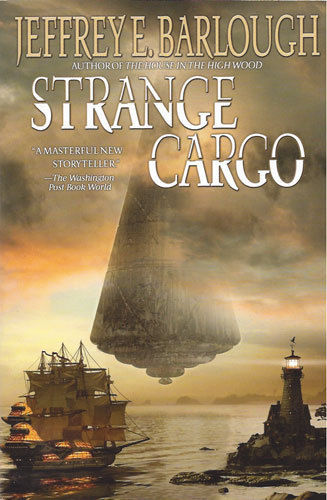
The House in the High Wood-smallJeffrey E. Barlough’s first three Western Lights novels were published in trade paperback by Ace over a decade ago, beginning with Dark Sleeper (2000), and followed by The House in the High Wood (2001) and Strange Cargo (2004). All three are highly prized today. Barlough began to publish them though his own Gresham & Doyle press beginning with the fourth volume, Bertram of Butter Cross (2007). I recently acquired the second book. Back when I was running SF Site, I recruited the author Victoria Strauss to write for us; here’s what she said about it the year it was published:

Framed in good Gothic style by ante and post scriptums in which a nameless narrator encounters the teller of the main tale (a somber, haunted Oliver Langley, 11 years later), The House in the High Wood is a homage to such classics of the Gothic genre as The Monk and Woman in White, replete with mystery, madness, illegitimacy, ghostly visitations, ancient ruins, brooding forests, sinister dwellings, and supernatural terror. Like the first in the series, Dark Sleeper, it’s a neo-Victorian pastiche, with an agreeably verbose 19th-century prose style and a large cast of eccentric characters. But where the previous book was as much digression as story, devoting entire chapters to character study and whole pages to the description of the contents of a single room, this novel is much more a straight-ahead narrative of suspense, proceeding grippingly from plot turn to plot turn, with moments that are genuinely bone-chilling.

The Western Lights novels have steadily been gathering acclaim (and readers) over the last few years. Jackson Kuhl reviewed the fifth volume Anchorwick for us in 2011, calling it “A Victorian Dying Earth —- gothic and claustrophobic yet confronted by its inhabitants with upper lips held stiff… It’s P.G. Wodehouse with woolly mammoths.” More recently, we covered What I Found at Hoole (2012) and the eighth volume, The Cobbler of Ridingham. We published an interview with him in 2013.

The House in the High Wood was published by Ace Books on August 1, 2001. It is 336 pages, originally priced at $14.95. The digital version is $17.99. The cover art is by Aleta Jenks.

The Series Series: American Craftsmen by Tom Doyle

The Series Series: American Craftsmen by Tom Doyle

American Craftsmen Tom Doyle-smallOh, best and most delicious of conspiracy-theory secret histories! From the first moment I heard the premise of American Craftsmen, I knew I would love this book. I am glad to report that it was even better than I imagined — smarter, funnier, more multi-layered and suspenseful, with even more kickass action.

Tom Doyle’s craftsmen are mages whose lineages have served in defense of our nation since George Washington bound them in a secret Compact. As the novel opens, with a craft op gone wrong in Iraq, old feuds between the Fighting Families and classic turf wars among occult branches of government bureaucracies threaten the United States from within.

Our hero Dale Morton gets hit with the triple-whammy of a dying foe’s curse, a case of straight-up PTSD, and subtle undermining by a mole who has infiltrated America’s supernatural defense forces. Whoever wants Morton out of the way is up to no good, so Morton leaves the Army to save it. His inner life is painstakingly honorable, but his environment is so full of intrigue that he has needed to cultivate his own devious tendencies and sufficient gallows humor to get himself through the day. He cunningly gives every appearance of going home to lick his wounds. Meanwhile, he works out how he’ll get a crack at the traitor hiding among his former comrades-at-arms.

The House of Morton itself is a House divided. Dale is the only living member of the household, and his numerous resident ghosts form rival camps around the sorcerous styles of Hawthorne and Poe. He knows how to recognize the cruel magics of the Left-Hand Path, because he grew up literally haunted by its most famous practitioners. Like every virtuous member of the Morton family for a century and a half, Dale has dedicated himself to the line of protective ancestors and pitted himself against the wicked ancestors his peers in the service will never let him live down.

Read More Read More

Doc Savage Meets… The Grinch Who Stole Christmas

Doc Savage Meets… The Grinch Who Stole Christmas

Doc Savage Grinch-small

Kez Wilson has been publishing Doc Savage fantasy covers at his website for years, and they get more and more creative as the months go by. His December entry this year (#252) sees Doc Savage face off against a diabolical agent of Christmas evil. Here’s his Doctor Seuss-inspired back cover copy:

Every Who down in Whoville liked Christmas a lot. But the Grinch, who lived just north of Whoville, did not. Then he got a wonderful idea! An awful idea! THE GRINCH GOT A WONDERFUL, AWFUL IDEA! Word of his plan to steal Christmas did leak, and the holiday began to look rather bleak. Then Cindy Lou Who took matters in her own tiny hands and got word to the one man who could foil those evil plans. Now when Grinchy Claus slips down the chimney with intent to burglarize, he’ll be face to face with a new holiday protector with glistening bronze skin and golden eyes.

Wilson’s pastiche covers are based on the brilliant work of James Bama and Bob Larkin, who illustrated the original Doc Savage paperbacks from Bantam. Check out his marvelous Doc Savage Fantasy Cover Gallery to see the Man of Bronze face off against Buffy, Ming the Merciless, Cthulhu, 007, The Thing, the Terminator, Sharknado, the Hardy Boys, Barbarella, Doctor Who, Kirk and Spock, and many others.

The Ballantine Adult Fantasy Series: Lud-in-the-Mist by Hope Mirrlees

The Ballantine Adult Fantasy Series: Lud-in-the-Mist by Hope Mirrlees

Lud in the Mist front coverLud-in-the-Mist
Hope Mirrlees
Ballantine Books (273 pages, March 1970, $0.95)
Cover art by Gervasio Gallardo

One of Lin Carter’s greatest achievements as editor of the Ballantine Adult Fantasy series, in my opinion, was rescuing Lud-in-the-Mist from obscurity. The third and final novel by Hope Mirrlees, Lud-in-the-Mist was her only fantasy. After this book was published, she stopped writing. More on that later.

Carter tells the story in his introduction that he had never heard of the book when a friend recommended it to him. The friend had a copy, which he loaned to Carter. Carter was immediately impressed and wanted to include Lud-in-the-Mist in the BAF series. At the time, Carter says, he didn’t know if Ms. Mirrlees was even still alive. (She died in 1978.) It’s questionable how much effort he put into locating her, since by that time the book was in the public domain.

The story takes place in a country based on both England and the Low Countries. Lud-in-the-Mist is the capital of the small country of Dorimare. It is situated at the confluence of two rivers, the Dapple and the Dawl. The Dawl is the largest river in Dorimare. The Dapple, on the other hand, has its source beyond the Debatable Hills in the land of Fairy.

Until 200 hundred years ago, relations between Dorimare and Fairy were good. Then, during the reign of Duke Aubrey, the merchants rose up and overthrew him. Aubrey wasn’t the best of people. He had a bet going with another man that they could drive the court jester to suicide. (They were successful.) But he wasn’t all bad, either. He was also known for acts of extreme generosity.

Since the time of the revolution, all traffic with the inhabitants of Fairy is forbidden. Indeed, even mentioning fairy fruit is illegal. According to the Law, it doesn’t exist, despite the fact that it was consumed with regularity before Duke Aubrey’s overthrow.

Read More Read More

Vintage Treasures: Dancer’s Rise by Jo Clayton

Vintage Treasures: Dancer’s Rise by Jo Clayton

Dancer's Rise Jo Clayton-smallJo Clayton was an amazingly prolific American fantasy writer. Her first novel, Diadem from the Stars, was published by DAW in 1977. Over the next 20 years, she published no less than 35 fantasy novels, and nearly as many short stories.

In 1996, at the age of 57, she was diagnosed with cancer of the bone marrow; while in the hospital she completed the second novel in the Drums of Chaos trilogy, and most of the final book, Drum Into Silence. It was eventually completed by Kevin Andrew Murphy and published in 2002 by Tor. Jo Clayton passed away on February 13, 1998.

Sixteen years after her death, every single one of her 35 books is out of print — fairly typical for a midlist fantasy author, sad to say — and none are currently available in a digital edition. I found a copy of Dancer’s Rise, the sequel to the Duel of Sorcery trilogy and the first book in the Dancer series, in a collection I acquired a few months ago.

I’ve never read a Jo Clayton novel, and in fact we’ve never covered any of her books here at Black Gate, a pretty serious oversight on both counts. I decided it was time to correct that deficiency.

There’s some confusion surrounding the cover of Dancer’s Rise. It is credited to Jody A. Lee in the book and the ISFDB lists Lee at the verified artist. But that sure looks to me like Richard Hescox’s signature in the bottom right (click the image at right for a bigger version), and Hescox currently has the painting for sale for $6,000.

Read More Read More