Reconsiderations: The Book of The Dun Cow and The Book of Sorrows
 One of the characteristics of a great book is that you can go back to it at different times in your life and get different things out of it. But then sometimes the reverse happens: you read a book before you’re ready. If you’re lucky, though, the book hangs around in the back of your mind, and eventually you pick it up again and find out what you weren’t able to grasp the first time around.
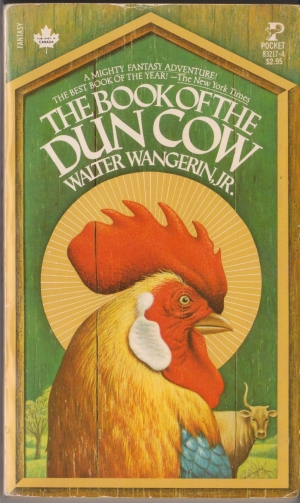
When I was in elementary school, someone gave me a copy of The Book of the Dun Cow, by Walter Wangerin, Jr. I read it, but I didn’t particularly appreciate it. Many years later, I bought another copy, and was much more impressed. I also understood why I didn’t care for it as a child. Not long ago, I found a copy of the sequel The Book of Sorrows. Reading the books together I was impressed again.
The books are an animal fantasy, set when “the earth was still fixed in the absolute center of the universe. It had not yet been cracked loose from that holy place, to be sent whirling — wild, helpless, and ignorant — among the blind stars. And the sun still traveled around the moored earth, so that days and nights belonged to the earth and to the creatures thereon, not to a ball of silent fire. The clouds were still considered to flow at a very great height, halfway between the moon and the waters below; and God still chose to walk among the clouds, striding, like a man who strides through his garden in the sweet evening.”
Humans have not yet been made, and the world is inhabited by animals, who talk and think. And they have a purpose, which is to act as Keepers against Wyrm, the evil that dwells in the heart of the earth and wants to ruin all creation. It is the connection between the animals — their community — that keeps Wyrm from rising. The two books describe two particularly vicious assaults by Wyrm against his keepers, and what happens to the animals as a result.


 Swords From the West

 Conan and the Amazon
 Okay, this is the Age of the Internet, so you’ve probably had this experience.