Fantasia 2017, Day 19: Heightened Realities (Night Is Short, Walk On Girl, Deliver Us, and Blade of the Immortal)
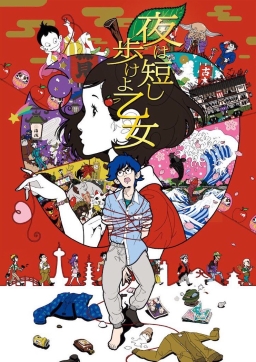 On Monday, July 31, I had three movies I wanted to see at the Fantasia Festival. First up was a surreal Japanese animated comedy, Night Is Short, Walk On Girl (Yoru wa Mijikashi Arukeyo Otome) in the De Sève Theatre. Then I’d stay at the De Sève to see an Italian documentary, Deliver Us (the English translation of the Latin title Libera Nos), about real-life exorcisms. The day would wrap up in the Hall Auditorium with a screening of Takashi Miike’s adaptation of the best-selling supernatural samurai manga Blade of the Immortal (Mugen no Junin). It looked, all told, like a lovely day.
Night Is Short, Walk On Girl was written by Tomohiko Morimi from a novel by Makoto Ueda, and directed by Masaaki Yuasa. Yuasa’s previously overseen an animated TV adaptation of another Ueda novel, Tatami Galaxy; the stories share a setting and some minor characters, but there’s nothing obtrusive to someone like me who has neither seen nor read Tatami Galaxy. Walk On Girl takes place in Kyoto, following a group of university students through a long night of seeking love, of seeking a long-lost and beloved book, and of encountering supernatural and near-supernatural entities. It mainly centres on a male student, called only Senpai (‘senior,’ voiced by Gen Hoshino), who is in love with a girl called Kurokami no Otami (literally, ‘the girl with black hair,’ here played by Kana Hanazawa). Senpai’s been arranging seemingly-accidental meetings, hoping Otami will notice him; on the night the film follows them, she goes partying and ends up looking for a copy of a beloved storybook from her childhood. This swiftly leads into a proliferation of subplots and genuinely zany characters — from the God of the Old Books Market (Hiroyuki Yoshino), to the School Festival Executive Head (Hiroshi Kamiya) who keeps the University campus under constant surveillance, to ‘Don Underwear’ (Ryuji Akiyama) who will not change his drawers until he finds (through the medium of pop-up theatrical happenings) the girl he once saw and fell in love with. The film whirls along through the night in a delirious whirl of pub crawling, dancing, philosophers (dancing and otherwise), guerilla theater, used book fairs, surveillance, cross-dressing, wishes, bad colds, punching technique, clocks, night, and true love.
I was worried for most of the film that Senpai’s obsession with Otami, which at least borders on stalking, would be glossed over. In fact it is at least addressed toward the end of the film, and the constant humiliations Senpai brings on himself throughout the movie certainly can be seen as a kind of poetic justice for his actions. In this as in much else the film is aware of its dark undertones, but maintains a generosity of spirit despite them. It’s a movie that maybe more than any other I’ve seen captures the university experience — or what one might hope the university experience would be like. It does this without naivete; it is clearly the product of older creators telling a tale of youth, but doing it without either speaking down to the young in any way or, conversely, romanticising the experience of youth.
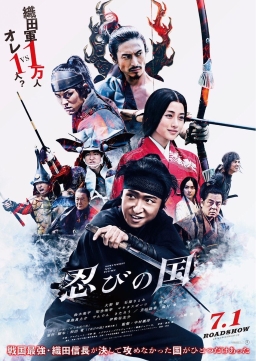 I ran up the steps in the Hall Building, hurrying from the basement where I’d just seen
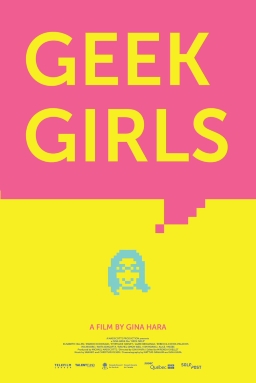 Sunday, July 30, was going to be a big day. I had four movies I hoped to see, some of them scheduled so tightly I wasn’t sure I could get to all of them in time despite the convenient proximity of the Fantasia theatres one to another. Still, I at least knew I’d start my day in the D.B. Clarke Theatre, where I would see Geek Girls, a documentary by Gina Hara.
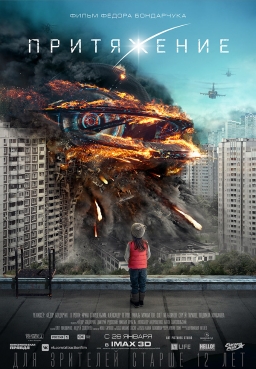 There were two screenings I wanted to attend at the Fantasia Festival on Saturday, July 29. First was the Russian science-fiction film Attraction (Prityazhenie). After that was a triple-bill of animated shorts: “Valley of White Birds,” from China; “Scarecrow Island,” from Korea; and “Cocolors,” from Japan. All together, a promising day of fantastic imagery on the big screen in the 400-seat D.B. Clarke Theatre. (In addition, a long short film preceded Attraction, “Past & Future Kings”; as it happens I know some of the local creators, and so feel it would be inappropriate to write about the movie here.)
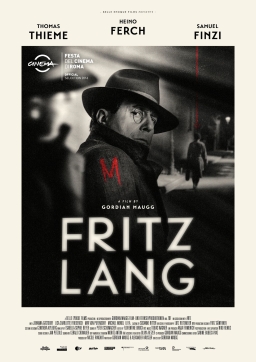 On Friday, July 28, I had two films on my schedule at the Fantasia Festival. The first was a German period crime film with biographical aspects, a movie called Fritz Lang that imagined the great director of the title mixed up with the killings that would shape his now-classic film M. The second was a screening of George Romero’s 1973 film The Crazies, arranged quickly by the festival’s organizers as a tribute following Romero’s death only 12 days before. Together the movies would make for a day that, to me, exemplified much of what is best in Fantasia: a profound appreciation of film history of every kind, mixed with challenging genre artistry.
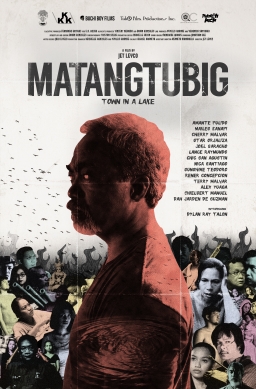 On Thursday, July 27, I planned to watch two films at the Fantasia International Film Festival. First, an artistically ambitious movie from the Philippines called Town In A Lake (Matangtubig). Then, later in the evening, a documentary about the quest to develop nuclear fusion technology called Let There Be Light. Both looked to be about the mysteries of the universe, in very different ways.