 I had three consecutive movies I wanted to watch on July 23. All three came from director Shinsuke Sato, all three were live-action manga adaptations, and all three were followed by question-and-answer sessions with Sato (the first at the De Sève Theatre, the second two at the larger Hall). I’ll write up what he had to say about his films in a separate post tomorrow. Today, my impressions of the movies themselves: the zombie apocalypse thriller I Am a Hero, the supernatural epic Bleach, and the science-fictional super-hero movie Inuyashiki. Note that I have read precisely none of the original works these movies were based on, and can speak only to the films I saw.
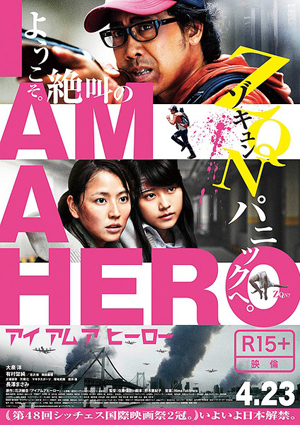
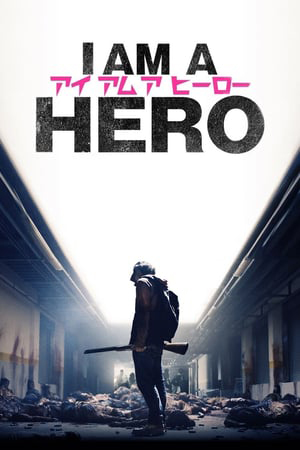
I Am a Hero (Ai Amu a Hiro, アイアムアヒーロー) was written by Akiko Nogi based on the manga by Kengo Hanazawa. Hideo (Yo Oizumi, Tokyo Ghoul) is a 35-year-old assistant to a manga creator, his aspirations and dreams dead or dying. Then the world suffers a zombie apocalypse from the spread of a deadly virus. Survivors flee to the top of Mount Fuji, because the virus can’t survive in the rarified air high up the mountain. Hideo scrambles to flee urban Tokyo, which is degenerating into mayhem; along the way he picks up a sidekick, a schoolgirl named Hiromi (Kasumi Arimura). Hiromi’s bitten by a zombie but instead of dying shows some strange powers and falls into a coma. The hapless Hideo — “the entire world changed, but I didn’t,” he groans — brings her along as he finds a community of survivors holed up in a mini-mall, and struggles to survive the tensions and suspicions he causes within the group.
The movie’s entertaining but oddly structured. The scenes early on, as Tokyo falls prey to the zombies, are fast and filled with explosions, with an epic scale that drops away for the rest of the film. Hideo’s discovery of the survivors in the mall in particular feels like a real slackening of the tension. And the climax of the film isn’t especially satisfying — it’s a big fight, but not a particularly imaginative one, and the challenges aren’t met by any new development in character or theme. It feels like more of the same rather than a rising to a satisfying end.
Moreover, on a basic plot level, more’s left unexplained and undeveloped than I’d like. Specifically, Hiromi’s powers, established early on, don’t return. She herself never wakes up from her coma. Apparently there was a scene shot for the end of the film which would have established that she held the key to a cure of the virus, but that exchange was dropped for the sake of the flow of the ending; I can understand the thinking, but that information needed to be put into the film somewhere, I think. As it is, Hiromi seems to exist mainly to show that Hideo has some spark of heroism latent within him, as he tries to save her from the madness of the world. That’s fine to a point, but effectively turns her into a plot coupon with no agency of her own.
…
Read More Read More
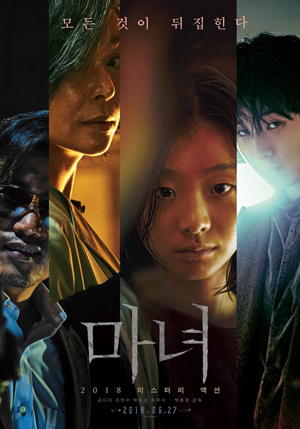 I had two movies on my schedule for Wednesday, July 25. The first was The Witch: Part 1. The Subversion, a Korean action movie with super-hero elements. The second was a German-language Swiss movie called Blue My Mind, about a teenager moving to a new school and finding herself undergoing a strange metamorphosis. Both films were about young women, and both leads had elements of the inhuman to them. But these things were expressed in very different ways.
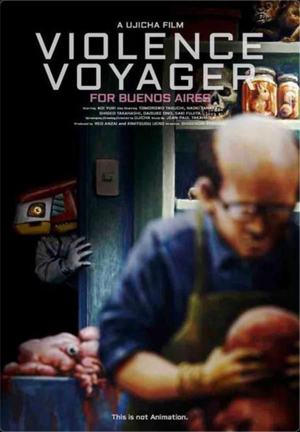 Late in the evening of Tuesday, July 24, I made my way to the J.A. De Sève Theatre for my one film of the day: Violence Voyager, an 83-minute animated feature by Japanese writer-director Ujicha. We follow an American schoolboy in Japan, Bobby (Aoi Yuki), as he and his friend explore some hills near his home. They find a strange, nearly-abandoned amusement park, but upon entering find themselves caught up in a terrible scheme. They and other children are captured, mutilated, mutated, and (in many cases) killed. Can Bobby free himself and others, and destroy the horrible place called Violence Voyager?
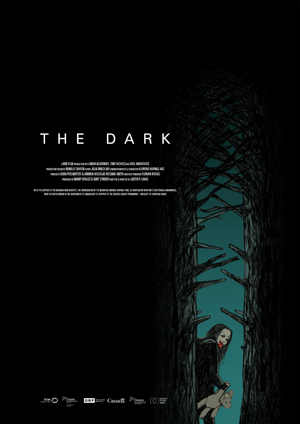 I had four movies on my schedule for Monday, July 23. Three of them were the work of one director. But before I got to those, I had an intriguing horror film at the J.A. De Sève Theatre to watch first: The Dark.