Fantasia 2020, Part XXII: The Block Island Sound
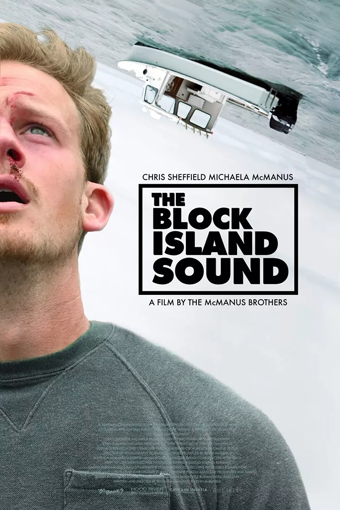 Day 9 of Fantasia began for me with The Block Island Sound. Directed by brothers Kevin and Matthew McManus, and written by Matthew, it’s a horror movie named for a body of water off the coast of Rhode Island. It’s the rare horror story that deals with inhuman mysteries on the northeastern coast of the United States while not feeling Lovecraftian at all.
The plot revolves around a family native to Block Island, where a small community largely of fisherfolk lives year-round, tripling in size in the summer tourist season. It is not summer as the film opens, and an old fisherman named Tom Lynch (Neville Archambault) is beginning to act very strangely. Tom’s adult son Harry (Chris Sheffield), who lives with him, is getting worried. Coincidentally, when a mass of dead fish washes ashore on the island, Harry’s sister Audry (Michaela McManus), who has moved away from Block Island, is sent by her bosses at the EPA to investigate. Accompanying Audry is her subordinate Paul (Ryan O’Flanagan) and her young daughter Emily (Matilda Lawler). They stay at the family home as they investigate, and things become more and more unreal.
If the story’s about family, so’s the production; Michaela McManus is the sister of Kevin and Matthew, while in a Q&A after the film Sheffield described himself as an unofficial third McManus brother. At any rate the focus of the narrative is clearly on the Lynch family, as they reunite with plenty of long-held arguments still between them. Tom’s a hothead, who, as Audry percipiently observes, is always looking for someone to blame. Audry for her part is conscious of having left Block Island for another life, and is not especially happy to be back. And then there’s Tom, who may be slowly losing his faculties. Or may have something more disturbing afflicting him.
The movie’s not Lovecraftian, as I say, in part because it’s centred so intensely on the dynamic of the family — an emotional landscape utterly unlike anything in Lovecraft. It’s also far more class-conscious than Lovecraft, or at least conscious in a completely different way. If Audry’s vaguely like the academics who come to a small New England town to investigate some disturbing goings-on, her role in the story becomes something quite different: she’s involved, in ways Lovecraftian academics aren’t.
Worth noting that the look and feel of the film is also different from the twice-told narrative frame-structures of so much of Lovecraft. There’s an almost tactile sense to the film, a visual precision and a detailed soundscape — the washing of waves, the hush of wind — that between them convey a deep sense of place. That place has an atmosphere born not of isolation, though one does get that from the bare trees and the grey ocean, but of lives hard-lived. Tom’s home feels like the real home of a real person, living and working in a small town. The location of Block Island itself is shot such that it comes alive as a lived place, not defined in terms of its institutions so much as in the context for the lives and histories of the main characters. You believe that these people grew up here.
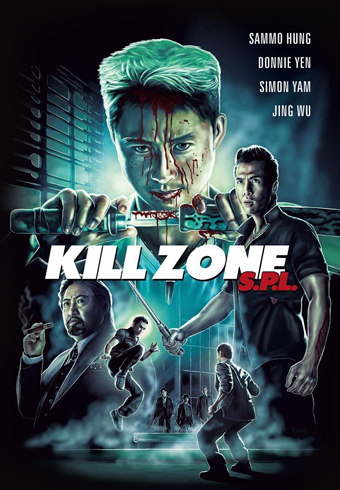 One of the lovely things about covering Fantasia is the chance to see genre classics I missed the first time around, often brought back to the screen in a restored version. Again in 2020, notwithstanding its streaming-only nature, Fantasia revived a number of great films from prior years. While my own inefficiency with scheduling meant I ended up missing Johnnie To’s A Hero Never Dies, I saw many of the others, including Wilson Yip’s 2005 movie SPL: Kill Zone (also just Kill Zone, originally SPL: Sha Po Lang, 殺破狼).
 There is, or was, or might have been according to some, a movement in Greek cinema that started and flourished in the first half of the second decade of the twenty-first century called the Greek Weird Wave. This movement,
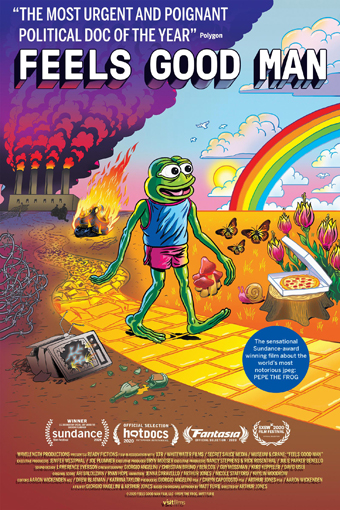 I try to keep an eye on comics, but like many people my first exposure to Pepe the Frog was as a poorly-drawn meme spouting racism. I remember reading about Pepe’s comics origin, but the name of Matt Furie, the cartoonist who created him, remained a piece of trivia. As did his comic Boy’s Club, where the frog first appeared. Now there’s a documentary telling the whole story of Furie, Pepe, and Boy’s Club — a tale of politics, appropriation, and how art can be used in ways the artist could not imagine, for worse and for better.
  One of the genuinely wonderful things about covering a film festival is occasionally getting to be among the first audiences for a movie trying something new. That is, being an early viewer of a movie that does things unlike other movies, and getting to make one’s own mind up on whether those things work. Movies at a festival have often not had a critical consensus formed around them, and have not yet been defined by other writers or had their influences mapped out. You as the viewer are alone with the thing, almost contextless, in a way that’s rare these days.
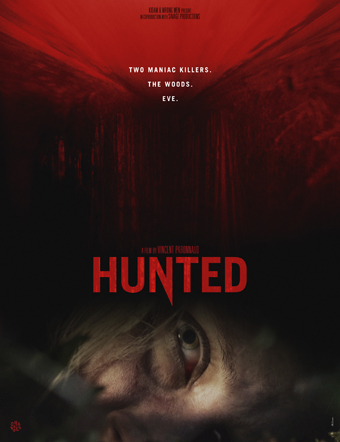 Watching a film festival at home instead of in theatres raises a question that’s become a much-debated point over the last couple of years: is the experience of viewing a movie on a TV screen essentially different and essentially lesser than watching the same movie in a theatre? I don’t think there’s a single answer to this question. Different movies and different viewers and different circumstances will create better or worse scenarios. I think it is probably safe to say that the theatrical experience has much more sensory power; that the powerful sound system and the controlled environment and the full dark of a theatre will usually be more immediately overwhelming to a viewer. But it’s reasonable to wonder if a movie that relies on sheer sensory power can be called ‘a good movie.’
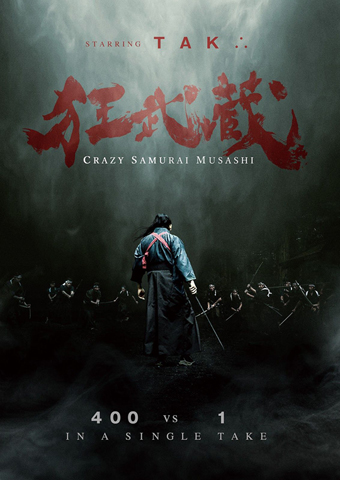 Miyamoto Musashi (1584-1645) was one of the greatest samurai and greatest swordfighters ever to live. By his own account, he fought over sixty duels and won all of them. Stories about Musashi have been told and retold over the centuries, notably including the great novel Musashi (1935-39) by Eiji Yoshikawa. Films about him have proliferated, the most famous likely being Hirohi Inagaki’s Samurai trilogy (1954-55) starring Toshiro Mifune as Musashi.