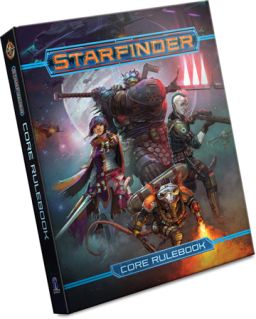
Kurtzhau, my 13 year old son who’s currently GMing the game for his mates, rates it as “Awesome.”
I concur.
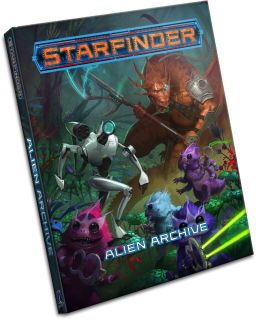
80+ new aliens (depends on how you count), 20 playable races (some delightfully nuts ), lots of alien tech, each entry a rich adventure seed in its own right and rules for building your own NPC aliens.
Lovely illustrations. Good writing. And it’s got a sort of creative gravitas. Nothing here is throwaway.
When playing Dungeons & Dragons or other fantasy RPGs, have you ever wanted to play a space wizard? A gnome with a jet pack? Or a fighter with a flaming laser sword and a force field?
These options are all available to you in the new Starfinder RPG (Paizo, Amazon). Paizo has built the new science fantasy game to explore the distant future of their Pathfinder universe. Though I’ve been excited about it for over a year, since it was first announced, I’ve only just gotten the opportunity to play a full game of it.
So now that the game is more than an abstraction … now that I’ve actually rolled the dice and taken some damage … does it still hold up like I was hoping? Honestly: Even better.
But rather than just singing the praises of the game (which I’ve and others have already done here and here and elsewhere), I’m going to dive a bit deeper into how the game is similar – and different – from the Pathfindergame that we know and love.
Creighton Broadhurst is the founder and head honcho of Raging Swan Press, one of Pathfinder‘s leading third party publishers. His Shadowed Keep on the Borderlands is the spiritual successor to the old moat house in The Village of Hommlet. Creighton plays Pathfinder, but he approaches the rules-heavy game with an old school style, which is something I’ve been trying to figure out for myself.
His blog features lots of lists: GM advice, player tips, favorite modules, etc.. I broke his 25 Dungeon Delving tips into Parts One and Two and added my own comments (nothing like letting somebody else do the heavy lifting for a good post!). It seemed to work and Creighton didn’t mind, so I’m going to write some more Modular posts along those lines, like this one.
The Principles and bolded text below are Creighton’s, followed by my comments. Please share your thoughts on these principles and definitely go check out Creighton’s blog: it’s got a lot of great stuff for both players and GMs. And if you’re looking for some products to help out with your game, head on over to Raging Swan Press.
Selection and Maintenance of the Goal
A single, unambiguous goal is the keystone of a successful foray. Selection and maintenance of the goal is the master principle of adventuring. Do not get sidetracked or distracted; that way, disaster lies.
This is the opposite of the “Ooh, shiny object” approach. It’s so easy to get off track and chase after the ‘thing of the moment.’ Rumor of a dragon in the mountains, let’s go get him! Treasure in a cave outside of town? We’re on it! Heard a sound down that tunnel, turn left.
Over the past few years retro-gaming has been on the rise. From the NES Classic, to the upcoming AtariBox, many companies are releasing games and devices that pull at your nostalgia, allowing you to relive some of the gaming moments from your past.
Along with retro gaming, indie game development has rocketed over the past few years. Independent game developers with small budgets and small teams are creating new games and experiences in a variety of genres, leading to the creation of compelling stories and incredible pieces of art.
In 2015, Thomas Happ created a sci-fi game that matched the wonder and exploration of a nearly bygone era. An era of 2 dimensional side scrolling games, featuring exploration, with an emphasis on combat, puzzle solving, and powerups. This game is called Axiom Verge.
Axiom Verge features many of the game mechanics from classics such as Zelda, Castlevania, and Metroid. This game and many others similar to it are often categorized as a “metroidvania” game. The comparisons between Axiom Verge and Metroid are more than a subtle nod, with the difference being Axiom Verge takes those ideas and expands on them.
Well-authored and beautifully illustrateDoes for Science Fantasy what Dungeons and Dragons did for “traditional” Fantasy.
“Dad, we can’t get the Starfinder combat system working…”
“Look, Son, it’s a D20 system, so Armor Class reduces the chance of being hit, rather than absorbs damage.”
“OK. I get it now! You’re the best, Dad!”
(Tousles hair) “That’s what Dad’s are for, Son.”
OK it didn’t quite go like that. For a start, I did not in fact tousle my 13-year-old son’s hair since (a) it’s shoulder length and he gets cross if you tangle it, and (b) he’s 13. Even so, it was a “life’s full circle” Country and Western moment of the same order as when non-geeks teach their kids to throw a rabbit or skin a baseball or whatever.
However, Kurtzhau was indeed encountering a D20 system for the first time, the engine at the heart of Starfinder, Paizo’s new Science Fantasy (it uses that term in the text!) system, with which he’s pretty much fallen in love. The blurb says it all.
The Starfinder Roleplaying Game puts you in the role of a bold science-fantasy explorer, investigating the mysteries of a weird and magical universe as part of a starship crew. Will you delve for lost artifacts in the ruins of alien temples? Strap on rune-enhanced armor and a laser rifle to battle undead empires in fleets of bone ships, or defend colonists from a swarm of ravenous monsters? Maybe you’ll hack into the mainframe of a god-run corporation, or search the stars for clues to the secret history of the universe or brand new planets to explore. Whether you’re making first contact with new cultures on uncharted worlds or fighting to survive in the neon-lit back alleys of Absalom Station, you and your team will need all your wits, combat skill, and magic to make it through. But most of all, you’ll need each other.
Inspired by my son’s enthusiasm, I decided to take a look myself…
I’ve covered a number of new games that I saw at Gen Con, including fantasy deck-building games, science fiction games, and youth games. Some games, though, are hard to classify under a large thematic umbrella, defying the tight boxes of genre. Here I’d like to touch on some of those games.
Privateer Press
One of my favorite miniature war games is Warmachine, created by Privateer Press. In fact, my first article with Black Gate was an essay on their Iron Kingdoms RPG line. At that time, the Iron Kingdoms RPG was built on the D20 system, and it’s now a standalone RPG line … but Privateer Press is really known for their miniature line.
In Warmachine, you create an army commanded by a unique warcaster, and comprised of their large, magical, steaming metal constructs called warjacks, supported by units of troops, solo soldiers, and officers. Their companion game, Hordes, is fully compatible, but the warlocks in Hordes use a slightly different magical mechanic to command their feral, rampaging warbeasts. You assemble an army by picking one of the available factions, and then buying, assembling, and (hopefully) painting your miniatures to represent your completed army. The folks over at Penny Arcade have recently begun broadcasting full games of Warmachine for your viewing pleasure, if you want to see what it’s all about. But Privateer Press has major expansions on the horizon for their game lines.
I’ve finally started making use of the Mongoose 2 Traveller Central Supply Catalogue. As predicted, it’s been handy to have two sets of armour listings, which is as far as I got last time with my page-by-page.
The players — all 13-14 year old boys — liked the catalogue just to look at. Rules aside, it added coolness to our Traveller sandbox game. One or two of the items proved invaluable, including the Diplomatic Vest, which the rogue character leapt on with unholy glee. (He should, however, have considered something more powerful than the flechette gun.)
So, now we’re onto Survival Gear, Electronics, and Computers, sections that continue the faux catalogue conceit.
2. Survival Gear
As with Armour, this section duplicates and expands on the equipment in the core rules. For example, it tells us more about “Artificial Gills” to make clear that these must be worn with a mask, and includes lots of new items.
I’m currently running a Swords & Wizardry (S&W) campaign for a few friends. I wrote here about why I chose S&Winstead of my preferred system, Pathfinder. In fact, that post served as the genesis for this Black Gate feature, Modular. But now, I’m going to look at some of the strengths of Pathfinderand why, when this S&W campaign is done, I’m going to transition the group to a Pathfinderadventure.
So, though I had both played and run Pathfinder, I chose S&W for reasons I talked about in that prior post. I wanted a more story-driven, less mechanics-based system. Also, because two-thirds of the party was new to pen and paper RPGing, I wanted something lighter in the rules department. And there’s no comparison between the two in that regard. The S&W Core Rules comes in at just over 140 pages. The Pathfinder Core Rulebook is almost 600!
Now, I explained in that first post that while I was still reading RPG products, I had stopped playing during 3rd EditionDungeons & Dragons (D&D): there simply hadn’t been time for it.
But I wanted to get back into playing, and the choice seemed to be between Pathfinderand the newly released 4th Edition. Now, I had only ever played D&D, going back to 1st Edition. I mean, it was synonymous with role playing games and 4th Edition was the natural choice. But as I researched both systems, Pathfinderclearly seemed to be the way to go.
Spacers in Ganelon Navy uniforms cram the bar. These guys have a reputation for trashing bars and brawling with strangers. However, this evening, they are beyond well behaved. They keep their hands off the waiting staff, even tip them generously. They are almost painfully polite — “I’m sorry I nearly jostled you! Please accept my apologies, and further apologies on behalf of my ship and indeed my culture…”
This is a problem!
Or at least a problem for the three hard-up traveling companions huddled around a small corner table… let’s call them Travellers... sipping beer from bulbs designed to cope with the 0.15G (these are real!). They have a contract to catch the Ganelon spacers behaving badly so as to compromise that star kingdom’s naval goodwill tour. So far, they are not seeing any bad behaviour.
Somewhat direct in mentality, Charadack, the retired marine sergeant in the group, starts loudly boasting about a battle in which the Imperium forces utterly thrashed those of Ganelon Star Kingdom. Perhaps he can provoke an assault?
After about fifteen minutes, a Ganelon officer carefully navigates the crowded bar and addresses Charadack: “I hear you are talking about your great victory. May I compliment you and the entire Imperium for your chivalry? You are brave and noble fighters, and indeed were exceptionally polite and gracious to the POWs captured as a result of your glorious success…”
At this point, our Travellers are starting to freak out. What is going on?
I’m a huge fan of solitaire role playing adventures. They’re a great way to exercise your imagination and sample an immersive RPG experience when you can’t find any other players — or just can’t convince them to try out a new game with you.
Of course, the biggest drawback of solo RPGs (aside from the fact that they’re relatively thin on the ground these days) is that most expect you to be fully conversant with the system. That’s why I’m so delighted with Alone Against the Flames, the newest solo adventure for Call of Cthulhu. You don’t need to read the (rather daunting) rulebook before you start playing. Just settle in a comfy chair with some lucky dice, open the book, and follow the instructions. It dumps you right into the story and teaches you the game as you go.
Call of Cthulhu is a horror RPG based on the work of HP Lovecraft, and Alone Against the Flames is a complete tale set in the 1920s in which you are the main character, and your choices determine the outcome. Although it’s designed to walk you through the basics of the game as you go, a copy of the Call of Cthulhu Seventh Edition QuickStart Rules (which you can download for free here) is required to play.