The Locus Index, Galactic Central, and other Fantasy Resources
 Newcomers to fantasy collecting may be unaware of the scope of pertinent and very useful information on the web, and particulary the resources assembled by members of the Yahoo Fictionmags Group. The terms “Big List,” “FMI,” “Galactic Central,” “Locus Index” and many others crop up without necessarily being understood. Fictionmags includes the authors of some of the most seminal and definitive reference works on magazine Science Fiction, Fantasy, and General Fiction. Not only is this material substantial and providing of answers to many questions, but it is also FREE to anyone conversant in accessing the internet.
The major portal to this trove is www.philsp.com, the website of Fictionmags’ Phil Stephensen-Payne. This place is rather like a fantasy collector’s version of the Smithsonian. Just about everywhere you turn, there is something of interest. The site opens directly onto Phil SP’s “Galactic Central.” If you’ve ever wondered what a full run of Amazing Stories, Astounding/Analog, New Worlds or most any other SF prozine looks like, this is where you get to scroll through pages of color cover images arranged chronologically as illustrated checklists (including, for example, an up-to-date Black Gate checklist).
There are tens of thousands of these images from SF/F/H, Western, Crime, Adventure, Romance and general fiction titles. I’ve contributed images to this project from my own collection as have many others, and Phil has also gathered the content from many sources on the internet as well. There is also an accounting (The Big List) provided of all of the magazine titles pictured in Galactic Central showing where else they are more fully indexed. Huge as it is, this project is still not done, and Phil will probably have to come back in another lifetime to complete it.
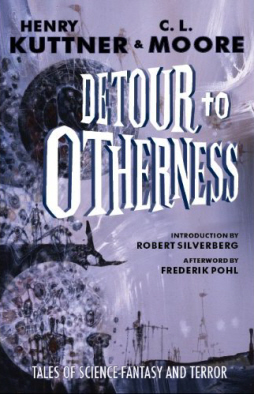 Yesterday’s deliveries here at the Black Gate rooftop headquarters yielded — among the usual bills, magazines, and spare parts for the plutonium-powered signal beacon — a review copy of Detour to Otherness, by Henry Kuttner & C.L. Moore.
 “Beyond the Sunrise” is the unofficial title afforded an unfinished Kull story that did not see print until over forty years after the author’s death. Its significance is due largely to the fact that it was the first of four widely differing attempts to continue the Kull series following the publication of both “The Shadow Kingdom” and “The Mirrors of Tuzun Thune” in Weird Tales in 1929.
 Science Fiction and Fantasy Artists of the Twentieth Century: A Biographical Dictionary, by Jane Frank
 From his first appearance in print in the pages of The Story-Teller in October 1912, Sax Rohmer’s criminal mastermind, Dr. Fu Manchu took the world by storm. While Rohmer would complete three novels featuring the character between 1912 and 1917, the Devil Doctor would extend his domain to include film and comics in the fourteen years before Rohmer bowed to commercial demand and revived the series.
 In a post on his blog last week, Canadian science fiction author Robert Sawyer asked “
 I’ve discovered that once you start writing about 1930s magazine science fiction — a field small enough for thorough analysis, but bursting with enough wonders to fill the galaxy — it becomes difficult to stop. Pondering the marvels of
  I have a habit of buying books — a compulsion, really. Older books, mostly, from book fairs and small used bookstores. Things that look unusual, and which, in the absence of an immediate reason on my part to read them immediately, often sit on my shelves for some time before I get around to them.
 Last night at dinner we were discussing (as one does) Homer Eon Flint.