Browsed by
Category: Pulp

My Favorite Robert E. Howard story: “Pigeons from Hell”

My Favorite Robert E. Howard story: “Pigeons from Hell”

pigeon-from-hellWhen other genre-lovers find out I’m a fan of Robert E. Howard, they often ask me what my favorite of his stories is. They probably expect I’ll name one of the Conan yarns, or perhaps a Solomon Kane or Kull story. (Kull is, indeed, my favorite Howard character.) If they already know something of my background in history, they may think I’ll name one of the Crusader stories that appeared in Magic Carpet Magazine.

But instead I say, without hesitation, “Pigeons from Hell.” And, after an inevitable moment of surprise, they always answer back: “Oh, that’s a great story! I had almost forgotten about that one!”

The irony of my love for “Pigeons from Hell” isn’t lost on me: I praise Howard for his foundational contribution to sword-and-sorcery and historical action tales, and yet my personal favorite story he wrote is a contemporary America-set horror story. But “Pigeons from Hell” is quintessentially Robert E. Howard from first word to last; Howard was an author who knew how to transform naturalism into the “weird tale,” and who also took great inspiration from the folklore of his small world of rural central Texas.

Read More Read More

Targetted Book Recommendations #2

Targetted Book Recommendations #2

Part One of this enthralling series is here.

Finally, I shut my big mouth and show a few cards. Novels are what it’s all about, but not just any novels. We want something immediate. We want action and adventure. And although introspection and other, more literary qualities won’t be run out of town with the imprint of my boot on their buttocks, they must never, ever slow the story down. In short, we’re after books that embody the spirit of Black Gate.

Got it? Let’s see then…

Read More Read More

Targetted Book Recommendations for Non-Existent Readers

Targetted Book Recommendations for Non-Existent Readers

You and Me

Once upon a time, I met a guy who only ever ate fries*. Anything else, it was claimed, would make him violently ill. Now, he looked healthy enough and suffered no heart attacks while I was watching him, so who knows? Maybe it worked out well for him. But it’s rare in life to find an adult whose belly is so cantankerous that it rejects even pizza with such colourful speed. And it is equally rare to meet an adult reader who only wants Sword and Sorcery, or Flying Carpet Wonder tales. Or whatever.

Most people, enjoy a bit of variety. Personally, I feast at many tables — historical fiction, mysteries, SF hard and soft; fantasy high, low, light and dark. I love it all depending on my mood, and I imagine that most of you will have similar lists, maybe replacing the SF with Romance, or the mysteries with Great American Novels. The only thing we can be sure of having in common, is a penchant for character-driven SFF adventure stories — i.e. the type of thing that BG does best. You probably wouldn’t be reading this otherwise.

Targeted Book Recommendations

Recommending books, as we all know, is a bit like giving presents to a loved one. You can give something that you would like, or, if you’re feeling more generous, you can take their tastes into consideration too.

I remember one particular disaster when a friend of mine suggested George R.R. Martin’s A Game of Thrones to One-Footed Jimmy, even though everybody knew poor Jimmy has had an aversion to swords since that time the display came loose during his visit to a museum… OFJ wouldn’t touch Black Gate with a barge-pole, but imagine, if you will, that you had to buy a book for somebody who loved the magazine. What would you pick? You’re not trying to educate this person, you’re not allowed to show-off. The one thing you know about your victim’s diet is that he or she drools twice a year over the brown envelope that Mr. O’Neill sends from Chicago.

What would you choose? Why?

I’ll be putting up my answers to these questions some time next week.

* In Ireland, we refer to them as “chips”. Do NOT be confused.

Tarzan Swing-By: Tarzan and “The Foreign Legion”

Tarzan Swing-By: Tarzan and “The Foreign Legion”

Tarzan and Foreign Legion 1st edI would like to step forward at this moment to address the audience before the curtain rises on our feature book review presentation so that I may make a personal observation about Edgar Rice Burroughs. Specifically, I would like to explain why I’ve written so many posts about his work in the last few weeks.

Burroughs needs no excuse for discussion in a magazine dedicated to heroic fantasy and planetary romance. Adventure literature as we know it springs from the influence of Burroughs in the early twentieth century. Although pulp magazines existed before Burroughs published Under the Moons of Mars (later titled A Princess of Mars) and Tarzan of the Apes, this double-punch in 1912 changed the style of this publishing medium for the remainder of its lifetime, and the influence continued into the paperback revolution and on into our era. Burroughs looms as one of the Titans of genre literature. But the true question is: Why am I re-reading so much of his work right now, in concentrated doses that I usually reserve for no author?

One answer is that I enjoy writing about Burroughs almost as much as I enjoy reading him. For an author who supposedly crafted straightforward entertainment, Edgar Rice Burroughs’s novels contain a remarkable breadth of ideas for debate and consideration. But a deeper reason for such current copious reading of Burroughs is that his work always gives me a unique uplift. In times of uncertainty and concern, I find that no author can temporarily re-energize me than ERB. Even a violent and embittered book, such as the one I’m about to discuss, provides an energy boost like a literary vodka with Red Bull. Burroughs knows how to make life seem wild, colorful, and far removed from the petty concerns of the everyday. It isn’t strictly “escapism,” a word I dislike, but a form of romantic empowerment. Burroughs’s daydreams on paper enhance our yearning for that which is beyond what we have to struggle with in day-to-day life.

End of psychological exegesis. The curtain now rises on today’s Tuesday Topic: one of Burroughs’s most unusual books, one that few people have read because — let’s face facts — how many but the most dedicated fans manage to reach Book #22 in any long-running series?

Read More Read More

Caspak Victorious: The Land That Time Forgot

Caspak Victorious: The Land That Time Forgot

First Edition Cover“You have read the opening paragraph, and if you are an imaginative idiot like myself, you will want to read the rest of it; so I shall give it to you here…”

I often refer to Edgar Rice Burroughs as an “excuse” author. It seems readers or critics can’t discuss him without qualifiers to excuse reading him. A typical statement: “Edgar Rice Burroughs wasn’t a good writer but he had a vast imagination.”

I not-so-respectfully object to the assessment of Burroughs as a poor writer. In his best works, he pulls me along and engrosses me far more than most bestselling “thriller” authors published today. I can pick apart objective deficiencies in his style, criticize his dips into awkward phrasing, but this ultimately doesn’t matter in his overall style, which reads fast, involving, and exciting. His prose style matches the types and tones of the stories he wants to tell, fits them so well that I can’t imagine another style that would work with them. That, in my reader’s eyes, makes Edgar Rice Burroughs a great writer.

Read More Read More

Read Planet: Kline’s The Swordsman of Mars

Read Planet: Kline’s The Swordsman of Mars


I read The Swordsman of Mars out of a sense of obligation, which is probably the worst way to read anything, and with the firm conviction that it would suck. That’s the word on the virtual street about Otis Adelbert Kline: he’s a poor man’s Edgar Rice Burroughs. So I was thinking: ERB, without that mellifluous prose style and brilliant plotting. Urk.

Well, I was completely wrong. I enjoyed the book enormously, but that’s not all. You can enjoy almost any piece of writing if you approach it with the lowest possible expectations (and, yes, I am thinking of Lin Carter‘s multifarious pastiches here). I came away from it with considerable respect for Otis Adelbert Kline as a writer of fantastic fiction.

Read More Read More

Adventure Fantasy in the Children’s Section

Adventure Fantasy in the Children’s Section

My just-turned-nine-year-old son is a voracious reader, and in searching for books that would interest him I’ve become aware of the explosion of quality sf/f books written for the so-called middle reader and young adult audience. More or less at the time we started reading these books together, I also became bored and impatient with a lot of what passed for adult f and sf. As a consequence, over the past three or four years, a lot of what I’ve read recreationally has been fantasy that you will rarely if ever find in the regular genre sections of bookstores. A good deal of it, however, I’ve enjoyed very much, and the reasons are not arcane.

Successful fantasy for kids–meaning books my son loves, which includes but is not limited to books that sell a lot of copies–generally shares several characteristics. First and foremost, Things Happen. Middle reader/young adult fantasy is almost by definition adventure fantasy. Also, Things usually start Happening right away. Kids won’t read past the first page or two if they aren’t drawn into the story right off; this doesn’t necessarily mean that things blow up on page 1, but that the characters and their situation are immediately involving.

Read More Read More

Reader vs. Reader

Reader vs. Reader

Reading the old guys can be tricky sometimes. After I reviewed Robert E. Howard’s Almuric last week, I got some correspondence accusing me of being “politically correct” (that terrible thing it is so incorrect to be nowadays) because I had suggested, in the mildest possible way, that REH’s depiction of the black-skinned, sexually predatory and cannibalistic Yagas has racist overtones. Well, in my view, it has, and I didn’t draw that opinion from a bank of statements pre-approved by some central committee. If we entertain, for the sake of argument, the idea that I am right about this, what does it mean about how we read REH?

It means we read REH the same way we read anyone else: in two different ways, simultaneously. Umberto Eco famously dubbed these two readers the naive reader and the sophisticated reader. The naive reader wants the hero to kill the bad guy and marry the space-princess (or space-prince, or what have you). The sophisticated reader is muttering, “Yes, this is much like the plot Burroughs used, with overtones of Hamlet and the occasional oblique reference to postmodernism which is de rigueur for self-consciously retrogenerical pastiche, n’est-ce pas?” The naive reader just wants to sit back and enjoy the movie. The sophisticated reader is the guy sitting in the row behind who won’t STFU. More beyond the jump, in which JE does not STFU

The Spider Revival Part 2: City of Doom

The Spider Revival Part 2: City of Doom

Spider-CityOfDoomLast week, I reviewed the first volume in Baen’s trade paperback reprints of the adventures of Norvell Page’s grisly pulp hero, The Spider. Now, I plunge into the violent maelstrom of … The Spider: City of Doom!

The three novels reprinted in this volume are The City Destroyer, The Faceless One, and The Council of Evil. The City Destroyer, which Page submitted under the title Crumbling Doom, is the earliest of Baen’s reprinted Spider stories, published originally in the January 1935 issue of The Spider. It also appeared in Pocket Books’ reformatted (with pointless modernizing) series in the ‘70s. It ranks as one of the Norvell Page’s best-written works, but it has an ugly timeliness that dulls the edge of the absurdist fantasy and may unsettle some readers. In the opening chapter the villain, decked out with the bland handle “The Master,” steals the secret for a metal-corroding dust. Richard Wentworth thinks the Master plans to use the chemical invention to break into bank vaults, but he should know that his adversaries don’t think that small. Instead of wasting time with piddling safes, the Master uses the chemical to knock down entire New York skyscrapers, killing thousands of people. His first target is New York’s newest, tallest building, and the writing dwells for a few pages on a gruesome depiction of the skyscraper’s collapse and the gory aftermath, complete with fleeing crowds, a dust cloud pluming over the Manhattan skyline, and trapped people trying to escape certain death in a crumbling tower.

Uhm … not a pleasant memory. At times, our world and that of the pulps share tragic similarities. Amidst the Great Depression and staring toward an oncoming second world war, pulp authors occasionally tapped into an insecurity not far removed from our own. The City Destroyer delivers more fear and tension than any thriller you’ll find on the recent bestseller lists, but new readers should be prepared for moments of queasy familiarity. It isn’t much of a nostalgia trip, and even the Spider’s heroics can’t halt an obscene death toll. I would conservatively estimate that seven thousand people perish during this story.

Read More Read More

The Spider Revival, Part 1: Robot Titans of Gotham

The Spider Revival, Part 1: Robot Titans of Gotham

spider-robot-titans-of-gothamIf you have never met the most notorious of all pulp magazine heroes — The Spider, Master of Men! — then Baen Books has a deal for you. After a long absence from mass market paperbacks, the Spider returns in two Baen collections The Spider: Robot Titans of Gotham and The Spider: City of Doom. The two volumes pack together five of Norvell Page’s best Spider novels, plus a bonus yarn from his madcap typewriter.

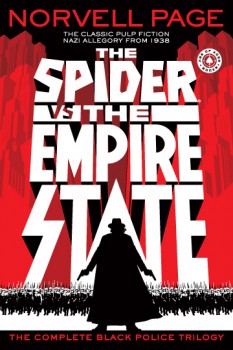
(Update: Now there’s a third volume, The Spider vs. The Empire State.)

If you’ve previously met the Spider, you might have read some of these adventures from reprints in the Carroll & Graf series. Buy these new books anyway; I want Baen to feed us more.

As for you newcomers, I feel obliged to give you fair warning about the Spider. Otherwise you might wonder after reading one of these stories, “Was Norvell Page completely insane?” No, he was a professional pulp writer. Which may come down to the same thing, when you consider the deadlines. But even for the crazy world of the cheap paper story magazines of the 1920s and 1930s, the zenith years of this lost world of fiction, Page’s tales of the Spider are so overloaded with outrageous violence and fear, and so under-stocked with logic and elementary structuring, that it seems the author wrote them after shooting more heroin than Popeye Doyle confiscated in The French Connection.

Read More Read More