Browsed by
Category: Pulp

New Treasures: The Merriest Knight, The Collected Arthurian Tales of Theodore Goodridge Roberts

New Treasures: The Merriest Knight, The Collected Arthurian Tales of Theodore Goodridge Roberts

AppleMarkYesterday, I spent the day at the Spring Auction at Games Plus, which I’ve taken to calling the Paris Fashion Week of Games. It was a very successful outing — so successful that I knew I had some explaining to do to Alice, who balances the family finances.

While I was waiting to settle up with the cashier, my eyes fell on a curious artifact in the tiny books section at Games Plus: The Merriest Knight, The Collected Arthurian Tales of Theodore Goodridge Roberts. Roberts was a Canadian pulp author whose tales of Sir Dinadan, whom Mallory called “the merriest knight,” appeared in the pulp magazine Blue Book in the 50s. Sir Dinadan was known as the most practical of the Knights of the Round Table, and Roberts’s stories differed from many of the Arthurian tales of the era in their warmth and wit.

Late in his career, Roberts wrote a final entry in the Dinadan saga, “Quest’s End,” which remained unpublished in his lifetime. Rumor had it he’d also begun collecting all the tales with an eye towards publishing a book, but the project remained unfinished when he died.

Now the peerless Mike Ashley, who’s edited countless anthologies — including 32 books in The Mammoth Book Of... series, and five other Arthurian Anthologies, such as The Pendragon Chronicles and Chronicles of the Holy Grail — has finished what Roberts began with The Merriest Knight, a beautiful collection of the complete tales of Sir Dinadan:

Under the guidance of editor Mike Ashley, The Merriest Knight gathers for the first time all of Roberts’ tales of Sir Dinadan — including the previously unpublished “Quest’s End” — and several other long lost Arthurian works by this master of the stylish adventure yarn and the historical romance. Within these pages, readers will find a collection of Arthurian tales that are sometimes poignant, often humorous, and always ingenious, as well as a Camelot made fresh by the wry and often scathing eye of Sir Dinadan, who never rushes into battle without first being certain of the need to fight at all.

Why is The Merriest Knight for sale in a games store? Ah, that’s an entirely different tale.

Read More Read More

Galaxy Science Fiction, December 1950: A Retro-Review

Galaxy Science Fiction, December 1950: A Retro-Review

Galaxy Science Fiction December 1950It is clear from this issue’s editorial that Galaxy was beginning to invade newsstands and draw quite a following. And they were doing it by seeking reader participation in structuring the magazine the way readers wanted it.

That, and by attracting great writers. In fact, editor H. L. Gold announced that they had raised their pay rates “to the highest in science fiction… We want the best and are prepared to pay for it.” Let’s see how the fiction in this issue shapes up.

“Second Night of Summer” by James H. Schmitz – On the planet Noorhut, Grimp welcomes his grandmother as she makes her annual summer return to the village. Like the rest of the villagers, he’s unaware of a scheduled attack on the planet – one that would wipe out all life as it has on other worlds. Grandma Wannattel is actually an agent sent to thwart the attack, but she can only do so with Grimp’s help; he may be the only one able to sense the precise moment of the attack.

This story hasn’t deteriorated at all over time. It succeeds because it avoids cultural references and stock characters of that time. This was my favorite tale of the issue.

“Judas Ram” by Sam Merwin, Jr. – Roger Tennant lives in a furnished home with a harem of women. Imprisoned by fourth-dimensional beings, Roger and the women are the only humans captured from Earth.

They’re forced to breed through implanted desires, but their minds remain clear; they hate the beings and, to some degree, one another. But there is no choice for them, and the beings train Roger like a dog, teaching him their powers so that he might return to Earth to aid them in capturing others.

Read More Read More

Amazing Stories, August 1964: A Retro-Review

Amazing Stories, August 1964: A Retro-Review

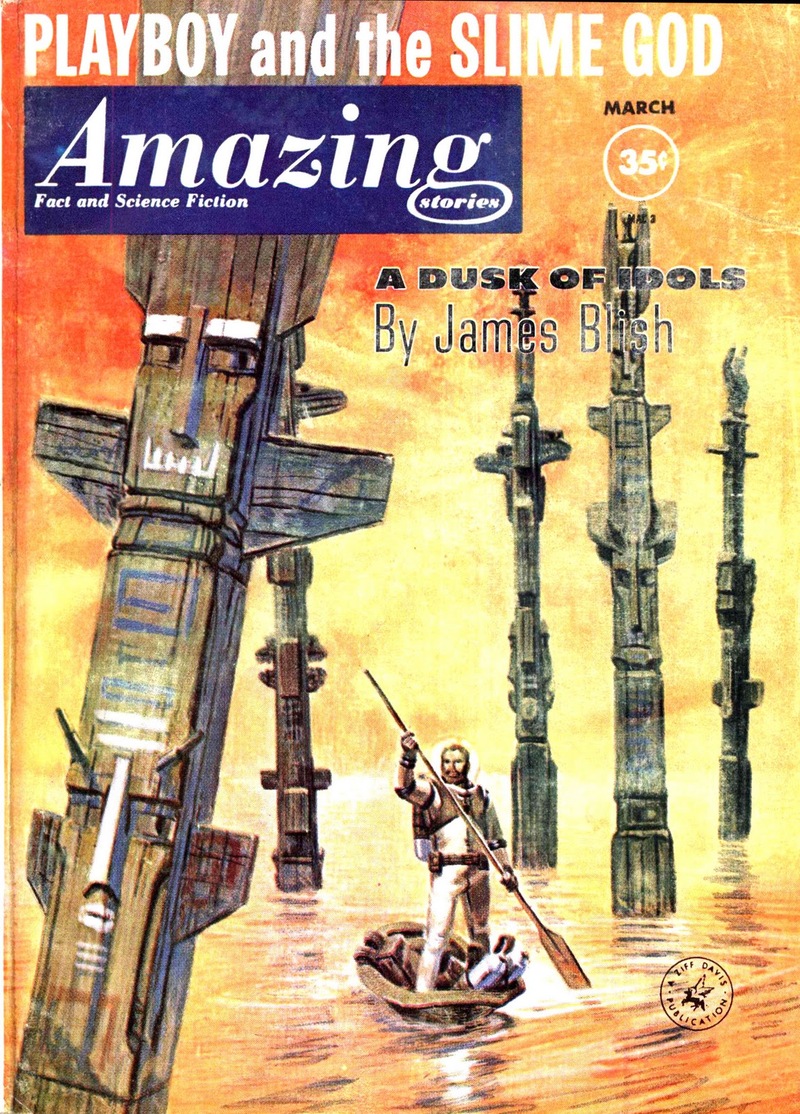
Amazing Stories August 1964Here’s another of Cele Goldsmith’s issues of Amazing, though by this time she had married, and was Cele Lalli. Of particular interest this time around is an obscure Ursula K. LeGuin story.  I notice as well a different font for the title – I liked it. Not sure when it changed.

This time the cover is by Richard McKenna. At first I thought it might be the author of the Nebula winning story “The Secret Place” as well as “Casey Agonistes” and the bestselling non-SF novel The Sand Pebbles (for which last I have seen it suggested he did the original cover). This is credited to him in the ISFDB, actually, and it’s creditable if not brilliant, a scene at a restaurant on the Moon, with aliens – vaguely reminiscent, perhaps, of David Hardy.

However, further investigation (with the help of ace bibliographer Phil Stephenson-Payne) reveals several further covers from mid-60s SF magazines, mostly Galaxy and If, credited to R. McKenna. These covers bear some resemblance in style to this cover, and those that are signed are signed RMcK, much as with this painting. The latest of these other covers dates to 1968, while Richard McKenna of The Sand Pebbles died in 1964. So it seems most likely that another Richard McKenna worked as an illustrator for a while in the mid-60s.

The editorial, unsigned this time (other examples I’ve seen were signed by Norman Lobsenz, the Editorial Director) is about continental drift, which was just beginning to gain traction as a believable theory. There is no science article, but Sam Moskowitz contributes an SF Profile on Mort Weisinger, focusing on his early career as an SF fan, fanzine producer, and occasional writer, before giving him a bit more credit for Superman than seems fair to Siegel and Shuster.

Read More Read More

The Best One-Sentence Reviews of Manly Wade Wellman: The Winners of The Complete John Thunstone Contest

The Best One-Sentence Reviews of Manly Wade Wellman: The Winners of The Complete John Thunstone Contest

The Complete John Thunstone-smallThree weeks ago, we announced a contest to win one of two copies of Manly Wade Wellman’s The Complete John Thunstone, compliments of Haffner Press.

To enter, contestants had to submit a one-sentence review of their favorite Manly Wade Wellman novel or short story. That’s it. Are we good to you, or what?

It quickly became the most popular contest in our history, with a steady stream of diverse entries covering the entire expanse of Wellman’s nearly 60-year career, from his first story in Thrilling Tales in 1927, to his final John the Balladeer story, “Where Did She Wander,” in 1986.

We’d like to present some of the best submissions here, and at the end we’ll announce the two winners, both of whom will receive a copy of The Complete John Thunstone, the latest archival quality hardcover release from Haffner Press.

Perhaps not surprisingly, we received the most votes for Wellman’s popular Silver John stories, also known as the John the Balladeer tales. We begin with Jeremy Harper, who highlights the very first Silver John story:

“O Ugly Bird!” A legend is born when a saintly hillbilly musician confronts a backwoods sorcerer and his goddamn Ugly Bird and smites them dead with his silver string guitar.

Nick Ozment expands on Jeremy’s comments this way:

Having enjoyed one of Manly Wade Wellman’s Silver John novels, I find it interesting how Wellman’s traveling troubadour provides an American folk counterpart to Yeats’s Irish bard Owen Red Hanrahan, rooting the mysticism and magic in American soil.

Read More Read More

Damnation Books Releases Waters of Darkness by David C. Smith and Joe Bonadonna

Damnation Books Releases Waters of Darkness by David C. Smith and Joe Bonadonna

Waters of DarknessWe’re very pleased to note the March 1 release date of a new novel by two Black Gate contributors, David C. Smith and Joe Bonadonna, which they describe as “the best supernatural pirate dark fantasy… EVER.” We asked Dave about the book’s genesis, and here’s what he told us:

This story is based on a ms. I wrote in 1978 that was to be a sequel to The Witch of the Indies, my first published novel, based on Robert E. Howard’s Black Vulmea character… I wrote a 50,000-word first draft in the spring of 1978 (before Witch was published) that I filed away for decades. Despite my naive enthusiasm (at the age of 24!) that Zebra would certainly want a sequel, as we know, The Witch of the Indies sank fast and has pretty much been forgotten. But! Who doesn’t love a pirate story? Joe asked to see that old, yellowing (literally) draft and went to work on it. So we wound up collaborating — at a distance of 35 years, in a way — and have written what we both think is a terrific pulp-style pirate dark fantasy.

Joe took my rough draft, added at least 10,000 words to it, recrafted who knows how many thousands more, and brought in new characters, new developments… He went to town and really brought the thing to life.

David and Joe’s last collaboration for us was The Big Barbarian Theory, one of the most popular articles on the Black Gate blog last year. We featured David’s The Fall of the First World in December, and posted the complete text of Joe’s Dorgo the Dowser novella “The Moonstones of Sor Lunarum” last Sunday.

Waters of Darkness was published by Damnation Books on March 1, 2013. It is 60,000 words and currently available in Kindle format for $5.95. The wonderful cover is by Dawne Dominique. More details at the website.

Blogging Sax Rohmer’s The Bride of Fu Manchu, Part Four

Blogging Sax Rohmer’s The Bride of Fu Manchu, Part Four

1858522_320The Bride of Fu ManchuSax Rohmer’s The Bride of Fu Manchu was originally serialized in Collier’s from May 6 to July 8, 1933 under the variant title, Fu Manchu’s Bride. It was published in book form later that year by Cassell in the UK and Doubleday in the US. The US edition retained the original magazine title until the 1960s when the UK book title was adopted for the paperback edition published by Pyramid Books.

Sir Denis Nayland Smith and Alan Sterling lead the police raid of Mahdi Bey’s Riviera estate. Moving deep below sea level in the underground catacombs, they find themselves cut off by steel doors which descend on both sides. Fearing for their lives and plunged in darkness, they are startled to hear the voice of Fu Manchu informing them he is leaving by submarine and that Dr. Petrie and Fleurette go with him. He explains he is sparing their lives only because Sir Denis and Sterling spared his when they both encountered him in his opium trance.

Smith and Sterling manage to climb through an opening in the catacombs and descend into the underground stream and swim across until they can climb the rocks leading to the beach at St. Claire. Sir Denis notes that Petrie could never have made the journey to the submarine in his weakened condition and sees evidence of oil trails that suggest that another party has left the beach via motorboat. The question remains where the motorboat will meet up with the submarine. Smith suspects their destination would be a yacht with which to transport the party to the rendezvous.

Read More Read More

Last Chance to Win a Copy of The Complete John Thunstone from Haffner Press

Last Chance to Win a Copy of The Complete John Thunstone from Haffner Press

The Complete John Thunstone-smallIn a moment of weakness earlier this month, I decided to give away two copies of the long-awaited pulp compilation The Complete John Thunstone by Manly Wade Wellman.

Too late to back out now. How do you win one, you lucky dog? Just send an e-mail to john@blackgate.com with the title “John Thunstone” and a one-sentence review of your favorite Manly Wade Wellman novel or short story. And don’t forget to mention what story you’re reviewing!

That’s it. Two winners will be drawn at random from all qualifying entries, and we’ll publish the best reviews here on the Black Gate blog.

But time is running out — the contest closes March 3. Because if I have to hold these things any longer than that, there’s no way I’ll be able to part with them.

Haffner’s archival-quality hardcovers are some of the most collectible books in the genre. The Complete John Thunstone is 640 pages in hardcover, with an introduction by Ramsey Campbell and cover art by Raymond Swanland. It is edited by Stephen Haffner and illustrated by George Evans, and has a retail price of $40. Our original article on the book is here.

All entries become the property of New Epoch Press. No purchase necessary. Must be 12 or older. Decisions of the judges (capricious as they may be) are final. Terms and conditions subject to change as our lawyers sober up and get back to us. Not valid where prohibited by law. Or anywhere postage for a hefty hardcover is more than, like, 10 bucks. Good luck!

Black Gate Online Fiction: “The Moonstones of Sor Lunarum” by Joe Bonadonna

Black Gate Online Fiction: “The Moonstones of Sor Lunarum” by Joe Bonadonna

mad_shadowsWe first posted Joe Bonadonna’s sword and sorcery novelette “The Moonstones of Sor Lunarum” in December 2011, and it has proven to be one of our most popular online stories. We’re proud to re-present it here as part of the new Black Gate Online Fiction library.

Long before the legendary cities of Cush and Erusabad were destroyed by war, the graveyard was old. No one knew how old the graveyard truly was, for the carvings on its headstones and markers had been long worn away by the hands of time, wind, and weather. The cemetery crouched with its dead in a hidden vale in the dark heart of Khanya-Toth, land of shadows, black magic, and creatures of the night.

A tall, slim woman sat on the opposite side of the fire, close to the entrance to her bamboo hut. She wore a black robe, her face partially hidden within its hood.

“You’ve come a long way from Valdar to see me,” she said. Her name was Zomandra Chuvai, and she was a witch, one of the Kha Jitah. She lived alone in that ancient graveyard, with only ghosts and memories to keep her company.

“We’re the Blunker boys,” Ollo said. He was all skin and bone, with a sickly yellow pallor.

“I’m well aware of who you are,” Zomandra said. “Shall we talk business?”

“The Moonstones of Sor Lunarum” is part of Joe’s first published swords and sorcery collection, Mad Shadows: The Weird Tales of Dorgo the Dowser. Read more about Mad Shadows in “Dorgo the Dowser and Me,” posted on the Black Gate website here.

The complete catalog of Black Gate Online Fiction, including stories by Mark Rigney, C.S.E. Cooney, Vaughn Heppner, E.E. Knight, Jason E. Thummel, Judith Berman, Howard Andrew Jones, Dave Gross, Harry Connolly, and others, is here.

“The Moonstones of Sor Lunarum” is a complete 15,000-word novelette of weird fantasy offered at no cost.

Read the complete story here.

Kirkus Looks at Astounding Science Fiction

Kirkus Looks at Astounding Science Fiction

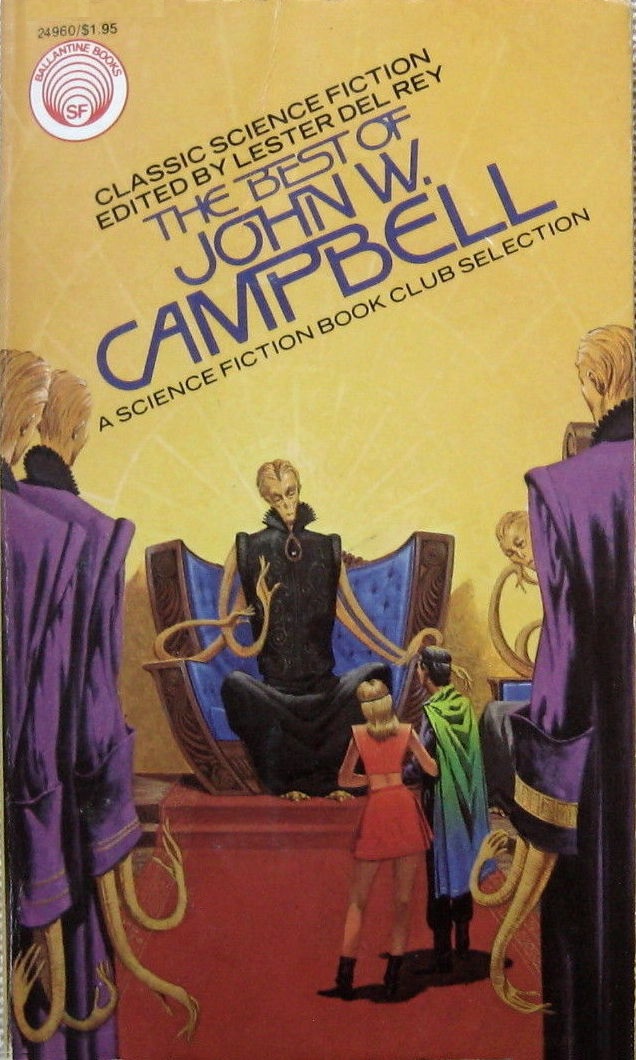
Astounding Science Fiction May 1938Andrew Liptak at Kirkus Reviews has posted a nice retrospective of one of the most influential figures in the history of our genre: John W. Campbell, editor of Astounding Science Fiction and the short-lived Unknown magazine. Here’s a snippet:

In 1938, science fiction would run into another personality who would change science fiction again: When 28-year-old author John Campbell Jr. was hired to edit Astounding Magazine. Campbell’s influence in the magazine market is commonly cited as the beginning of the so-called Golden Age of Science Fiction, and represented a major shift away from the conventions of Gernsback’s pulp era…

With the release of the July 1939 issue of Astounding, the gloves came off. The issue’s table of contents contained a number of high quality stories from new and regular Astounding writers: “The Black Destroyer,” the first published story by A.E. van Vogt; “Trends,” Isaac Asimov’s first sale to the publication; “City of the Cosmic Rays,” by Nat Schachner; “Lightship, Ho!,” by Nelson S. Bond; “The Moth,” by Ross Rocklynne; Amelia Reynold’s “When the Half-Gods Go;” and “Greater than Gods,” by C.L. Moore.

Subsequent issues of Astounding featured a regular stable of authors who have become household names: Theodore Sturgeon, Robert Heinlein, L. Ron Hubbard and Isaac Asimov, amongst many others. The magazine had changed the landscape…

The complete article is here. Thanks to John DeNardo at SF Signal for the tip.

Read More Read More

Affair of the Bear: The Oakdale Affair by Edgar Rice Burroughs

Affair of the Bear: The Oakdale Affair by Edgar Rice Burroughs

Oakdale Affair frontspiece Jack BurroughsYes, this is the 3,000th post on Black Gate. Discovered after the fact, of course. Never thought I’d be writing about a murder mystery centered on a bear for the occasion, but what the hey.

In the spring of 1917, as he was completing the last of the “New Tarzan Adventures” that would eventually fill the volume Jungle Tales of Tarzan, Edgar Rice Burroughs wrote a short novel (40,000 words) titled “Bridge and the Oskaloosa Kid.” A reader of the previous year’s The Return of the Mucker might recognize the name “Bridge” as belonging to that novel’s itinerant poet and co-hero. Burroughs liked the character so much that he spun him off into his own story: a crime drama/mystery, something different for the author.

Editor Bob Davis at All-Story found little to appreciate about ERB’s new tact when “Bridge and the Oskaloosa Kid” landed on his desk. He argued that its twist ending stretched credulity past what readers would tolerate: “Lord! Edgar, how do you expect people who love and worship you to stand up for anything like that? And the bear stuff, and the clanking of chains!” Davis may also have objected to mentions of one of the villains injecting morphine to feed an addiction. Although Davis remarked that Bridge was a “splendid character” in The Return of the Mucker and “well worth a great story,” the editor didn’t think this was it. He bounced the novel back to ERB.

Burroughs had his own doubts about “Bridge and the Oskaloosa Kid,” criticizing his performance as “rotten” even before he finished. But his name was still good for a sale in a magazine in 1917, and the novel ended up at Blue Book, printed in full in the March 1918 issue under the more economical title The Oakdale Affair. Editor Ray Long paid $600 for it, considerably less than ERB’s standard pay-rate at the time.

A year later, a movie titled The Oakdale Affair starring Evelyn Greeley premiered from World Film Company. It was the fourth film made from ERB’s work, and a rare non-Tarzan one. Somebody must have liked the book, the opinions of the author and his editor be damned!

What to make of this unofficial third novel of the “Mucker Trilogy,” a crime thriller/mystery with a vanished heiress, murderous drifters, gypsies, an enthusiastic child detective, a deadly bear, a lynch mob, a couple of dead bodies, and a chain-clanking ghost in a haunted house? Did ERB stray too far in looking for somewhere else for his poetry-loving Bridge to roam?

Read More Read More