Browsed by
Category: Pulp

Vintage Treasures: Big Planet by Jack Vance

Vintage Treasures: Big Planet by Jack Vance

Startling Stories September 1952-small Big Planet Jack Vance Ace-small Big-Planet-Ace-1978-small

I’m embarrassed to admit that I became a Jack Vance fan only late in life. I blame a misspent youth.

I first discovered him through his short fiction — especially “The Dragon Masters” and “The Moon Moth,” two brilliantly imaginative tales of far-off worlds. But I was slow to discover his novels and I’ve spent the last few years trying to catch up.

The one I want to read next is Big Planet, his 1952 novel of a massive but technologically backwards world known simply as Big Planet, settled over the centuries by a host of criminals, malcontents, and outcasts from Earth. Claude Glystra is sent to Big Planet to investigate rumors of a dark plot against Earth, but his ship is sabotaged and crash-lands 40,000 miles from his destination. Glystra and his crewmates must undertake an impossible journey on foot across a dangerous landscape filled with aliens, human colonies isolated for centuries, and the treacherous agents of his enemies.

Big Planet was Vance’s first major SF novel, and it is one of the classic adventure fantasies of the 1950s. It has been reprinted over a dozen times. I have several different paperback editions — and they are, in fact, very different. All I have to do is figure out which one to read.

Read More Read More

What Would it Look Like to Pull a Watchmen on Planetary Romance? Part II

What Would it Look Like to Pull a Watchmen on Planetary Romance? Part II

carson aWhen we last left our intrepid blogger (me) two weeks ago, he was blogging (very roughly) about the superhero genre, pre- and post-Watchmen, and the kind of light that Alan Moore’s Watchmen shone onto superhero comics. I did this because I think Moore did something very special and I wondered if it could be done to other fields, especially planetary romance.

I ended on a cliffhanger. And now, Part II….

I said last time that most of the traditions of the superhero genre were born in a very brief period between 1938 and 1945. In fact, the elements of the superhero tradition come part and parcel from the larger pulp tradition, which contained westerns; gritty and occasionally lurid detective stories; and planetary romances like Buck Rogers, Flash Gordon, John Carter of Mars, and Carson Napier of Venus.

The planetary romance tradition was powerfully tailored to its key market: white male American teens and men. If you were an under-appreciated teen with hero or power fantasies, pulp was your thing.

The heroes were young, white, smart, good looking, physically able, self-deprecating, and commanding. They confronted immediate perils (like a monster) or vast dangers (like an invasion), often single-handedly, or from a position of inspiring leadership.

And the opponents the hero fought were most often one-dimensional, morally-destitute cardboard placeholders for savage (non-whites) in our world, a view consistent with racial views of the late 19th century.

Read More Read More

Blogging Sax Rohmer’s The Shadow of Fu Manchu, Part One

Blogging Sax Rohmer’s The Shadow of Fu Manchu, Part One

Doubleday ShadowShadow JenkinsThe Shadow of Fu Manchu was serialized in Collier’s from May 8 to June 12, 1948. Hardcover editions followed later that year from Doubleday in the U.S. and Herbert Jenkins in the U.K. The book was Sax Rohmer’s eleventh Fu Manchu thriller and was also the last of the perennial series to make the New York Times bestseller list.

The story had its origins in a Fu Manchu stage play that Rohmer had developed for actor Basil Rathbone. The project had failed to get off the ground, but became instead the first new Fu Manchu novel in seven years. Sadly, during these seven years, the property had begun to fade from the public eye.

It had been eight years since the character last appeared on the big screen (in the popular 1940 Republic serial, Drums of Fu Manchu) and eight years since the well-received Shadow of Fu Manchu radio series (from which the planned stage play and later novel borrowed its title) had left the air. Detective Comics had long since finished reprinting the Fu Manchu newspaper comic strip as a back-up feature for Batman. As far as the public was concerned, Fu Manchu was a part of the past that seemed far removed from the world that had been transformed by the Second World War.

Read More Read More

The 1939 Retro Hugo Award Winners Announced

The 1939 Retro Hugo Award Winners Announced

The Sword in the Stone T. H. White-smallBack in April, we told you about the nominees for the 1939 Retro Hugo Awards, for the best science fiction and fantasy first published 75 years ago.

The Hugos were first awarded at the 11th World Science Fiction Convention in 1953. The 1939 Retro Hugo Awards celebrate the finest work published in 1938, which fans would have voted on at the very first Worldcon in New York in 1939 (if the Hugos had existed in 1939).

The Retro Hugos were awarded at Luncon 3, the The 72nd World Science Fiction Convention, held from Thursday, August 14th through Sunday, August 17th, in London, England. The 2014 (non-Retro) Hugos will be awarded tomorrow in a ceremony just before the close of the convention.

The Retro Hugo awards were presented by Mary Robinette Kowal and Rob Shearman.

Without further ado, here are the winners:

Best Novel:

The Sword in the Stone by T. H. White (Collins)

Best Novella:

“Who Goes There?” by Don A Stuart [John W. Campbell] (Astounding Science-Fiction, August 1938)

Read More Read More

Collecting Lovecraft, Part I

Collecting Lovecraft, Part I

HP Lovecraft Ballantine Paperbacks-small

Last month I wrote about the first Arkham House books I ever bought, the beautiful 3-volume 1964 edition of the complete stories of H.P. Lovecraft. It was a splendid purchase, and a great introduction to the master. But, as I mentioned last month, collecting Lovecraft can be a lot of fun, and that initial purchase robbed me of the joy of tracking down his fiction in paperback. Until I finally decided to do it anyway.

Now, if you’re going to start collecting Lovecraft in paperback (and why wouldn’t you?) I recommend starting with the 1958 Avon paperback Cry Horror!, originally released as The Lurking Fear. That’s a terrific little book.

Of course, it’s just one book, and one that’s pretty easy to find, really. Amazon has copies starting at $7.95, and eBay has around a dozen copies, starting at $6.99. You want more of a challenge than that, don’t you?

Read More Read More

Vintage Treasures: Sturgeon in Orbit by Theodore Sturgeon

Vintage Treasures: Sturgeon in Orbit by Theodore Sturgeon

Sturgeon in Orbit-smallA few weeks ago, I wrote about my surprise in finding a Theodore Sturgeon collection I hadn’t known existed: To Here and the Easel, a handsome Panther Books paperback from 1975 that never had a US edition.

That book re-ignited my interest in Theodore Sturgeon, whom I consider one of the finest short story writers to dabble in SF and fantasy in the 20th Century. And it reminded me that I have by no means exhausted the Sturgeon titles I already have in my collection.

So this week I pulled another one off my shelf — the 1978 paperback edition of Sturgeon in Orbit, which I’ve never read before. It collects a fine sample of Sturgeon’s work from the early 1950s, the era of flying saucers, national paranoia, and a newborn fear of nuclear Armageddon. It features mysterious alien invaders, noble scientists facing terrifying choices, and stranger things.

The unusual cover, by Stanislaw Fernandes, was a departure for Sturgeon, whose books usually featured abstract space scenes. This one features… well, I’m not sure really. A runway model wearing three capes and a swami headdress, who looks like she’s about to level up. I get it.

Whatever the case, it’s a nice, slender volume that promises to be something I haven’t enjoyed in a while — a very quick read. So far, it’s been a lot of fun and I look forward to finishing it this weekend.

Here’s the description from the back of the book.

Read More Read More

A Must for Sax Rohmer Fans – A Rohmer Miscellany

A Must for Sax Rohmer Fans – A Rohmer Miscellany

Rohmer Miscellanysumuru-cover-final+flapsJohn Robert Colombo is a Canadian author and poet with over 200 titles to his credit. Apart from the acclaim his creative work has brought him, he is also a lifelong Sax Rohmer fan and collector, who has distinguished himself in this rarefied circle. A charter member of the now-defunct Sax Rohmer Society and early contributor to the society’s official publication, The Rohmer Review, Colombo never lost his passion for the weird fiction of this former bestselling thriller author. Rather late in his prestigious literary career, Colombo decided to contribute to Rohmerania by expanding the author’s catalogue in conjunction with Dr. George Vanderburgh’s Battered Silicon Dispatch Box imprint.

Colombo edited the definitive collection of Rohmer’s female variation on Fu Manchu with The Sumuru Omnibus, a massive tome which brought together all five Sumuru novels, penned during the author’s last decade, and preserved them in their original unexpurgated text. Colombo also compiled a monograph of Sumuru’s aphorisms direct from Rohmer’s original text with Tears of Our Lady. The unique feature of the monograph being that this same title exists within the fictional universe of the books and is referred to and quoted from frequently. Now, thanks to Colombo’s efforts, Sumuru’s fictional monograph exists as a real world collectible. Colombo and Vanderburgh also competed (unknowingly at first) with Will Murray and Altus Press in publishing the first book to collect all of Rohmer’s tales of The Crime Magnet. Still later, they teamed to produce the first anthology of Rohmer’s non-fiction articles and autobiographical essays, Pipe Dreams, spanning the author’s entire career.

Read More Read More

New Pulp Delivers its own Occult Anti-Hero in Magee

New Pulp Delivers its own Occult Anti-Hero in Magee

22ca6069f22a20114e9bdbb1f223deb7f3ce43c715119I’ll come right out and admit I have mixed feelings about ebooks. I travel considerably for my day job and don’t mind having portable versions of books I own for quick reference, but the idea of owning books that cannot be found in print editions on my shelves at home irks me. That said, I recognize the market for digital-only titles is steadily growing, particularly among small press publishers. This, of course, is having its impact on the “New Pulp” community. Witness Pro Se Press’s decision earlier this year to discontinue their pulp magazine, Pro Se Presents and replace it with their Single Shot Signatures line of short stories available exclusively as ebooks.

My first sampling of the above is the newly published Magee, Volume One – “Knight from Hell” by David White. At first glance, I was struck by the apparent illustration of publisher Tommy Hancock on the cover, but on second glance I determined it was actually author David White wearing one of Tommy’s trademark hats. Of course, I was wrong on both counts since the illustration actually depicts the anti-hero of the piece, Magee.

Magee, it transpires, is actually the fallen angel Malachi who was exiled from Heaven after a fight over a woman with the archangel Michael. We’ll pause right here and note that David White is not a theologian and plays fast and loose with Christian tradition on such celestial matters. Following that disclaimer, we’ll make mention of the fact that Michael likewise banished the archangel Lucifer from Heaven following a similar fight. It seems that God is an absentee deity in these proceedings as He has abandoned Heaven to putter around in the Garden of Eden for several thousand years now.

Read More Read More

The Original Bug-Eyed Monster: Astounding Stories, May 1931

The Original Bug-Eyed Monster: Astounding Stories, May 1931

Astounding Stories May 1931-smallPulps are my weakness. I discovered them when I was just 12 years old, in Jacques Sadoul’s marvelous art book 2000 A.D. Illustrations From the Golden Age of Science Fiction Pulps (which I discussed back in May). That book sparked a lifetime interest in pulp magazines, where American science fiction was born.

Of course, I was too young to have purchased or read any pulp magazines myself in 1976. Pulps died out in the 1950s, killed off by wartime paper shortages and changing economics. So I’ve relied on the collector’s market to supply me with magazines — an expensive proposition, especially if you’re a completist.

Over the years, I’ve gotten more discriminating in my collecting. I dearly love Planet Stories, Weird Tales, Amazing Stories, Thrilling Wonder, Unknown, Air Wonder Stories, and many other pulps. But my favorite is Astounding Stories (later Astounding Science Fiction), the magazine which — under legendary editor John W. Campbell — ushered in the so-called Golden Age of Science Fiction, discovering Robert A. Heinlein, A.E. van Vogt, Isaac Asimov, Theodore Sturgeon, and many, many others. Campbell became editor with the October 1937 issue and he quickly transformed the entire field. 

Curiously, the most expensive and in-demand issues of Astounding aren’t from Campbell’s reign, however. They’re from its first three years, 1930-1933, the period known as the Clayton Astounding, when it was owned by Clayton Magazines. That’s their symbol, the little blue pennant, in the top right of the cover at left.

Very little fiction from the Clayton period is remembered today — and if you’ve never heard of the Clayton Astounding, you’re not missing much. The magazine’s early editors, like most of the American public, didn’t really understand science fiction and mostly filled the magazine with thinly disguised westerns in space and early space operas. But the covers… ah. They’re a very different story.

Read More Read More

Blogging Sapper’s Bulldog Drummond, Part Four – “The Third Round”

Blogging Sapper’s Bulldog Drummond, Part Four – “The Third Round”

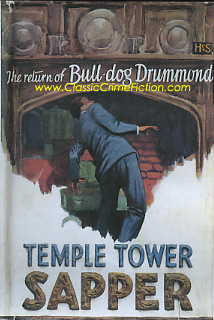
510+vaEqotL._SY344_BO1,204,203,200_20974339Sapper’s The Third Round (1926) marked a return to the more humorous tone of the first book in the series. Not only the humor, but the premise of that initial book is invoked with the decision to again build the plot around a spunky female whose doddering old father has fallen prey to heinous villains. All trace of The Black Gang (1924) and its doom-laden paranoia over England likewise falling prey to a communist revolution has been removed. In its place we have Hugh Drummond once again eager to escape the boredom of everyday life and engaging in comical banter with friends and foes alike.

The starting point for the adventure this time is the impending nuptials of Algy Longworth, Hugh’s old friend who has finally been reduced to the silly ass familiar from the stage play and film adaptations. The catalyst for Algy’s descent into idiocy is his having fallen head over heels in love to the extent that he now horrifies his friends by reciting poetry. So serious is his obsession with the girl of his dreams that he has become a literal walking disaster shunned by all who know him.

Read More Read More