Browsed by
Category: Comics

Blue Sonja: The Last Red Sonja Post
Blue Sonja: The Last Red Sonja Post

Unchained 1 BlueI started this series of posts with the intention of only writing one. “In Defense of Red Sonja” was meant to be a stand-alone post about how the character was more than just a female version of Conan the Barbarian, more than just a fan-service redhead in a chain mail bikini, more than a misogynist rape-challenge. I’ve been collecting comics from the “Bronze Age” (approximately 1970 through 1985) for years and Red Sonja wasn’t the only female character to pop up. There was Spider-Woman, She-Hulk, Ms. Marvel … all clearly starting as female versions of established male heroes and all eventually transcending those limits to become their own concepts.

That first post quickly grew in size, reaching over three-thousand words before even going into her appearances in Marvel Feature or her self-titled book. As it covered three distinct themes (how she differed from Conan, where the bikini came from, what the vow meant), I thought it would be better to break it into three separate articles. By the time the third post came out, I’d gotten enough positive reaction that I thought it might be nice to keep exploring how the character grew over the course of her own title. It was at this point that I realized just how much humor got slipped in to various panels of the title, which got me in the habit of highlighting a couple images each week. The novels and film were good ways to show how the character translated into other media, as well as how she was still evolving. And it was all a lot of fun.

So why is this the end? There were two more Marvel Comics series in the early eighties, as well as two Dynamite Entertainment series (Red Sonja and Queen Sonja) currently running. Not to mention a slew of one-shots and mini-series. I’ve got enough material to easily keep this column running at least another three years. And it is tempting to try.
Read More Read More

Try a Free Preview of IDW’s Dungeons & Dragons: Cutter #1

Try a Free Preview of IDW’s Dungeons & Dragons: Cutter #1

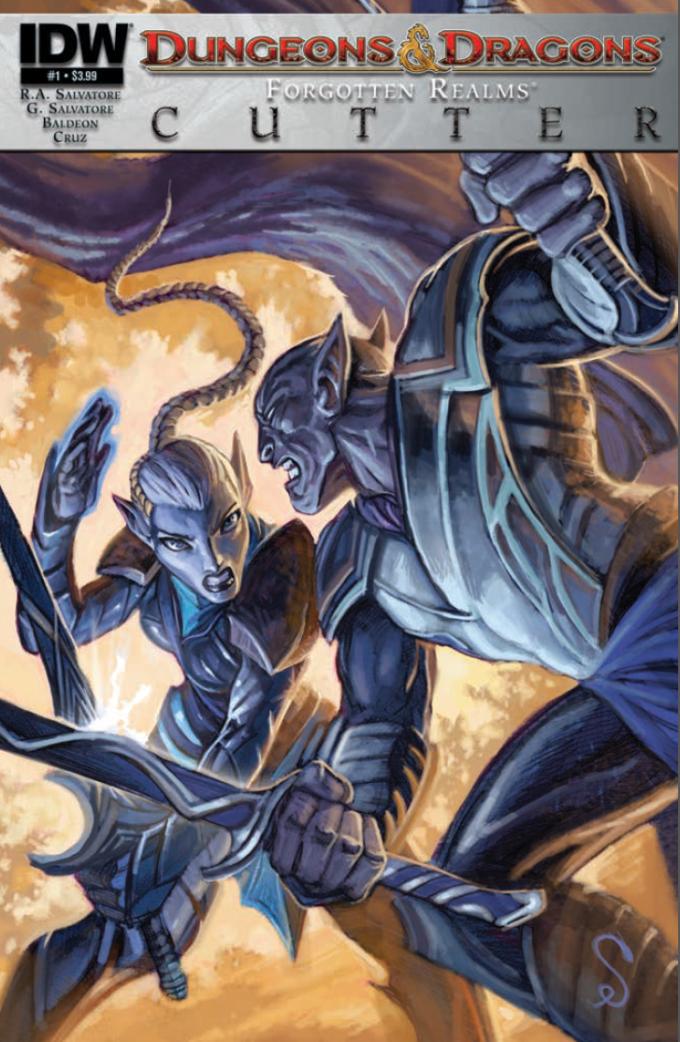
Dungeons-Dragons-Cutter-1 coverIDW’s Dungeons and Dragons comics have been my favorite D&D comics since… well, ever, really. Which is saying something, since some pretty respected publishing houses — including Marvel, DC, and Kenzer & Co — have tried their hand over the decades.

IDW’s comics have been successful, as well. Enough that they’ve spun off a number of titles in the game’s most popular settings, including Forgotten Realms, Eberron, and Dark Sun. Now IDW has announced another entry in their impressive line of D&D titles: Cutter, a five-issue miniseries written by R.A. and Geno Salvatore, with art by David Baldeon and covers by Steve Ellis.

Cutter follows the saga of a fiercely divided drow family… and a legendary sword. When the battle-hardened Drow renegade Tos’un must choose an heir to his legacy, his half-Drow son Tierflin and daughter Doum’weille become locked in vicious competition. But what will the prize, the bloodthirsty sword Khazid’hea — known as the Cutter — have to say? Author R.A. Salvatore tells us:

These comic series have become a wonderful tool for me to fill in the blanks and to crystallize my thoughts on the Legend of Drizzt novels going forward. The fallout from the twisting events in Neverwinter Tales not only came into play in the last couple of Drizzt books, but allowed me a strong plot line for an upcoming novel I’ve yet to pen. The same is true for Cutter — I see it already. So while these comic stories are self-contained, they open up to the wider stories.

We’re very pleased to be able to offer a preview, in high resolution full-color PDF format. Click on the link below to enjoy the first seven pages of Cutter, compliments of IDW.

Dungeons & Dragons Cutter #1 – Preview

Dungeons & Dragons: Cutter #1 will be published by IDW Publishing on April 17.  It is 32 pages in full color, priced at $3.99.

Red Sonja: The Novels

Red Sonja: The Novels

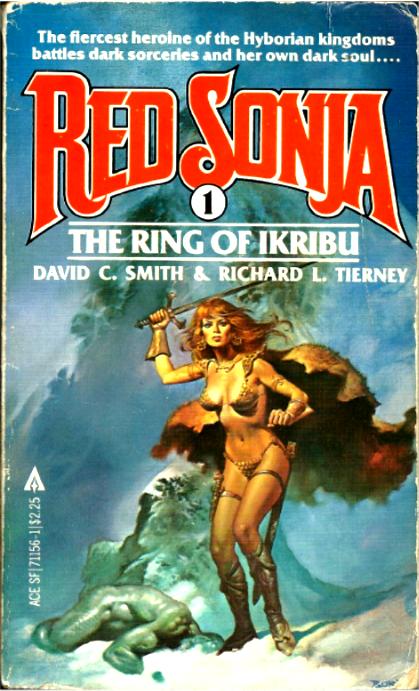
Red Sonja 1 - The Ring of IkribuIn late 1981, Red Sonja finished her orbit from Robert E. Howard character to Conan supporting cast member to comic book heroine and back to text. Writers David C. Smith and Richard L. Tierney were commissioned to write six Red Sonja novels. Their take on the character was uniquely their own, yet there’s enough of the character’s trademarks to leave no doubt these are Red Sonja novels and not just generic adventure tales with a recognizable name pasted over them.

The series began with The Ring of Ikribu, first published in December 1981. After a brief introduction by Roy Thomas (wherein the origins of the character are explained), the story opens with Asroth (an evil wizard) chewing out one of his lieutenants for failing to locate the titular ring. As punishment, he magically rearranges the lieutenant’s face into some sort of Lovecraftian unspeakable horror. Shifting locations, we learn that Asroth has seized the kingdom of Suthad with an army of ghosts. The ousted king, Olin, is gathering a mercenary army to take back Suthad and Red Sonja is one of those mercenaries. Also amongst the mercenaries is Duke Pelides, the aforementioned lieutenant who is now forced to wear a mask at all times. Olin wants the return of his kingdom, Pelides wants revenge, and Sonja just wants to get paid. Of course, as is the way with Sonja, she slowly becomes emotionally invested in those around her and eventually the money ceases to be her driving motivation. In less than two-hundred and fifty pages, the novel does a good job of conveying the sense of a long, grueling campaign without actually become monotonous.

Read More Read More

The Enigma

The Enigma

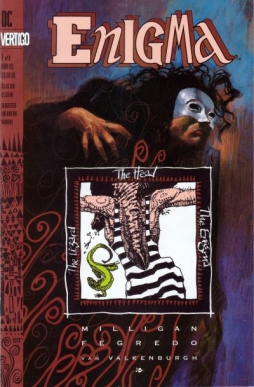
The EnigmaIn 1990, the Walt Disney Company launched a new comics imprint, Disney Comics, to publish titles starring their cartoon characters; they’d previously licensed their characters to other comics companies, but the new imprint represented their own entry into the field. The venture met with some initial success and Disney began to plan further imprints, including one under former DC Comics assistant editor Art Young, which would be called Touchmark and feature creator-owned books for ‘mature readers.’ In this context, that meant something like ‘literary fantasy.’ At the time, DC had a number of books labeled for ‘mature readers’ which had gathered critical attention and good sales — among them, Neil Gaiman’s Sandman, Grant Morrison’s Doom Patrol and Animal Man, Jamie Delano’s Hellblazer, and Peter Milligan’s Shade the Changing Man. Young brought some of these writers over to the projected Touchmark line. Announced titles included a book written by Morrison with art by Steve Yeowell, Sebastian O, one by Milligan and artist Duncan Fegredo, The Enigma, and J.M. Dematteis and Paul Johnson’s Mercy.
Touchmark never published a book. Sales for the Disney titles had begun to drop, and all the projected imprints were cancelled. But the work wasn’t wasted. Young returned to DC, bringing some of the Touchmark books with him. There, editor Karen Berger was developing a publishing plan for DC’s ‘mature readers’ books, which would be grouped together along with some new titles as an imprint of their own, to be called Vertigo. The Touchmark titles fit in seamlessly, and helped increase the diversity of the new imprint: these weren’t just re-imagined DC characters, but something completely new. I want to write here a bit about one of those books: Milligan and Fegredo’s Enigma.

The Enigma is a difficult book to describe. It opens with a seemingly random sequence of events. A narrator — abrasive, confrontational, but unseen — fills captions with sarcasm and rhetorical questions. Improbable, bizarre things happen; characters react to them in weird, apparently inexplicable ways. But then as the story goes on things begin to link up. What seems deranged becomes coherent. Explanations slowly emerge. Even the identity of the narrator and the reason for that narrator’s tone become clear during the unwinding of the tale. It’s an incredible technical accomplishment that works as more than technique: the surreality breaks open your mind, and the slow-emerging explanations build around peculiar links, feeling like dreams or obsessions, all of it gaining inexplicable depth as it resolves itself into a kind of postmodern Freudian parable. With super-heroes.

Read More Read More

Marvel Team-Up 79

Marvel Team-Up 79

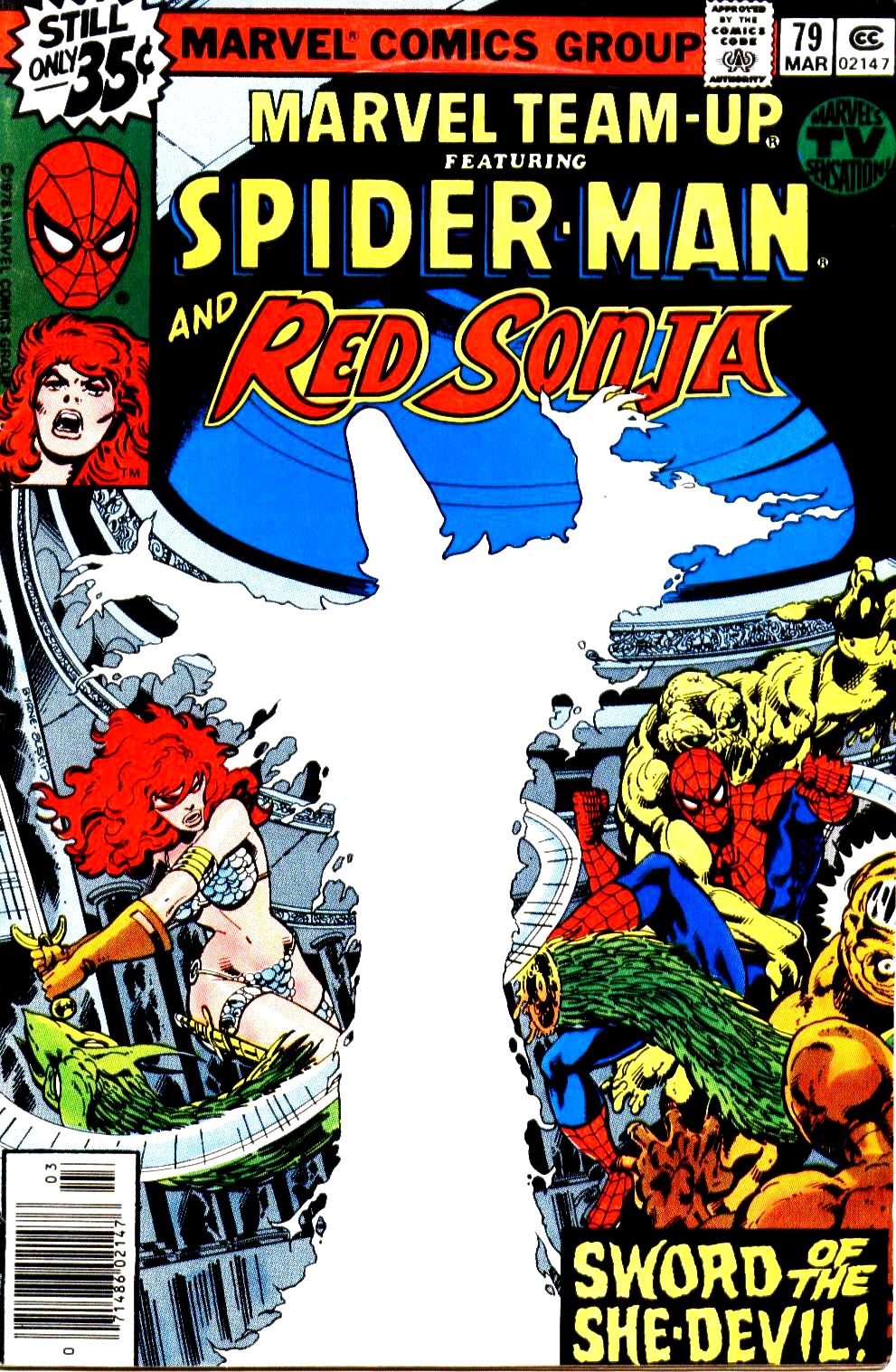
MTU 79 coverLet’s start with the cover. In the foreground is our reverse-silhouette antagonist, looking very much as if some meta-fictional demon took a pair of cosmic sheers and simply snipped him out of that four-color reality. In the background is Red Sonja, looking very much in her element as she chops the head off a giant snake. Standing beside her is Spider-Man, punching out a demon. If none of this convinces you to pick up the issue, a small blurb in the corner reminds you that it’s “Still Only 35¢.”

The first page reveals that this story will be set not in the Hyborian Age, but rather in the equally mythical 1978 New York. December 22, to be specific. And the team who will be working on this story? Chris Claremont (who wrote all those X-Men comics you loved as a kid), John Byrne (who wrote all those Fantastic Four comics you loved as a kid), and Terry Austin (who probably inked a few issues of every title you loved as a kid). This is what would commonly be referred to as a dream team. And seeing the casual beauty of something like Spider-Man swinging past a museum on a snowy evening gives only a hint of what’s to come.

Page two is the story of security guard Gus Hovannes going on his nightly patrol of the museum. And let me add once again that, yes, it is nice when someone as incidental as a random security guard gets a name and a little background. It makes the world feel lived in, the characters richer. So when Gus breaks through a glass display case and grabs the onyx necklace, his cut hands spilling blood on the ancient jewelry, he’s a little more than just a plot device.

The scene then cuts to an office Christmas party at the Daily Bugle. I’ve ranted before about the trend towards decompressed storytelling, but it’s truly amazing to see how quickly a great writer can present a string of characters and their major personality traits. If you don’t know who J. Jonah Jameson is, one panel tells you everything you need to know about him. Mary Jane Watson gets her one character-defining panel as well (Kirsten Dunst never did THAT). And then the editor gets a call about some sort of disturbance at the Metropolitan Museum of Art. He sends Peter Parker and Charlie Snow out to investigate by virtue of the fact that they’re the only two people at the party who aren’t falling down drunk.

Read More Read More

Weird of Oz Wishes you a Happy Easter

Weird of Oz Wishes you a Happy Easter

scan0017
Mixed-media collage by Nick Ozment

Happy Easter! Or, if you do not celebrate that holiday, happy celebration of spring and the goddess of fertility!

I have nothing to review or to report today. I will soon be following my young children around as they fill their baskets with eggs. But for those of you who snuck away from the ham and hardboiled eggs long enough to log on and drop by, I wanted to be here to chat at the Gate a minute or two.

This weird blog of Oz’s is about three months old; last week, its entries entered the double digits. Today, for post number 11 (“This blog goes up to 11.” And thumbs up to those of you who get that allusion), I thought I’d mention a few of the projects I have in the works for upcoming posts. And, if you’re feeling chatty, you could help me out by letting me know if any topic in particular piques your interest, which may influence my prioritizing.

  • I’m reading Manly Wade Wellman’s complete John Thunstone collection, which I recently won in a Black Gate giveaway. When I’m done, I’ll post a review.
  • I have a stack of the complete run of Arak, Son of Thunder that is just crying out for a series of issue-by-issue breakdowns.
  • In a follow-up to an earlier post, I’d like to do an episode-by-episode guide to the new Scooby-Doo series Mystery Inc., “annotated” to note the fantasy/sci-fi/horror allusions and references peppered throughout.
  • In another follow-up, I’m hankering to try some more single-player RPGs similar to the Fighting Fantasy books that I reviewed a couple weeks back.
  • As I said from the outset, a large part of what fuels the engine of this blog is nostalgia. In that vein, I’ll be revisiting some vintage fantasy board games like Dungeon!.
  • Also — top secret confidential hush hush — over the past few years I’ve been doing some research to uncover the sources or inspirations for certain D&D monsters that burst straight from the mind of Gary Gygax, i.e., iconic D&D monsters that have no clear antecedent in myth or folklore (the rust monster, for example).
  • The last two comments to last week’s post inspired me to begin writing a piece considering the spectrum of RPG game-masters and players ranging across the continuum between pure gamers (the rules sticklers) and storytellers (those who may consult the dice, but the GM’s final call is always more bound to the service of the unfolding narrative over and above any game rules).

There are more — always more ideas floating around up here in this egg than I can pursue to all their rabbit holes — but I’ll leave it there for now.

See you in April.

Master of Shadows

Master of Shadows

MoS 6As I mentioned last week, Red Sonja’s first series ended with issue fifteen. But cancellation often came quickly and without warning in the Bronze Age of Comics (look it up – it’s my favorite era). So there was already another Red Sonja story written and illustrated, no doubt ready for coloring, when the axe fell.

Well, nothing went to waste at the House of Ideas, so in October 1979, the story was published as a back-up feature in Savage Sword of Conan 45, in glorious black and white. Master of Shadows reads like a new direction for the series was seriously being considered before the whole thing got shut down. It’s one of the rare Red Sonja stories completely free of the supernatural and with a plot that’s far more coherent than what we’ve come to expect from the She-Devil with a Sword.

The new direction is likely due in large part to Roy Thomas being replaced as writer by Christy Marx. If that name sounds familiar, it might be because you heard an interview with her a couple months back. Maybe you’re a fan of her sword-and-sorcery limited series, Sisterhood of Steel. Maybe you’re following her current take on Amethyst, Princess of Gemworld in the pages of Sword of Sorcery.

But, more likely, you’ll remember her as the creator of Jem, the truly outrageous holographic pop singer from the 1980s. Jem would occasionally get transported back in time or shanghaied by yetis in her never-ending quest to keep the Starlight Home for Plot Device Girls open. So Marx certainly would seem to have the writing pedigree to follow-up giant clams and ancient green robots. But she instead chose a rather straight interpretation of the character.

Of course, there’s still room for fun in a straight version of Red Sonja. The story opens with our heroine trying to catch a nap in a public park. Draped out on a park bench in her chain mail bikini, she certainly draws her share of appreciative leers, but three men in particular decide to approach her with the standard “show you a good time” dialogue. Two of the three get tossed in a nearby pond, while the third, who only identifies himself as the Master of the House of Shadow, tells her that she was right to toss them, but now she should leave town as they’ll want revenge. It’s good advice, but Sonja won’t be driven off.

Read More Read More

Red Sonja 15

Red Sonja 15

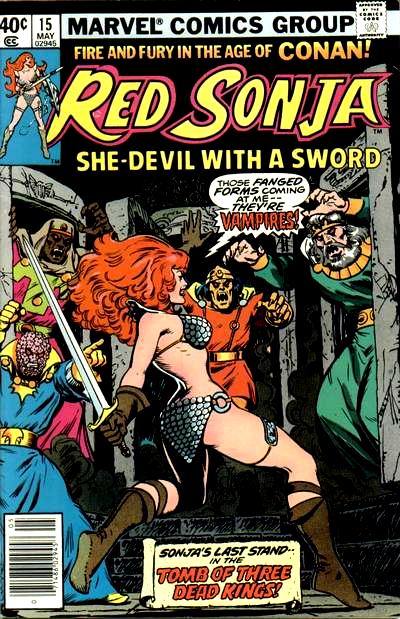
Red Sonja 15 coverI know I’ve gone on about this before, but cover spoilers can ruin an otherwise great story. Seriously, click the cover to Red Sonja 15 and tell me if you can guess the secret of the three dead kings. Honestly, even the title (The Tomb of Three Dead Kings!) practically gives it away.

So it is a little surprising when we open to page one and find … a mummy. Just some guy wrapped in cloth strips, surrounded by a circle of swords in the snow. Sonja stops at the sight of him and is about to take a closer look when she sees three men dressed like kings (spoiler, they are) riding in the distance. So what’s an adventurer to do? Investigate the mummy or the three kings riding together in the dark?

Sonja opts for neither. Instead, she heads in the opposite direction to a sleepy little town where she finds a warm inn to relax in.

Of course, Red Sonja’s idea of relaxing includes beating everyone at dice until her satchel is full of coins and everyone at the inn is mad at her. She gets invited into the backroom by three of the losers, only to get attacked. Even though she’s expecting it, one of them gets a lucky shot and Sonja’s quickly stripped of her sword and purse, then thrown out in the snow.

Even with her cloak, that bikini isn’t helping much in the snow. And, honestly, why would she still be wearing a bikini in the dead of winter? In fact, a metal bikini would get even colder than a regular cloth one. Even her horse is wearing a blanket.

Fortunately, Red Sonja always keeps an emergency coin in her boot, so she has enough to cover a crappy inn on the other side of town. Before she goes, she manages to steal a sword by holding a passerby at knife-point. Near as I can tell, this is just one of the shlubs she beat at dice a few hours earlier. He’s not one of the guys who attacked her and he didn’t even try to hold out on what he owed. He just happened to be at the wrong place at the wrong time and now Sonja has a new sword.

Read More Read More

New Treasures: Comics: The Complete Collection by Brian Walker

New Treasures: Comics: The Complete Collection by Brian Walker

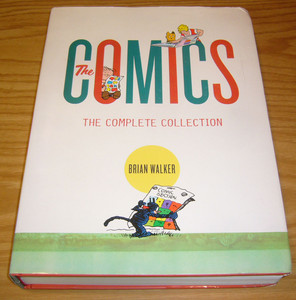
Comics The Complete CollectionThere are coffee table books, and there are coffee table books. Brian Walker’s Comics: The Complete Collection is the latter — meaning it’s a “coffee table” book in the sense that it’s large enough to be propped up and used as a coffee table. For a family of five.

If the very existence of a 672-page, 7-pound book crammed full of vintage American comics strips from the past 110+ years isn’t enough to interest you, then you probably have no soul. But maybe this will help: this book collects 1,300 of the best newspaper strips from some of the finest comics ever created, including Walt Kelly’s Pogo, Berke Breathed’s Bloom County, Bill Watterson’s Calvin and Hobbes, Scott Adams’s Dilbert, Charles Schulz’s Peanuts, Will Eisner’s The Spirit, Gary Larson’s The Far Side, Hal Foster’s Prince Valiant, Chester Gould’s Dick Tracy, Ernie Bushmiller’s Nancy, Milton Caniff’s Terry and the Pirates, Al Capp’s Li’l Abner, Roy Crane’s Wash Tubbs, Dik Browne’s Hagar the Horrible, Jim Davis’s Garfield, Harold Gray’s Little Orphan Annie, Bill Griffith’s Zippy the Pinhead, Johnny Hart’s B.C., Geroge Herriman’s Krazy Kat, Burne Hogarth’s Tarzan, Lynn Johnston’s For Better Or For Worse, Bil Keane’s Family Circus, Hank Ketcham’s Dennis the Menace, Winsor McCay’s Little Nemo in Slumberland, Dale Messick’s Brenda Starr, Richard Outcault’s Yellow Kid, Brant Parker’s Wizard of Id, Alex Raymond’s Flash Gordon, E.C. Segar’s Popeye, Mort Walker’s Beetle Bailey, Tom Wilson’s Ziggy, and Chic Young’s Blondie.

And others. Lots and lots (and lots) of others.

It’s called The Complete Collection because it was originally published in two volumes: The Comics Before 1945 and The Comics Since 1945. These survey volumes were useful in their own right, with comics organized by decade, and well-written biographical profiles, as well as thoughtful analysis of the different genres. But the omnibus collection is both an incredible value and a beautiful piece of work, the kind of gorgeous and massive tome you could place prominently in the living room, flip through for years, and never exhaust. Or use to prop up the foundation of your house, whatever.

Comics: The Complete Collection was published in April 2011 by Abrams ComicArts. It is 672 pages in hardcover, and there is unlikely to be a softcover or digital edition. It’s a bargain at $40, and you can find copies online for around $29. Highly recommended.

Red Sonja 14

Red Sonja 14

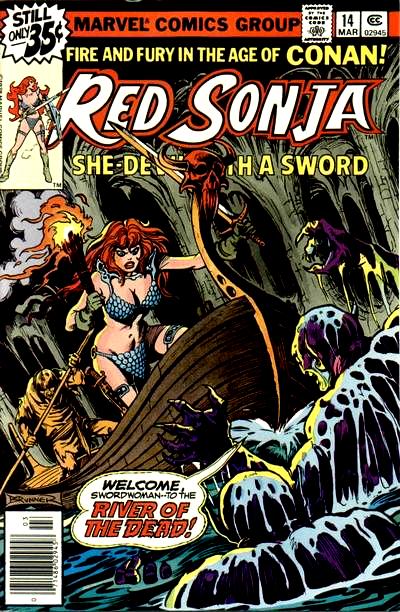
Red Sonja 14 coverSo this issue begins with Red Sonja walking through an unnamed town at night, minding her own business. Not sure how small the town is or how late, but on page one, we see only one other person on the street and he’s sleeping on it. I’ve probably mentioned before in these reviews that I find the preponderance of unnamed towns and unnamed demons to be a bit annoying, especially coming from Roy Thomas, who’s fairly knowledgeable about all things Hyborian. Seriously, just make up a name for the town or use a real city name. No one’s going to check.

Watch. Evanston. Red Sonja’s walking through Evanston, trying to forget her beloved Suumaro (the mommy-fixated boy-king who treated his wives like slaves and wanted Sonja to join his harem – what a catch). Now let’s move along.

So Red Sonja is just minding her own business, which is pretty much all the invitation anyone seems to need to bother her. She’s approached by a glowing nobleman named Gonzallo (see, no one cares that it’s a stupid name), who offers to pay her a diamond if she’ll act as his bodyguard for a few hours. When she asks why he’s glowing, he dismisses the question by saying that he’s eccentric.

The diamond looks real, so Red Sonja lets herself be hired. The first thing Gonzallo does is guide her to his gondola (oh, so they’re in Venice) and his requisite deformed gondolier, Karon. As the three of them make their way through the canals of (Venice? Evanston? Lower Aquilonia?), Sonja notices the surroundings have begun to change and soon they’re moving through an underground canal. The chamber is lit faintly by phosphorus, just enough for Sonja to see an iron gate rising up out of the water to block the way they’d come.

Read More Read More