Howard Andrew Jones on How Captain Kirk Led Me to Historical Fiction
 Man, that Howard Andrew Jones is, like, everywhere.
Today he’s at Tor.com, writing about how James T. Kirk led him on a many-year mission to explore strange new worlds of historical fiction:
I’d read that Star Trek’s creator Gene Roddenberry had modeled Captain Kirk after some guy named Horatio Hornblower. I didn’t think I’d like history stories, but I sure liked Star Trek, so I decided to take a chance. Once I rode my bicycle to the library and saw how many books about Hornblower there were, I figured I’d be enjoying a whole lot of sailing age Star Trek fiction for a long time to come.
Of course, it didn’t turn out quite like that. Hornblower wasn’t exactly like Kirk, and his exploits weren’t that much like those of the Enterprise, but they were cracking good adventures. Thanks to my own curiosity but mostly to the prose of the talented C.S. Forester, my tastes had suddenly, and accidentally, broadened beyond science fiction… I no longer thought of historical fiction as a strange, untouchable world, and as I grew older I tried more and more of it, sometimes because a period interested me and sometimes just because I liked a cover or a title. That’s how I found the work of Cecilia Holland, and it’s why I wasn’t afraid to try out a book by Harold Lamb titled The Curved Saber after I was spellbound by Lamb’s biography of Hannibal, the great Carthaginian general…
The complete article is here, and you can learn the mind-boggling details about Howard Andrew Jones month at Black Gate here.
 Black Gate blogger Bradley Beaulieu’s first novel The Winds of Khalakovo was published by Night Shade Books on Monday. I asked him to tell us a little bit about it, and his influences:
 Traveling around the world in eighty days is not only quite possible, but a leisurely journey. One could, on this trip, stop to smell the roses, perhaps do a little sight-seeing on an island or two, and pursue adventure in remote locations. Really, if one were pressed for time, anyone with a passport and a few plane tickets could circumnavigate the globe in about a week or two, depending on the flight paths of the planes.
 What a TRIP…
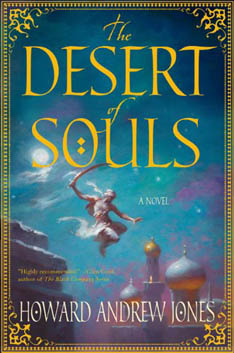 Desert of Souls, by Howard Andrew Jones.