Browsed by
Category: Books

Goth Chick News: The Best Book to Not Read on a Plane

Goth Chick News: The Best Book to Not Read on a Plane

image0021Until recently, reading on a plane was one of my personal joys.

As an electronics geek (admitting it is the first step) it is a rare thing indeed for me to find myself in an environment where connectivity isn’t possible.  Okay, I know that some flights are now offering Internet in the sky, but I prefer to ignore this for the time being in the name of preserving the one place where I can guiltlessly escape email, IM and my cell phone.  And though it is still possible to “work” while disconnected, I generally ignore this as well and relish the opportunity to sink uninterrupted into a novel.

And this was precisely what I did on a recent getaway to my favorite US destination; New Orleans.  I boarded the American Airlines jet and settled back in my window seat with Chris Bohjalian’s fourteenth novel, The Night Strangers.

Things went all wrong shortly thereafter.

We had only just pushed back from the gate when the plane came to a rather abrupt halt and the engines shut down.  The pilot’s voice sounded a tad embarrassed when he explained our aircraft had just experienced an “electrical abnormality” and mechanics were being called to look into the issue before we would be cleared to take off.

Now, as someone who has clocked countless hours on airplanes, this “electrical abnormality” didn’t concern me all that much.  I imagined that some unexpected red light was blinking away in the flight deck that probably wouldn’t have meant much if it had occurred aloft, but as it had started up while we were still on the runway, the crew was obligated to halt our journey and have it looked at.

I went back to The Night Strangers.

In case you’re not familiar (I certainly wasn’t prior to picking up his latest book), Chris Bohjalian is a New York Times bestselling author, and his latest outing The Night Strangers is a ghost story inspired by both a door in his basement and Sully Sullenberger’s successful ditching of an Airbus in the Hudson River.

Read More Read More

Fantasy Out Loud

Fantasy Out Loud

the-hobbitNearly every night, I read aloud to my boys.   For Evan, my seven-year-old, I have lately been reading The Hobbit.  Two nights ago, no sooner had I begun than Evan interrupted, saying, “It’s funny how they spell ‘Smaug.’”

“Oh?” I asked.  “How would you spell it?”

“S-M-O-G.”

“Good,” I said.  “That is how you would normally spell it.”  But privately, I thought how wonderful it was that Tolkien chose this other, more evocative spelling.  It also occurred to me that without Evan’s commentary, I might not have even noticed.

What we choose to read to our children has ramifications almost beyond counting.  Certainly, a shared reading experience is pivotal to the in-home dynamics and shared knowledge of any family, but insofar as one tackles a diet of writing that qualifies as “fantastic,” reading aloud is also crucial to the development and enculturation of an entire new generation of fantasy readers.  Given a world that grows ever more hectic, and therefore has less and less time for “pleasure” reading, this is no small thing.

I am fortunate to have two children, both boys, and I can see the results of my reading choices –– the goblin fruit, as it were, of my labor –– as if I had scrawled on their souls with indelible ink.  Corey, my older boy, now reads nothing but fantasy fiction, at least not by choice.  (He has also, to my dismay, discovered comics, and for this, too, I blame myself.)

Read More Read More

New Treasures: Strange Worlds

New Treasures: Strange Worlds

strange-worldsBack on October 7th I reported on a promising little artifact called Strange Worlds,  an anthology of sword and planet stories from Space Puppet Press, collected and edited by Jeff Doten.

Now I’m holding a copy in my hot little hands, and I can report that it’s just as cool as it looks.

Strange Worlds collects nine pieces of original fiction from Ken St. Andre, Charles A. Gramlich, Paul R. McNamee, Lisa V. Tomecek, Charles R. Rutledge, and others.

Each story is also illustrated by Doten with a full color plate, done in loving homage to the Ace Doubles of the 50s and 60s, where much of the most-loved sword & planet in the genre first appeared.

Doten also provides some fine black & white interior illustrations for each story.

Interior color plate by Jeff Doten
Interior plate by Jeff Doten
It’s a quality package, and no mistake. There’s even a 13-page full-color “Strange Worlds” comic, written and illustrated by Doten, rounding out the book.

It’s very clear to me that Doten knows his stuff, and his love and knowledge of the genre comes across on every page. There’s even a three-page Suggested Reading list, an invaluable reference for modern fans covering virtually every major practitioner of the genre — from Edgar Rice Burroughs, Otis Adelbert Kline, Gardner Fox, Leigh Brackett, and Lin Carter, all the way up to more modern writers experimenting in the same playground, such as S.M. Stirling.

In his introduction Doten says Strange Worlds was “my effort to rectify the tragic lack of Sword and Planet stories in the modern world.” He has succeeded with flying colors.

Strange Worlds is 189 pages printed on quality stock in oversize format. It is available from Space Puppet Press for $27 plus $3.75 U.S. shipping, and richly deserves your support.

Order today from strangeworldsanthology.com.

Mur Lafferty on Reading the Classics

Mur Lafferty on Reading the Classics

Mur Lafferty, author of The Afterlife Series and Playing For Keeps, has kicked off an interesting discussion on reading classic SF and Fantasy on her blog:

earth-abidesI’m not quite sure how to read classic SF. You know the stuff that was groundbreaking with its expanse of ideas that hadn’t even been considered yet? But it was also the stuff that was very likely sexist, had cardboard characters, was completely lacking women or POC, used what we consider now to be hack tools (eg “looking in a mirror to describe the protag”), and may have protags that are total jerks.

I couldn’t finish The Stars My DestinationThe Chronicles of Thomas Covenant the Unbeliever or the Book of the New Sun. I can’t root for a rapist protagonist. And I really wanted to read Stars and New Sun.

Recently I couldn’t finish Earth Abides (despite the wonderful intro by one of my favorite authors of all time, Connie Willis.) I got bored and annoyed with the elitist, “It’s the end of the world, but I’m CERTAINLY not going to hang out with whores and drunks,” attitude of the protagonist. And WTF is up with mentioning that a woman is “young enough” in her description, and leaving it at that? …how can I appreciate the classics when I run into such painful roadblocks like this? It’s hard to read things I’m not enjoying, even for academic purposes.

Speaking as someone with an unnatural fondness for pulp fiction, this is a problem I’m intimately familiar with. My last attempt to re-read Asimov’s Foundation Trilogy ended in utter failure. And I dearly loved that book in my early teens. But I didn’t pay much attention to girls then, and I suppose a book that also pretended women didn’t exist just didn’t seem very unusual.

Comments are now closed on Lafferty’s blog (she notes they had “gone into unhelpful areas“), but you can read the original post and comments here.

Hal Duncan’s The Book of All Hours, or Vellum and Ink

Hal Duncan’s The Book of All Hours, or Vellum and Ink

VellumHal Duncan’s The Book of All Hours is a dazzling, fascinating, frustrating work. A duology consisting of 2005’s Vellum and 2007’s Ink, it plays with structure and story in powerful ways, while also seeming to fall back too easily into black-and-white absolutes and traditional forms. The oddity of the book is that although in some ways it appears radically new, in other ways, as one reads further into it, it comes to feel more and more familiar.

The basic idea might have come from a Marvel comic book: hidden among mortal humans are individuals who, when they undergo certain traumas, develop great powers to shape the world — they become gods, angels, demons. Archetypes. Unkin. Their powers extend not only across time and space, but through the array of alternate worlds called the Vellum; and, as well, into worlds deeper and more profound than our own and its cognates.

A long time ago one of these Unkin created the Book of All Hours, which is, among other things, a map of the Vellum, and a text describing everything, defining everything, holding all stories and worlds within itself. Various Unkin factions want to get their hands on the Book, to rewrite it to suit themselves. The Covenant, a primal patriarchy ruled by archangels, represent one major faction. Another loose grouping is formed by seven individual Unkin, seven archetypes we trace through a range of alternate selves. These seven are (to use only one version of their various names, and a reductive description of their identities) Jack Flash, eternal rebel; Joey Pechorin, eternal traitor; Guy Fox, mastermind; Seamus Finnan, a tortured Prometheus; Don MacChuill, the old soldier; Phreedom Messenger, warrior queen; and her brother, Thomas Messenger, the eternal sacrifice.

Read More Read More

Dabir and Asim return in The Waters of Eternity

Dabir and Asim return in The Waters of Eternity

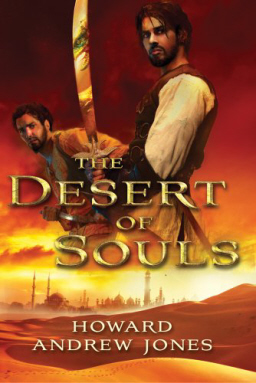
waters-of-eternityDabir and Asim, the heroes of The Desert of Souls, return in a new collection from Black Gate Managing Editor Howard Andrew Jones.

The Waters of Eternity includes six short stories of Arabian fantasy, including “Sight of Vengeance” (BG 10), which brings our heroes face to face with a supernatural horror while searching for a killer in the heart of ancient Baghdad.

Venture into the time of the Arabian Nights with stalwart Captain Asim and the brilliant Dabir as they hunt an unseen killer that craves only the eyes of his victims, and pursue a dark entity haunting the halls of an opulent mansion. Ride with them on a desperate journey to preserve a terrible weapon from Byzantine agents, and seek the waters of eternity to save a dying girl’s life. In six tales brimming with mystery and sword-slinging action Dabir and Asim stride forward into adventure. With nothing to shield them but Asim’s sword arm and Dabir’s wit, the two heroes must unravel sinister puzzles, confront dark wizards, rescue fair maidens, and battle the terrifying monsters of legend.

The Waters of Eternity was published by Macmillan in a Kindle Edition on November 22. It is available for $2.99 from Amazon.com, iBooks, and Barnes & Noble. The cover art is by Ervin Serrano.

This is excellent stuff… mysteries surrounded by magic… in the grand tradition of high adventure, Arabian Nights, and Sherlock Holmes. These are unique, clever and well-written little gems.

Joe Bonadonna, author of Mad Shadows

If you’re a fan of adventure fantasy, you owe it to yourself to check it out.

Pathfinder Tales: Death’s Heretic by James L. Sutter

Pathfinder Tales: Death’s Heretic by James L. Sutter

Death's Heretic-smallIf there’s one potential flaw in reading stories set in roleplaying game settings, it’s that the emphasis is more on the mechanics of the system and magical setting than on the development of the characters. The best stories, of course, are able to avoid this and create complex, dynamic characters that resonate among some of the most memorable in all of fantasy. Raistlin Majere, Elminster, and Drizzt Do’Urden all come to mind as iconic characters born in roleplaying tie-in novels.

Into this esteemed category steps Salim Ghadafar, the protagonist of James L. Sutter’s Death’s Heretic (Amazon, B&N), an upcoming addition to the Pathfinder Tales fantasy novel series from Paizo Publishing. Salim serves the goddess Pharasma, the Lady of Graves, goddess of birth, death, and prophecy, but he does so only grudgingly. This unusual tension, together with a compelling plotline, draws the reader deeply into the world of the story.

Salim is called upon by Pharasma to investigate a man who died shortly after obtaining one of the greatest treasures available to mortals: the sun orchid elixir, which grants near immortality. The details of his death are of secondary concern, though, compared to the events that followed. Pharasma is far more concerned with why her priests are unable to resurrect him. His soul has gone missing … seemingly stolen from the goddess’s very realm of the dead, the Boneyard itself. Salim’s investigation takes him – and the victim’s orphaned daughter, who is bankrolling the investigation – from local rivals for the elixir, including a crimelord and a gorgeous half-elven brothel madame, to the outer planes and Pharasma’s Boneyard. The investigation brings him face to face with creatures who predate the creation of the world itself, with the power to thwart the natural laws of life and death.

Read More Read More

Howard Andrew Jones on The Roots of Arabian Fantasy

Howard Andrew Jones on The Roots of Arabian Fantasy

The Adventures of Amir Hamza, translated by Musharraf Ali Farooqi

Black Gate Managing Editor Howard Andrew Jones, author of The Desert of Souls, knows a thing our two about Arabian fantasy — and excellent storytelling.

He was recently invited to be a guest blogger by our friends at SF Signal. The result is a fascinating post on the origins of Arabian Fantasy, the influence of Indian folklore, puzzle box stories, Aesop’s Fables, Persian myth, and more more.

Anyone looking for pointers on excellent non-Western fantasy will find the entire article richly rewarding, including this fascinating tidbit:

The fantastic tales of Arabia might, sort of, begin with the 1001 Nights, but they certainly don’t end there. Less well known in the west is The Adventures of Amir Hamza. This immense work was written by Ghalib Lakhnavi in 1871 — though that’s not when it was created. Lakhnavi was just setting to paper the result of some thousand years of oral stories concerning the fictitious exploits of the Uncle of the prophet Mohammad — though that should in no way diminish what was a mammoth undertaking. Like the 1001 Nights, The Adventures of Amir Hamza brim with fantastic monsters, magic, and mayhem and romance. Within them, though, is a more obvious strain of Indian influence. It is currently available in one volume from Modern Library, painstakingly and lovingly translated/assembled by Musharraf Ali Farooqi.

The complete post is here.

Joan North, The Cloud Forest, The Whirling Shapes, and The Light Maze

Joan North, The Cloud Forest, The Whirling Shapes, and The Light Maze

The Light MazeIf you read a lot, you’ll soon find yourself drawn to writers who become personal favourites but who, unaccountably, go unrecognised by the wider world. A little while ago my girlfriend introduced me to a book by one of her own favourite writers, a woman named Joan North. I want to write about North here, because I was impressed by her work and I think she deserves to be better known.

North wrote three books, fantasies for children; what you’d now call stories aimed at the younger end of the YA category. North’s first book, The Cloud Forest, was published in the UK in 1965 and in the US the year after. Her second book, The Whirling Shapes, was published in 1967. Her last book, The Light Maze, was published in 1971 and shortlisted for the 1972 Mythopoeic Award.

I’ve looked for more information online about North, but can find nothing. What I know about her is what’s written on the dust jacket of The Light Maze:

Joan North was brought up in North China but now [1971] lives in North London, “in a household which comprises a mathematical husband, two daughters, and two Siamese cats.” She says that her chief interest is in “what might be called exploring Inner Space.” This preoccupation can be traced in her earlier books, The Cloud Forest and The Whirling Shapes, which, like The Light Maze, bring into an ordinary and often comical picture of everyday life an awareness of other worlds, other modes of being. She likes reading about Yoga, Zen, Christian mysticism and Eastern philosophy.

Read More Read More

Hunger Games Trailer Released

Hunger Games Trailer Released

200px-hunger_gamesYoung adult fiction has a lot going for it in recent years. In the wake of the Harry Potter craze, there’s an entire generation of young people who have grown up with the understanding that reading is a cool way to spend your time and entertain yourself.

Certainly, there has been some fall out from this positive trend. Personally, I can’t stand the Twilight films (although, in fairness, my wife assures me that the novels are much better), which have definitely inherited the youth mania mantle from young Mr. Potter. Vampires and zombies are all the rage, often because it’s what this “Harry Potter generation” seems to be choosing to read.

While the fantasy and young adult horror genres have had commercial success, there’s also been a growth among young adult science fiction. Specifically, dystopian science fiction set in an indistinct future era, focusing mostly on social issues. This sort of “soft science fiction” has long been part of the genre, but it’s really coming into its own withsome of the recent series. Among them was Scott Westerfeld’s fantastic Uglies trilogy (Amazon, B&N), now being made into a film, and Ally Condie’s Matched (Amazon, B&N) and Crossed (Amazon, B&N). These books speak to young people, in part because it resonates with the ever-present sense among the young that the world isn’t fair and that the people with power to make things better don’t care or, even worse, are actively out to get them. In these books, that is often quite literally the case.

Read More Read More