Browsed by
Category: Books

New Treasures: The Bookman Histories by Lavie Tidhar

New Treasures: The Bookman Histories by Lavie Tidhar

The Bookman HistoriesI’m a big fan of these Angry Robot omnibus volumes. Talk about reading feasts… I can settle into my big green chair with a bag of chips and one of these babies, and I’m set until August.

They’re surprisingly diverse, too. There’s Tim Waggoner’s zombie detective saga The Nekropolis Archives, Aliette de Bodard’s Aztec mystery series Obsidian & Blood, Andy Remic’s blood-drenched sword-and-steampunk epic The Clockwork Vampire… and now we have Lavie Tidhar’s steampunk serial-killer trilogy The Bookman Histories to add to the list.

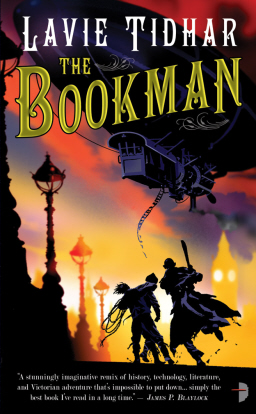
The trilogy opened with 2010’s The Bookman (cover here), described as “a steam-powered take on V for Vendetta.” Set in an alternate Victorian London on the verge of the first (cannon-powered, naturally) expedition to Mars, the book follows the exploits of the young poet Orphan, who witnesses a stunning attack by a masked terrorist that paralyzes the city. Filled with mysterious automatons, airships, exploding books, pirates, giant lizards, pirates, and more airships, The Bookman was the first novel from the short fiction author whom Locus called “an emerging master.”

Camera Obscura (2011) introduced us to the mysterious and glamorous Lady De Winter, agent of the Quiet Council. Tasked with solving a locked-room murder on Rue Morgue in Paris, De Winter soon finds herself drawn into a far more sinister mystery.

The series wraps up with The Great Game (2012), which begins with Mycroft Holmes’ murder in London. It falls to Holmes’ protégé Lucy Westerna to solve the case — but before she does she crosses paths with a young Harry Houdini and a retired shadow executive named Smith (team up!). Together they find the trail leads inexorably to a foreboding castle in Transylvania… and to get there they’re need to cope with with airship battles, Frankenstein monsters, alien tripods, and more.

The Bookman Histories contains all three novels in one fat 1,022-page package. It was published by Angry Robot in December, 2012; the paperback is $15.99, and the digital version is $9.99. Lavie Tidhar won the 2013 World Fantasy Award for Best Novel for Osama; this is a guy who is clearly going places. Ignore him at your peril.

You can see all of our recent New Treasures articles here.

Vintage Treasures: The World Invisible by Shulamith Oppenheim

Vintage Treasures: The World Invisible by Shulamith Oppenheim

The World InvisibleI just found a dusty plastic bag stuffed full of paperbacks tucked in a corner of my living room. Hidden behind another pile of books, of course. Near as I can figure, I bought them at Capricon back in February (possibly at the same time as Peter Haining’s Vampire anthology.) Man, I need a better filing system.

There’s some good stuff in it, though. If I did indeed buy them, and the bag didn’t just spontaneously materialize from the ether, then I clearly have great taste. Or maybe I just patronize fabulous booksellers. Whatever the case, the bag was filled with vintage paperbacks by Norman Spinrad, Robert Silverberg, Jerry Sohl, and Lloyd Arthur Eshbach. The most intriguing item, however, was a slender Ace paperback from 1984, The World Invisible by Shulamith Oppenheim.

Beware the world invisible.

It lies in forest shadows beneath the hills, and below the waves that pound so fiercely on Scotland’s shores.

It is a world of beauty and magic, of fey creatures wondrous beyond imagination.

But beware.

Do not cross its boundaries or consort with its denizens. Or you will never be content with the human world again…

Okay, I have no idea who Shulamith Oppenheim is. According to some hasty research at her website, she’s a children’s writer with 14 books to her credit, including one about Albert Einstein, who was best man at her wedding (!). The World Invisible appears to be her only adult fantasy. It was reprinted in 2007 by White River Press, with the world’s most boring cover (what is that? An island? A fog machine? It’s like a travel book for blind people). Seriously, if you want to read it, the Ace version with the Don Maitz cover is the one to get (click on the image at right for a full-sized version).

The World Invisible was published by Ace Books in 1984. It is 198 pages in paperback, with an original price of $2.75. I figure I paid around two bucks for my copy. It is currently in print in both paperback and digital formats from White River Press.

See all of our recent Vintage Treasures articles here.

Paul Di Filippo on “A” is for Android and Other Tales: Masters of Science Fiction Vol. #8

Paul Di Filippo on “A” is for Android and Other Tales: Masters of Science Fiction Vol. #8

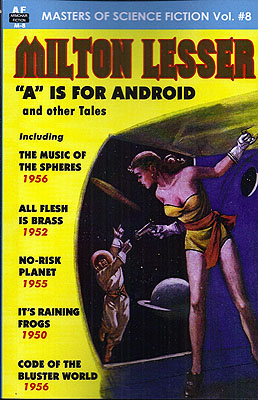
Milton Lesser A is for AndroidOver at Locus Online, Paul Di Filippo has a look at the latest Masters of Science Fiction reprint from Armchair Fiction, this one focused on Milton Lesser, author of Slaves to the Metal Horde and The Thing from Underneath.

If you do not know the enchantingly retro line of SF/F/H books published by Armchair Fiction… then I offer you now an eye-popping introduction. Visit his site and marvel at the vast range of vintage fiction, long out of print, lovingly repackaged with period artwork. Names as seminal as those of Fritz Leiber, Clifford Simak and Edmond Hamilton consort with the bylines of lesser craftsmen… The Armchair Fiction catalogue opens an essential window onto a vital and overlooked and still enjoyable portion of our history.

The latest entry in their “Masters of Science Fiction” series is awarded to Milton Lesser, who bears a name the majority of modern fans will probably be unfamiliar with. Lesser was one of those working-stiff writers back in the day who turned out intelligent, yet perhaps sometimes over facile, goods to suit whatever market was looking for material and paying a decent word rate… Truly the work of a Master? Did it exhibit a genuine affinity for the mode, a sense of wonder, some unique ideation? Does it seem hokey and clunky today, or do its narrative virtues still engage and reward?

We last looked at Armchair Fiction — via Paul W. Fairman’s The Girl Who Loved Death and Murray Leinster’s Planet of Dreadlast January.

Curiously, this book is listed under the variant title “A” as in Android at Amazon.com and other places. I haven’t seen a copy myself, so I can’t confirm which title is correct.

“A” is for Android (or maybe “A” as in Android) was published January 30 by Armchair Fiction. It is 320 pages in trade paperback, priced at $16.95. There is no digital edition. See more details at the Armchair Fiction site here, and you can read Paul’s complete review here.

New Treasures: The Warlord of the Air by Michael Moorcock

New Treasures: The Warlord of the Air by Michael Moorcock

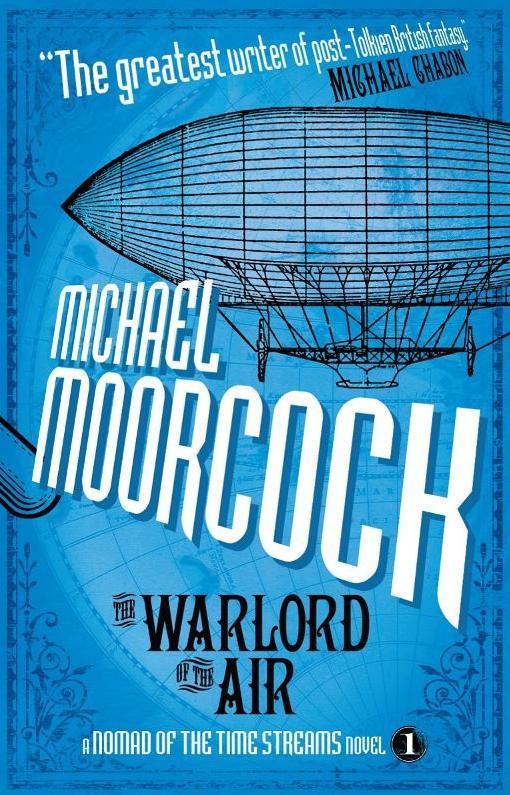
The Warlord of the AirWe covered several high quality reprints from Titan Books last year, including Kim Newman’s Anno Dracula: The Bloody Red Baron; Sax Rohmer’s The Hand of Fu Manchu; and books by James P. Blaylock, Guy Adams, and others.

But their accomplishments don’t end there. Starting in January of this year, Titan began reprinting Michael Moorcock’s early steampunk trilogy Nomad of the Time Streams, beginning with The Warlord of the Air, originally published way back in 1971:

It is 1973, and the stately airships of the Great Powers hold benign sway over a peaceful world. The balance of power is maintained by the British Empire – a most equitable and just Empire, ruled by the beloved King Edward VIII. A new world order, with peace and prosperity for all under the law. Yet, moved by the politics of envy and perverse utopianism, not all of the Empire’s citizens support the marvelous equilibrium.

Flung from the North East Frontier of 1902 into this world of the future, Captain Oswald Bastable is forced to question his most cherished ideals, discovering to his horror that he has become a nomad of the time streams, eternally doomed to travel the wayward currents of a chaotic multiverse.

The first in the Nomad of the Time Streams trilogy, The Warlord of the Air sees Bastable fall in with the anarchists of this imperial society and set in train a course of events more devastating than he could ever have imagined.

These classic novels have been out of print for some fifteen years. Titan has already released the second, The Land Leviathan, on April 16; that volume finds Bastable in an alternate 1904 devastated by a terrible war waged with futuristic weapons and deadly biological attacks. The third and final volume, The Steel Tsar, follows Bastable’s adventures in an alternate 1941 where both World Wars were averted and Russia is still ruled by Tsars, and Bastable finds himself imprisoned by the rebel ‘Steel Tsar,’ Joseph Stalin. It will be released on August 13.

The Warlord of the Air was published by Titan Books on January 15. It is 215 pages in trade paperback, priced at $9.95 ($9.95 for the digital edition).

Forrest J. Ackerman and the Days of the Do-It-Yourself Anthology

Forrest J. Ackerman and the Days of the Do-It-Yourself Anthology

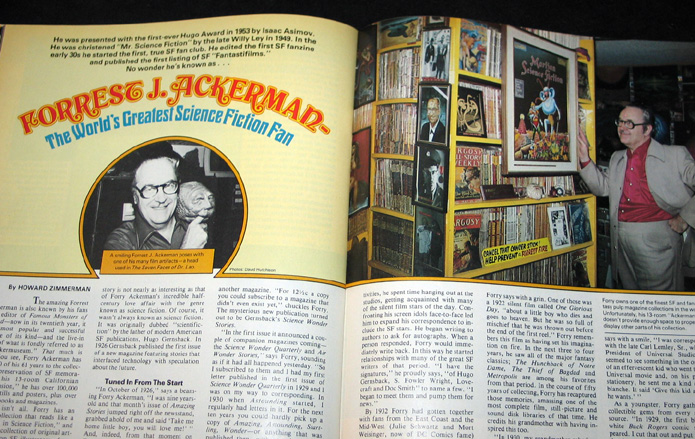
Forrest J Ackerman Starlog 1978-2When I was 14 years old, I stumbled on an article in Starlog magazine titled “The World’s Greatest Science Fiction Fan.”

It was about Forrest J. Ackerman, of course: writer, literary agent, and editor of Famous Monsters of Filmland. But Forry’s greatest claim to fame was his legendary science fiction collection, housed in the Ackermansion in Los Angeles.

The article was accompanied by some mind-blowing photos. Forry standing before one of his greatest prides: his complete collection of Weird Tales. Forry posing with the original model used in George Pal’s War of the Worlds. Forry shaking hands with the Maschinenmensch from Metropolis. [Click on the image at left or below for bigger versions.]

The article appeared in the 1978 issue of Starlog, and it had a pretty profound effect on me. After I read it, I knew what my life’s work would be: to build a science fiction collection that could stand with pride alongside Forrest J. Ackerman’s.

These are the things that only a 14-year-old can dream.

Read More Read More

Two Sought Adventure

Two Sought Adventure

Don QTwo weeks ago I talked about the city vs. country tension that’s often found in literature, and how it might have contributed to the  rise of the barbarian hero in our own genre. Now I’m wondering whether we haven’t seen a fine-tuning of that same tension in a more familiar guise: the buddy movie, or, more to the point for us genre types, the buddy adventure.

Like some of the other stuff I’ve been talking about, I don’t think this concept is something that’s just shown up recently. In Don Quijote – widely considered to be the first novel, though you won’t get many who’ll agree on what genre it is – we have the titular Don himself, but we also have his travelling companion and side-kick, Sancho Panza.

But, you might argue, Sancho is a side-kick, and not an adventurer in and of himself – though again, you’ll find those who’ll dispute that, and maybe even convince you that, title aside, the book really belongs to Sancho. But let’s think about the implications here for genre heroes. When is a character a side-kick (pray note that I don’t qualify that by saying “just”) and when is the character a co-hero?

Read More Read More

New Treasures: The Watchers by Jon Steele

New Treasures: The Watchers by Jon Steele

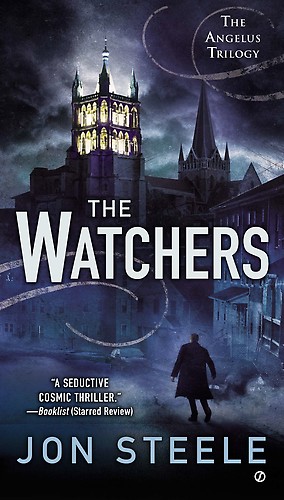
The Watchers Jon Steele-smallI encountered The Watchers for the first time during my last trip to Barnes & Noble. There I was with an arm full of paperbacks, making my way to the register, when I spotted it on a display in the middle of an aisle.

The cover looked intriguing, in a spooky, gas-lit London sort of way. But was it fantasy? I don’t want to get stuck with another Da Vinci Code clone.

The Booklist quote on the cover called it “A seductive cosmic thriller.” What the heck did that mean? Cosmic, like Elder Gods cosmic? Thanos versus The Avengers cosmic? Or 700-pages-that-feel-like-they’ll-never-end cosmic?

The back cover text wasn’t much help:

Every hour, childlike Marc Rochat circles the Lausanne cathedral as the watchmen have done for centuries. Then one day a beautiful woman draws him out of the shadows — the angel his mother once promised him would come.

But Katherine Taylor is no angel. She’s one of the toughest and most resourceful call girls in Lausanne. Until something unnatural seething beneath a new client’s request sends her fleeing to the sanctuary of an unlikely protector.

Into their refuge comes Jay Harper. The private detective has awakened in Lausanne with no memory of how he got there — and only one thing driving him forward: a series of unsettling murders he feels compelled to solve.

That doesn’t even tell me what era it is. Present day? 1880s? Were there private eyes in 1880s London? Look, is this a fantasy or not? All these books I’m holding are getting heavy.

Read More Read More

Teaching and Fantasy Literature: Or Maybe It Can’t Be Toned Down

Teaching and Fantasy Literature: Or Maybe It Can’t Be Toned Down

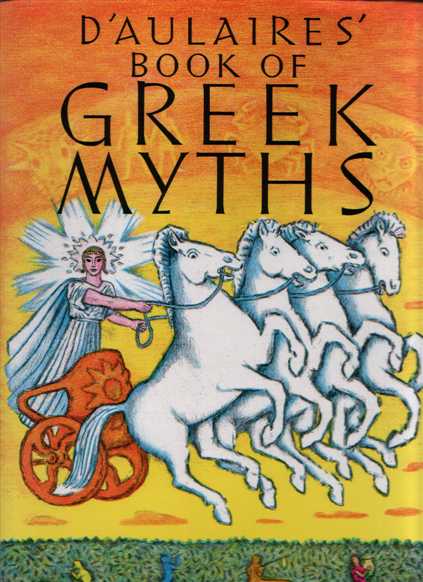
I got my first taste of Greek mythology from D’Aulaire’s Greek Myths. Later, when I was old enough for Bulfinch’s Mythology, I thought I had graduated to the real thing. Homer came to me by way of a dusty turn-of-the-century book with a title along the lines of The Boy’s Own Homer, with glorious color illustrations. D’Aulaire gave me the Norse myths, too, though I didn’t get The Ring of the Niebelungen until a friend gave me a mixtape that included Anna Russell’s brilliant twenty-minute Ring cycle sketch.

When my parents realized I knew nothing whatever about the Bible — I was ten — they rectified my cultural illiteracy with Pearl Buck’s two-volume The Story Bible. Of all those beginner versions of classics, only Buck’s biblical books kept all the sex and violence in. Imagine my shock when my mother handed me Ovid’s Metamorphoses in Mandelbaum’s complete and very faithful translation. I was twelve. What was she thinking? If the Metamorphoses were a blog, every post would have cut text with PTSD trigger warnings.

Mark Rigney’s post on how old a kid should be before reading or watching The Hunger Games touched on a problem I face often as a teacher of teenagers, some as young as 13. Since I’m a freelance teacher, making house calls, my students’ parents are sometimes directly involved in the question of how old is old enough for which book. Other times, especially when the parents don’t speak much English, I actually wish I could involve them more directly than the language barrier allows.

I’ll face the age question all over again, differently, when my own kids can read on their own. Inevitably, I come at the predicament through my own history as a reader — which stories I was denied too long or permitted too early. As a maker of stories, I’m fascinated also with seeing what of a story can survive the translation into the consciousness of the young, either through the efforts of adult writers who reinterpret the stories, or through the efforts of kids themselves when they try to make sense of them.

Read More Read More

Sean T. M. Stiennon reviews Twenty Palaces

Sean T. M. Stiennon reviews Twenty Palaces

Twenty PalacesTwenty Palaces Cover
By Harry Connolly
Self-Sabotage Press (E-book, $2.99, November 2011, available on Kindle and Nook)

This seems as good a time and place as any to say a word about the tragic fate of the Twenty Palaces series. The books gathered critical accolades, high Amazon.com rankings, and a blurb from the prince of urban fantasy, Jim Butcher himself. However, after the third novel in the series, Circle of Enemies, the series was cancelled by Del Rey due to underperforming sales. Harry Connolly had a fourth novel — a prequel exploring Ray Lily’s introduction to the bloody world of the Twenty Palaces society — already written. Rather than allowing it to be consigned to the bottom drawer of his dresser, the deepest recesses of his hard drive, or the bottom of the Hudson River, Connolly did the world a favor and produced it as a self-published e-book.

I’ll be writing reviews of the second and third volumes in the series (watch this space!); but for this week, I wanted to look at that prequel, Twenty Palaces, for three reasons. First, sales of this book will put more money in the author’s pocket than sales of remaining copies of the other books, and I’m a big enough Connolly fan to think his labors deserve it. Second, if you’d like to give the books a shot, but are too profoundly avaricious to lay down $7.99 for Child of Fire, you’ll be delighted to learn that Twenty Palaces is available on Kindle and Nook for the fantastically low price of $2.99, payable in one easy installment. Third, it’s a good book.

Read More Read More

Mucking with the Mundane

Mucking with the Mundane

Gloriana, the Unfulfill'd QueenFantasy readers expect the world of a fantasy novel to be different from our mundane reality.

There’s magic afoot — of course the world operates differently. The author paints the fantastical milieu and we enter it primed to believe, donning those 4-D glasses that let us accept strangeness. It’s a more-than-willing suspension of disbelief.

We don’t ask for justifications, as long as the fantastic elements of the world are internally consistent. It’s in the tradition.

But with fantasy as re-imagined history or a re-imagined place, we enter a slightly different relationship with the story. Now we’re in a realm that is accessed, not through a portal or straight immersion in a new world, but through a delicate balance of writer allusions and reader indulgence. Readers know they’re being seriously mucked with. And the author must go the extra mile to pull it off.

There’s something logically different about creating an imagined world — like Middle Earth — versus fiddling with the actual world and its history. After all, it already happened the way it did. So the reader must swim against the mental tide of a different narrative, that of history.

Depending on your preferences for justification, you may want an explanation of how it all came to be, or you may wish the author would just get on with it.

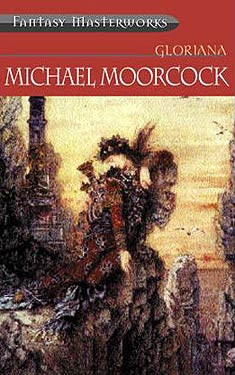
One way to coax the reader into abandoning “real” history is with parallel worlds. Michael Moorcock uses this framing device in Gloriana, the Unfulfill’d Queen, set in a twisted Elizabethan-style court and a very changed history.

Read More Read More