Browsed by
Category: Books

Alan Moore Completes 1 Million+ Word Historical Fantasy Novel, Jerusalem

Alan Moore Completes 1 Million+ Word Historical Fantasy Novel, Jerusalem

Alan-Moore-smallAlan Moore’s daughter Leah has posted a report on Facebook that her father has completed the first draft of his second novel, Jerusalem, and that the draft clocks in at more than one million words.

To give you a sense of perspective, that’s more than five times the length of Dune (186,000 words), and twice the length of all three novels of The Lord of the Rings (473,000 words). As The A.V. Club puts it, “Alan Moore wrote a novel so heavy even he can’t lift it.”

Jerusalem reportedly examines history of a small section of Moore’s native Northhampton, with chapters written in dramatically different styles. Here’s Moore’s description:

I’ve done a chapter that’s like a mid-sixties New Wave, New Worlds Michael Moorcock-era science fiction story. There’s one that’s like a piece of noir fiction. It’s all these different styles…

In some ways, the book sounds similar to his first novel, The Voice of the Fire, which portrayed 6,000 years of English history by following twelve different characters in the same region of central England. As Comics Beat points out, it’s also similar in some respects to his unfinished comic opus Big Numbers.

Alan Moore is the writer of some of the most famous comics of the 20th Century, including Watchmen, V for Vendetta, Swamp Thing, From Hell, and The League of Extraordinary Gentlemen. Moore does not yet have a publisher for the mammoth tome.

New Treasures: The Ghost Pirates and Others: The Best of William Hope Hodgson by William Hope Hodgson

New Treasures: The Ghost Pirates and Others: The Best of William Hope Hodgson by William Hope Hodgson

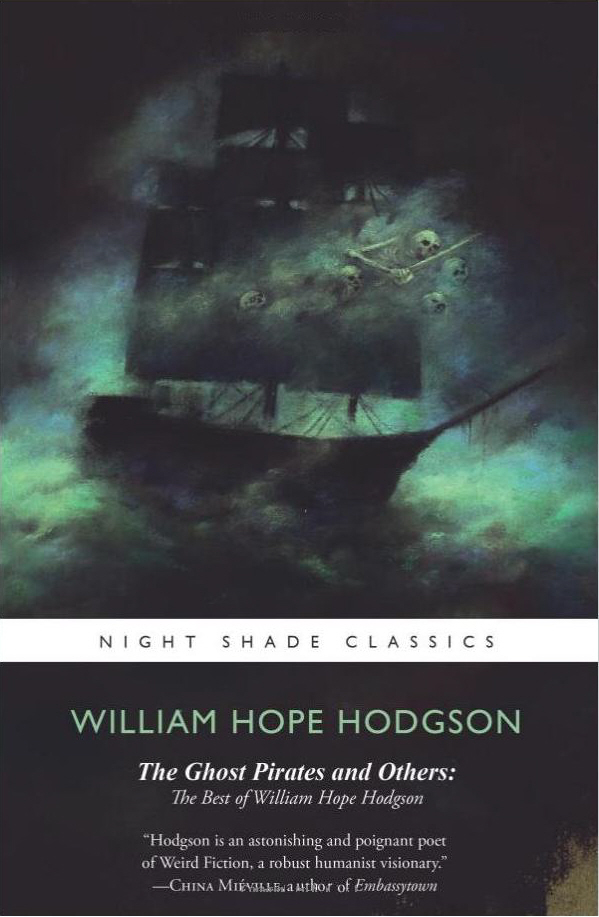
The Ghost Pirates and Others-smallNearly ten years ago, I bought The Collected Fiction of William Hope Hodgson, a five volume set from Night Shade Books. It’s a terrific group of hardcovers, with eye-catching cover art by Jason Van Hollander, and there’s no reason anyone who possesses that handsome collection would ever need to spend another penny on William Hope Hodgson.

And yet here I am, shelling out for The Ghost Pirates and Others, a beautiful trade paperback collection of the best short fiction of William Hope Hodgson, selected and edited by Jeremy Lassen. Maybe it’s the marvelously spooky cover. Maybe it’s the thought of having Hodgson’s best, including his finest Carnacki tales and the famous title story, under one cover, where I can curl up with it in my big green chair. Or maybe, as my wife Alice suggests, it’s a compulsion and I need psychiatric help. You decide — I’m busy with my latest treasure and will be unreachable for the next few hours.

“With its command of maritime knowledge, and its clever selection of hints and incidents suggestive of latent horrors in nature, [The Ghost Pirates] reaches enviable peaks of power.” — H.P. Lovecraft.

William Hope Hodgson was a contemporary of H. P. Lovecraft, and Clark Ashton Smith, and was one of the most important and influential fantasists of the 20th century. His novel The Ghost Pirates is a take-no-prisoners supernatural adventure story that is just as powerful today as it was 100 years ago.

In addition to his landmark novel, this volume contains some of his most influential short fiction; from his supernatural detective Thomas Carnacki to tales of the mysterious Sargasso Sea. The Ghost Pirates and Others is the perfect introduction to the magic, mystery and adventure of William Hope Hodgson.

The Ghost Pirates and Others: The Best of William Hope Hodgson was edited by Jeremy Lassen and published by Night Shade Classics on December 4, 2012. It is 264 pages, priced at $16.99 in trade paperback and $9.99 for the digital edition. The gorgeously spooky cover art is by Matt Jaffe.

Where Did the Cat Come From? Or, Who Translated This S&*%?

Where Did the Cat Come From? Or, Who Translated This S&*%?

Christie 2Talking about subtitles last week got me thinking about book translations. It’s a different beast, of course; for one thing, translating prose isn’t subject to the same time constraints that translating dialogue is. So that should make translations better than subtitles, right?

In general, I think that’s true. However, with one exception, I’m going to focus on occasions when it’s been done badly. After all, when the translation’s done well, no one notices.

We all know examples from our mundane lives of unfortunate, or impossible, translations. I’m sure everyone’s heard the story of Chevrolet having to change the name of their Nova for the South American market. In Spanish, “no va” means “doesn’t go.” Not the best name for a car.

As I’ve mentioned before, I often read in Spanish to keep in practice, and since my preferred reading material is genre (Fantasy, SF and Crime), this has often meant that I’m reading books translated into Spanish.* This can be helpful, since I often own the book in English, and if something gets away from me (miss the meaning of two or three critical words and the whole paragraph can go wonky on you) I can check the original, which is far superior to hauling out the dictionary and trying to sort it out piecemeal. I learned this the hard way.

Read More Read More

Blogging Sax Rohmer… In the Beginning, Part Four

Blogging Sax Rohmer… In the Beginning, Part Four

illo-Sax Rohmerrohmer2We already noted in our last installment that Arthur Henry Ward had adopted the pseudonym of Sax Rohmer for his relatively successful career as a music hall songwriter and comedy sketch writer. He would later claim that he worked as a newspaper reporter during these years, but that his articles were published anonymously. Allegedly he covered waterfront crime in Limehouse, but he also claimed to have successfully managed interviews with heads of state. There is little doubt the man was a great raconteur, but none of the anonymously published articles and interviews Rohmer credits himself with writing have ever been located by researchers. It is highly questionable whether he ever actually worked as a journalist or at least to the extent he claimed. What is factual is that he did begin having works published anonymously.

As a young man, he ran with a crowd of self-styled bohemians who occupied a clubhouse on Oakmead Road in London. Each member of the gang was known by rather fanciful nicknames with Rohmer being known as Digger. Their activities ran from simply hanging around the clubhouse to picking up girls and attempting various get-rich-quick schemes to avoid making an honest living. Some of their schemes were of questionable legality.

Around this time, Rohmer decided he would fictionalize their exploits. It is believed he authored seven stories about the Oakmead Road Gang. Five manuscripts were known to have survived their author’s death: “Narky,” “Rupert,” “Digger’s Aunt,” “The Pot Hunters,” and “The Treasure Chest.” All seven stories were submitted for anonymous publication to Yes and No. It appears only the first of the group of stories ever saw print. The surviving four manuscripts passed upon the death of Rohmer’s widow to Cay Van Ash. When Van Ash died in Paris twenty years ago, Rohmer’s unpublished manuscripts were being held by a friend in Tokyo (where Van Ash lived for many years while teaching at Waseda University). When the friend had his visa rescinded on short notice in 2000, he was forced to leave his  belongings behind, where they were junked by a Japanese family who thought the storage boxes contained worthless garbage.

Read More Read More

Goth Chick News Checks into The Grand Hotel

Goth Chick News Checks into The Grand Hotel

The Grand Hotel-smallWhen exploring the back roads on the far outskirts of my beloved New Orleans, it is not unusual to spot the occasional decrepit plantation home.  It will be there, nearly out of sight behind the dense, mossy trees, but you can just spot the vine-covered columns barely supporting what was once a magnificent monument to the splendor of the “Old South.”

The sight of such a house, nearly consumed by the wildness lurking just beyond the paved road, always ignites sadness and dread in equal measure; sadness at the idea that this once, much-loved structure has been abandoned to the swamp, and dread at the idea that those who once loved her might still be doing so while peering back at you from behind those rotted lace curtains.

An isolated, deteriorating mansion sitting at the end of an overgrown road triggers something in all of us.  You hear “I dare you” in the back of your mind.  You wonder if there’s a flashlight in the trunk and you start thinking there would be no harm at all in going up one or two of the porch steps, just to see…

Author Scott Kenemore knows exactly how we feel.

He welcomes you to The Grand Hotel, where nobody checks out.

Where the desk clerk invites you into his mysterious and crumbling hotel, then takes you on a little tour to introduce you to the hotel’s “long term” residents who only look like they never call for room service.

As the very proper and solicitous clerk takes you deeper and deeper into the heart of the hotel, secrets that have been hiding for eons begin to show themselves. Although your guide seems quite prepared for this experience, there is some question as to whether or not the rest of the world shares his readiness.

Read More Read More

Why Humorous Fantasy Isn’t Popular

Why Humorous Fantasy Isn’t Popular

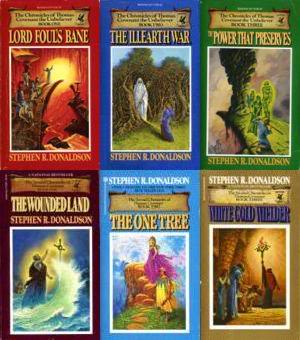
The Chronicles of Thomas Covenant the Unbeliever (six volumes)
“Clench Racing”

Dave Langford describes Clench Racing thus:

Up to six can play. The rules are simple: each player takes a different volume of Stephen Donaldson’s blockbuster Chronicles of Thomas Covenant, opens it at random, and leafs feverishly through the text. You win by being first to find the word “clench” (or “clenched”, “clenching”, etc). It’s a fast, furious sport, and a round rarely lasts a full minute.

Clearly, Fandom has a tradition of affectionate mockery of the books it loves. Furthermore, Geeks, the cultural group that includes Fandom, tend to value intelligent wit. It seems odd then that Humorous Fantasy isn’t a massive subgenre.

It’s hard to get facts and figures. An industry insider friend says that Humorous Fantasy’s bestseller/midlist ratio is the same as for other subgenres, it’s just that there’s less of it. Similarly, two authors I know who had humorous fantasy series that petered out both said that the main problem was the size of the market. One of them told me about how at conventions people’s eyes glazed when he talked about his humorous series, but lighted up when he talked about other projects.

Of course, you could argue that Terry Pratchett is so prolific and so very good, that he simply absorbed the subgenre. However, in Heroic Fantasy there’s room for Patrick Rothfuss and Joe Abercromby.  George RR Martin may dominate Epic Fantasy, but he has peers. It seems that a typical reader has slots for several favorite authors in a couple of chosen subgenres, but just one slot for Terry Pratchett Humorous Fantasy.

So, I don’t think I’m going out on a limb assuming that Humorous Fantasy isn’t popular compared to other Fantasy subgenres. Why is this?

Read More Read More

Vintage Treasures: Mustapha and his Wise Dog by Esther M. Friesner

Vintage Treasures: Mustapha and his Wise Dog by Esther M. Friesner

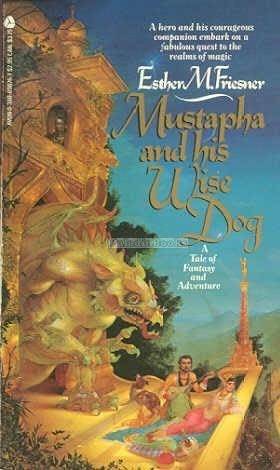
Mustapha and his Wise Dog-smallEsther M. Friesner’s first novel, Mustapha and his Wise Dog, was a considerable success and it launched her lengthy and very productive career as a fantasy author and editor. Since it appeared in 1985, she has produced over 40 novels, over half a dozen anthologies, and more than 180 short stories.

Mustapha was a humorous fantasy and, at a slender 175 pages, a very quick read. It was also one of the few fantasies with an Arabian setting on the shelves in the mid-80s (or even today, for that matter). It became the first of the four-volume Chronicles of the Twelve Kingdoms series, which continued in Spells of Mortal Weaving (1986), The Witchwood Cradle (1987), and The Water King’s Laughter (1989). Here’s the book description:

Spells, Enchantment, and Treachery

Some tales are told for gold; some for joy. But who would guess the ancient storyteller’s purpose in beguiling the children of the bazaar with the strange story of Mustapha and His Wise Dog…

Mustapha, young and clever, was outcast by his own brothers to wander in a dangerous land with only his magical, mischievous dog Elcoloq at his side. They were the unlikely warriors chosen by the gods to challenge the evil rising to threaten the world. They were the defiant ones willing to venture into the kingdom of powerful warlocks and seductive witches only to discover the fantastic journey yet awaiting them… a destiny of unforgettable adventure filled with dread demons and a treacherous lady… an awesome odyssey to a country of death, beauty… and a storyteller’s secret.

Mustapha and his Wise Dog was published in 1985 by Avon Books. It is 175 pages, priced at $2.95 in paperback. The gorgeous cover art is, sadly, uncredited. The book has been out of print for over 25 years and there is no digital edition. Used copies are easy enough to find, but this is one title ripe for a new edition — digital or otherwise.

Future Treasures: Shattered Shields, edited by Jennifer Brozek and Bryan Thomas Schmidt

Future Treasures: Shattered Shields, edited by Jennifer Brozek and Bryan Thomas Schmidt

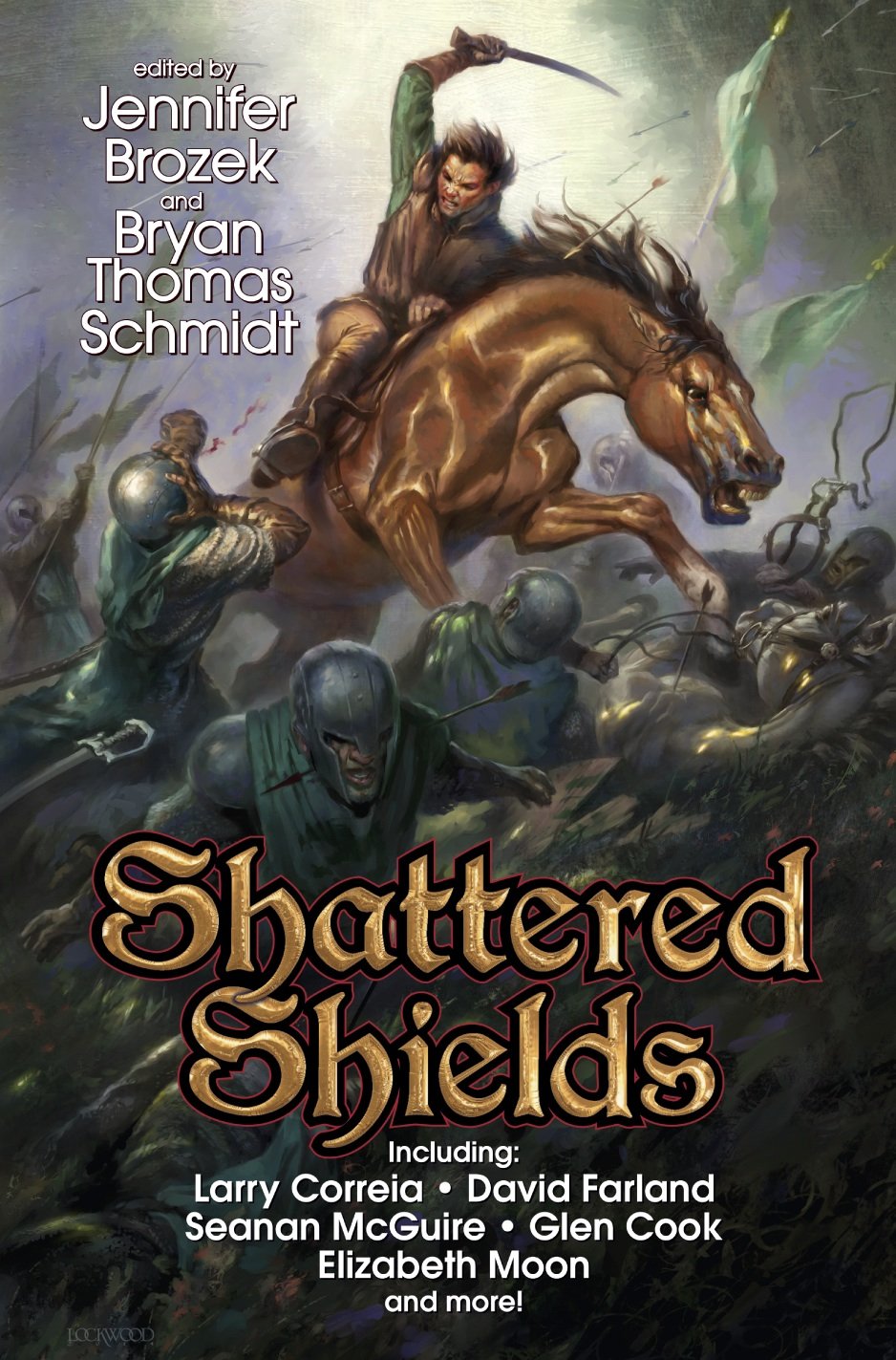
Shattered Sheilds-smallWell, here’s a fun thing: an upcoming anthology packed with tales of epic battles and soldiers struggling against overwhelming odds, with a stellar cast of contributors.

Shattered Shields is edited Jennifer Brozek and Bryan Thomas Schmidt, and will be available in November. Jennifer — who got her start as an RPG reviewer in Black Gate magazine back in 2002 — has previously edited no less than ten anthologies, including Space Tramps and Human for a Day. Her co-editor Bryan Thomas Schmidt has also edited Space Battles and Beyond The Sun, among others.

The book includes a brand new Black Company story from Glen Cook, a Paksenarrion tale from Elizabeth Moon, a Runelords story by David Farland, a tale of October Daye from Seanan McGuire — and a story set in the World of Zang by our very own John R. Fultz. Here’s John on his story:

“Yael of the Strings” is my contribution…  Most of the Zang Cycle stories were collected this year in The Revelations of Zang, but this is a brand-new excursion into that world. The protagonist isn’t a soldier at all, but a minstrel whose fencing skills become his only chance at survival when the red tide of battle overwhelms. “Strings” revisits the nation of Ghoth with its behemoth spiders (from “Oblivion Is the Sweetest Wine”), and introduces Sharoc, Land of the Griffon.

Readers who remember John’s terrific sword and sorcery tale, “Oblivion Is the Sweetest Wine” (from Black Gate 12) will surely want this one. Other contributors include Cat Rambo, Robin Wayne Bailey, Dave Gross, James L. Sutter, and many others.

Read More Read More

New Treasures: A Discourse in Steel by Paul S Kemp

New Treasures: A Discourse in Steel by Paul S Kemp

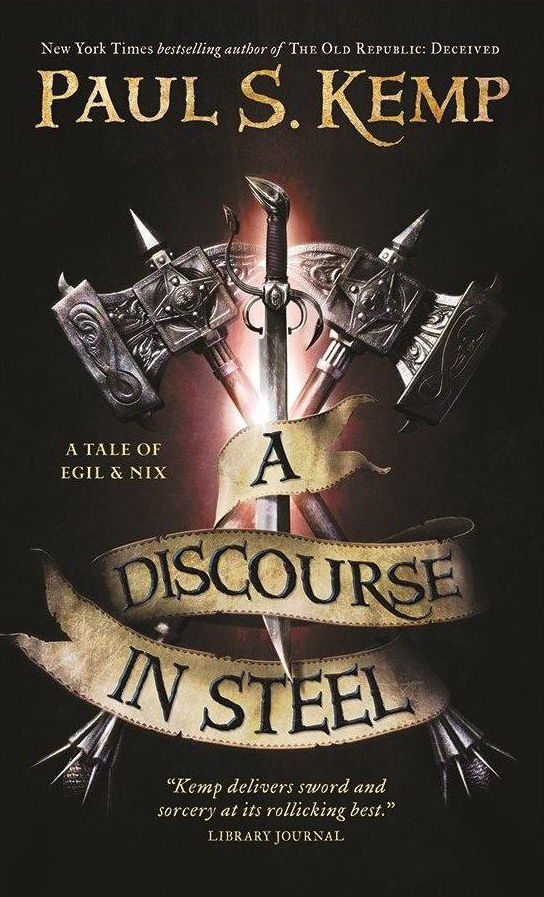
A Discourse in Steel-smallThere’s a school of thought in cover design that says that book covers with a heavy design element — as opposed to a reliance on artwork — are taken more seriously.

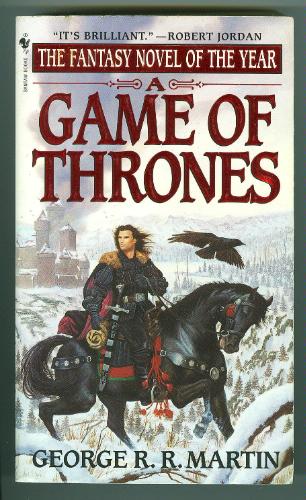
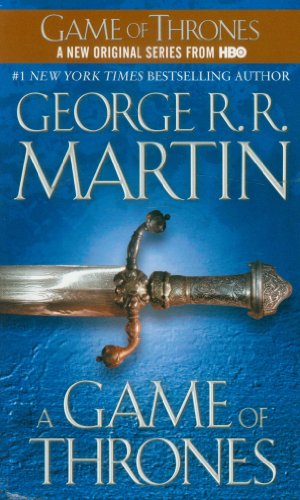
There’s something to this. A lot of bestsellers eschew artwork altogether in favor of design, and it seems to work just fine. When George R.R. Martin’s A Game of Thrones became a bestseller, Bantam Spectra jettisoned the artwork by Stephen Youll that had been on the cover for nearly ten years, and replaced it with the boring cover you’re familiar with today. No artwork, just a shining sword. Most mainstream readers won’t buy a book that looks too much like a fantasy novel — or at least, that’s the theory.

That was the first thing I thought of when I saw the cover of Paul S. Kemp’s  A Discourse in Steel, the second novel in his Tales of Egil & Nix series. It’s a sharp cover, actually, with a clear adventure fantasy theme. The lack of artwork and focus on design brought A Game of Thrones to mind (maybe it’s supposed to). But I also found it a little generic.

Here’s the book description.

Egil and Nix have retired, as they always said they would. No, really – they have! No more sword and hammer-play for them!

But when two recent acquaintances come calling for help, our hapless heroes find themselves up against the might of the entire Thieves Guild.

And when kidnapping the leader of the most powerful guild in the land seems like the best course of action, you know you’re in over your head…

A hugely-enjoyable stand-alone adventure in classic sword and sorcery mode, from the New York Times bestselling author of Star Wars: Deceived and The Hammer and the Blade.

Read More Read More

Self-Published Book Review: Malarat by Jessica Rydill

Self-Published Book Review: Malarat by Jessica Rydill

Malarat - eBook Cover DisplayingIf you have a book you’d like me to review, please see the submission guidelines here. I’ve run short on books that I’ve received in the past year, so anything new has a good chance of being reviewed.

This month’s self-published novel is Malarat by Jessica Rydill. The book is the third book in Ms. Rydill’s shamanworld series, but also a standalone novel. The novel takes place in a world much like our own, with France (called Lefranu), England (Anglond), Jews (Wanderers), and Christians (Doxans). But these analogs are not exact (for example, the Doxans elevate Megalmayar, the Mother of God, to the position of a goddess) and there are also a number of things that are very different, such as the Great Cold, that isolated a portion of Lefranu so that it remained stuck in Medieval times while the rest of the world advanced to what most closely resembles the late 19th and early 20th century, complete with trains, firearms, and electricity.

The novel focuses on Annat Vasilyevich and her father, Yuda, two Wanderers who are also shaman, who have a number of magical (or psychic) abilities, such as communicating by thought, traveling to other worlds, and blasting things with shaman fire. They have been asked by the rulers of Masalyar, a large city-state in Lefranu, to investigate the rise of Clovis, a new claimant for the crown of Lefranu, who has the support of the Duc de Malarat, a powerful duke, and the Canes Dei, Doxan warrior-priests with a reactionary theology and an invention, the Spider, which they can use to overcome shaman. The Canes Dei are led by the beautiful but brutal Valdes de Siccaria. Yuda is a former Railway guard, who has connections among the Railway workers, but he was crippled in a previous adventure. He plans on disguising himself as a pilgrim seeking the blessing of the new king. They are accompanied on their mission by Yuda’s non-shaman son Malchik, Malchik’s lover, Camille, and their newborn daughter, Annat’s current lover Genie and ex-husband Cluny, Yuda’s apprentice Huldis, the railway workers Nico and Lukacs, and the nuns Sister Coty and Mother Kana. This is admittedly a large cast, but they soon split into smaller parties, with Annat and Genie staying in the city of Yonar in order to defend it. There they are joined by Casildis, Huldis’s sister, and her husband, Sergey Govorin, and the shaman Semyon Magus. The others continue on toward their fateful encounter with Clovis’s forces.

Read More Read More