Harry Connolly’s Child of Fire
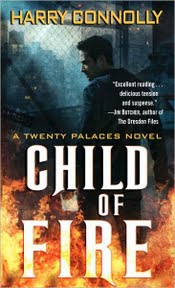 Harry James Connolly made his first fiction sale with “The Whoremaster of Pald,” way back in issue 2 of Black Gate.
It was the most popular piece in the issue by a fair margin, and not just because the title grabbed readers’ attention (although, speaking as the person who picked it out of the submissions pile, the title definitely didn’t hurt).
Since then Harry has appeared frequently in our pages and his fourth story, “Eating Venom,” will be in BG 15. But he hasn’t spent all his efforts on short fiction, as evidenced by the arrival of his first novel, Child of Fire.
Child of Fire is described as “a contemporary fantasy in the tone and style of a crime thriller,” and it’s received a lot of great press — including a mention on the Publishers Weekly’s Best Books of 2009 list.
Here’s what bestselling author Jim Butcher says about it:
“Excellent reading… has a lot of things I love in a book: a truly dark and sinister world, delicious tension and suspense, violence so gritty you’ll get something in your eye just reading it, and a gorgeously flawed protagonist. Take this one to the checkout counter. Seriously.”
And here’s the publisher’s blurb:
Ray Lilly is just supposed to be the driver. Sure, he has a little magic, but it’s Annalise, his boss, who has the real power. Ray may not like driving her across the country so she can hunt and kill people who play with dangerous spellsespecially summoning spellsbut if he tries to quit he’ll move right to the top of her hit list.
Unfortunately, Annalise’s next kill goes wrong and she is critically injured. Ray must complete her assignment alonehe has to stop a man who’s sacrificing children to make his community thrive, and also find the inhuman supernatural power fueling his magic.
 Though I had unrealistic high hopes for the remake of The Prisoner, if only because of the presence of Ian McKellan,
 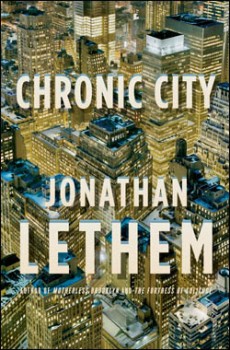 On a more positive note, I just finished Jonathan Lethem’s
  In today’s mail arrived the December 2009
 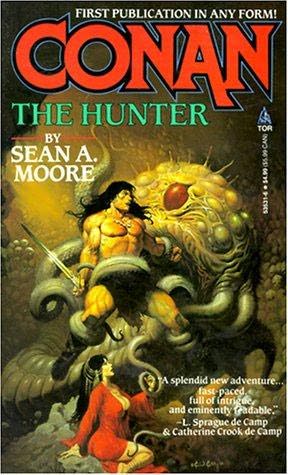 Conan the Hunter


 with my good friend
 ![[info]](http://l-stat.livejournal.com/img/userinfo.gif)
 As far as I’m concerned, Christmas just came early.
 If there is a watch, then there must be a watchmaker. That’s the crux of the argument for intelligent design, that existence, and specifically you and me, are the result of some conscious creator. My main problem with this is the adjective “intelligent.” If I was designing existence, there’s a lot I’d leave out, like cancer or maggots or flatulence or Glenn Beck. Or that for certain kinds of life to continue and thrive, other life forms must suffer. Besides, this all begs the question of, if there is a designer (intelligent or otherwise), who created the designer?
 From Jason Sizemore of Apex Magazine:
 My novel-writing continues apace. Therefore, I shall be brief today. Or as brief as I possibly can.
 Chances are if you are at all interested in fantasy or science fiction books or games, you’ve at least brushed against Games Workshop’s ubiquitous Warhammer franchise. Warhammer comes in roughly two flavors, the fantasy version which is a Tolkien, D&D, and Moorcock mash-up, and the space opera version, called Warhammer 40,000. Taking place in the bleak world of the 41st millennium, with the tagline “In the grim darkness of the future there is only war,” Warhammer 40k is a violent world of warring factions, lost technology, dark and corrupting forces, fanaticism, and a medieval Gothic aesthetic. It is a universe where power armored soldiers charge into battle with chainsaw swords screaming religious oaths, millennia-old spaceships a mile long look more like Notre Dame Cathedral than the starship Enterprise, and daemonic forces and hostile races in the form of orks, ‘elves,’ and H.R. Geiger aliens erode the power of a moribund human civilization presided over by a nearly-dead God Emperor.