Imaro: The Naama War
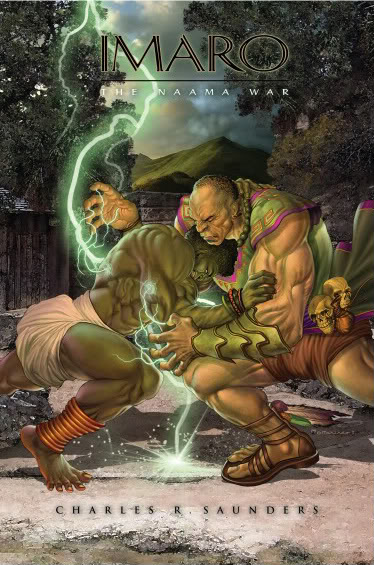 Imaro: The Naama War
Charles R. Saunders (Sword & Soul Media, 2009)
Here we have the long-awaited fourth volume in the “Imaro” series of sword-and-sorcery novels set in a fictional fantasy Africa. Imaro: The Naama War brings to a conclusion the many character arcs and plotlines that have built through Imaro (1981; revised 2006), Imaro 2: The Quest for Cush (1984; revised 2008), and Imaro: The Trail of Bohu (1985; revised 2009). The third book (which was the first written specifically as a novel instead of a collection of novellas and short stories) moves the tale of the Ilyassai warrior Imaro into the territory of the grand epic, threatening to plunge all of the continent of Nyumbani into a battle between the gods and the kingdoms they support, with Imaro as the fulcrum point. The novel ends on a cliffhanger, with the war about to erupt.
Now at last we have that great battle of gods and men, which Saunders started writing back in 1983. And it’s Epic. Big Capital “E” Epic. Charles R. Saunders more than rewards readers’ twenty-five years of patience with the single best installment in the saga of Imaro. This is sword-and-sorcery beauty, filled with bloody rage, bizarre magic, pounding battles, horrific monsters, and intense emotion. It is one of the best fantasy novels I have read over the past five years—and I’m actually glad I came late to reading the Imaro stories, because it means I didn’t have to wait so long to read the last and the best.
Imaro: The Naama War is the sort of fantasy trip I love to take, and I’ll admit that I felt an enormous rush of emotion and nearly came to tears during the thirty page wrap-up, where Saunders refuses to let the reader go from the passion of the story and the characters’ dramatic journeys. The escalation from the beginning to the unexpected conclusion is pitch-perfect. It is almost a textbook for how to build suspense and keep readers reeling with surprises while also maintaining their belief in the story’s inner truth.
So, yeah, this is kind of a good book. (Buy it here!)
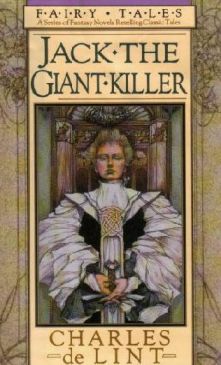 Jack the Giant Killer, by Charles de Lint
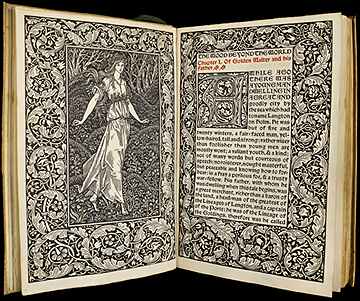 This is the third in a series of posts looking at the question of who wrote the first otherworld fantasy: that is, the first fantasy to be set entirely in its own fictional world, with no connection to conventional reality at all. It’s an innovation traditionally ascribed to William Morris, but I think I’ve found an earlier writer who deserves that honor.
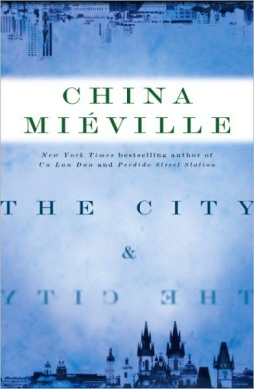 The City and the City
 I said a few words about Dragon*Con itself in
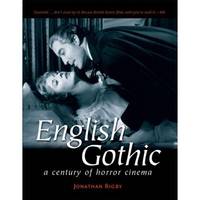
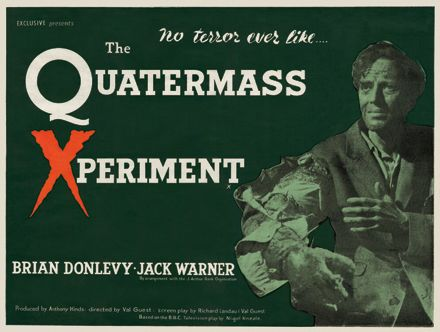
 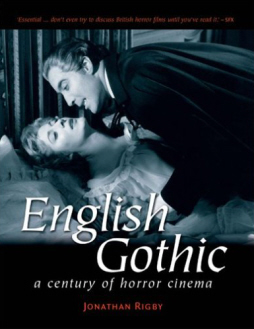 Jonathan Rigby’s ENGLISH GOTHIC (2000) is an excellent survey of British horror and science fiction films. Misleadingly subtitled A CENTURY OF HORROR CINEMA; the book focuses instead on the 20 year period from THE QUATERMASS XPERIMENT (1955) through TO THE DEVIL, A DAUGHTER (1976) when British production companies like Hammer, Amicus, and Tigon consistently outperformed the Hollywood majors in producing the finest and most influential genre films.
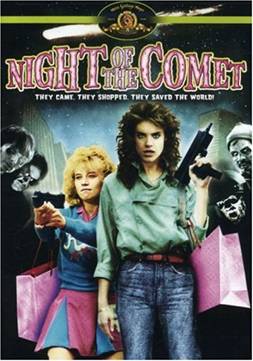 Before this, I was already obsessed with my Wii gaming system. On evenings following particularly stressful bouts at my “day job,” I can generally be found playing House of the Dead 3 on two-person mode; armed with the pistol in one hand and the machine gun in the other. Nothing says “stress relief” like laying waste Rambo-style to a seemingly endless parade of the undead.
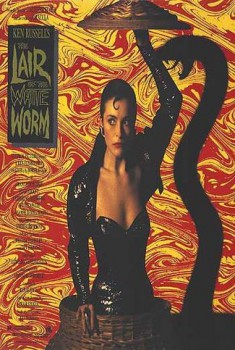 No, this isn’t a review of the Ken Russell film The Lair of the White Worm. The poster just fits so well with Cornell Woolrich’s 1935 story “Kiss of the Cobra” that I had to use it. You would almost think Russell was adapting Woolrich, not Bram Stoker.
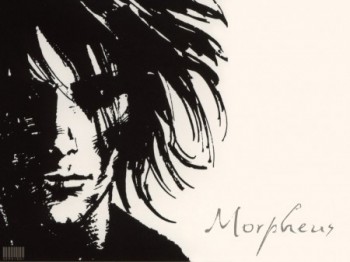 Many of my contemporaries believed that one of the most amazing comic book series ever was Neil Gaiman’s The Sandman, which ran from 1989 through 1996 – formative teenage years for me and my peers – originally by DC Comics and (from issue #47) under their Vertigo imprint. Now it looks like The Sandman has been re-optioned for consideration as a television series. Though the series creator isn’t associated with the show, there’s still reason to be hopeful.