Browsed by
Category: Blog Entry

Edgar Rice Burroughs’s Mars, Part 4: Thuvia, Maid of Mars
Edgar Rice Burroughs’s Mars, Part 4: Thuvia, Maid of Mars

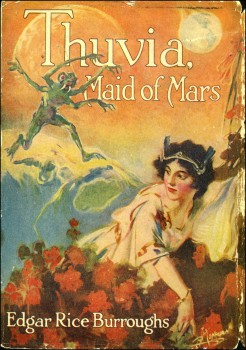
thuvia-maid-of-mars-mcclurg-coverJohn Carter’s story appeared finished with The Warlord of Mars. But readers wanted more, and Burroughs was fired with productive energy. Less than a year after “ending” the Martian novels, he launched into the second phase of the series, with a new hero, new heroine, and new point-of-view style.

Our Saga: The adventures of earthman John Carter, his progeny, and sundry other native and visitors, on the planet Mars, known to its inhabitants as Barsoom. A dry and slowly dying world, Barsoom contains four different human civilizations, one non-human one, a scattering of science among swashbuckling, and a plethora of religions, mystery cities, and strange beasts. The series spans 1912 to 1964 with nine novels, one volume of linked novellas, and two unrelated novellas.

Today’s Installment: Thuvia, Maid of Mars (1916)

Previous Installments: A Princess of Mars (1912), The Gods of Mars (1913), The Warlord of Mars (1913-14)

The Backstory

Burroughs wrote the fourth Barsoom novel in April–June of 1914 under the stunningly uninspired working title of “A Carthoris Story.” But it wouldn’t appear in magazine form until two years later, where it ran in All-Story in three installments in April 1916. Burroughs was deep in the middle of the busiest period of his life, and he spent most of 1915 trying to sell his new properties to Hollywood, all without success. The delay getting Thuvia, Maid of Mars to market may reflect how crazy the author’s life was getting — and that he realized that Tarzan was going to be his big franchise.

Read More Read More

It’s a World of Slaughter: Small World Board Game

It’s a World of Slaughter: Small World Board Game

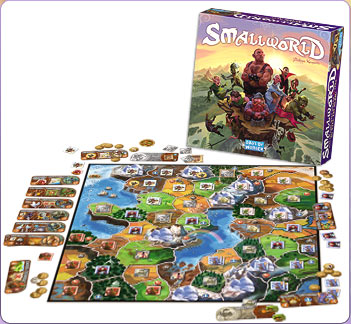
smallworldSmall World (Amazon)
Days of Wonder ($49.99)
2 to 5 players
Recommended ages: 8+
Playtime: Around 1 hour

Reviewed by Andrew Zimmerman Jones

Small World is a game where various fantasy races get to fight over a world that’s just too small for them all to coexist. The intriguing gameplay mechanic ultimately drives your races into decline, forcing you to select new races to sweep in and take their place. The victor is the one with the most Victory Points at the end of the game.

Each Race has special powers which are randomly chosen each game, resulting in a total of 280 different possible Race & Special Power combinations, from Swamp Giants to Dragon Master Skeletons to Seafaring Dwarves. (Or, in another permutation, Dragon Master Giants, Seafaring Skeletons, and Swamp Dwarves.)

The set-up can be a bit overwhelming when you first open the game, but once you’ve played it once, it’s a quick, fun game for the whole family. One nice feature is that there’s nothing hidden about the game, so this is excellent for introducing younger players to gaming. Though the recommended age is 8+, my precocious 6-year-old son and I have played this game multiple times. He often has questions about the way certain powers work, so the game lasts longer than an hour, but it’s loads of fun.

Read More Read More

Apex #33

Apex #33

apexmag02_mediumThis month’s Apex Magazine features ”Bear in Contradicting Landscape” by David J. Schwarz and ”My Body, Her Canvas” by A.C. Wise; the classic reprint is “Useless Things”  by Maureen McHugh, who is interviewed by Maggie Slater. Donata Giancola provides the cover art and Alex Bledsoe and editor Lynne M. Thomas penned columns round out the issue.

Further details about this on-line publication can be found here.

Blogging Alex Raymond’s Flash Gordon, Part Twenty – “Battle for Tropica”

Blogging Alex Raymond’s Flash Gordon, Part Twenty – “Battle for Tropica”

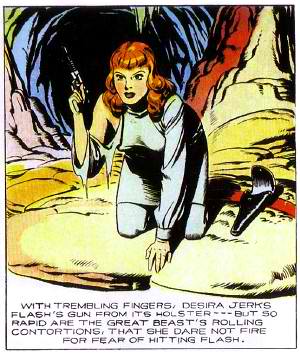
queendesiragun3battlefortropica“Battle for Tropica” was the twentieth installment of Alex Raymond’s Flash Gordon Sunday comic strip serial for King Features Syndicate. Originally published between July 18, 1943 and February 6, 1944, “Battle for Tropica” marks the final installment to be completely illustrated by the character’s creator, Alex Raymond. The storyline picks up where the preceding installment, “Fiery Desert of Mongo” left off with the roguish desert chieftain Gundar pledging to aid Flash in restoring Desira to the throne of Tropica. Desira is reluctant to trust the outlaw chief, but Gundar makes it known that he has aspirations of becoming the Queen’s royal consort for his troubles. Meantime, Gundar’s discarded queen, Pequit vows to make sure that Gundar never reach the throne of Tropica.

The group makes a daring nighttime raid on the city of Placida. Zarkov seizes the communications center while Gundar takes the sentries by surprise and informs them that their lives will be spared if they recognize Desira as their Queen. The Mayor of Placida kneels before the Queen and Flash is elated that the first city has fallen without a drop of blood being spilled. The important point, that Don Moore’s script never makes clear, is that the people of Tropica are beginning to learn that the Queen is not an imposter and Brazor is a traitorous usurper. Sentries later inform Flash that Brazor’s aide, Colonel Mogard is leading a fleet of tanks to Placida. Flash has Gundar’s men abandon the city to draw them away, but Mogard gives the order to raze the city to send a message to all who would remain loyal to the deposed Queen.

Read More Read More

Goth Chick News: When Goth Chicks Attack

Goth Chick News: When Goth Chicks Attack

image002Vampire Fashionistas, Flesh-Eating Ogres, Paranoid Werewolves and Sugar-Addicted Zombies…

Welcome to Gothopolis.

As I stare at the cover of Blood Feud: The Saga of Pandora Zwieback, Book 1 which was just delivered by the spotty intern handling the Black Gate mailroom this semester, several thoughts are competing for top billing; like “Where is this ‘Gothopolis’?” and “Someone get my travel agent on the horn,” and “Would Steven Roman mind if I developed a crush on him?”

Finally, someone who understands…

The cover of this magnificent work of art is reminiscent of looking in a mirror. Okay, not so much. But still I’m mesmerized. Is this really a novel about a zombie shooting, werewolf booting Goth chick?

It looks too good to be true really.

So I fire up the blender and with fine adult beverage in hand, I climb into my comfy chair (the big leather one just under the life-size stand up of Bela Lugosi) to have a nice, long, get-to-know-you session with Pandora Zwieback.

Read More Read More

Art of the Genre: Art of Dungeon Maps

Art of the Genre: Art of Dungeon Maps

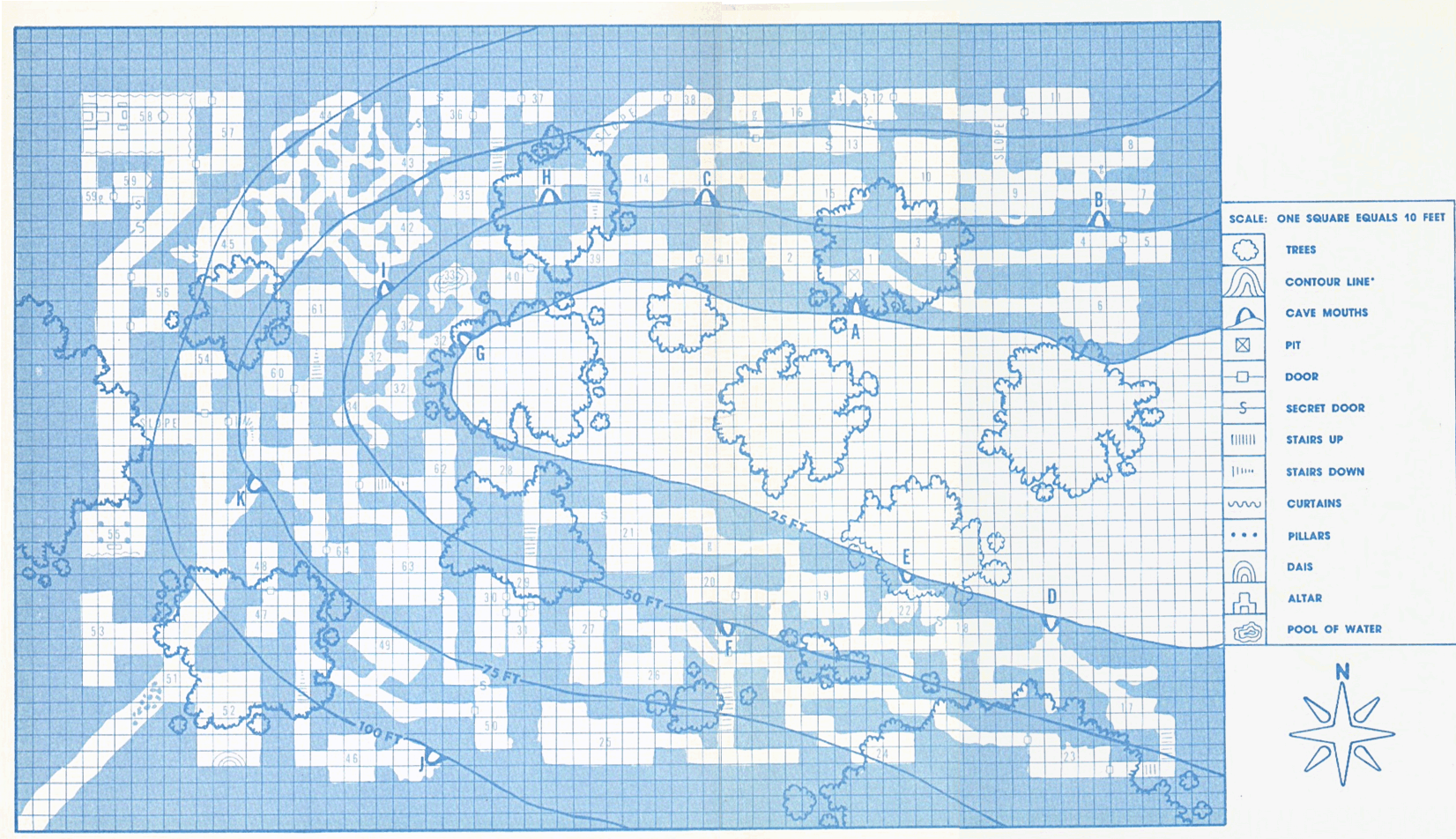
It doesn't get much more Old School than the Caves of Chaos
Earlier this week I had all my AD&D 1E hardcover books face out on a shelf in my home office for another project, each of the Jeff Easley covers staring at me while I worked. It was a truly inspiring set of images to have at your flank while you composed fantasy literature, but I think the best part was that later in the day my five year old son walked into the room and smiled as he stared up at them.

Which one do you like?” I asked, knowing full well what his answer would be.
This one,” he replied, pointing to the top shelf where Easley’s red dragon fighting with four pegasi on the cover of Monster Manual stood at attention.

Yep, of course my son the vegetarian and animal activist would pick that one, even if the animals involved are all imaginary.

A conversation followed with various questions like, “That man is going to save his friend, right?” for the cover of Wilderness Survival Guide, and, “I know the ninja is going to get away.” for the cover of Oriental Adventures.

Read More Read More

DANGEROUS BEAUTY: The Kung Fu Fantasies of Zhang Yimou

DANGEROUS BEAUTY: The Kung Fu Fantasies of Zhang Yimou

Ziyi Zhang as Xiao Mei in HOUSE OF FLYING DAGGERS, Yimou's second kung fu masterpiece.
Ziyi Zhang as Mei in the masterful HOUSE OF FLYING DAGGERS.

“Even without a weapon, the warrior can slay his enemy from a hundred paces. But the ultimate ideal is when the sword disappears altogether.
The warrior embraces all around him. The desire to kill no longer exists.
Only peace remains.”

–The King of Qin, HERO

Back in 2000 director Ang Lee reinvented the kung fu film (or “wuxia film”) with his Oscar-winning CROUCHING TIGER, HIDDEN DRAGON. Inspired by the great tradition of Chinese martial arts films, Lee brought solid storytelling, deft acting, and superb special effects to bring a new originality to the genre. The film set a new bar for kung fu flicks, where over-the-top action and supernatural elements blended seamlessly with high drama and solid scripting. Yet for Lee this was not the first installment of a new series, or a new direction for his creativity. CROUCHING TIGER, HIDDEN DRAGON was his single entry into the martial arts film genre–he quickly moved on to other types of films.

In 2002 a film called HERO was released in China by well-established director Zhang Yimou, who was acclaimed for such “serious” (i.e. non-action) films such as RAISE THE RED LANTERN and TO LIVE. Two years later, HERO hit American cinemas (thanks to Quentin Tarantino championing the film) and established Yimou as the new reigning king of the kung fu flick. What Lee failed to do (i.e. continue exploring the fertile ground of his CROUCHING TIGER universe), Yimou did with style, finesse, and sheer visual bravura.

Read More Read More

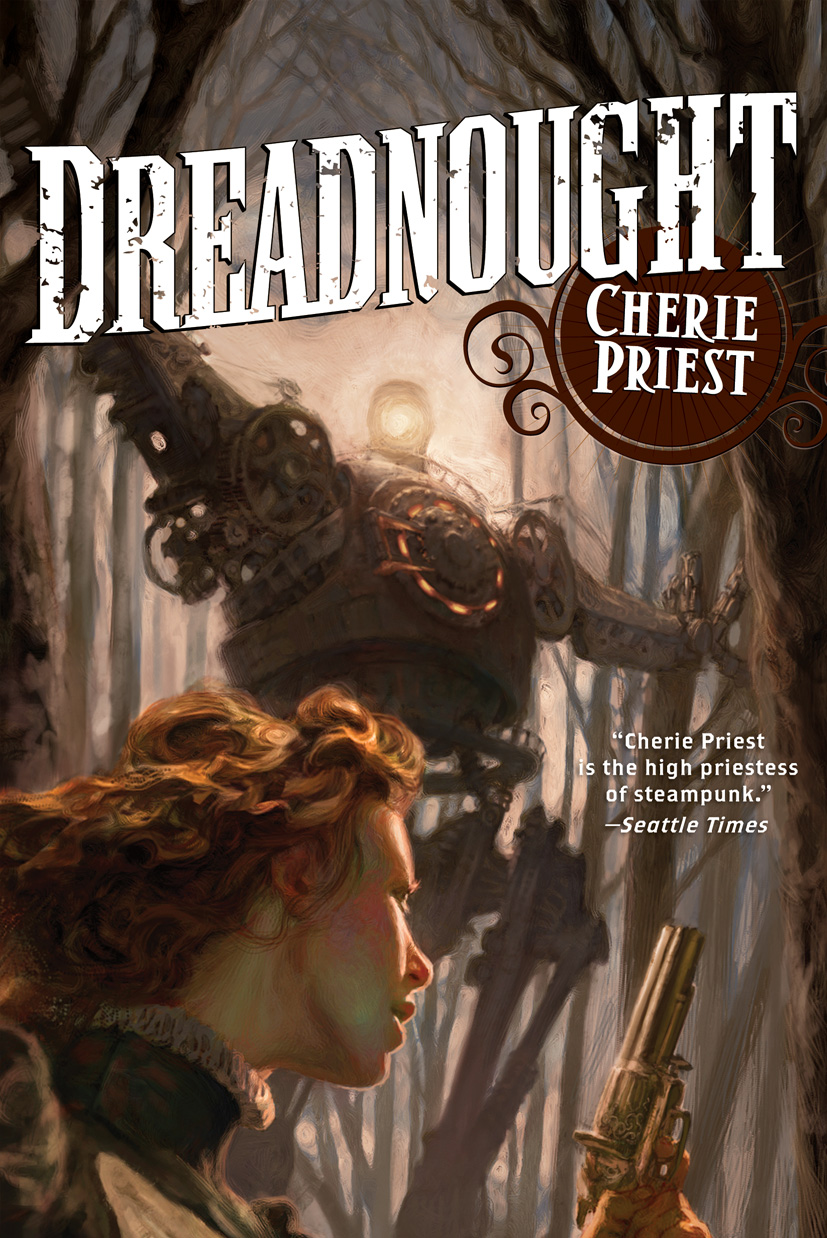
Steampunk Spotlight: Cherie Priest’s Dreadnought

Steampunk Spotlight: Cherie Priest’s Dreadnought

dreadnoughtDreadnought (Amazon, B&N)
Cherie Priest
Tor (400 pp., $14.99, 2010)

Reviewed by Andrew Zimmerman Jones

Cherie Priest returns to her “Clockwork Century” in full force in this third novel. In some ways, I would recommend that readers begin with Dreadought, even though it’s the third book in the series. Basically, the plot twist at the end of Dreadnought is the entire premise of Boneshaker, as I’ll explain later in the review. (Spoiler-ish alert!)

The book focuses on Mercy Lynch, a Confederate nurse whose husband has just died fighting for the Union. (Gotta love those border state romances!) She receives word from her father – who left her as a child – that he is dying, and he would like her to visit him in the Washington territory. That father is Jeremiah Swankhammer, who readers of Boneshaker will recognize as one of the key characters in that story.

With nothing really to keep her in Virginia, she sets off on a cross-country journey by airship and train to reach Tacoma and, ultimately, Seattle.  Unfortunately, the only train that can get her from St. Louis to Tacoma is the Union steam engine Dreadnought, and the train is carrying some bizarre cargo … cargo which makes the train trip into a harrowing ride that brings Mercy and the other passengers into conflict with bushwackers, a mad scientist, and even zombies!

Read More Read More

The Future of Bookstores Latest Update

The Future of Bookstores Latest Update

29-barnes-jp4-articleinlineSo it now it seems publishers are counting on Barnes and Noble to help them stay in business.  Which is funny because it wasn’t that long ago when Barnes and Noble was a slayer of independent bookstores and an enemy of the books business; now it’s considered the only thing that stands in the way of total world domination by Amazon.

Interesting that the notion of a bookstore is beginning to look more and more like an Apple store. Which is not necessarily a bad thing. My kid just got a Nook and she goes to our local Barnes and Noble because she can read certain e-books online for free there. Meanwhile she can consume some mocha lattes and maybe even take home a real book. Like everyone else I shop on-line, but the atmosphere of a bookstore leads to impulse buys that isn’t the same as scanning some algorithm’s suggested reads.

Speaking of physical books, I just finished Richard Morgan’s The Cold Commands, Book Two of presumably a trilogy ironically titled A Landcc Fit for Heroes (in which the land is neither fit for heroes nor populated with behavior typically classified heroic) by Richard K. (whose middle initial is used on book jackets only on the American side of the pond for some reason) Morgan describe it as “genre busting.” That’s not just some publicist’s hyperbole.  You can read the complete review over here at the SF Site.
Blogging Alex Raymond’s Flash Gordon, Part Nineteen – “Fiery Desert of Mongo”

Blogging Alex Raymond’s Flash Gordon, Part Nineteen – “Fiery Desert of Mongo”

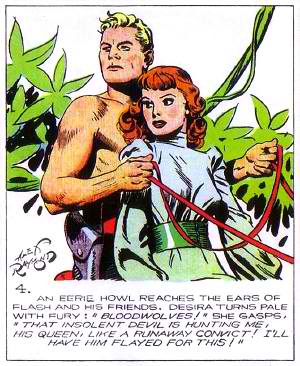
fiery-desertqueendesira2“Fiery Desert of Mongo” was the nineteenth installment of Alex Raymond’s Flash Gordon Sunday comic strip serial for King Features Syndicate. Originally published between November 8, 1942 and July 11, 1943, “Fiery Desert of Mongo” picks up where the preceding installment, “Jungles of Mongo” left off with Prince Brazor trailing Queen Desira to the border of Tropica’s Flaming Desert.

Flash causes an avalanche to delay Brazor’s men. The river of lava and the fire dragon that lurks within menace the fugitives as they proceed into the increasingly unbearable heat of the Flaming Desert. A volcanic eruption nearly finishes them off. Flash escapes to safety by managing a broad jump of over thirty feet. Alex Raymond and script writer Don Moore make the escape from the volcanic eruption a tension-filled drama that makes one forgive the implausibility of Flash’s near-superhuman feat.

As they near the edge of the Flaming Desert, the fugitives run out of water. A delirious Flash sees pixies emerge from a volcano and float through the air and set upon him, beating him senseless. On the verge of collapse, they are rescued by desert raiders.

Read More Read More