Gustav Meyrink’s Golem
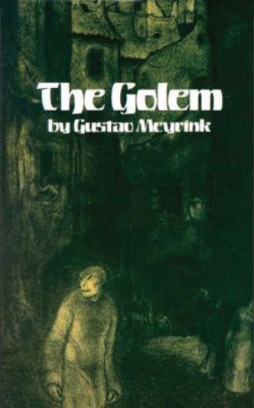 The first thing I feel I have to say about Gustav Meyrink’s novel, The Golem, is that it’s intensely, thrillingly strange. Dreamlike, elliptical, informed by theosophical and occult symbols, it wrong-foots you; nothing in it develops the way you’d expect, not in terms of character or plot or imagery. And yet that strangeness feels almost like a side-effect, a byproduct of its insistence on its themes, on its vision, on its focus on the reality of Prague and on whatever it is that lies beyond that reality. Perhaps the strangest thing about the book, published in installments in 1913 and 14 and published as a whole in 1915, was that this odd esoteric horror story was also tremendously popular in its day.
It was Meyrink’s first novel. A banker with an interest in theosophy and the occult, apparently for a time a member of the Hermetic Order of the Golden Dawn, he turned to writing after being thrown in jail for using spiritual guidance for his investments. He published a number of short satirical fictions, and then The Golem, which made his fortune. More novels followed, dealing with similar metaphysical themes. He died in 1932. The Golem remains his best-known work, certainly in the English-speaking world (though often cited as the inspiration for Paul Wegener’s multiple Golem movies, there seems to be no direct conection between films and book). It’s been translated several times; I have the 1995 version by Mike Mitchell.
Written in the first person, the book follows a gem-engraver named Athanasius Pernath who lives in the Jewish Ghetto in Prague (but is apparently not himself Jewish). Pernath is suffering from a strange loss of memory; a woman who knows him begs him to hide her in his lodging, but he cannot recall who she is. Then a strange man presents him with an ancient book of Jewish mysticism, whose elaborate first letter needs to be repaired. Pernath accepts the task; but this is only a sub-plot, and much of the action involves following Pernath through interactions with an odd set of characters around him — a sinister junk-dealer named Wassertrum; his bitter enemy, the medical student Charousek; the saintly archivist of the Jewish Town Hall, Shemaiah Hillel; and Hillel’s lovely but unworldly daughter, Miriam. We follow Pernath also through dreams and visions, through his life among puppeteers and whores and slumming aristocrats and deaf-mutes.

 Less than a week ago, we posted here to talk about
  Apex Magazine turns 40 with its September issue, featuring