Browsed by
Category: Blog Entry

Not A Visit From The Suck Fairy

Not A Visit From The Suck Fairy

My Real Children Jo Walton-smallA while ago, I was reminded of Jo Walton’s post on the “Suck Fairy.”
You should look at the whole post yourself, here, but let me give you a quick recap: when you reread something you once loved, that had a significant impact on you, you sometimes find that it has deteriorated considerably from what you recall.

Don’t worry, says Walton, it’s not you, it’s just that the book has been visited by the Suck Fairy, who has endowed it with… well, you get the idea.

This is an experience we’ve all had, I’m sure, but being reminded of it started me thinking about why we reread books in the first place, and, if we do, what books do we re-read?

Of course, the Suck Fairy can only affect beloved books which haven’t been revisited in some time, though they may have been read and reread often in the past. For example, I read LOTR at least fourteen times between the ages of eleven and twenty-one, but I haven’t reread it in its entirety since. I’m not afraid of the Suck Fairy – I’ve written papers on LOTR, and if that doesn’t bring on the Suck Fairy, nothing will – I’ve just been a bit busy.

No, I’m talking about books you might reread or re-visit maybe only once, maybe twice, as well as those you might regularly reread. I reread the novels of Jane Austen every year or so, for example, and the Sherlock Holmes Canon every two or three years.

Read More Read More

Blogging Sapper’s Bulldog Drummond, Part Five – “The Final Count”

Blogging Sapper’s Bulldog Drummond, Part Five – “The Final Count”

1189621421509Sapper’s The Final Count (1926) saw the Bulldog Drummond formula being shaken and stirred yet again. The first four books in the series are the most popular because they chronicle Drummond’s ongoing battle with criminal mastermind Carl Peterson. The interesting factor is how different the four books are from one another. Sapper seemed determined to cast aside the idea of the series following a template and the result kept the long-running series fresh, as well as atypical.

The most striking feature this time is the decision to opt for a first person narrator in the form of John Stockton, the newest member of Drummond’s gang. While Drummond’s wife, Phyllis, played a crucial role in the first book, she barely registers in the early sequels. One would have expected Sapper to have continued the damsel in distress formula with Phyllis in peril, but he really only exploits this angle in the second book in the series, The Black Gang (1922).

The Black Gang reappear here, if only briefly, and are quickly dispatched by the more competent and deadly foe they face. This befits the more serious tone of this book, which has very few humorous passages. The reason for the somber tone is the focus is on a scientific discovery of devastating consequence that threatens to either revolutionize war or end its threat forever. Robin Gaunt is the tragic genius whose invention of a deadly poison that could wipe out a city the size of London by being released into the air proves eerily prescient.

Read More Read More

How to Slay a Dragon, Realistically

How to Slay a Dragon, Realistically

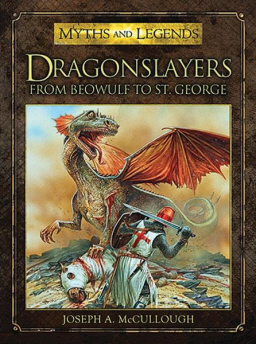
Dragonslayers from Beowulf to St. George
How does a Dark Age warrior or Medieval knight imagine he might kill a dragon?

One of the draws of  Heroic Fantasy is that it takes the archetypal, the magical — the magical realistic even! — and makes it immersively real by engaging with it in a practical, sweaty-browed, grimy handed way.

For example, a surrealist artist might paint a city inhabited by human wolves, but James Enge in Wolf Age plunges his hero into a realistically imagined civilization of werewolves and makes him fight to survive physically and morally.

That’s what the genre does. It says: Assume this crazy but cool thing was true; what would be the implications?

Now, dragons are about as crazy and cool and magical as beasts get. Suppose you had to kill one?

Don’t look to Greek Myth for tips! Yes, Heracles prunes the Hydra to death,  but he’s a demigod. Jason slays the Colchian dragon, but only after Media cast Sleep on it. Faced by a dragon, a mythological hero uses supernatural cheat codes. Puny humans without magic or divine descent don’t get a look in — which is fine. The listener, or reader, is civilised, and dragons belong to another era.

You’ll have more luck with the tales crafted — evolved in the telling — for the descendants of the barbarians who took down the Roman Empire. These rough men were accustomed to resolving problems through the medium of muscle-powered violence. The dragon, like a post-Roman city, a Byzantine army, or the walls of Jerusalem, merely presented an interesting challenge and thus their response becomes interesting to us:

So how does a Dark Age warrior or Medieval knight imagine he might kill a dragon?

Read More Read More

The Ballantine Adult Fantasy Series: The Sorcerer’s Ship by Hannes Bok

The Ballantine Adult Fantasy Series: The Sorcerer’s Ship by Hannes Bok

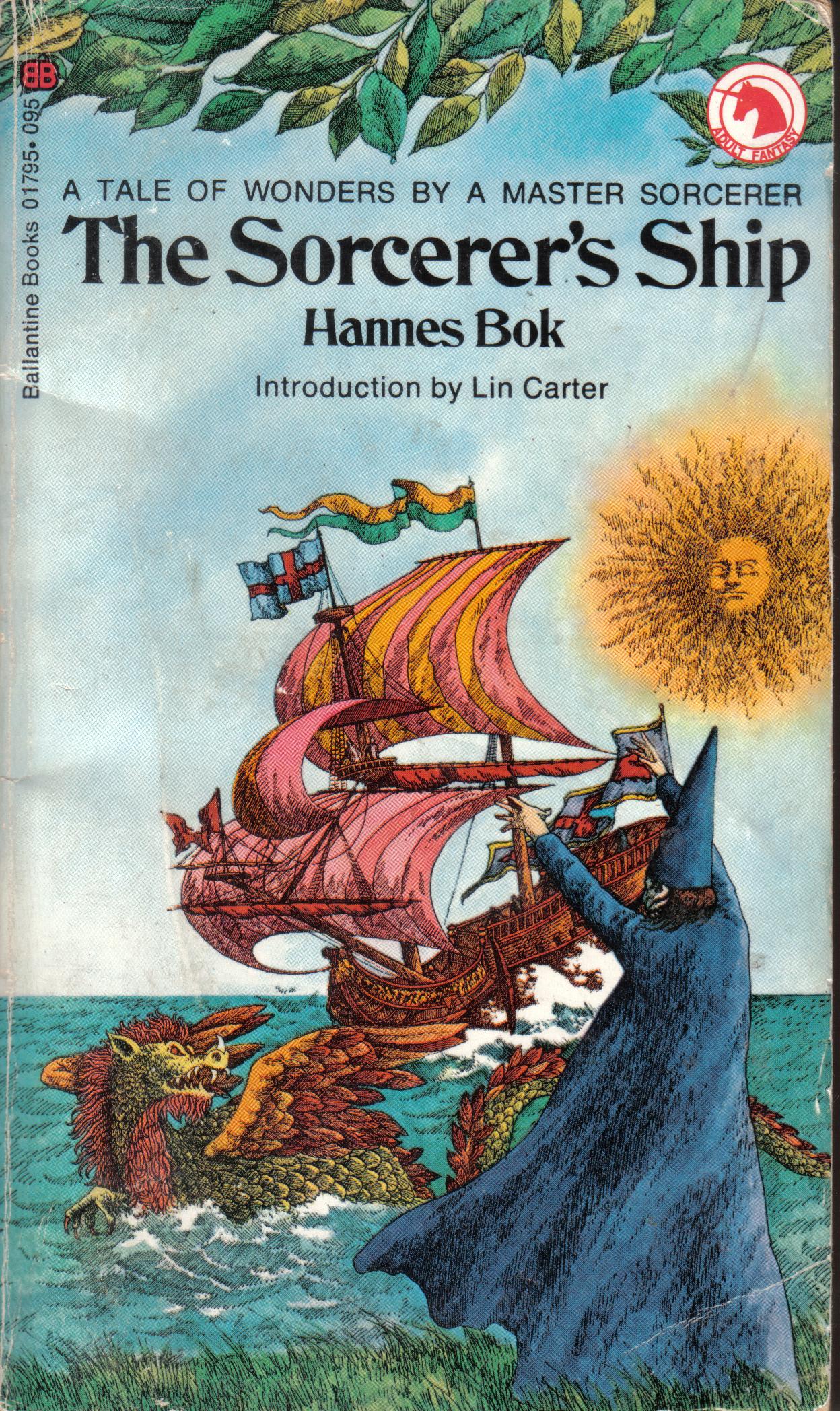
The Sorcerer's Ship 001The Sorcerer’s Ship
Hannes Bok
Ballantine, 205 p., December 1969, $0.95
Cover Art by Ray Cruz

First, I’d like to apologize to John and everyone else who reads these posts for taking so long to get this one done. I was on the road quite a bit from the end of May up through the Fourth, but I thought I would be able to get this particular post done quickly. Then things started happening. Car repairs, then house repairs, and then more car repairs. (This has necessitated bank account repairs.) Then last night, one of the wires in my son’s braces snapped loose. If anything else happens, I’m going to snap.

I don’t mean to kvetch. As you can see, I’ve been a bit distracted and apologize for the delay. I’ve already started the next book I’ll read for this series.

Anyway, on to something a little different than what we’ve seen in the Ballantine Adult Fantasy series up to this point. Rather than something deep and complex, with complicated writing (The Wood Beyond the World) or bizarre imagery (Lilith) or even not-so-subtle innuendo (The Silver Stallion), The Sorcerer’s Ship is almost a children’s story.

It’s not intended to be, but this is one that might hold a younger person’s interest. There’s certainly nothing in it that most parents would find objectionable for a child capable of reading a book of this length.

Hannes Bok is best remembered for his art, but as Lin Carter discusses in his introduction, Bok was also a more than capable writer. Carter chose this volume and The Golden Stair for inclusion in the BAF line. The Sorcerer’s Ship was originally published by John Campbell (not the world’s easiest sell by any means) in Unknown in December 1942. After Weird Tales, Unknown is arguably the greatest fantasy pulp in the history of the field.

Read More Read More

Vintage Treasures: To Here and the Easel by Theodore Sturgeon

Vintage Treasures: To Here and the Easel by Theodore Sturgeon

To Here and the Easel-smallA few weeks ago, I wrote about Theodore Sturgeon’s collection The Stars Are the Styx and complained that virtually all of Sturgeon’s brilliant short story collections had now been out of print for over three decades.

I did this mostly out of bitterness and greed. I’d spent several years happily tracking down all 16 of Sturgeon’s paperback collections — a highly collectible lot — but now, those days were over. I wanted more, but  no more were forthcoming. It’s not like I was going to discover a new Sturgeon collection I’d never heard of or something.

Of course, a few days after I wrote that article, I discovered a new Sturgeon collection I’d never heard of.

It was To Here and the Easel, a gorgeous Panther paperback from 1975, with an eye-catching Peter Jones cover. I discovered it accidentally on eBay and, after gawking at it for several long minutes — and them making sure it wasn’t simply a retitled version of a US collection I already had — I promptly purchased it.

It arrived a few days later and I am thrilled to have it. Here’s the back cover blurb:

Here are all the ingredients for a splendidly varied and entertaining collection of science fiction and science fantasy: a mental parasite which lives in the minds of successive human hosts, forcing them to do its will… the man who ‘reads’ gravestones… a devastating weapon sent from beyond space and time which poses the ultimate threat to an already shaky galactic federation… and more!

With virtuoso skill and brilliance of invention, Theodore Sturgeon displays in this collection the mastery of his field which has won him international acclaim.

Read More Read More

A Saxon Tower in Oxford

A Saxon Tower in Oxford

The Saxon Tower rises above a busy shopping street.

Ha! I bet you were expecting another Spanish post, weren’t you? Well, I spend the summers in Oxford, so this week you’re getting something a little more northern. When I’m not researching my next book in the Bodleian Library, I set out to explore the city and surrounding countryside for sights of historical interest.

Oxford is a beautiful university town filled with fine architecture. It’s also an ancient city with roots back into prehistory. It first came into prominence in Anglo-Saxon times and a trace of this has survived. On busy Cornmarket Street, there’s a well-preserved example of a Anglo-Saxon tower. It’s part of St. Michael at the North Gate church and was built around the year 1040. This makes it Oxford’s oldest building and one of the oldest Anglo-Saxon structures anywhere.

Read More Read More

New Treasures: There is No Lovely End by Patty Templeton

New Treasures: There is No Lovely End by Patty Templeton

There is no Lovely End-smallIt’s always a delight when one of our bloggers publishes a book. But it is a very special delight to see the brilliant Patty Templeton release her first novel, There is No Lovely End, which I have been enjoying in tiny snippets at various readings across Chicagoland for the last two years.

There is No Lovely End is a ghost book with a truly amazing cast of characters, living and dead — including Hester Garlan, once the most powerful medium in the nation, bereft of her supernatural gifts and in relentless pursuit of the boy she thinks can return them: her son Nathan; and Sarah Winchester, heiress to the Winchester Rifle fortune, on a quest of her own to rid herself of ghosts. Not to mention a very resourceful rat named O’Neill. C.S.E. Cooney calls the novel “a New World populated with a new kind of ghost. Templeton’s language is lavish and diabolical, as if Charles Dickens strolled into the Cabinet of Dr. Caligari and came out the other end wearing ruby slippers.” How right she is.

Apparitions! Outlaws! Mediums! 1884. Nathan Garlan hears and sees the dead. Using his uncanny aptitudes to assist society and its specters, he has become the most acclaimed medium in Boston. But not all esteem him. Nathan Garlan’s own mother craves her boy butchered — and she’s not the only one…

Misery! Lust! Murder! New Haven. Sarah Winchester is the heiress to the Winchester Rifle fortune and a haunted woman. She has searched for release from familial phantoms for two decades, yet found no respite. However, she has heard of a medium in Boston who regularly administers miracles…

Wit! Wonders! Outrage! Who is the Reverend Doctor Enton Blake? Why does the lawless Hennet C. Daniels search for him? What form of profane curio is a trick box — and what, precisely, does one inter within it? Will Sarah Winchester find serenity through Nathan Garlan’s services? Or will Hester Garlan find her son first?

There is No Lovely End was published on July 1st by Odd Rot. It is 444 riveting pages, priced at $16 in trade paperback, and $4.99 for the digital edition. Check out the trailer here. The cover and interior spot art are by Matthew Ryan Sharp. It gets my highest recommendation.

Art of the Genre: Gandalf, Conan, and Gray Mouser review Tales from the Emerald Serpent Volume II: A Knight in the Silk Purse; moderated by Cthulhu

Art of the Genre: Gandalf, Conan, and Gray Mouser review Tales from the Emerald Serpent Volume II: A Knight in the Silk Purse; moderated by Cthulhu

Another Word for Rain art by Jeff Laubenstein and writing by Dave Gross

Somewhere, in the labyrinthine halls of time and space, three figures sit in what would be considered a green room by the standards of the world we know today.  Each, in their time, was brought forth by the hand and mind of a great writer, but upon their passing, most of their tales came to an end, so what else is there to do but sit in the purgatory of licensing and read about other adventures that they can no longer partake.  So it is that these three immortal characters have come to discuss a new work of fiction, one that has a seed of commonality with the genre they so thoroughly understand.  And to keep them on track, the Great Cthulhu has been summoned from R’lyeh to moderate the affair.

Cthulhu: zzzzzzzz

Gandalf: Introductions you say, why yes, I am Gandalf, and Gandalf means me!

Gray Mouser: Seriously, if I have to hear him say that one more time, Cat’s Claw is coming out…

Conan: Nay, friend Mouser, stay thy hand that it can be put to better use on dark sorcerers like those of ancient Stygia and not this kindly grey-cloaked priest.

Gandalf: Priest! I dare say you misjudge, my heavily girded friend, but you do bring up a point of interest, that being the mage-craft and wizardry, something that appears in the tale Water Listens.  Now Cenote is indeed one of my kindred and has the grace of the Secret Fire and the flame of Anor certainly burns within her.

Gray Mouser: Flame?  Did you read as I did, Stormcrow? That woman is more reminiscent of Sheelba of the Eyeless Face, and there was no fire in her at all, but instead she seems filled with water as deep as the soul of Sea-King.

Conan: Tis true, Gandalf, yet she has friends of the flame, her slave Hunhau and the stout black, Tohil.

Cthulhu: zzzzzzzzzz

Read More Read More

Headed For a Watery Grave: The Adventures of Captain Marvel, Chapter Ten: Doom Ship

Headed For a Watery Grave: The Adventures of Captain Marvel, Chapter Ten: Doom Ship

Captain Marvel Chapter Ten BettyI’m glad to see that you’ve gotten here early — as we near the end of our saga, seats are going to be at a premium, and you’re fast running out of opportunities to see Frank Coughlan Jr. and Tom Tyler perform their mystic switcheroo. I mean, once this silly thing is out of the theater, it’ll be forever relegated to the realm of nostalgic memory — it’s not like anyone will be able to watch it at home sixty years from now! That would be magic…

And so, while we still have the chance, let’s join the ragged remains of the Malcolm Scientific Expedition in their struggle against the malific machinations of the sinister Scorpion in this week’s chapter of The Adventures of Captain Marvel, “Doom Ship.” Shazam! (Cough, cough…)

Pay close attention to this week’s title cards, recapping Chapter Nine; there will be a quiz after the main feature. “The Scorpion — Forces Doctor Lang to reveal the hiding place of his lens.” “Doctor Lang — Gives Betty the combination to his safe.” “Captain Marvel — Tries to warn Betty of a death trap at Lang’s home.” “Billy Batson — And Betty decide to get the lens.” Now to pick up where we left off…

Last week, we left Billy and Betty standing in front of the late Doctor Lang’s safe, unaware that two tommy guns were aimed at their backs, primed to fire as soon as the safe is opened. (They’re also unaware that Barnett and two other Scorpion men are watching them from hiding.) Just as Billy turns the safe’s dial to the last number, but before he can open the door, Barnett and his boys emerge from behind the drapes.

One of them shoves Betty out of the way. She slams against the wall and is knocked out (by the serial’s end, this woman will have suffered more concussions than Brett Favre) and then he slugs Billy on the head with a gun, laying the intrepid broadcaster out cold.

Read More Read More

Game Changers

Game Changers

book4In previous posts, I may have mentioned that, as a kid, there were three roleplaying games that I liked – and played – above all others: Dungeons & Dragons, Traveller, and Call of Cthulhu. I played lots of other games, too, but these were the ones that most strongly captured my imagination. Because I played these three so much, I was also a voracious consumer of supplementary materials produced for them. Of course, being a young person, my funds were limited; I had to be judicious in what I purchased. Consequently, I tended to put a priority on items I deemed to have the most overall utility. This meant, in the case of AD&D for example, that I placed greater value on hardcover rulebooks than on adventure modules (though I still bought plenty of adventures over the years).

My appetite for such broadly “useful” supplements was practical, since my friends and I played RPGs a lot. We were young and well nigh addicted to this weird new form of game. During the summer months, we quite literally played all day long, from the time we got up until the time the sun set, taking brief breaks only to scarf down some food before returning to the table. I’d conservatively reckon that, in terms of raw hours of play, my friends and I had probably played more than had many of our elders who’d started roleplaying years before us. That’s the nature of youth, as we had the free time to indulge our boundless enthusiasm in a way that most people do not.

I hesitate to say that, because we played so much, we more quickly became jaded than did many of our peers, but it’s probably true nonetheless. We were constantly on the lookout for ways to take our campaigns in new directions, to stoke the flame of our RPG ardor. The first supplement that I remember achieving this was Book 4: Mercenary for GDW’s Traveller. My friends and I started playing Traveller with The Traveller Book, which was released in 1982. That book alone was enough to keep us busy for many, many months of science fiction adventure in the far future. However, we did eventually want more out Traveller and Mercenary fit the bill, providing us with new skills, equipment, and – most importantly – expanded rules for generating Army and Marine characters.

Mercenary changed the way we played Traveller forever. Previously, Merchants, Scouts, and Navy personnel were favored, because these careers were all space-based and thus what we considered to be the stuff of sci-fi. But Mercenary-generated characters were so much better than those generated using the original system. They had more (and better) skills, as well as lots of fun perks like advanced training and commendations. Our campaigns quickly shifted gears to focus on ground-pounding mercenaries involved in interstellar brush fire wars (which, as it turned out, was how nearly everyone else we knew played the game). Mercenary had a profound impact on us and extended the life of our ongoing Traveller campaign considerably.

Read More Read More