Browsed by
Category: Blog Entry

Chivalry: Not Really About Opening Doors (and Still Quite a Useful Coping Strategy)

Chivalry: Not Really About Opening Doors (and Still Quite a Useful Coping Strategy)

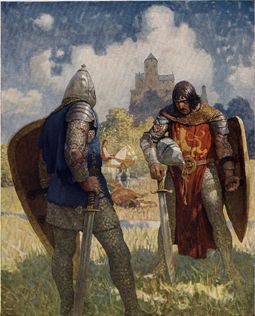
800px-Boys_King_Arthur_-_N._C._Wyeth_-_p38
He can’t give the lady her favor and spare the other man. What’s he going to do?

So, Lancelot is fighting this knight who insulted him. A few blows in and the rude fellow is on his knees: “Mercy, Sir Lancelot!”

Sir Lancelot stays his hand. He always grants mercy when asked.

However, before he can help the other chap to his feet,  a lady rides up. “Lancelot! I beg you a favor.”

“OK…,” says Lancelot. He also always grants favors to damsels.

“Give me that knight’s head! He slew my sister.”

Lancelot frowns. Now he’s caught between two imperatives.

He can’t give the lady her favor and spare the other man.

What’s he going to do?

Read More Read More

Galaxy Science Fiction, November 1952: A Retro-Review

Galaxy Science Fiction, November 1952: A Retro-Review

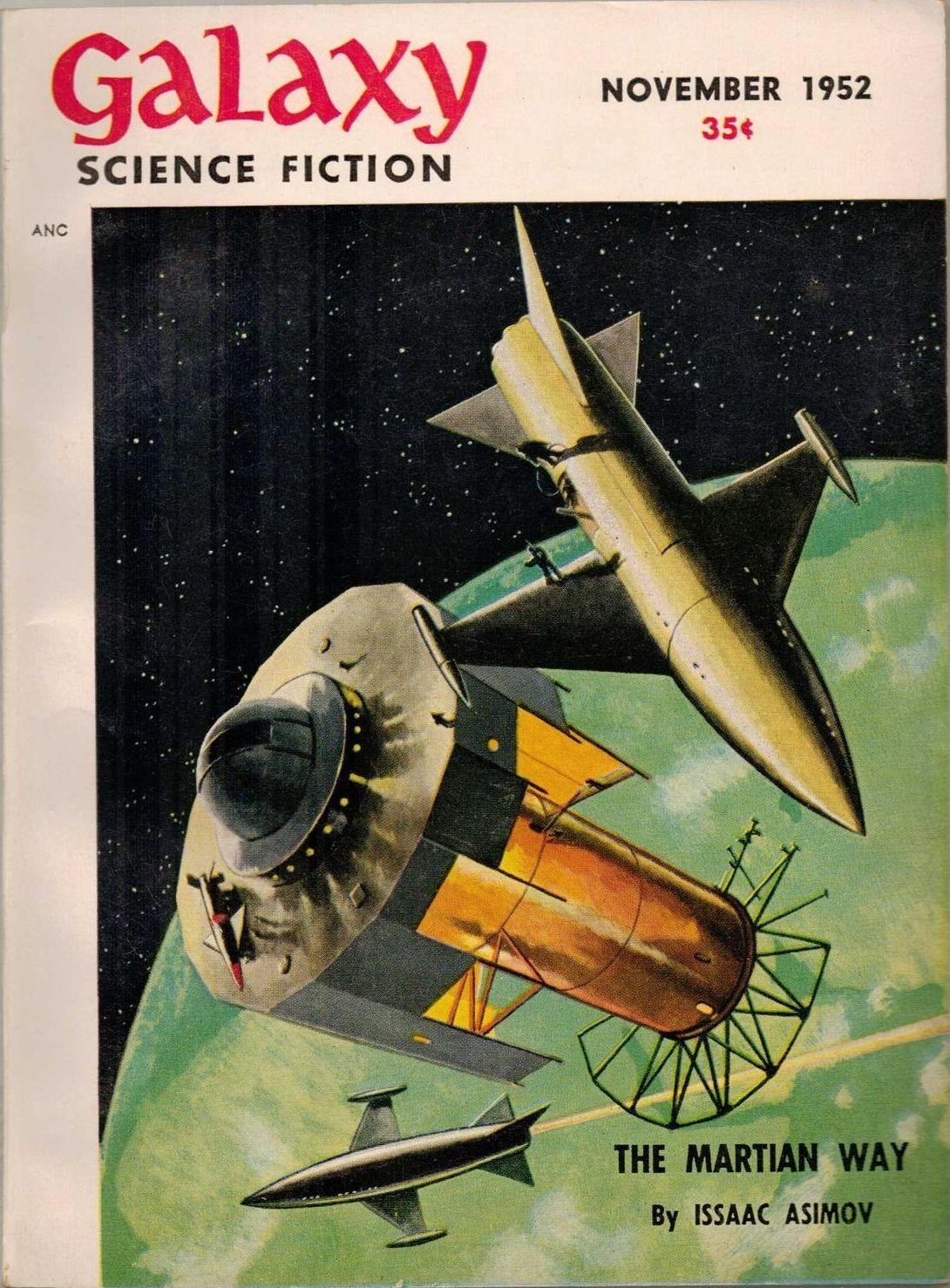
Galaxy November 1952-smallThe November 1952 issue of Galaxy Science Fiction features cover art by Jack Coggins of an Earth satellite. This satellite is more like a space station than satellites I typically think of. But considering that the first artificial satellite (Sputnik 1) wasn’t launched until about five years after this issue hit newsstands, everything was still left to the imagination at this point.

Before I jump to the fiction, I want to comment on Willy Ley’s “For Your Information.” In part of the column, he discusses Mars and its vegetation. I thought that was rather odd or presumptuous for him, but at this time, scientists were observing coloration on the planet’s surface that changed seasonally. That coloration plausibly suggested vegetation, and if there’s vegetation, what other life might be there? Then Mariner 4 did a fly-by in 1965, showing reality. Additional Mariner spacecraft confirmed more of the same — that Mars was a dead planet.

I wonder how many people were crushed by this, including authors of science fiction. There might have been some who feared Martians coming to destroy us and felt relief. But I also think that the possibility of life on Mars offered a kind of hope to some — that humanity wasn’t completely alone. With the truth of Mars revealed, that hope had to extend beyond the neighboring red planet. It will be interesting to see how science fact continues to influence science fiction, not necessarily by devestating our hopes and dreams but by helping to reshape them into new possibilities. And even without life on Mars, the planet still has an allure to it — a vacant planet that beckons to be explored and perhaps settled.

“The Martian Way” by Isaac Asimov — Mario Rioz and Ted Long work together on a small ship near Mars, tracking and scavenging the abandoned shells of Earth spacecraft. These jettisoned pieces are essentially rocket stages cast off as part of the flight, and they contain metal the humans on Mars can reuse.

A rising politician on Earth named Hilder points out that Mars doesn’t reimburse Earth for the shells, and the monetary investments will take many years to return. But worse than that, Mars can never replenish the water it takes from Earth to propel its ships. As Hilder’s voice gains more attention, other politicians begin mimicking him, which leads to new policies that prevent the scavenging of shells.

Read More Read More

July Short Story Roundup

July Short Story Roundup

Between Heroic Fantasy QuarterlySwords and Sorcery Magazine, and Beneath Ceaseless Skies, July was rich with fiction (nine stories, two poems, and a video treat), and some of it is pretty darn good. So let’s get started.

oie_105135GlDNN9g6Heroic Fantasy Quarterly #25, with beautiful banner art by Dana Martin, has the usual complement of stories and poetry, and, this month, a special bonus from editor Adrian Simmons.

Beast Hunter’s Song” by Michael A. Liguori, is about Sedrick the monster hunter’s second chance in life. Dragon hunters get all the glory, but the really dangerous and dirty work is done by the men bold and crazy enough to stalk the caverns of the Underlands for beasts that can swallow a dragon whole. Since the High Lord of Hunters decided there aren’t enough monsters left underground to hunt anymore, men like Sedrick have been reduced to guard duty.

When a Trogon, a beast “twice the size of a dragon, with two or three heads and terrible claws that could cleave an ox in half with a single swipe” ravages a city, the High Lord has no choice but to call Sedrick back to duty. While the plot is nothing out of the ordinary, there’s a wild inventiveness to Liguori’s underground world and its denizens. The end felt a little abrupt, but it could easily serve as an introduction to more adventures for Sedrick, which I would like to read.

In Linda Donahue’sWhite Elephants” Darius, sent to guard an Indian princess betrothed to the Persian emperor, becomes infatuated with his charge. When she and the priceless white elephant accompanying her are snatched by a roc, Darius is determined to rescue her. The thing is, neither the emperor nor the Indian king’s emissary care much about the princess; they just want the elephant rescued. There’s magic and mystery behind everything, and Darius is forced to make some dangerous choices along the road to save the princess. This is a solid adventure tale with a setting not used often enough in fantasy.

Read More Read More

Atlantis, Vikings, and the Hordes of Kublai Khan: Merlin’s Ring by H. Warner Munn: Part I

Atlantis, Vikings, and the Hordes of Kublai Khan: Merlin’s Ring by H. Warner Munn: Part I

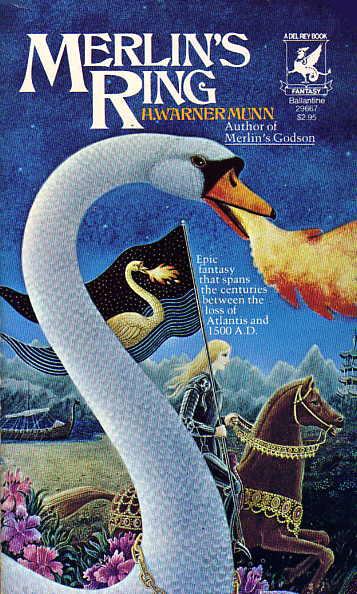
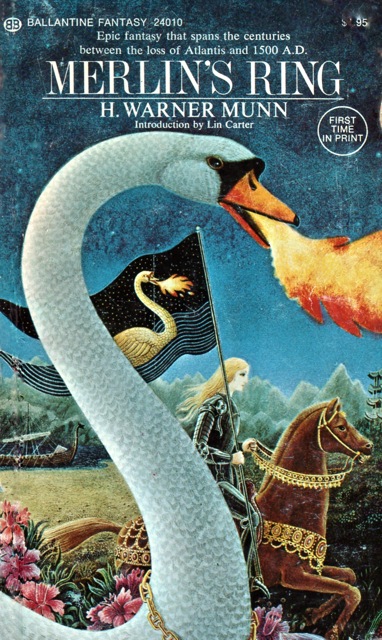
Merlin2-smallMerlin1-smallA few months ago I wrote an article about H Warner Munn’s excellent books The King at the World’s Edge and The Ship From Atlantis. Munn wrote both in the 1930’s, although the latter was only published later. By all accounts he took a hiatus from professional writing to concentrate on raising a family and providing the financial security that entails.

His passion for writing had not totally subsided, and as his “day job” career wound down, Munn embarked upon what many consider to be his magnum opus: Merlin’s Ring. Please note that this article does contain a few spoilers, which are necessary to explain certain concepts.

The volume sat on my shelf for years, like so many under the “one day I’ll read it” tag, but having undertaken the previous two books in what is now considered the Merlin’s Godson Cycle, I felt obliged to start Merlin’s Ring.

Merlin’s Ring continues the tail of Gwalchmai, whom we last encountered in The Ship From Atlantis. The book was published by Ballantine in 1974 with a cover by Gervasio Gallardo. It appears to have been republished a few times under the same imprint and later by Del Rey, with the same cover, until 1981. (Click on the images at left and right for more detailed versions.)

Read More Read More

The Public Life of Sherlock Holmes: Ronald Howard – A Younger Holmes

The Public Life of Sherlock Holmes: Ronald Howard – A Younger Holmes

RonHoward_GunSheldon Reynolds, an American producer, went to England looking for an actor to cast as Holmes in a new television series. Alan Wheatley had appeared in six televised plays (filmed live) for the BBC in 1951. Reynolds had much broader horizons. He found Ronald Howard, son of the famous English actor Leslie Howard. It was the senior Howard who insisted that Humphrey Bogart get to reprise his role of Duke Mantee when the successful play was turned into a film. It was Bogart’s first success on screen and helped launch his career. Howard was killed during World War II when the Nazis shot down his commercial plane over the Bay of Biscay.

Ronald Howard sold his house and took his family to France in early 1954. The entire series was to be shot there to save on costs. Reynolds had used this approach before, filming the American series Foreign Intrigue, in Stockholm for reasons of economy.  This time he would be an American producer, with a British Sherlock Holmes, shooting a television show in France.

Read More Read More

Sharing Creative Space: An Interview with Marvel Editor Daniel Ketchum

Sharing Creative Space: An Interview with Marvel Editor Daniel Ketchum

ketchu 3So far in this series, I’ve interviewed Marvel Associate Editor Jake Thomas, Assistant Editor Xander Jarowey, and Assistant Editor Heather Antos about their roles in the production process and their editorial voices.

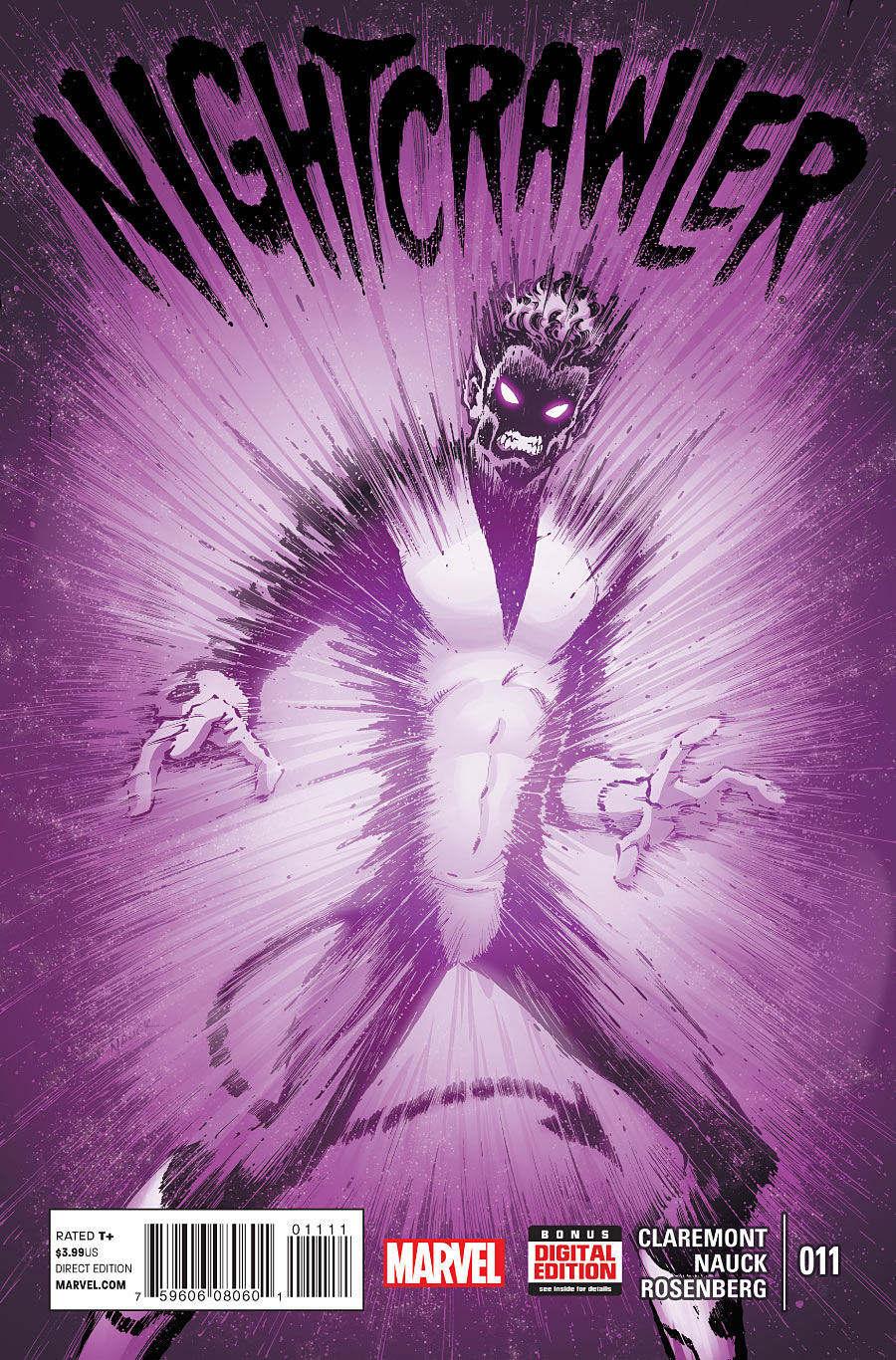
Today, I wanted to e-talk about the sharing of creative territory between writer and editor. So, I’m having an e-conversation with Marvel Editor Daniel Ketchum, who edits A-Force, Magneto, Nightcrawler, Storm, X-Force, X-Men and other books.

Daniel, in an interview you mentioned that part of your job is deciding which villain the X-Men fight in the next issue. I suppose I assumed (naively) that the writer got to decide most things. How do you divide creative decision-making roles with your writers?

Haha. Truth be told, that answer I gave is more of an easy-to-grasp oversimplification of what Marvel editors do. Four times out of five, the conversation with a writer at the outset of a story arc starts with them pitching the story they want to tell. (That other one time is when something like AXIS or SECRET WARS comes up and you just shouldn’t avoid addressing it.)

Read More Read More

Fantasia Diary 2015, Day 7: International Science-Fiction Short Film Showcase 2015, and Meathead Goes Hog Wild

Fantasia Diary 2015, Day 7: International Science-Fiction Short Film Showcase 2015, and Meathead Goes Hog Wild

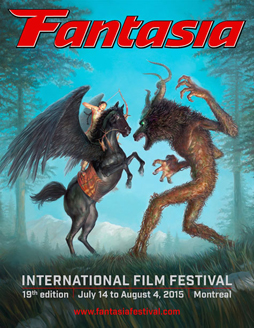
Fantasia FestivalMonday, July 20, was a relatively short day for me at the Fantasia Festival, but one I was looking forward to with great curiosity. At 5 PM I was going to the De Sève Theatre to watch a collection of science-fictional short films: Fantasia’s International Science-Fiction Short Film Showcase 2015 (to give the screening its official name) would show nine films ranging from four to twenty minutes long from seven different countries. Afterwards I’d stick around to see the world premiere of Meathead Goes Hog Wild, a Chicago-set movie about a man pushed to the edge of sanity. It ended up an interesting mixed bag. To go through everything I saw in order:

“Welcome to Forever,” an American short written and directed by Laddie Ervin, clocks in at 13 minutes and opens with a newscast setting up a future in which minds can be uploaded into the cloud and then downloaded into robot bodies. We learn that 112 million people have taken advantage of this technology, sparking protests — and then also learn that a nasty virus has struck at the cloud consciousnesses. The film then focusses in on a small-scale story of a man (Clive Hawkins) trying to clean up one of the many loose ends the virus left.

It’s effective enough, but doesn’t entirely come together; the introductory section and the main story feel disconnected. And the setting’s much larger than the story, so the themes of the main dramatic action are out of sync with the science-fictional elements. The world’s too big, the questions raised by the uploading technology too varied. And while the film looks sharp, the characters don’t feel real. Oddly, the film’s own success at sketching the setting undermines it: the world feels so interesting I want a story that explores it more deeply. As it is, the movie’s an interesting piece, but I don’t think it’s a total success.

Read More Read More

Visiting a Holy Well in Oxfordshire, England

Visiting a Holy Well in Oxfordshire, England

St. Margaret's church.
St. Margaret’s church.

Oxford is one of the most popular day trips for visitors to London thanks to its beautiful university and world-class museums such as the Ashmolean and Pitt-Rivers. It’s also worth staying overnight so that you can take advantage to the surrounding area, which offers some pleasant country walks.

One of the more enjoyable is a two-mile stroll along the Thames (locally called the Isis) that takes you to the hamlet of Binsey and the medieval church of St. Margaret’s. Set amid trees in the peaceful English countryside, the church makes for a relaxing stop and you can visit an Anglo-Saxon holy well that’s been an object of pilgrimage for centuries.

Read More Read More

Discovering Robert E. Howard: Pigeons From Hell From Lovecraft by Don Herron

Discovering Robert E. Howard: Pigeons From Hell From Lovecraft by Don Herron

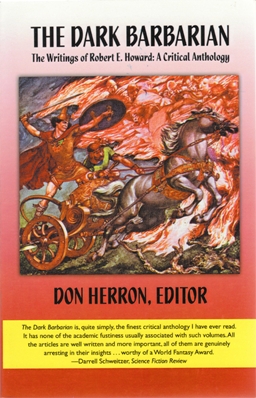
Herron_DarkBarbarianBefore the Cumberbunnies took over and flooded the internet with “I heart Sherlock” memes, the term ‘Sherlockian’ referred to those who studied (and often wrote about) Arthur Conan Doyle’s sixty stories of Sherlock Holmes. Some  of it was dead serious, some was tongue in cheek and much was in between. Monsignor Ronald Knox’s 1921 “Studies in the Literature of Sherlock Holmes” is the cornerstone of Holmes studies.

With that, I tell you that that Don Herron is THE Ronald Knox of Robert E. Howard. “Conan vs. Conantics” and the ensuing “The Dark Barbarian” showed that Howard could be analyzed and treated as literature. As well as something to stir up debate! If you haven’t read the over-600 page essay collection, “The Dark Barbarian That Towers Over All,” you need to pony up $4.99 and get the kindle version now.

And with that, Herron, who is also a noted expert on Dashiell Hammett (this man knows good writing) is going to treat you to a little Howardiana regarding REH’s most chilling horror story, “Pigeons From Hell.”


Recently I did a reread on H. P. Lovecraft’s Fungi from Yuggoth sonnet cycle and had a Hey, Wait a Minute moment. . .

Deep into his follow-up book to A Look Behind the Derleth Mythos, John D. Haefele had asked me to look the poems over. Haefele is surveying Lovecraft’s Great Tales — not just the top achievements, but how the fiction developed as it went along, leading to the break-out stories — not just Lovecraft’s own writing, but how his discoveries of authors such as Robert W. Chambers and Arthur Machen and the ongoing cross-influences of his fellow pulpsters such as Frank Belknap Long, Clark Ashton Smith, and Robert E. Howard display in the ongoing saga that would become known as the Cthulhu Mythos.

Read More Read More

The Speed Of Dark: Paksennarion vs. Autism

The Speed Of Dark: Paksennarion vs. Autism

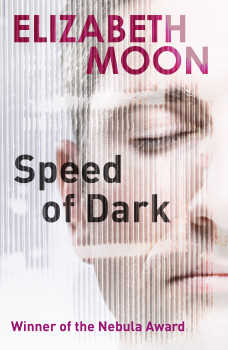
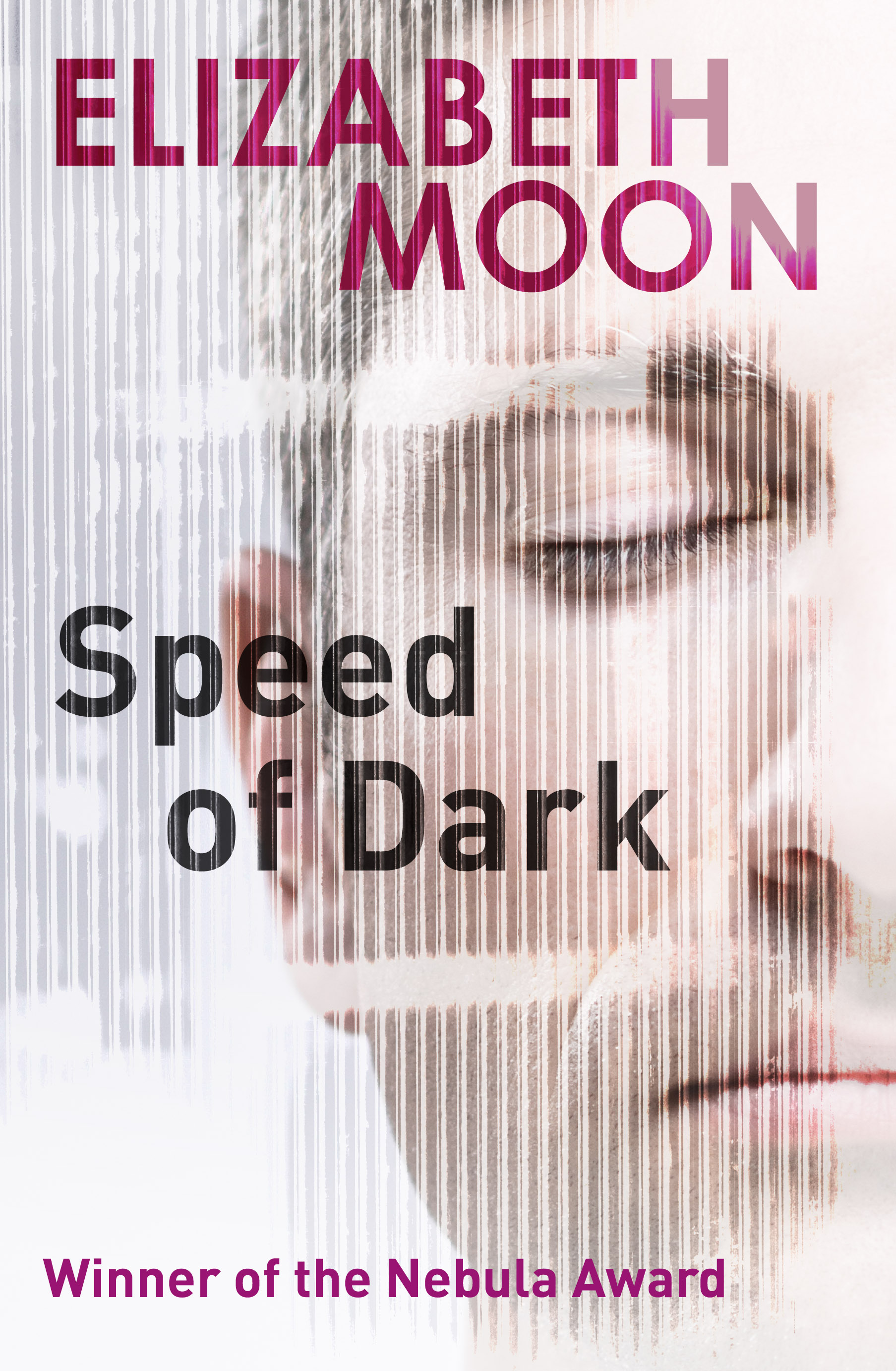
A Dark coverWhile wandering the aisles of Powell’s Books in Portland, Oregon – the kind of store that first leaves my jaw on the floor, then leaves my irises doing swirls straight out of an animated Warner Brothers short – I found myself in the Fantasy & Sci-Fi aisle.

Can’t imagine how that happened. Especially when my shopping list could also have led me to Photography, Sports (Tennis), Literature, Horror (Anthologies), and “Unisex Apparel.” Suffice it to say that I wound up face to face with my old buddy, Elizabeth Moon. Plenty of space opera on those shelves, sure, but also the various editions of the trilogy that made her name, her Deed Of Paksennarion series, together with the two less popular follow-ups, Surrender None and Liar’s Oath.

Then came the surprises. Turns out, Ms. Moon has resurrected Paks’s world, and some few of the characters from the various Paksennarion books in Oath Of Fealty, Kings Of the North, etc.

I was sorely tempted. I was. But in the end, I decided to let my fond memories remain exactly that: fond memories. As books with second-world settings go, and especially of the sword-swinging variety, I rate the Paksennarion trilogy very highly indeed, and as for Surrender None, well, I flat out love it.

The risk of spoiling all those warm recollections was just too great.

Even so, I would have picked up one of those newer titles – risk be damned, you only live once – but then I chanced upon a Moon title that didn’t seem to fit with her other work. The cover was different, for one thing. Not illustrative. Conceptual. No high fantasy or space opera here. No, indeed. But it had to be speculative fiction of some sort, since this unlikely loner of a book, The Speed Of Dark, had won the 2004 Nebula Award.

Read More Read More