Browsed by
Category: BG Staff

Who is the Daughter of Fu Manchu?

Who is the Daughter of Fu Manchu?

the-destiny-of-fu-manchu2The Destiny of Fu Manchu
By William Patrick Maynard
Black Coat Press (264 pages, $20.95 in trade paperback, April 2012)
A review by Joe Bonadonna

So who is the daughter of the infamous, the mysterious, the brilliant Fu Manchu? Is it the exquisite Koreani? The exotic Fah lo Suee? The lovely Helga Graumann? Who or what is the destiny of Fu Manchu? And who is “Khunum-Khufu,” and why is he in control of the Si-Fan?

The clues are there, the disguises are many, and the deception is all part of the fun in William Patrick Maynard’s sequel to his wonderful, The Terror of Fu Manchu.

I’ve become a fan of Maynard’s Fu Manchu. More importantly, I’m a fan of William Patrick Maynard. (His short story, “Tulsa Blackie’s Last Dive,” is one of the highlights of The Ruby Files, published by Airship27 Productions.) Now, in The Destiny of Fu Manchu, Bill picks up the story years after the events of his first novel, and this time he ups the ante in a tale that is far more complex and insidious than the good doctor’s previous adventure. I’ll do my best to give you a rundown without, hopefully, spoiling any of the fun.

The story opens with a prologue written by good old Petrie himself, the hero/narrator of the aforementioned The Terror of Fu Manchu. This time, however, Petrie has been abducted by Khunum-Khufu and a new faction of the Si-Fan, which plays back to the theft of the Seal of Solomon and the events related in the previous novel.

Read More Read More

Black Gate Online Fiction: “The Moonstones of Sor Lunarum” by Joe Bonadonna

Black Gate Online Fiction: “The Moonstones of Sor Lunarum” by Joe Bonadonna

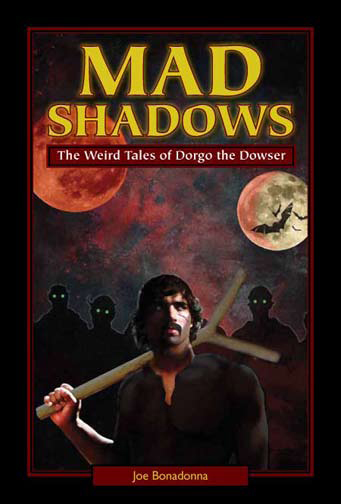
mad_shadowsWe first posted Joe Bonadonna’s sword and sorcery novelette “The Moonstones of Sor Lunarum” in December 2011, and it has proven to be one of our most popular online stories. We’re proud to re-present it here as part of the new Black Gate Online Fiction library.

Long before the legendary cities of Cush and Erusabad were destroyed by war, the graveyard was old. No one knew how old the graveyard truly was, for the carvings on its headstones and markers had been long worn away by the hands of time, wind, and weather. The cemetery crouched with its dead in a hidden vale in the dark heart of Khanya-Toth, land of shadows, black magic, and creatures of the night.

A tall, slim woman sat on the opposite side of the fire, close to the entrance to her bamboo hut. She wore a black robe, her face partially hidden within its hood.

“You’ve come a long way from Valdar to see me,” she said. Her name was Zomandra Chuvai, and she was a witch, one of the Kha Jitah. She lived alone in that ancient graveyard, with only ghosts and memories to keep her company.

“We’re the Blunker boys,” Ollo said. He was all skin and bone, with a sickly yellow pallor.

“I’m well aware of who you are,” Zomandra said. “Shall we talk business?”

“The Moonstones of Sor Lunarum” is part of Joe’s first published swords and sorcery collection, Mad Shadows: The Weird Tales of Dorgo the Dowser. Read more about Mad Shadows in “Dorgo the Dowser and Me,” posted on the Black Gate website here.

The complete catalog of Black Gate Online Fiction, including stories by Mark Rigney, C.S.E. Cooney, Vaughn Heppner, E.E. Knight, Jason E. Thummel, Judith Berman, Howard Andrew Jones, Dave Gross, Harry Connolly, and others, is here.

“The Moonstones of Sor Lunarum” is a complete 15,000-word novelette of weird fantasy offered at no cost.

Read the complete story here.

“Reminiscent of the Old Sword & Sorcery Classics”: Tangent Online on “The Find” by Mark Rigney

“Reminiscent of the Old Sword & Sorcery Classics”: Tangent Online on “The Find” by Mark Rigney

AppleMarkLouis West at Tangent Online reviews “The Find,” Part II of The Tales of Gemen, published here on Sunday, February 17th:

In Mark Rigney’s “The Find” we meet the young Gemen and learn his terrible secret: at age ten, Gemen followed his sister through an arcane portal and lost everything – sister, family, seven years of life and his entire world line. For decades he has crisscrossed this world, recovering the scattered portal stones to rebuild the gateway and return home…

Gemen… acquires Velori, sharp-tongued warrior priestess of Dominion, from the Courtyard of Trials where she deigns to kill her four attackers because her hidden weavers (giant spider friends) counseled “mercy.” The massive, bear-like Dorvic joins the pair by happenstance, an encounter that leads to a fight for their lives against several dozen Corvaen soldiers…

An enjoyable, often boisterous tale, reminiscent of the old sword & sorcery classics. I can’t wait to see what fate awaits Gemen. A must read.

“The Find” is the sequel to “The Trade,” Part I of The Tales of Gemen the Antiques Dealer, which Tangent Online called a “Marvelous tale. Can’t wait for the next part.”

Read Louis West’s review at Tangent Online, and read “The Find,” a 14,000-word novelette of weird fantasy, completely free here.

The complete catalog of Black Gate Online Fiction, including stories by C.S.E. Cooney, Vaughn Heppner, E.E. Knight, Jason E. Thummel, Gregory Bierly, Judith Berman, Howard Andrew Jones, Dave Gross, Harry Connolly, and others, is here.

Echoes of the Goddess: Schweitzer’s Newest Classic

Echoes of the Goddess: Schweitzer’s Newest Classic

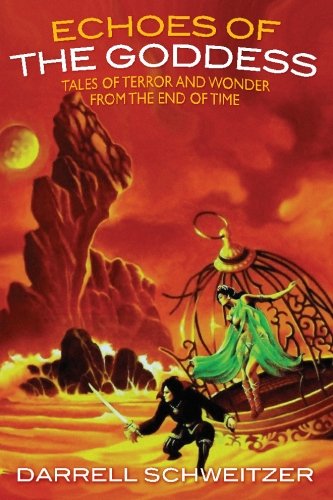
Echoes of the GoddessImagine a golden treasure chest filled to overflowing with rare and sparkling jewels. Now imagine the literary equivalent of that bounty: The jewels are visions of a fantastic world filled with dark magic, dead gods, and exotic cultures.

The latest book from Darrell Schweitzer is a treasury of obscure tales woven into a single, epic tapestry of high fantasy. Echoes of the Goddess collects eleven stories set in the same weird world as Schweitzer’s second novel The Shattered Goddess (1982). However, Echoes is not a sequel to Shattered. Instead it serves as a prequel, and a fine introduction to both the world of Goddess and the superb fantasies of Darrell Schweitzer.

Echoes of the Goddess: Tales of Terror and Wonder From the End of Time was released by Wildside Press in February 2013, but it was literally decades in the making. All of these stories were written between the years 1979 and 1985. Wildside describes the book: “This is an Earth of the far future, when the planet has declined into chaos, and darkness looms at the end of human history. Here you’ll meet… a wizard’s shadow attempting to become a man; two sorcerers grotesquely transformed by their fratricidal hatred; a musician who becomes the lord of death; a boy-priest consumed by divine visions; and a witch who loves a god, and many others. Here’s strangeness, wonder, and terror in the tradition of Clark Ashton Smith’s Zothique or Jack Vance’s The Dying Earth.”

Nobody works in the “story cycle” tradition quite as well as Schweitzer does. While most of today’s writers focus on cranking out novels, he prefers the short story form and is one of the widely acknowledged masters of the form. Some of his previous story cycles have been collected as the books We Are All Legends and The Book of Sekenre. Yet the stories in Echoes of the Goddess represent the author in the formative stages of his career, when his imagination was raw and unbounded. This was years before he would go on to win a World Fantasy Award for co-editing Weird Tales with the late George Scithers, and well in advance of his “To Become a Sorcerer” novella being nominated for that same prestigious award.

Read More Read More

New Treasures: Low Town by Daniel Polansky

New Treasures: Low Town by Daniel Polansky

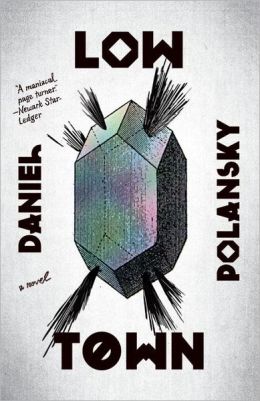
Low TownOne of our most popular articles in 2012 was Matthew David Surridge’s brilliant “The Enjoyment of Fantasy: Open Letters to Adam Gopnik, Mur Lafferty, and John C. Wright,” the latter part of which he spends taking Wright to task for some of his criticisms of Low Town. Matthew’s points are many and varied and I’m not going to summarize them here. I will admit, however, that after reading his article, my first reaction was, “What the heck is Low Town? It sounds kinda cool.”

A little investigation revealed that Low Town is Daniel Polansky’s debut novel. Here’s the description:

Drug dealers, hustlers, brothels, dirty politics, corrupt cops… and sorcery. Welcome to Low Town.

In the forgotten back alleys of Rigus, the finest city of the Thirteen Lands, sits Low Town. Here the Warden —  forgotten war hero and independent drug dealer — protects his turf. However, the Warden’s life of drugged iniquity is shaken by his dis­covery of a murdered child down a dead-end street… set­ting him on a collision course with the life he left behind. As a former agent with Black House — the secret police — he knows better than anyone that murder in Low Town is an everyday thing, the kind of crime that doesn’t get investi­gated. To protect his home, he will take part in a dangerous game of deception between underworld bosses and the psy­chotic head of Black House, but the truth is far darker than he imagines. In Low Town, no one can be trusted.

I’m intrigued. And while both Matthew and Wright seem to argue that Polansky doesn’t necessarily understand fantasy, it seems to me he’s grasped the basics just fine: he’s already written a sequel, Tomorrow the Killing, published in October 2012. Our man Myke Cole posted the following mini-review on Goodreads:

Polansky does it again. As with Mark Lawrence with King of Thorns, he shows progression as a storyteller with an even more twisted plot, more compelling and sympathetic character voice and more engaging setting.

Anybody who plugs Mark Lawrence in a one-sentence review has my immediate confidence. I purchased a copy of Low Town last month, and hope to check it out soon.

Low Town was published by Anchor Books in August, 2012. It is 341 pages in trade paperback, priced at $15 ($11.99 for the digital edition).

Congratulations to Black Gate on 3,000 Blog Posts!

Congratulations to Black Gate on 3,000 Blog Posts!

3000I feel like one of the service staff at a restaurant, waiting excitedly at the entrance for their 10,000th customer. Minus the cool food service uniform.

Ryan Harvey’s article on Edgar Rice Burroughs’ The Oakdale Affair, which went live less than an hour ago, was our 3,000th post. Congratulations to Ryan — and indeed, to the entire Black Gate staff.

The Black Gate blog was the brainchild of Howard Andrew Jones, who suggested I replace the outdated site he and I updated haphazardly with a modern WordPress web publication. I originally said no — and in fact said ‘No” the next half dozen times Howard brought it up. But he eventually talked me into it. Our new look was designed by Leo Grin and our first two posts, in November 2008, were both written by our site engineer David Munger. Our first regular bloggers were David Soyka, Judith Berman, E.E. Knight, Ryan Harvey, James Enge, Scott Oden, and Bill Ward.

Note that I was not a regular blogger. I was not a blogger at all. It took me six months just to figure out how to log in and puzzle out WordPress — and much longer before I dared make my first, timid post. I wrote over 750 in the next four years, and gradually got the hang of it.

We are very proud to be able to bring you, our readers, the best in new and overlooked fantasy every week. The site has grown by leaps and bounds in the last four and a half years, and today a team of nearly 30 bloggers contributes over 20 articles per week. In November 2008 our readership was in the hundreds; this month we are perilously close to breaking 100,000 visits. It’s been an honor and a privilege, and we’re pleased to have you here to celebrate with us.

Black Gate Online Fiction: “The Find,” Part II of The Tales of Gemen, by Mark Rigney

Black Gate Online Fiction: “The Find,” Part II of The Tales of Gemen, by Mark Rigney

AppleMarkGemen the Antiques Dealer gathers a resourceful team of fighters and adventurers to assist him in his mysterious quest, in the sequel to “The Trade”:

The guards finished lowering their prisoner into the octagonal pit. Gemen guessed that at least three hundred now looked on as the woman, very much alone, paced back and forth with restless, furtive energy while a bored-sounding magistrate, above, read out a host of generic accusations.

The magistrate rolled up his paintbark parchment. “The accused calls herself Velori, and she will now defend herself! Survival connotes innocence!”

Immediately four ladders snaked down, and as Velori planted herself in the center, four warriors slid down and advanced, their heads encased in bestial masks of iron and leather, inlaid axes at the ready.

Gemen’s companion let out a dry laugh. “You’re about to tell me it isn’t fair, aren’t you? They’ve got weapons. She doesn’t.”

Gemen shook his head. “It looks fair to me.”

Mark Rigney is the author of the plays Acts of God and Bears and winner of the 2012 Panowski Playwriting Competition. His short fiction has been nominated for a Pushcart Prize and has appeared in Black Static, The Best of the Bellevue Literary Review, Realms of Fantasy, Talebones, Not One Of Us, Andromeda Spaceways Inflight Magazine, Lady Churchill’s Rosebud Wristlet and many more. His contemporary fantasy novel, A Most Unruly Gnome, won the 2009 First Coast Novel Contest. Two collections of his stories (all previously published by various mags and ‘zines) are available through Amazon, Flights of Fantasy, and Reality Checks.

The complete catalog of Black Gate Online Fiction, including stories by C.S.E. Cooney, Vaughn Heppner, E.E. Knight, Jason E. Thummel, Gregory Bierly, Judith Berman, Howard Andrew Jones, Dave Gross, Harry Connolly, and others, is here.

“The Find” is a complete 14,000-word novelette of weird fantasy offered at no cost. It is the sequel to “The Trade,” Part I of The Tales of Gemen the Antiques Dealer, which Tangent Online called a “Marvelous tale. Can’t wait for the next part.”

Read the complete story here.

Amazing Stuff Where There’s a Will

Amazing Stuff Where There’s a Will

Amazing Stories August 2012Here’s some Amazing news. Just think what the Golden Agers who wrote for this magazine back in the 1940s might wonder about an online pulp magazine?

Actually, one of them, Ray Bradbury, considered the Internet a “waste of time.” I guess his problem was he never spent any time on the Internet.

We don’t have any of Shakespeare’s plays that he wrote in his actual hand, but we do have the plays as transcribed by members of his acting troupe. These days, it wouldn’t be profitable to have an Amazing Stories magazine if it weren’t for the Internet. Even Uncle Ray would be down with that, wouldn’t you think?

Apex Magazine 49Speaking of the Bard and online magazines, I had two “minor” fields of study for my English M.A. (if you must know, or care, the major field was Rhetoric), which were science fiction and Shakespeare.

When I say that, some people think there’s a discipline called “Science Fiction and Shakespeare” and maybe there should be, as certainly the Elizabethan fantasist has inspired many a modern one.

Case in point is the latest edition of Apex Magazine, which is a Shakespeare-themed issue featuring the work of Kate Elliott, Kat Howard, Sarah Monette, Merrie Haskell and Patricia Wrede.

Invocation of The Muses

Invocation of The Muses

Thalia Took’s Sketch of 9 Greek Muses

One of Steven Pressfield’s main topics of focus in The War of Art is the fight against what he calls Resistance — the unrelenting struggle a writer faces to NOT write. Every day a writer has to push forward and make the writing happen. You just can’t wait for inspiration, at least not if you’re going to write professionally.

I’ve found that The War of Art is one of the most useful writing books I’ve ever read because of its description of and advice about waging the battle against Resistance (note the capital R — you must respect the enemy). To help me do battle, one of my tactics is to recognize that when you sit down to write, you’re entering a different kind of mental state. I tell writing students that just as a professional athlete would not simply arrive at the track field and start sprinting, a writer will be poorly served to jump into the seat and immediately start typing.

It’s my thought that you have to acknowledge that change, that transition from one mental state (where you’re worrying about groceries and laundry or that news article) to another where the story is all, in order to do good work.

On the first page of The War of Art, Pressfield describes what he does each day to prepare to write so that he can be in the proper frame. Amongst several other personal rituals, Pressfield says a prayer. His is the Invocation of the Muse from Homer’s Odyssey, translated by T.E. Lawrence (that’s Lawrence of Arabia, incidentally).

I’ve never been much of a praying man myself, but I liked the sound of this, so I looked up the prayer, which I had read as a school boy and probably blipped over.

Read More Read More

Tangent Online on “Life on the Sun”: “This One Captured a Piece of my Soul. Brilliant.”

Tangent Online on “Life on the Sun”: “This One Captured a Piece of my Soul. Brilliant.”

cseLouis West at Tangent Online reviews C.S.E. Cooney’s original fantasy novelette, published here on Sunday, February 10th:

C.S.E. Cooney’s “Life on the Sun” is bold and powerful… While the previous story in this series, “Godmother Lizard,” entranced me, this one captured a piece of my soul. Brilliant.

Kantu, warrior of the Bird People, seeks to rid her desert city, Rok Moris, of the occupiers from the Empire of the Open Palm. When Fa Izikban Azur and his Army of Childless Men march upon Rok Moris, Kantu and her people rise up. But the Fa did not come to liberate, but to reclaim those who belonged to him — Kantu, his daughter, and the Rokka Mama, mother to the Bird People and the Fa’s favorite wife, even after she had killed him…

I don’t know how Cooney weaves so many rich story arcs into a single novelette tapestry. But, on a scale of 1 to 10, I rank this one as a twelve.

“Life on the Sun” is the sequel to C.S.E.’s “Godmother Lizard,” which Tangent Online called “a delightful fantasy tale about an orphan girl… The dialog has a pleasantly oblique edge to it which entranced me from the beginning.” We published “Godmother Lizard” right here on November 11th.

Read Louis West’s review at Tangent Online, and read “Life on the Sun” completely free here.

The complete catalog of Black Gate Online Fiction, including stories by Vaughn Heppner, E.E. Knight, Jason E. Thummel, Gregory Bierly, Mark Rigney, Judith Berman, Howard Andrew Jones, Dave Gross, Harry Connolly, and others, is here.