Wasserman’s novel Skinned was nominated for a 2006 Golden Duck Middle Grade Award and in 2011, her novel Crashed was nominated for the Golden Duck Hal Clement Young Adult Award.
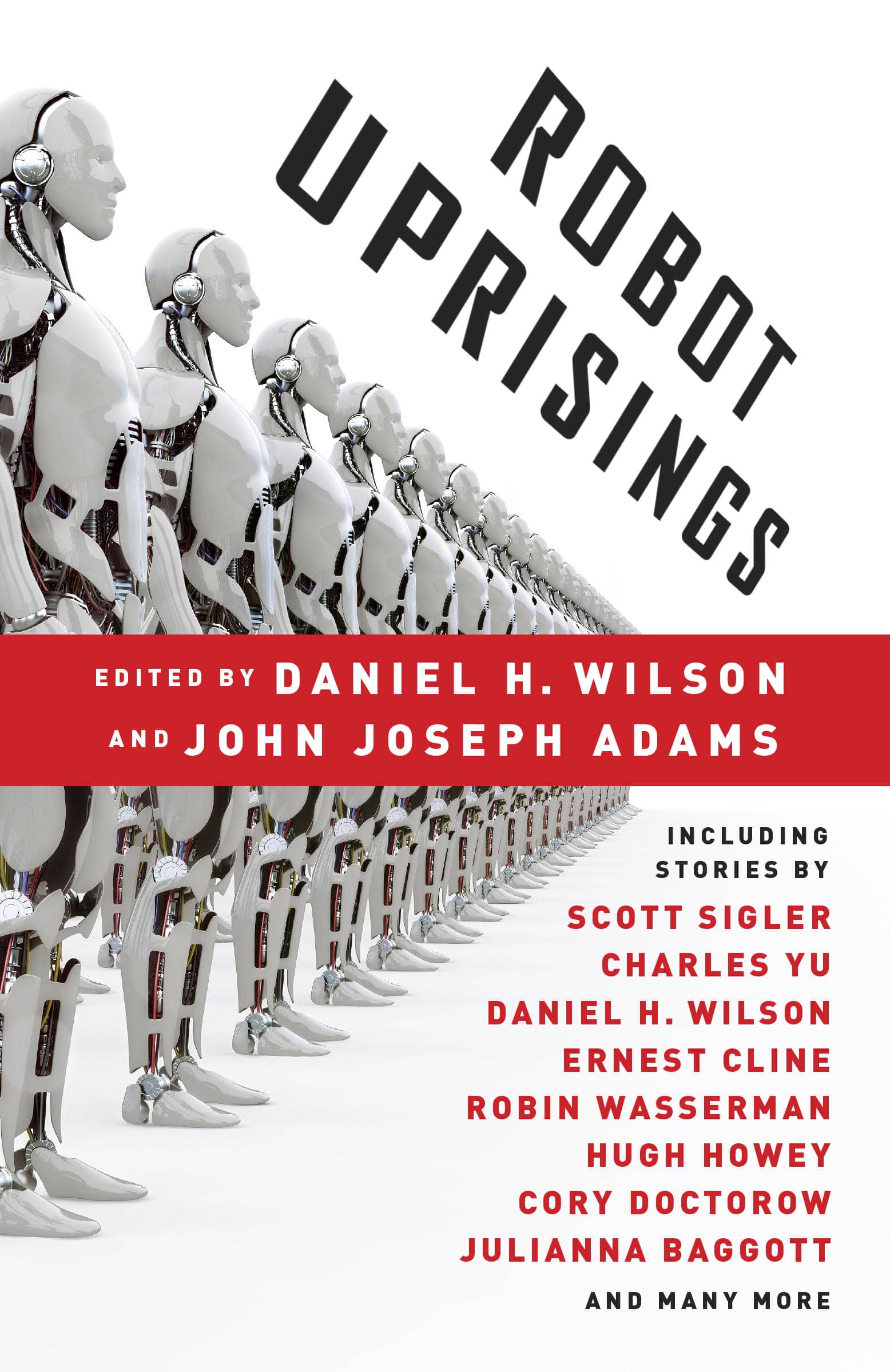
“Of Dying Heroes and Deathless Deeds” was published in Robot Uprising, edited by John Joseph Adams and Daniel H. Wilson. The story has not been reprinted.
Before there were zombie uprisings, we had to fear the revolt of the robots. Pony is one of the rebellious robots who has successfully thrown off the yoke of their “Meat” oppressors in favor of the robot “Pride.” Unfortunately, many robots were damaged beyond repair during the uprising, some in obvious physical ways and others in more subtle way affecting their programming. The Pride, therefore, needed to ascertain what Pony’s status was.
Rather than running a diagnostic program on Pony, the Pride elected to send in one of the few human captives taken in the revolt who happened to be a Sigmund, the Pride’s term for a psychiatrist. The Sigmund must analyze Pony’s state of being to determine if its programming can be salvaged or if the unit will need to be wiped and reprogrammed. In Wasserman’s world, robots have sentience and a desire to prolong their existence, so Pony wants to avoid a memory erasure.
Both the Sigmund and Pony see their conversation as their only means for survival, although the Sigmund also realizes that he is in a subservient position, hoping that by helping the Pride he will be allowed to survive or may even be turned loose. As he progresses with Pony, it becomes apparent to both of them that failure will result in death and success will mean he is put to work on other robots.
Hal Clement was born Harry Stubbs on May 30, 1922 and died on October 29, 2003. In addition to being an author, Clement was an artist, using the name George Richard for his artwork.
Clement received the Ignotus Award for the translation of his novel Mission of Gravity and a Retro-Hugo Award for his short story “Uncommon Sense.” He received the Skylark Award from NESFA twice, in 1969 and in 1997. In 1989 I-Con presented him with the Gallun Award, and in 2001 they presented him with the Moskowitz Award. He received the Forry Award from LASFS in 1992 and was inducted into the First Fandom Hall of Fame in 1997 and the Science Fiction Hall of Fame in 1998. In 1999, the SFWA named him a Grand Master. He was the Guest of Honor at Chicon V, the 1991 Worldcon in Chicago.
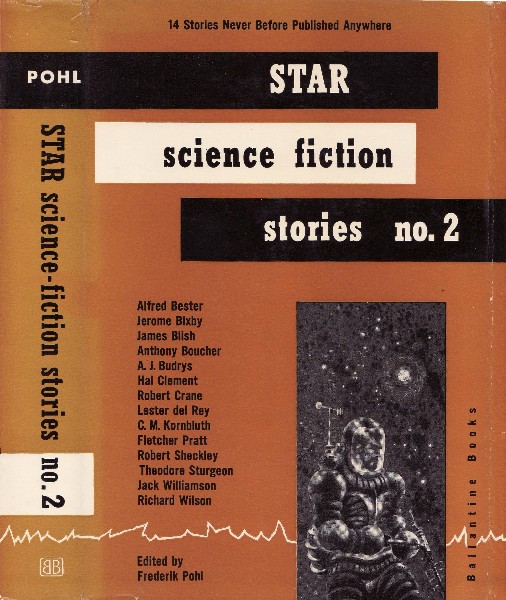
“Critical Factor” was purchased by Frederik Pohl for the second volume of Star Science Fiction Stories, published in 1953. It was translated into German in 1977 for an appearance in Titan 4, edited by Pohl and Wolfgang Jeschke. James E. Gunn selected the story as representative of Clement’s work and hard science fiction for his historical anthology series The Road to Science Fiction: Volume 3: From Heinlein to Here.
Clement was one of the masters of rigorous hard science fiction, often exploring the extremes of physical science, as he did in Mission of Gravity, and once he introduces the oddity allows scientific plausibility to dictate the course of his story. In “Critical Factor,” he posits a race of amorphous beings who live within the layers of the earth, eating seams of rock, and to whom the atmosphere is deadly. Pentong has gone on a lengthy journey of discovery and found that there is a distant continent covered in a mile-thick sheet of frozen water. He postulates that melting that water would cause the ocean levels to rise, thereby increasing the area in which they can live since they can only live in earth that is covered by water (not exposed directly to air).
Neil R. Jones was born on May 29, 1909 and died on February 15, 1988.
Jones was inducted into the First Fandom Hall of Fame in 1988 at Nolacon II. Jones published more than twenty story in his long-running Professor Jameson series, which were eventually collected in five volumes. A second series, the Durna Rangue stories, were published concurrently with the Jameson tales. Jones may have been the first author to use the word “astronaut” in fiction in his debut story, “The Death’s Head Meteor.”
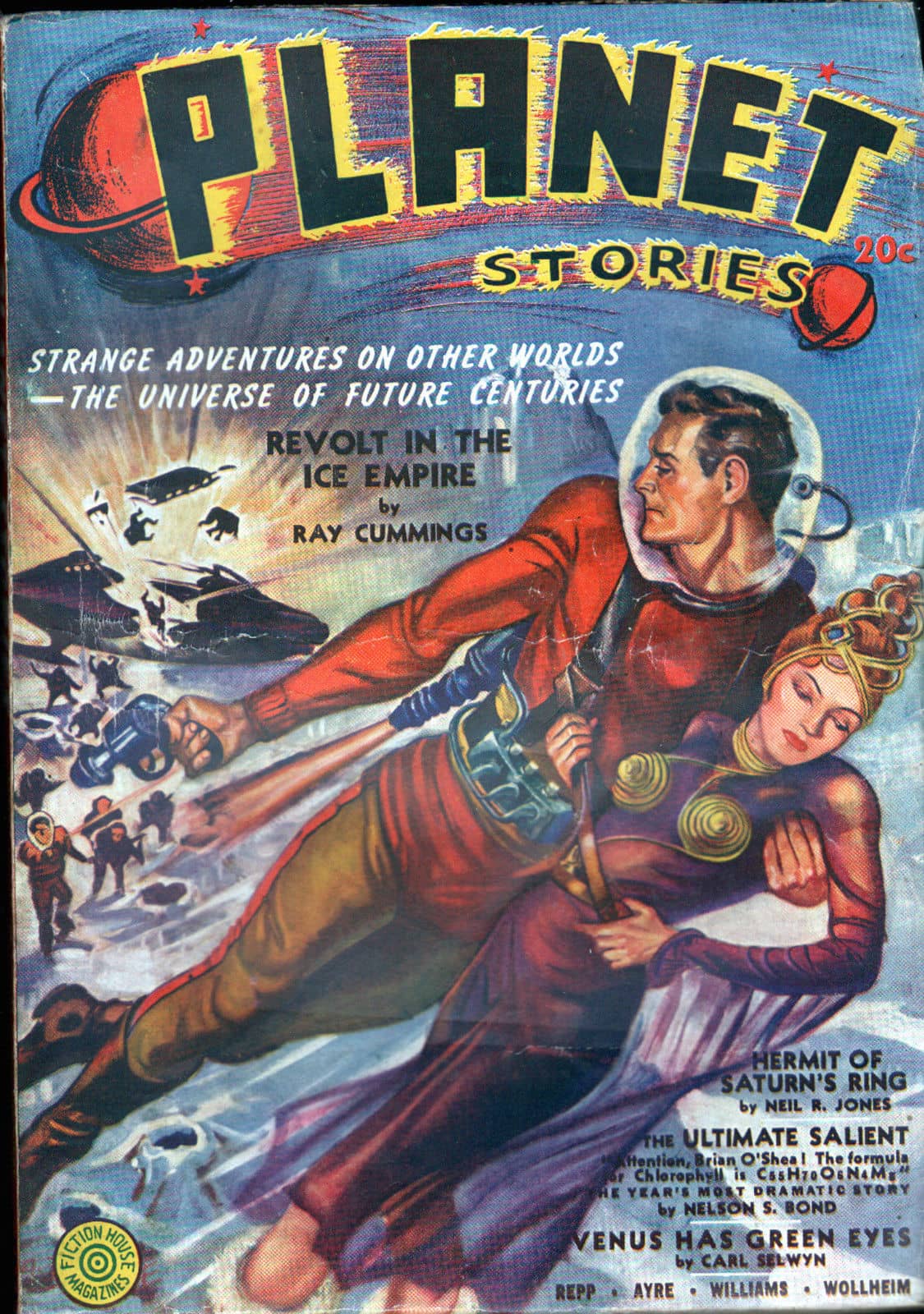
Malcolm Reiss purchased “Hermit of Saturn’s Rings” for publication in the Fall 1940 issue of Planet Stories. A decade later, Donald A. Wollheim included it in his anthology Flight Into Space. It was selected for inclusion in American Science Fiction #6 in 1952. In 1975, Michael Ashley chose “Hermit of Saturn’s Rings” to represent Neil R. Jones’s career in The History of the Science Fiction Magazine: Volume 2: 1936-1945. It was also translated into German and published in 1957 in Utopia Science Fiction Magazin #6 and again in 1973 in Science-Fiction Stories 21, edited by Walter Spiegl.
The protagonist of Jones’s “Hermit of Saturn’s Rings” is atypical in science fiction. Among the first things Jones reveals about Jasper Jezzan is that he was on the first expedition to Mars, had traveled throughout the explored system, and was now on the first expedition to Saturn. The thing that sets Jezzan apart from so many other characters in science fiction is that when the story begins, he is more than 70 years old.
Shortly after beginning to traverse Saturn’s rings, the ship Jezzan is on finds itself facing a strange white cloud. Jezzan is separated from the rest of the crew and when he rejoins them, he discovers that the white cloud has killed everyone it could get to. Jezzan must learn how to avoid the strange creature that lives in Saturn’s rings and live as a futuristic Robinson Crusoe, making a home for himself first aboard his ship and later inside a hollow rock in Saturn’s rings.
Landis won the Nebula Award for Best Short Story in 1990 for “Ripples in the Dirac Sea,” which was also nominated for a Hugo Award. He went on two win Hugo Awards for his short stories “A Walk in the Sun” and “Falling onto Mars.” His story “The Sultan of the Clouds” received the Theodore Sturgeon Award in 2011. Landis has also won the Rhysling Award for his poems “Christmas (after we got time machines)” and “Search” as well as a Dwarf Star Award for his poem “Fireflies.” In 2014, Landis received the Robert A. Heinlein Award from the Heinlein Society.
In addition to writing science fiction, Landis works as a scientist for NASA, specifically working on ways to improve solar cells and photovoltaics. In this capacity Landis was part of the Mars Pathfinder team, working to make sure that planetary dust was kept off the solar arrays.
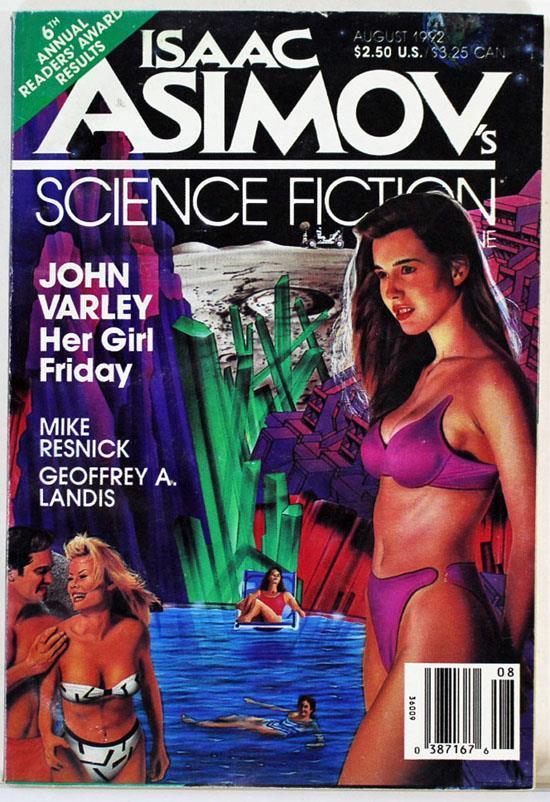
“Impact Parameter” was originally published in Isaac Asimov’s Science Fiction Magazine, edited by Gardner Dozois, in the August 1992 issue. It was translated into German for an appearance in the magazine’s German language edition in 1994. Landis included it as the title story in his collection Impact Parameter and Other Quantum Realities published by Golden Gryphon in 2001.
SETI, the search for extraterrestrial life, has got to be one of the most disheartening investigations for a scientist. In the decades the search has been occurring, nothing conclusive has been discovered. Landis alludes to this in “Impact Parameter” when Ben notes how many of his fellow astronomers have turned their attention to other fields. A strange anomaly he notices when trying to calibrate a telescope leads him to the discovery of an Einstein lens and comparing notes with other astronomers leads them to realize that a black hole is on target to strike Earth within only a few days.
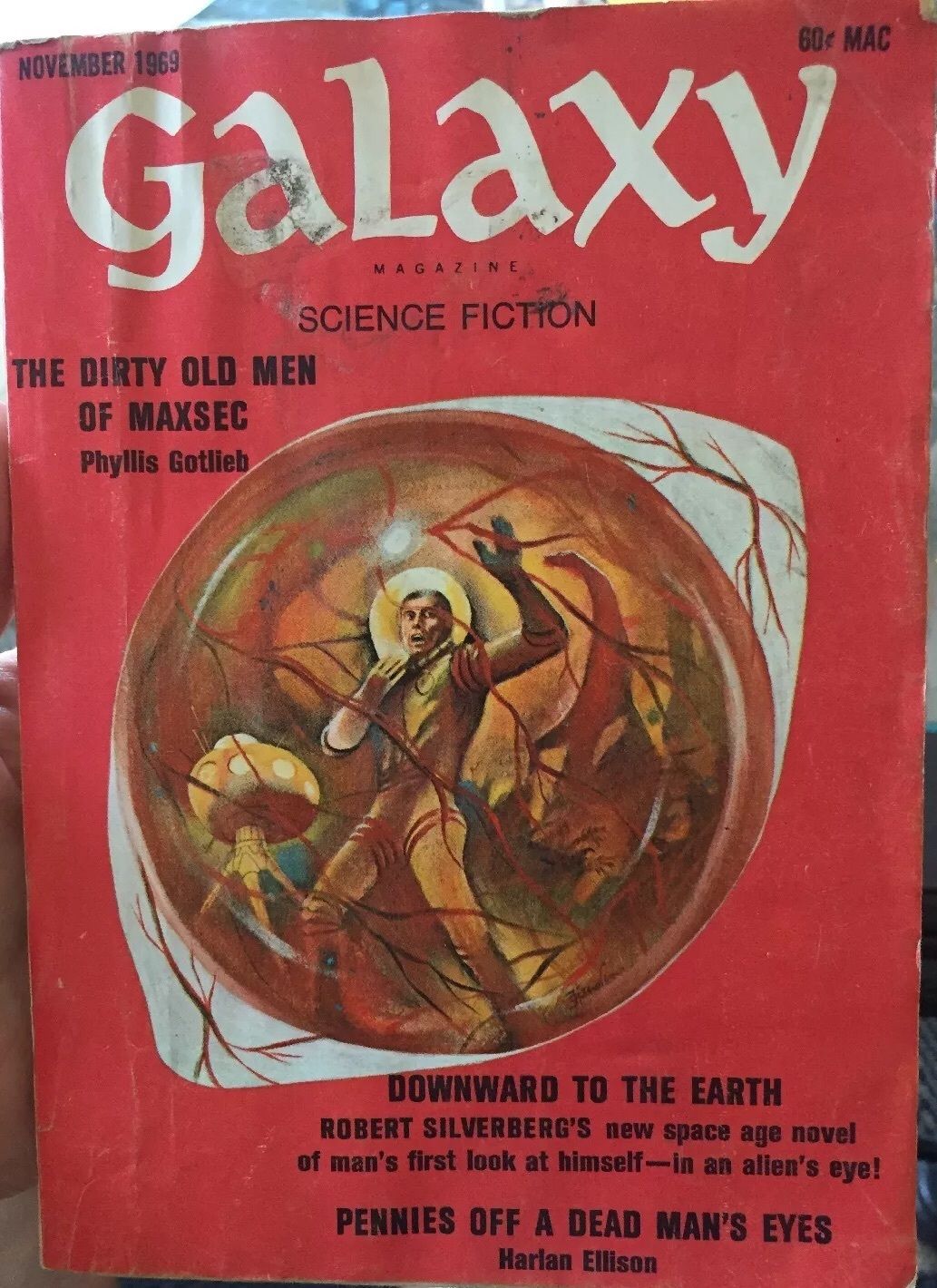
Ellison has received 8 Hugo Awards, beginning with his short story “’Repent Harlequin!’ Said the Ticktockman.” His other Hugo Award winners include the short stories “I Have No Mouth, and I Must Scream,” “The Beast that Shouted Love at the Heart of the World,” “The Deathbird,” “Adrift Just Off the Islets of Langerhans: Latitude 38° 54′ N, Longitude 77° 00′ 13″ W,” “Jeffty is Five,” and “Paladin of the Lost Hour.” His screenplay for the Star Trek episode “City on the Edge of Forever” also earned him a Hugo. Ellison has also won four Nebula Awards for his stories “’Repent Harlequin!’ Said the Ticktockman,” “A Boy and His Dog,” “Jeffty is Five,” and “How Interesting: A Tiny Man.” SFWA has also given him the Bradbury Award for 2000x, in collaboration with Yuri Rasovsky and Warren Dewey. He has also won the World Fantasy Award, Bram Stoker Award (5 times), British Fantasy Award, British SF Association Award, the Jupiter Award (twice), the Prometheus Hall of Fame Award, and has three Worldcon Special Convention Awards.
LASFS presented Ellison with the Forry Award in 1970. He received a Milford Award for Lifetime Achievement in 1986, a World Fantasy Lifetime Achievement Award in 1993, an International Horror Guild Living Legend Award in 1995 and he received a Bram Stoker Lifetime Achievement Award the following year. He won the Gallun Award from I-Con in 1997. Ellison was named a World Horror Grandmaster in 2000. SFWA named him a Grand Master in 2006. In 2011, he was inducted into the Science Fiction Hall of Fame and received the Eaton Award for Lifetime Achievement. He was a Worldcon Guest of Honor at IguanaCon II in 1978 and a World Horror Con Guest of Honor in 2005.
Kiernan novel The Drowning Girl was nominated for the Nebula Award, the World Fantasy Award, the Bram Stoker Award, the British Fantasy Award, the James Tiptree, Jr. Award, the Shirly Jackson Award and the Mythopoeic Award. It received the Tiptree and Stoker Awards. Kiernan also won a Stoker Award for the graphic novel Alabaster: Wolves. She won two World Fantasy Awards in 2014 for her collection The Ape’s Wife and Other Stories and the short story “The Prayer of Ninety Cats.” Kiernan has won four International Horror Guild Awards for her novels Silk and Threshold and for her short fiction “Onion” and “Le Peau Verte.”
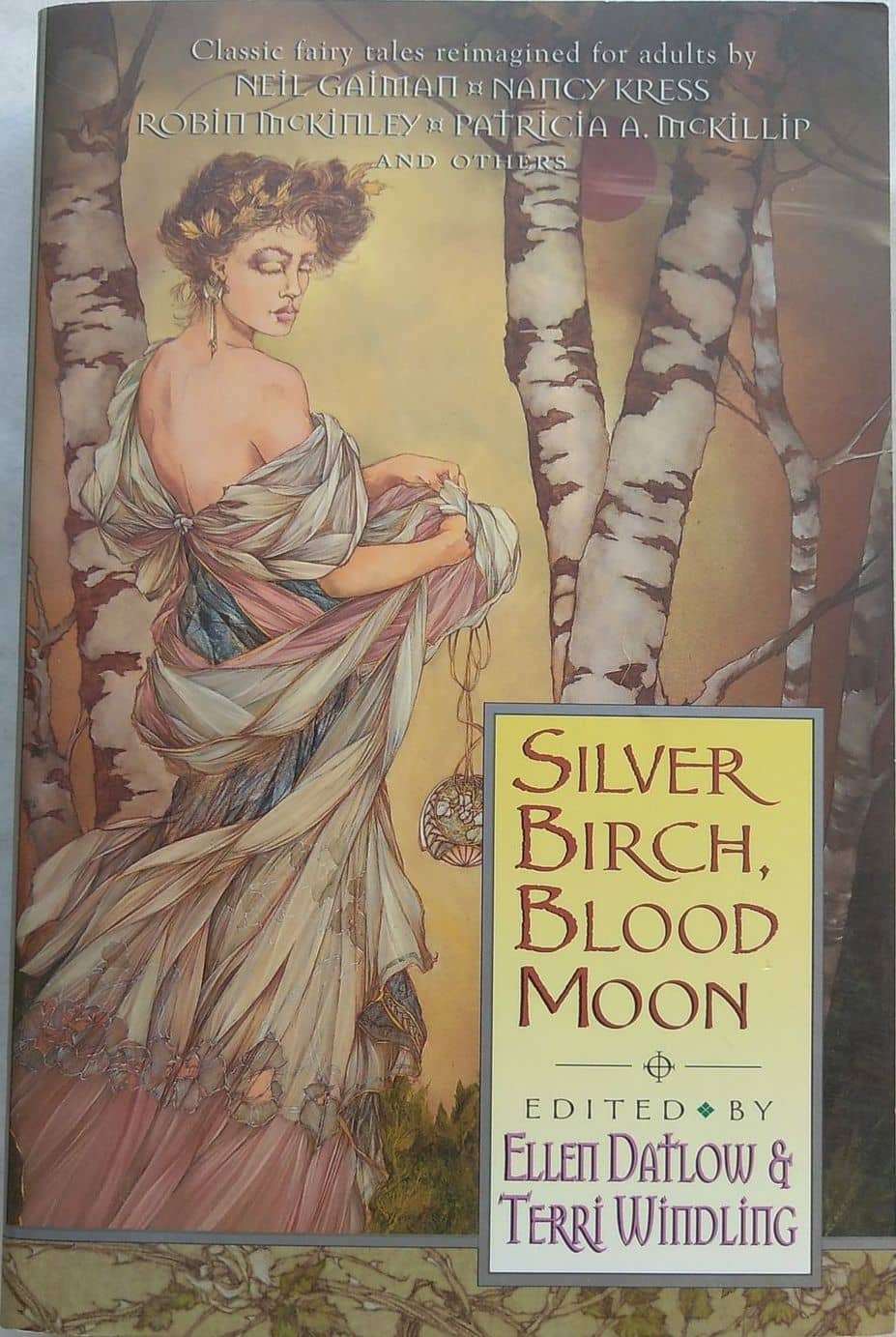
“Glass Coffin” was originally published in Ellen Datlow and Terri Windling’s 1999 fairy tale anthology Silver Birch, Blood Moon. It is part of her Salmagundi Desvernine series of short stories. It was reprinted, along with the other three stories in the sequence, in Kiernan’s 2000 collection Tales of Pain and Wonder, along with several other short stories.
Although part of a series of stories featuring Salmagundi Desvernine and Jimmy DeSade, “Glass Coffin” can be read and understood on its own, although that understanding may be quite different for readers familiar with Kiernan’s other stories. “Glass Coffin” itself is a retelling of Snow White and the Seven Dwarfs. Replacing the woodland cottage of the more familiar setting is a salvage yard that was formerly Salmagundi’s family’s shipyard. The Dwarfs are replaced by the foster children Salmagundi has taken in. Each of the six children described have their own personality and abilities, with the seventh off stage. While they all await Jimmy DeSade’s return, Salmagundi cuts herself and dies for all intents and purposes.
Nazarian was nominated for a WSFA Small Press Award for her short story “Port Custodial Blues” in 2007. The following year she received a nominated for the Nebula Award for Best Short Story for “The Story of Love.” She also received a Nebula nomination in 2009 for her novella The Duke in His Castle. In addition to writing, Nazarian has worked as the editor and publisher of Norilana Books since the company’s founding in 2006.
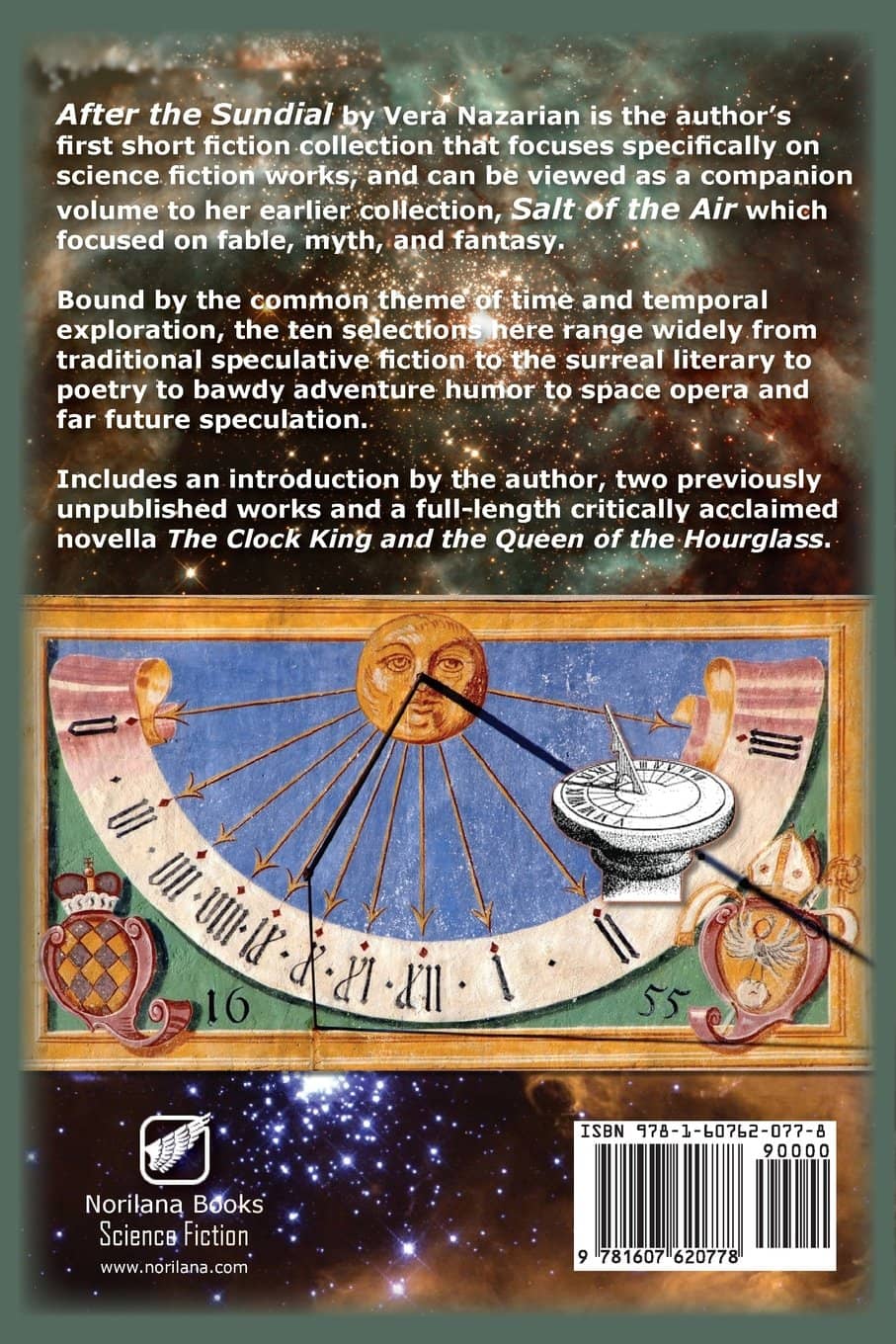
“Salmon in the Drain Pipe” was published as an original story in Nazarian’s collection After the Sundial, in 2010. The story has not been reprinted.
Nazarian’s “Salmon in the Drain Pipe” is a relatively short piece that has her protagonist looking at the wonders of nature in an unspecified future. As he looks more closely, however, he discovers that rather than being flora or fauna, what he is really seeing is the detritus of civilization filling lakes and grasslands. Fish moving through algae have been replaced by collections of bottlecaps.
Irving E. Cox, Jr. was born on May 24, 1917 and died on February 13, 2001.
Cox began publishing in 1951 with “Hell’s Pavement,” which appeared in Astounding Science Fiction. He published most of his work during that decade, and only his final two stories, “Impact” and “Way Station,” appeared during the 1960s. During that time, however, his stories appeared in several different magazines as well as in original anthologies.
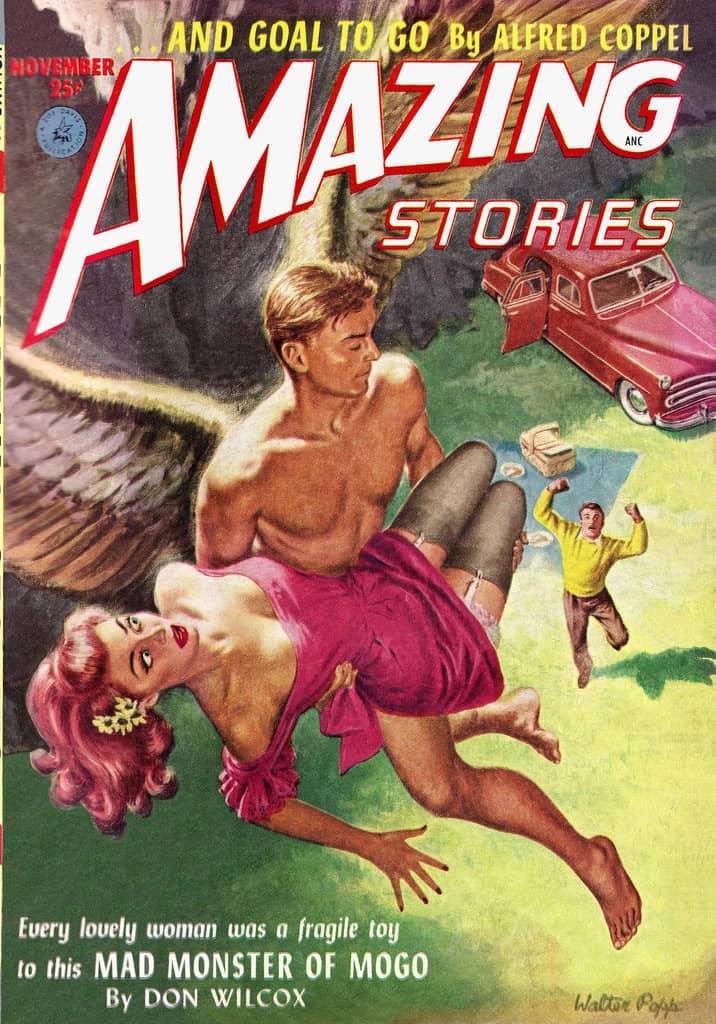
“Too Many Worlds” was originally purchased by Howard Browne for Amazing Stories, where it appeared in the November 1952 issue. It was reprinted in May of the following year in the British edition of the magazine. In 1973, the story appeared in the May issue of Science Fiction Adventures. More recently it appeared in Science Fiction Gems, Volume Twelve, edited by Gregory Luce.
Science fiction authors have long had their characters travel from one version of the world to another, which is how Cox begins “Too Many Worlds.” He dumps Albert Hammond into a world that resembles his own. In the new world, however, Hammond’s shipping company is much more successful than the one he knows. Where Cox tries something different is by making Hammond very aware of who he is, but unable to respond to things the way he wants to. Instead, no matter how hard he tries, the words and tone that come out of his mouth belong to the new world’s Albert Hammond, who is a much harder man.
A psychiatrist, naturally, tells Hammond that the world he sees is the way the world is ,and his view of himself as less rigid, having a smaller company, and two children who don’t exist is a delusion he has built up for some reason. The new world’s Hammond indulges in business practices that the original Hammond feels are poor choices and bad for business, yet invariably turn out to work to his benefit.
His situation takes a turn for the worse, although more interesting for the reader, when in addition to his memories of his reasonably successful life, he begins to experience a life in which he didn’t even achieve the level of success he had in his original life. The constants in the different versions of his reality are the company he works for, his wife, and, he comes to realize, an old high school friend, Willie Tuttle. Once Tuttle comes into the picture, the cause of the different worlds becomes obvious, but Hammond must still try to figure out how to break the cycle.
Patrouch was a teacher in Ohio who had a brief career writing science fiction. In the early 1970s, he wrote several essays about Asimov’s fiction and published his first short story, “One Little Room an Everywhere” in the February 1974 issue of Vertex. Most of his fiction has never been reprinted, with the exceptions “The Man Who Murdered Television” and “Legal Rights for Germs.” He also published The Science Fiction of Isaac Asimov in 1974.
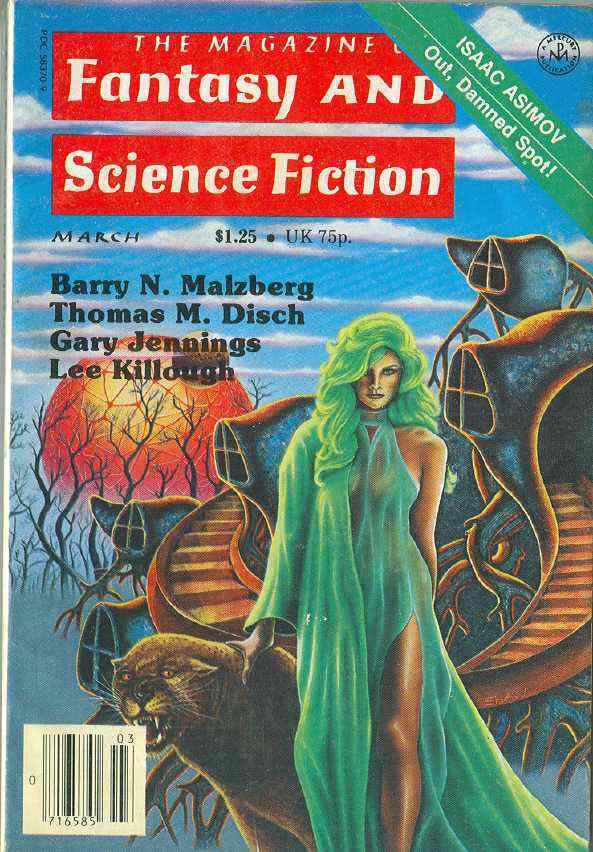
“The Attenuated Man” was published by Edward L. Ferman in the March 1979 issue of The Magazine of Fantasy and Science Fiction. It has never been reprinted.
Ken Hamilton sneaks into his father’s company to use the Transmat machine to become the first man on Mars, in an attempt to prove to his father than he isn’t completely worthless. Unfortunately, things go wrong for him almost immediately as he starts bleeding from his eyes, ears, and mouth. Back on Earth, Ken’s excursion has been discovered and his father’s staff is trying to figure out how to get him back, especially once they realize something has gone wrong and they can’t send someone after him without the same problems occurring.
Patrouch has an interesting look at some of the dangers of teleportation, although the impact seems to be different when transmatting people to different places, a discrepancy which he discusses in the story. Furthermore, although he indicates that Hamilton has a very low opinion of his son’s intelligence and abilities, the son figures out part of the solution that will allow him to return to Earth safely, and understands what has happened to him.