The Asgardian Adventures of Zelenetz and Vess: The Raven Banner and The Warriors Three Saga
 Marvel Comics has published some great works over the nearly fifty years since the company took its modern form with Fantastic Four #1. One thinks of the suberb superhero comics of Jack Kirby and Steve Ditko, but there’s a lot more than that in Marvel’s vaults. William Patrick Maynard’s done some strong work on this web site looking back at some excellent series, and I encourage everyone to take a look at his current posts on Tomb of Dracula, perhaps my own favourite Marvel book of the last forty years.
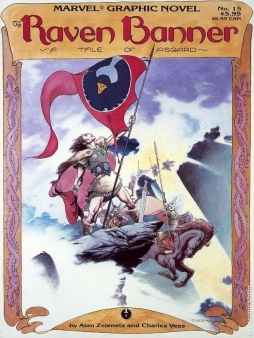
You can find Tomb of Dracula, like most Marvel books, in several reprint collections. But at least one of the best things ever published by Marvel isn’t currently available in any form. First printed in 1985, as part of Marvel’s early “Graphic Novel” line — actually a series of softcover graphic albums, about sixty pages each — The Raven Banner, written by Alan Zelenetz, with art, colouring, and design by Charles Vess, is a brilliant work of fantasy. The book unites a strong sense of myth, a deft touch in plotting, and highly impressive visuals to tell “A Tale of Asgard” (as its subtitle proclaims); and a powerful tale it is, filled with wonder and sorrow.
The Raven Banner is the story of Greyval Grimson, heir to a family entrusted with one of the greatest magical items possessed by the gods of Asgard, the Raven Banner of the title. When unfurled during a battle, the banner will grant victory to the army which holds it — at the cost of the life of the banner’s holder. The book opens with one such battle, in which Greyval’s father dies; but Greyval, we find, has been enticed under the earth by trolls, mischievous masters of illusion allied to the giants. Greyval feasts and drinks among the trolls while the battle plays out above, at which point the trolls let Greyval go, believing a prophet who says that Greyval will kneel before them till the end of time. Above ground, Greyval marries his love, a valkyrie named Sygnet; but when he finds that the banner’s been lost, he realises it is his duty to retrieve it. Only, as an Asgardian, Greyval need never die. So will he give up his immortality for the sake of the banner? What is the value of duty? What is more important: the joys of life, or a glorious destiny?
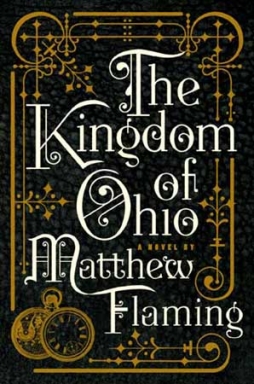 How to describe Matthew Flaming’s book The Kingdom of Ohio?
 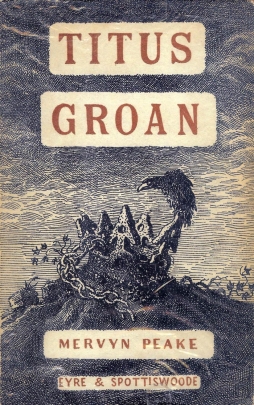 July 9, 2011 will be the hundredth anniversary of the birth of Mervyn Peake, the author of three remarkable fantasy novels: Titus Groan, Gormenghast, and Titus Alone. The books — published in 1946, 1950, and 1959 — form a series (along with the novella “Boy in Darkness,” which I have not read) following the early life of Titus Groan, Seventy-Seventh Earl of the immense castle called Gormenghast. Peake had intended to write a longer sequence of novels about Titus; he planned two more books, but the advent of Parkinson`s Disease made that impossible. A number of activities are being planned to commemorate Peake’s centenary, including the publication of a fourth Titus volume, Titus Awakes, written by Peake’s wife after his death in 1968.
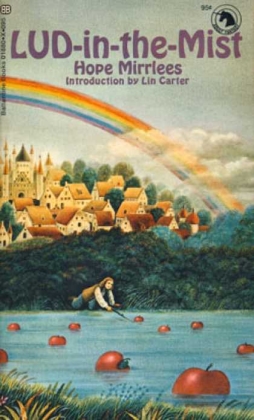 Hope Mirrlees’ stunning 1926 novel Lud-in-the-Mist begins with the following epigraph:
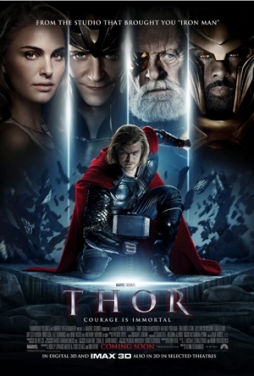 As a good Shakespearean, Kenneth Branagh understands fantasy. I think the movie Thor succeeds mostly because of what he as a director brings to the film, and what he’s able to get out of his cast. What’s missing seems to be what the script doesn’t give him — a larger world, memorable supporting characters, and a willingness to engage with the matter of fantasy.
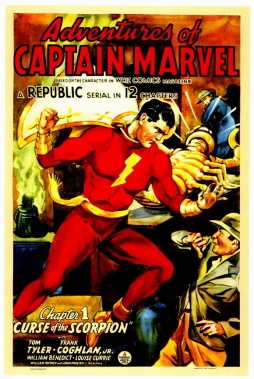 Serial storytelling is something of a mystery; even more so, perhaps, than most storytelling. When done right, it seems to hook an audience, to get them to invest heavily in the story being serialised. But for whatever reason, most serial forms have been pigeonholed as strictly popular arts; serial storytellers have generally been assumed to have a low amount of literary ambition. These presumptions about serials, and the way the form works, have always intrigued me — the more so since I’ve set out to write
 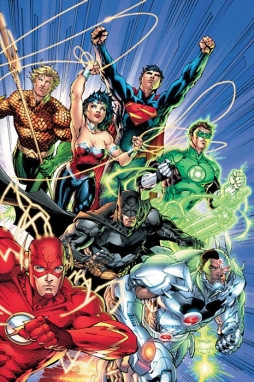 I admit I’d been planning to write another post this week about my new fantasy web serial,
  There’s been a lot of talk around the blogosphere lately about self-publishing, and its merits relative to traditional publishing. I’m not going to say anything about that, as such. But it seems obvious to me that self-publishing has a value if you have a story that could not, due to the nature of its form, be published traditionally.
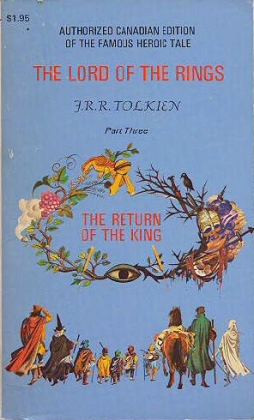 This is the third of three posts on The Lord of the Rings, prompted by a recent re-reading of the book. You can find the first post, looking at Tolkien’s sense of character,
 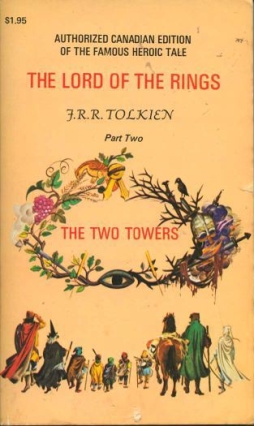 This is the second of three posts prompted by a recent re-reading of The Lord of the Rings. As I said in