Browsed by
Author: Matthew David Surridge

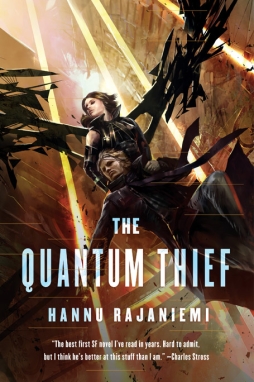
The Quantum Thief: A Review

The Quantum Thief: A Review

The Quantum ThiefThe Quantum Thief
Hannu Rajaniemi
Tor Books (A Tom Doherty Associates Book; 330 pp, $24.99 USD, $28.99 CDN; hardcover 2010)
Reviewed by Matthew David Surridge

Centuries in the future, Jean le Flambeur is a master thief, imprisoned in a virtual-reality jail: every day he makes choices, and dies, and is reborn. Until he’s freed by a violent woman named Mieli from the edge of the solar system, and taken to Mars. There, he must regain old memories he locked away from all possible recovery when he was literally a far different person than he is now. A youthful detective, hi-tech superheroes, and posthuman intelligences are waiting to complicate his task, which seems to have ramifications on an interplanetary scale.

That’s a basic description of Hannu Rajaniemi’s novel The Quantum Thief, the first in a series following le Flambeur’s adventures (the second, The Fractal Prince, will be coming later this year). Uncertainty and possibility and identity are key themes in this book; appropriate, then, that its own identity is somewhat paradoxical. On the one hand it’s aggressively bleeding-edge, incorporating quantum theory and game theory and any number of up-to-the-nanosecond science-fictional ideas. But on the other it’s highly traditional, drawing from different lineages within the genre and outside it.

Read More Read More

Richard Carpenter and Robin of Sherwood

Richard Carpenter and Robin of Sherwood

Robin of SherwoodI read some bad news earlier this week: Richard Carpenter died. Carpenter, 78 at the time of his death on February 26, was an actor and television writer. He created several shows; he’s probably best known for his children’s series Catweazle, the animated Dr. Snuggles, and the show that I want to talk about here, the ITV-broadcast series Robin of Sherwood. It’s easily my favourite interpretation of the Robin Hood story, and perhaps my favourite filmed piece of sword-and-sorcery.

Robin of Sherwood ran from 1984 to 1986. Carpenter reimagined the story of Robin Hood from top to bottom, infusing it with magic, myth, and the politicised anger of youth. He also created a show that unobtrusively captured the late twelfth century with remarkable fidelity, both in its visual aspects like props and costumes, and also in its social hierarchies and habits of thought. The series ran for three seasons before its production company ran into financial problems. Some plot threads were ended prematurely, without resolution or real development. Carpenter’s observed that the ending as it is works well enough, and I can see his point. Still, I can’t help but wish that the show had gone a bit further.

As it is, Robin of Sherwood’s one of the best examples I can think of in any medium of how to reinterpret a legend. The fact that the re-interpretation was specifically as a fantasy drew me when I first saw it as a teen, but I think the fantasy wouldn’t have mattered if it weren’t for the way Carpenter made the fantasy elements harmonise with themes and elements already present in the Robin Hood tales. Carpenter’s Robin is the spiritual son of Herne the Hunter; Herne’s a god of the ancient and fearsome forest of Sherwood incarnated in a hermit-like shaman. Robin bears a magic sword called Albion, one of the Seven Swords of Wayland. He and his Merry Men (never called that in the show) encounter Templars, Kabbalists, a cursed village populated by ghosts, Satanists, and, in the first episode, an evil wizard. The famous silver arrow is a symbol of Saxon rebellion, a magical item representing freedom.

Read More Read More

Tolkien and Attila

Tolkien and Attila

The Fellowship of the RingWhat follows may well be total coincidence.

J.R.R. Tolkien wrote The Lord of the Rings over the course of many years of his life, a life shaped in part by his experience as a young man fighting in the trenches of World War One against the Germans. Or, as they were sometimes called at the time, the Hun.

The Germans had been equated with Huns for over forty years by then. It had begun as a term of abuse in French newspapers, but some Germans adopted the comparison with pride. Kaiser Wilhelm II notoriously inspired his soldiers by linking them to the historical Huns and their great leader, Attila.

Now so far as I know Tolkien made few direct references to Attila in his writing. He refers in a letter to attending a lecture his son Christopher gave about Attila, and to being thrilled by a reference to the etymology of the name — from ‘Atta,’ ‘father,’ so meaning something like ‘little father.’ And I understand in The Legend of Sigurd and Gudrun, Attila makes an appearance, as he did in the original poems on which Tolkien based his story. But I’ve begun to wonder if the idea of the Huns didn’t have a bit more of an influence on Tolkien than that.

I want to be clear in what follows that I’m not talking about conscious influence. I don’t think that Tolkien had the history of the Huns actively on his mind at any point as he wrote. What I’m wondering is whether that history unconsciously suggested certain plot patterns to him that manifested in his writings.

Read More Read More

After the Golden Age: A Review

After the Golden Age: A Review

After the Golden AgeAfter the Golden Age
Carrie Vaughn
Tor Books (A Tom Doherty Associates Book; 304 pp, $24.99 USD, $29.99 CDN; hardcover April 2011, paperback January 2012)
Reviewed by Matthew David Surridge

Celia West is an accountant in her mid-twenties. She seems normal enough, but appearances are deceiving. Celia lives in Commerce City, home to a number of super-powered heroes and their archenemies. She’s not one of them, though, being in fact the non-powered daughter of two of Commerce City’s greatest champions, Captain Olympus and Spark, leaders of the group called the Olympiad. Now the Olympiad’s worst enemy, the Destructor, has been arrested, and Celia’s skills as an accountant can help to find the fiscal evidence to put him behind bars — only, once, years ago, Celia joined the Destructor as an ally. Can she overcome that act of youthful rebellion to build her own life, and see that justice is done?

That’s the question driving the plot of Carrie Vaughn’s novel After the Golden Age. Super-heroes arguably started in prose, with the exploits of Zorro, the Spider, the Shadow, and Doc Savage, to name some of the best known, but the full-blown super-hero — with exceptional powers, a distinctive costume, and an alter-ego — was really a development of comics. A costumed hero is inherently visual, and many of the best super-hero powers lend themselves to illustration. Can prose present a super-hero story as well as comics can? It’s notable that a lot of the better prose super-hero tales have been shorter works: the best of the Wild Cards shared-world books, for example (a series for which Vaughn writes), or the 2008 anthology Who Can Save Us Now?, or Daryl Gregory’s excellent story from the same year “The Illustrated Biography of Lord Grimm.” Perhaps the strangeness of powers and costumes works better at that length.

Read More Read More

Some Notes on The Eagle of the Ninth

Some Notes on The Eagle of the Ninth

The eagle of the NinthWhat I know about Rosemary Sutcliff:

She was born in 1920. At age two she was struck by a terrible form of juvenile arthritis; she was in a wheelchair most of her life. She didn’t learn to read until she was nine, but was read to by her mother — Dickens, the Mabinogion, Kipling, King Arthur, Robin Hood. She became a writer in 1950, with a book drawing from those tales: The Chronicles of Robin Hood. In 1954, she wrote a book about Roman Britain, The Eagle of the Ninth, that became the first of a well-known series. She died in 1992.

I recently read The Eagle of the Ninth. And as a result of that I know this, too: I will be reading more of her work, in the very near future.

The Eagle of the Ninth follows Marcus Flavius Aquila, a Roman Centurion assigned to Britain in the second century AD. Wounded in battle, he’s discharged from the military, recovers, and eventually begins a dangerous quest into the mysterious lands north of the Roman walls — into the wilderness haunted by strange tribes of barbarians.

Read More Read More

I’ll Look Down and Whisper “No”: “Before Watchmen”

I’ll Look Down and Whisper “No”: “Before Watchmen”

Watchmen 1Last Wednesday, DC Comics announced a new publishing venture: “Before Watchmen,” a set of related miniseries that would act as a prologue to the best-selling and critically acclaimed Watchmen graphic novel. The news was met with a considerably mixed reaction. Alan Moore, writer and primary creator of Watchmen, has spoken out against the project. Personally, I’m not going to buy any of DC’s new series, and I want to explain why.

First, some more details. From The Beat website, a list of titles and creators:

Rorschach (4 issues) – Writer: Brian Azzarello. Artist: Lee Bermejo
Minutemen (6 issues) – Writer/Artist: Darwyn Cooke
Comedian (6 issues) – Writer: Brian Azzarello. Artist: J.G. Jones
Dr. Manhattan (4 issues) – Writer: J. Michael Straczynski. Artist: Adam Hughes
Nite Owl (4 issues) – Writer: J. Michael Straczynski. Artists: Andy and Joe Kubert
Ozymandias (6 issues) – Writer: Len Wein. Artist: Jae Lee
Silk Spectre (4 issues) – Writer: Darwyn Cooke. Artist: Amanda Conner

“Before Watchmen” starts sometime this summer, with one comic to be released per week. Each book will have a two-page back-up feature, “The Curse of the Crimson Corsair,” written by Wein, who edited the original Watchmen, with art by John Higgins, who coloured the series. An epilogue featuring a number of writers and artists will wrap up the event.

Read More Read More

J.M. McDermott’s Never Knew Another

J.M. McDermott’s Never Knew Another

Never Knew AnotherNever Knew Another
by J.M. McDermott
Night Shade Books (240pp, $14.99 USD, trade paperback February 2011)
Reviewed by Matthew David Surridge

J.M. McDermott’s third book, Never Knew Another, is a secondary-world fantasy tale told in a sparse yet elegant style, about hunters seeking dangerous magical prey — and also about two people drawing closer to each other without knowing it, despite having to hide their true natures from the world around them. Perspectives nest one inside another; the book’s always clear, but leaves much meaningfully unsaid, and effortlessly holds the voices of its characters in a delicate balance, allowing them to contrast with each other without any given one being overwhelmed. It’s a remarkable accomplishment, and a strong, unconventional beginning to a promising trilogy.

It starts with a pair of holy werewolves, following a trail to a human city they call Dogsland. The werewolves are hunting demons, or humans with demonic ancestry. Creatures with demons in their family tree are dangerous; their sweat is acidic, and their blood can wither plants, or make normal humans very sick indeed. It’s as though they’re radioactive, potentially causing illness and death around them even if they don’t consciously intend evil. The hunters see their task as a sacred duty. Their story, though, is effectively a frame for the main action; one of the hunters communes with the memories of a dead demon-descended man, searching through those recollections for hints of the whereabouts of others of his kind. The stories of that man, Jona Lord Joni, and of the others of his kind that he knows, provide the meat of the book.

Read More Read More

A Few Words About The Order of the Stick

A Few Words About The Order of the Stick

Dungeon Crawlin' FoolsDying is easy, the old saw has it, but comedy … that’s hard. Only — what happens if we’re talking about a world in which miracles happen to order, and people come back to life whenever a priest wants? Dying suddenly isn’t quite so easy. But comedy, real comedy … that’s still pretty hard.

Fantasy’s no more or less risible than almost anything else in life, and you can find comedic fantasy good, bad, and indifferent. I want to talk about one particular example. Lately, I’ve been rereading a lot of Rich Burlew’s webcomic, The Order of the Stick. It’s a successful, funny fantasy; impressive, since it looks like it should have no business succeeding as well as it does. It’s not just a fantasy comedy, it’s a gaming fantasy comedy. Clearly, the strip’s appeal is going to be somewhat limited.

The main characters are adventurers in a fantasy world that operates according to the rules of Dungeons & Dragons (version 3.5); inevitably a good part of the comedy comes from the characters consciously manipulating the rules of the game, and commenting on its conventions and mechanics. But there’s more to it. The strip isn’t just about the game, nor is it just a showcase for Burlew’s killer sense of humour. The comic’s run for over eight hundred installments up to this point, plus extra stories in various print collections; it’s developed a coherent story, and surprisingly sympathetic characters. It’s gone from a gag strip to a fantasy epic — a nice trick, given that the story’s told with stick figures.

Read More Read More

A Few Words on Clark Ashton Smith

A Few Words on Clark Ashton Smith

A Rendezvous in AveroigneLast Friday was Friday the thirteenth. It was also Clark Ashton Smith’s birthday. In memory of that conjunction, I’d like to write a bit about Smith and his work. I have only a few thoughts about Smith’s prose style; Ryan Harvey’s excellent and insightful look at Smith’s fiction can be found in four parts, here, here, here, and here. And you can find an online collection of Smith’s works here.

Smith’s probably a familiar figure to many readers of this site, but for those that don’t know him, some background: Born in 1893, Smith suffered from a fear of crowds, and never attended high school. He was an autodidact and dedicated reader; he apparently read, in fact, through the Encyclopedia Britannica and Webster’s Dictionary. He wrote novels as a teenager (I haven’t read them, though in recent years they’ve been put into print), sold a few stories at 17, and then published a collection of verse at 19. Plagued by ill-health, he continued to write poetry, and in 1922 received a fan letter from H.P. Lovecraft. The two men became pen pals, and shared ideas and imagery.

In 1929 Smith began writing weird fiction, odd mélanges of horror, science fiction, and fantasy. He published in Weird Tales, like Lovecraft, and like Robert E. Howard, with whom he struck up a friendship by post in 1933. Howard died in 1936, Lovecraft in 1937, and then late in 1937 first Smith’s mother and then his father passed away. Smith had for the most part stopped writing fiction in 1935; although a few stories came in later years, as well as more verse, Smith shifted his focus to sculpture for much of the rest of his life. He died in 1961.

Read More Read More

Temeraire, Harry Potter, and Some Thoughts on Ambiguity

Temeraire, Harry Potter, and Some Thoughts on Ambiguity

His Majesty's DragonI’ve been in unwilling low-content mode for the past couple of weeks (question: what’s worse than getting the flu at Christmas? Answer: getting the flu along with a sinus infection). That’s meant I’ve had some time to read, which is good for a number of reasons. As it happens, though, one of the things I picked up to read left me wondering something I’ve wondered several times before: why do certain books pull me along, and compel me to read them, even when I think they’re not particularly good?

The best example of what I mean is the Harry Potter books. I don’t dislike them, but I’ve never understood the way they absorb me when I read them. They’re tightly-plotted, yes, and the world is carefully-built — but these things together only create an odd video-game feel, where every riddle has its designated solution, and the lead characters wander around finding clues to unlock new areas or gifts or side quests, until everything’s resolved in a climactic scene. The characters are flat, the dialogue’s occasionally funny but not especially memorable, and the prose is bland at best. Yet the fact remains that when I read a Potter book I find it easier to move my gaze along the text on the page rather than turn away. It’s like being on a railway train, being carried over a fixed track, with no way to disembark except by something like an act of force, jumping to the ground while the thing’s moving at speed.

Over Christmas — just before, actually — I found another example of this phenomenon, when I read His Majesty’s Dragon, the first of Naomi Novik’s Temeraire series. It’s a story about the Napoleonic Wars, in a world where intelligent dragons exist and bond with human riders. I’d had it in mind to look into the series for a while, so when I found a used copy of the first book I grabbed it. And then found it had grabbed me. It’s unusual for me these days to find that I literally can’t put a book down; but that’s what happened with His Majesty’s Dragon. And I’m not sure why.

Read More Read More