Fantasia 2018, Day 9: A Rough Draft and The Man Who Killed Hitler and Then The Bigfoot
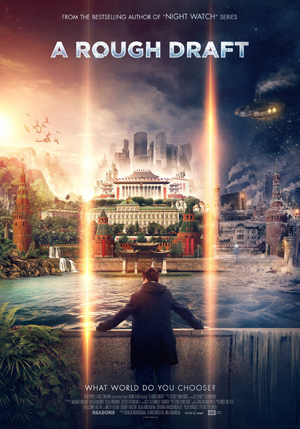 I’ve said that the last two movies I saw on Thursday, July 19, did different things with weirdness: one extremely weird in its way, the other unweird to a surprising degree. As it turned out, the same could be said of the two movies I saw on Friday, July 20. The first (at the J.A. De Sève) was a Russian film, A Rough Draft. The second (at the larger Hall Theatre) was American, The Man Who Killed Hitler and Then The Bigfoot. From those titles you might not guess which movie had the weirdness and which didn’t. But that’s the reward of watching things at Fantasia: the chance of the wholly unexpected.
A Rough Draft (Chernovik, Черновик) was directed by Sergey Mokritskiy from a script he wrote with Maksim Budarin, Denis Kuryshev, and Olga Sobenina, adapting a novel by Sergey Lukyanenko. Kirill (Nikita Volkov) is a successful computer game designer in Moscow — until he begins to disappear from the memory of his friends and family. Reality has changed, and he’s no longer part of it. He confronts the woman who seems to be the cause, Renata (Severija Janusauskaite). Kirill, we learn, has become a Functional, a person with superhuman powers; he’s been drafted to serve as a customs officer in a stone tower that’s a gateway between worlds. Mysteries abound. Can he get back to his family and to the love of his life, Anna (Olga Borovskaya)? And will he find the mysterious other reality, Arkan, that is 30 years ahead of our own and thus a rough draft for our own world?
A Rough Draft plays like a film that’s supposed to be a blockbuster. It’s full of big ideas, bright visuals, and the unexpected. Whole universes can lurk behind a door. At every turn it seems like a new concept or gimmick’s being introduced. Which is really why it goes off the rails so spectacularly, in ways an American blockbuster would never be allowed to do. It’s a train wreck, but a fascinating, entirely watchable train wreck. After the movie ended, seven of us gathered in the atrium outside the De Sève Theatre to form an impromptu therapy group trying to work through what it was that we’d just seen. While this felt necessary, it was pointless. It’s not possible to make what’s on screen make sense as a coherent whole. Too many pieces are missing. But I’d very much like to read Lukyanenko’s original novel.
The first act of the film, in which Kirill finds himself being erased from everyone’s memories, is simple enough. We’ve seen this before — a man being wiped out of the world, a man being initiated into a new life with strange and secret powers. It moves well; Volkov brings Kirill’s astonishment across; the mystery’s enough to make us want to see what happens next. And then the chaos begins. We start getting ideas thrown at us hard and fast, and halfway through an explanation of one idea another breaks in on us and we get some of the basics on that and never end up getting the rest of the explanation of the first. Meanwhile another three things have happened.
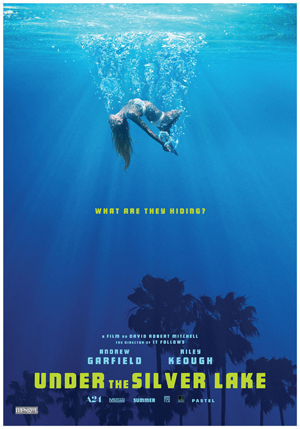 Strangeness has many vectors; you can be weird in multiple directions at once. Whichever shape a movie takes, it’s often a good idea to have something strange in it. Something unexpected. You can usually count on movies at Fantasia to have at least one well-developed kind of weirdness in them, but the last two movies I saw on July 19, both at the large Hall Theatre, went in very different directions; one the strangest film (in a certain way) that I’d see this year, and the other imagining a world in which there is nothing unpredictable at all. The first was an odd Hollywood-set detective story, Under the Silver Lake. The second was Laplace’s Witch, an adaptation of a Japanese science-fiction novel, directed by Takashi Miike.
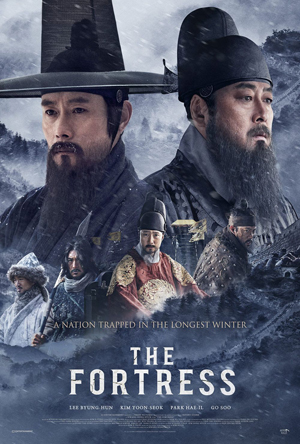 The first movie I saw at Fantasia on Thursday, July 19, was at the J.A. De Sève Theatre, a Korean film called The Fortress (Namhansanseong, 남한산성). Based on a novel by Hoon Kim, Dong-hyuk Hwang wrote the screenplay and directed his own adaptation. It’s a historical war story, set in 1636 when the Chinese Qing dynasty invaded Joseon-ruled Korea. The royal court has to flee before the Qing armies, taking refuge in a mountain castle, the fortress of the title. The Qing besiege the place, and the film follows what happens in the fortress as a result. More precisely, it follows the dispute between two of the officials of King Injo (Hae-il Park): on the one hand Myeong-gil Choi (Byung-hun Lee, who was in RED 2 and was Storm Shadow in the G.I. Joe movies), the Interior Minister who wants to negotiate with the Qing and if necessary surrender; and on the other, Sang-heon Kim (Yoon-seok Kim), the Minister of Rites who wants to hold out until the end, believing that an army’s gathering in the south that will strike north and relieve the fortress.
  The only film I planned to see on Wednesday, July 18 was called Cam. Directed by Daniel Goldhaber from a script written by Isa Mazzei, it tells the story of a woman named Alice (Madeline Brewer, of The Handmaid’s Tale and Orange is the New Black) who works as an erotic webcam performer under the name of Lola — until she finds her account stolen by parties unknown. As Alice investigates she finds it’s more than just her financial information or identity that’s been stolen; someone who looks and sounds exactly like her is performing as Lola in her place, and this Lola is breaking all the rules Alice established for herself as a performer. Alice investigates and tries to regain control of her life, driving the story toward a brutal conclusion.
 I had one film on my schedule for Tuesday, July 17. It was a Japanese movie called Room Laundering, which looked like an odd fusion of comedy and horror. I wasn’t too sure what to make of it from the program description, but sometimes it’s the films that don’t lend themselves to easy description that’re the most rewarding. And so here.
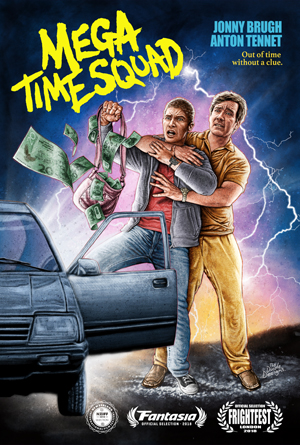 Monday July 16 was an odd day, beginning with the neorealist neo-noir
 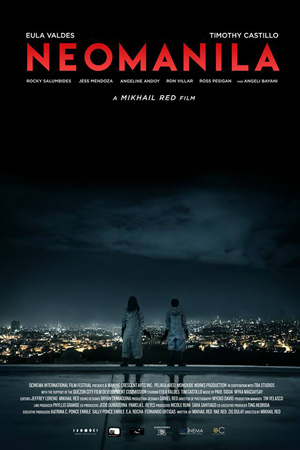 You can tell a bit about an audience at Fantasia just from how they react to what goes on screen before the movie starts. You don’t get trailers before a movie, though sometimes you see a trailer for that year’s festival, using brief clips of several of the films playing that edition of Fantasia; this year’s trailer often drew cheers. You get a couple commercials, from a very limited selection; there’s one particular commercial for Nongshim noodles that’s played for several years and often draws warm applause for its earnestness. And of course there’s the meowing, an audience tradition — after the light goes down and before the movie starts, people in the audience meow, others shush them, still others make other animal noises. How much of any of this you get depends on how playful the audience is, and how excited they are for a crowd-pleasing thrill-ride. Which means, from the noise an audience makes before a film begins, you can tell what kind of a film you’re about to see.
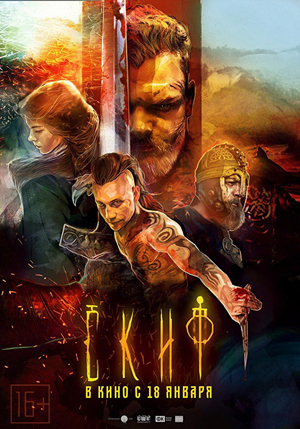 My last movie of Sunday, July 15, was a film I knew little about going in. It was The Scythian (Skif, Скиф), a Russian film directed by Rustam Mosafir from a script he wrote with Vadim Golovanov. It started late, and for most of the day I’d been unsure whether I’d stick around to watch it; in the 11 hours between leaving my house and the time it started, I’d ingested a few handfuls of peanuts, one (1) tin of off-brand cola, and a few mouthfuls of water. Still, I took my seat, the movie started, and then I quit paying attention to my physical body for one hour and forty-seven minutes. The Scythian is one of the best action films I’ve seen in years. It’s engagingly violent, and the violence is done well — but more than that, it’s filled with cleverness and unexpected twists. If you’re a fan of sword-and-sorcery or sword-and-sandal movies, you owe it to yourself to see this movie, and as soon as possible. (And I note it’s being released August 14 under the title The Last Warrior on VOD, Blu-Ray, and DVD.)
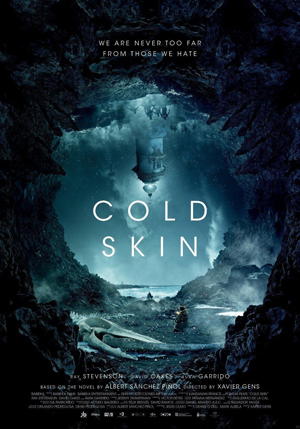 My third movie on Sunday, July 15, was a France-UK co-production called Cold Skin. It was scheduled to start at 5:10 in the Hall Theatre, and ran 107 minutes. At 7:15, across the street at the De Sève, there’d be a showing of the 1911 Italian film L’Inferno, an adaptation of the first part of Dante’s Divine Comedy. Musical accompaniment to the silent film would be provided by Maurizio Guarini of Italian prog band Goblin, well-known for providing the soundtrack to Dario Argento’s
 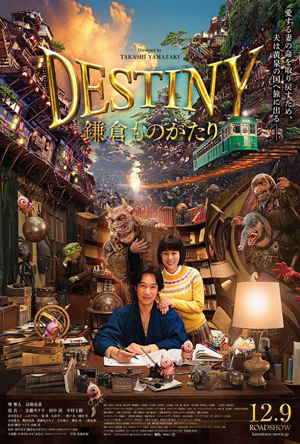 Sunday, July 15, was going to be my first really busy day of the Fantasia Film Festival. There were four movies I planned to see, with a chance of a fifth, depending on how things worked out. The day’d begin at the Hall Theatre; first, I’d see Destiny: The Tale of Kamakura, a lighthearted Japanese urban fantasy. Then would come Aragne: Sign of Vermillion, also from Japan, a horror anime.