Browsed by
Author: John ONeill

2012 World Fantasy Award Winners Announced

2012 World Fantasy Award Winners Announced

osama-lavie-tidharThe winners of the 2012 World Fantasy Awards have been announced at the World Fantasy Convention in Toronto, Ontario.

This is the first World Fantasy Convention I’ve missed since 2009 and I don’t like to think about how much fun I missed. So let’s just get this over with.

Novel

  • Osama, Lavie Tidhar (PS Publishing)

Novella

  • “A Small Price to Pay for Birdsong,” K.J. Parker (Subterranean, Winter 2011)

Short Story

  • “The Paper Menagerie,” Ken Liu (F&SF, March-April 2011)

Anthology

  • The Weird,  edited by  Ann & Jeff VanderMeer (Tor)

Read More Read More

Adventure in the Spaceways with Perry Rhodan: The Cosmic League

Adventure in the Spaceways with Perry Rhodan: The Cosmic League

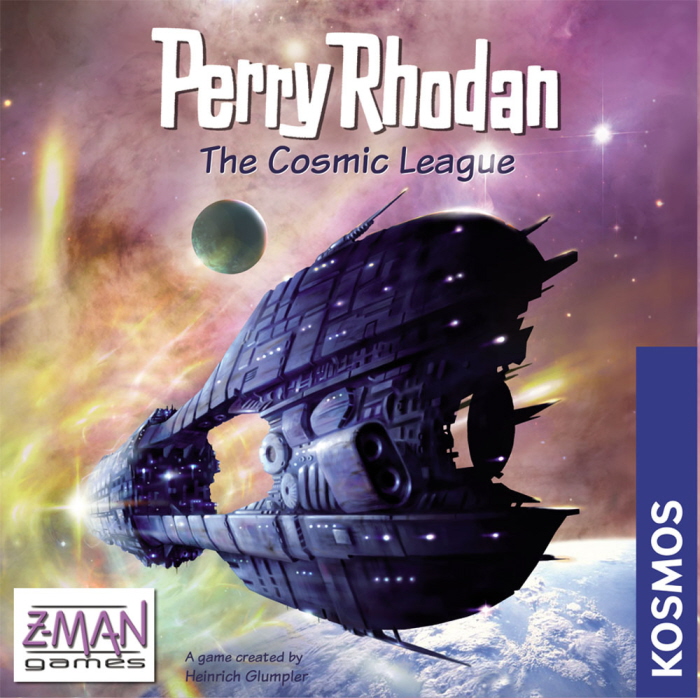
perry-rhodan-the-cosmic-leagueI’m willing to bet most of you have no idea who Perry Rhodan is.

Believe it or not, Perry Rhodan is the most ambitious future history ever written. Since its creation in 1961, over 3,000 Perry Rhodan novels have been published; the series has been translated into half a dozen languages and spawned at least one movie and a popular computer game, The Immortals of Terra.

Why haven’t you heard of him? Probably because the last English-language Perry Rhodan novel, #118 The Shadows Attack, was published by Ace Books in 1977. The English-language version was the brainchild of Forrest J. Ackerman, who hired his wife Wendy to do most of the translations. The series has continued in its native Germany, where it is published weekly.

I bring all this up because A) Perry Rhodan practically introduced me to science fiction, at the tender age of eleven, and B) I recently purchased Perry Rhodan: The Cosmic League, a two-player card game from Z-Man games that makes use of the Perry Rhodan license in a fast-paced game of interstellar trading and politics:

A newly colonized star system, populated by different peoples… Mysterious remains of age-old technology… Orbital stations to organize the trade between the worlds… and you and your spaceship right in the middle of it all…

Discover the Ambourella system with all its opportunities. Fight the adversities of gravity and do business with the planets. Your are the captain of a spaceship transporting goods and passengers. Invest your earnings early in valuable technologies and thus strive to become the most wealthy merchant of the Cosmic League.

Perry Rhodan doesn’t actually appear in the game, but it does draw on the rich backdrop of the Cosmic League. It comes with 60 technology and interventions cards, 6 planet tokens, 30 different cargo cards, and 2 spaceships. The average playing time is under half an hour. It’s a fairly simple game at heart, and the tie-in with Perry Rhodan is fairly light, but nonetheless it brought back a lot of great memories of 1970s pulp science fiction.

Perry Rhodan: The Cosmic League was published by Z-Man Games in 2007. It retails for $24.99, but I bought my copy new online for around 10 bucks.

Keep up on Fantasy Gaming with Kobold Quarterly

Keep up on Fantasy Gaming with Kobold Quarterly

kobold-quarterly-fall-2012-smallIn the early days of the adventure gaming hobby, the field was pretty diverse, with a healthy assortment of successful RPGs and board games. Much like today, as a matter of fact.

One major difference, however, was that each of the major titles was supported with its own magazine: Dragon (for D&D and other TSR games), Different Worlds (Runequest, Call of Cthulhu), Sorcerer’s Apprentice (Tunnels and Trolls), White Dwarf (Warhammer), Space Gamer (The Fantasy Trip), The Journal of the Traveller’s Aid Society (Traveller), and many others. Board gamers, too, weren’t overlooked on the magazine rack, with Nexus (Star Fleet Battles), Ares (SPI’s sci-fi games), The General (Avalon Hill), and others.

With the exception of White Dwarf, all those magazines are dead today.

And I miss them. Many were good, and a handful — including The Space Gamer and Different Worlds — were excellent. They kept us up-to-date on rapid market changes, talked-up overlooked games, and generally kept the level of excitement high around the whole industry.

I never expected the era of the specialized gaming magazine to return. For one thing, I know what it takes to keep a magazine alive these days (a series of miracles).

But Wolfgang Baur’s Kobold Quarterly has changed my mind.

Read More Read More

November/December Fantasy & Science Fiction Magazine now on Sale

November/December Fantasy & Science Fiction Magazine now on Sale

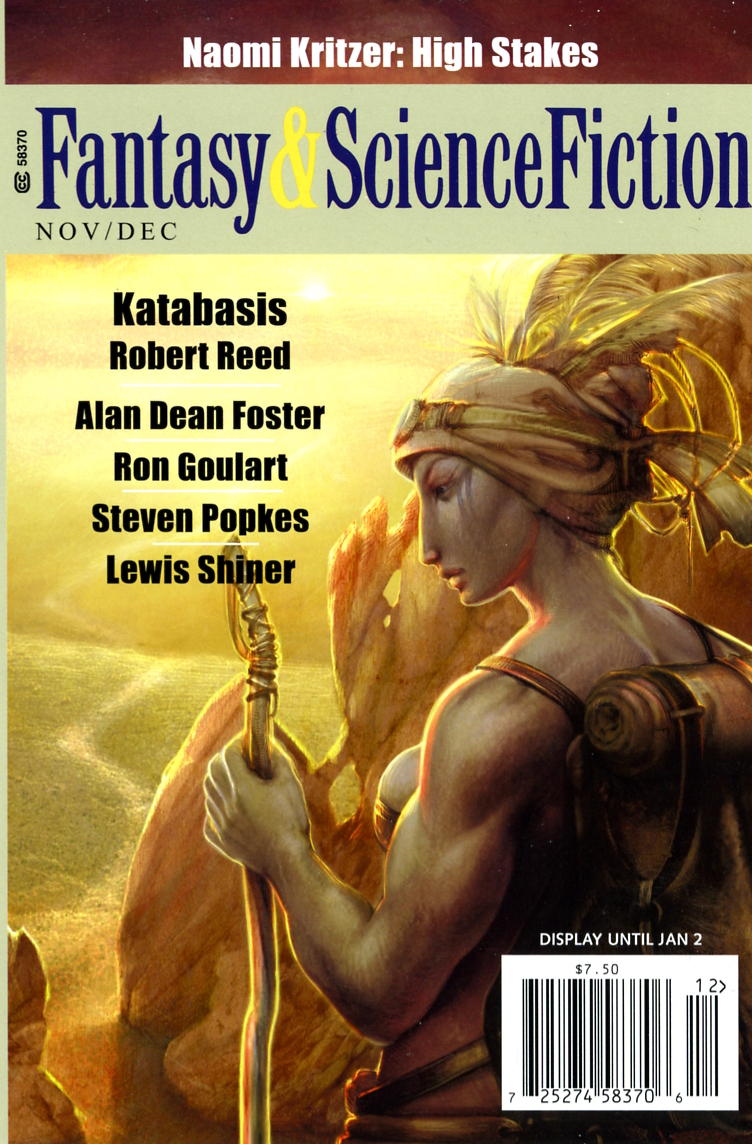
fsf-nov-dec-2012-smallCory and Catska Ench provide the intriguing cover to the Nov/Dec cover of Fantasy & Science Fiction, on sale this week. Lois Tilton reviews Robert Reed’s cover novella, “Katabasis,” set in his posthuman “Great Ship” universe, at Locus Online:

Inside the vast body of the ship, high-gravity beings once built a wheel-shaped habitat that is now used by tourists as a test of endurance. The high-gravity environment is so arduous that beings like humans can hardly bear their own weight, so they must employ porters to carry their food and water – and their bodies if they fail during the attempt. Katabasis works as a porter; she is a survivor of the arduous journey her own people once took to reach the ship…

The Great Ship is essentially a stage where different adventures can be set… knowledge of the previous stories is by no means required to enjoy the present one. What makes it different from other stages is time. The voyage is near-infinite in duration. Lifespans are measured in millennia. And as the author reminds us, death in this universe is no longer a permanent consideration. Xenophon was a student of Socrates, who would say that all humans are mortal. Reed makes us ask what, then, are the passengers on the Great Ship?

–RECOMMENDED

Read More Read More

New Treasures: The Nightbound Land #1: Night’s Engines

New Treasures: The Nightbound Land #1: Night’s Engines

nights-enginesYou’d think the rooftop headquarters of Black Gate would be a great place to stay up-to-date on the best new talent in fantasy. It probably would be, too, if I didn’t waste half my time watching H.R. Pufnstuf DVDs and trying to fix the coffee machine.

Still, I occasionally manage to overhear good tips around the water cooler. When I hear a new name enough times, I go back to my office, move around piles of pulp magazines until I can find a piece of paper, and make a note of it.

Australian writer Trent Jamieson generated a lot of chatter with his Death Works Trilogy. But it was last year’s Roil, the first novel in The Nightbound Land duology, that caused me to jot his name down on the back of a Jimmy John’s receipt.

Now Night’s Engines, the concluding volume of The Nightbound Land, has arrived, and suddenly it seems I can’t change the toner in the office copier without hearing the name Trent Jamieson.

Shale is dying. The vast, boiling maelstrom known only as the Roil has pushed humanity to the edge of extinction. The last cities teeter on the verge of collapse.

There is one hope, but it is enshrined in a decadent wastrel who does not want his destiny, and a young woman who seeks only an end to everything. And yet they go on, in search of the ancient weapons that worked against the Roil once, and must work again.

Even in fantasy, duologies aren’t that common (my spellchecker keeps wanting to change the word to Audiology, in fact). But for someone with precious little leisure time who still wants to join in on water cooler conversations, especially the ones involving that cute new intern, duologies seem like the way to go. Wish me luck.

Night’s Engines was published in May 2012 by Angry Robot. It is 400 pages, priced at $7.99 in paperback and $6.99 for the digital edition.

The Force is With Disney

The Force is With Disney

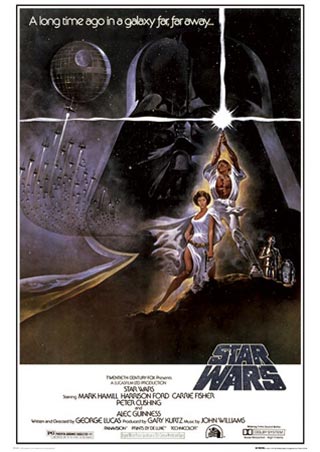
star-wars-poster-small1By now, most of you have heard that Disney has purchased Lucasfilm — the studio that produced Star Wars, Indiana Jones, and many other SF and fantasy properties — for over $4 billion. The deal was very similar to Disney’s acquisition of Marvel three years ago.

Prominent among the headlines was the news that Disney and Lucasfilm are already hard at work on Star Wars VII, aiming for a 2015 release, and that they also plan to produce Episodes VIII and IX. Walt Disney chairman Bob Iger announced that they expect to “release a new Star Wars feature film every two to three years.” If this is all news to you, Entertainment Weekly has a lengthy article here, including a 5-minute video in which you can hear George Lucas detail his current work on future films with unnamed writers.

“We could go on making Star Wars for the next 100 years,” Lucas says.

Okay. While part of me is appalled to see Lucasfilm, perhaps the most successful and creative independent studio of the last century, get swallowed up by an all-devouring entertainment conglomerate, that part has been roundly shouted down by my inner twelve-year-old, who desperately wants more Star Wars movies.

Now, I know what you’re thinking. Do I want Star Wars movies if they’re ground out on a schedule by a soulless corporation interested only in profit?

You know, I kinda do.

I’ve got nothing against corporations. Disney’s done pretty well by Marvel, far as I can see — and Pixar, now that I think about it (Disney bought Pixar from Steve Jobs in 2006). As for profit, the neat thing about profitable franchises is that they can attract talent. Look at Batman, Iron Man, and The Avengers.

And finally, I’m a fan of serial fiction. I know that properties can pass out of the hands of their creator, and land safely — especially pulp properties. That’s the process that brought us Frank Miller’s Dark Knight Returns, Star Trek IV, and the tenth regeneration of Dr. Who.

So while I expect to see a lot of debate in the fan press, I don’t expect to be part of it. Instead, I’ll be in line early in 2015, anxious to see the new Star Wars film. Even if it’s terrible, I won’t be too worried. Disney will keep trying. When you pay $4 billion for something, you tend to treat it right.

Black Gate Online Fiction: Pathfinder Tales: Queen of Thorns by Dave Gross

Black Gate Online Fiction: Pathfinder Tales: Queen of Thorns by Dave Gross

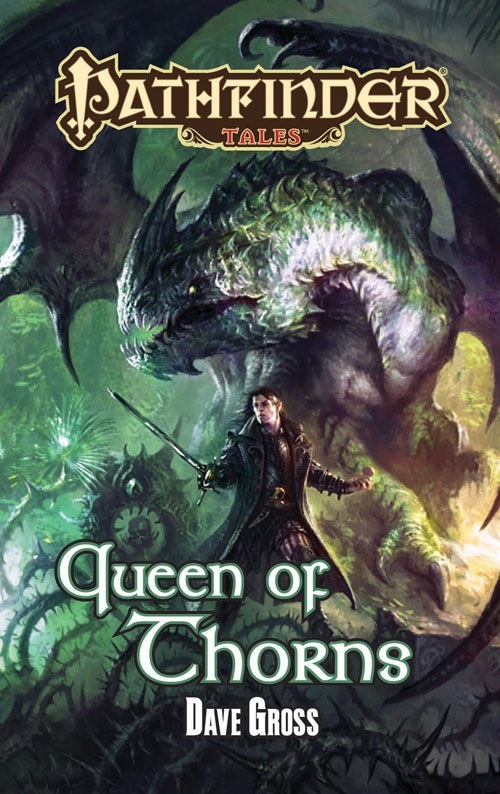
pathfinder-tales-queen-of-thorns-smallBlack Gate is very pleased to offer our readers an exclusive first look at the latest Pathfinder Tales novel by Dave Gross, the acclaimed author of Prince of Wolves and Master of Devils.

In the deep forests of Kyonin, elves live among their own kind, far from the prying eyes of other races. Few of impure blood are allowed beyond the nation’s borders, and thus it’s a great honor for the half-elven Count Varian Jeggare and his hellspawn bodyguard Radovan to be allowed inside. Yet all is not well in the elven kingdom: demons stir in its depths, and an intricate web of politics seems destined to catch the two travelers in its snares. In the course of tracking down a missing druid, Varian and a team of eccentric elven adventurers will be forced to delve into dark secrets lost for generations — including the mystery of Varian’s own past.

Dave Gross is the former editor of Dragon, Star Wars Insider, and Amazing Stories. His adventures of Radovan and Count Jeggare include the Pathfinder Tales novels Prince of Wolves and Master of Devils, as well as many novellas and short stories available at Paizo.com. His other novels include Winter Witch with Elaine Cunningham, and the Forgotten Realms novels Black Wolf and Lord of Stormweather.

We previously reviewed the Pathfinder Tales novels Death’s Heretic by James L. Sutter, Master of Devils by Dave Gross, and Howard Andrew Jones’s Plague of Shadows, and introduced you to BG Contributing Editor Bill Ward’s Pathfinder Tales story “The Box, and “The Walkers from the Crypt” by Howard Andrew Jones.

Pathfinder Tales: Queen of Thorns is published by Paizo Publishing and is part of their Pathfinder Tales Subscription. It is a 432-page mass market paperback available for $9.99 ($6.99 ePub and PDF). The digital versions are available today; the print version is officially on sale November 13, 2012. Learn more at Paizo.com.

“The Midsummer Masquerade,” the complete first chapter of Queen of Thorns, is presented exclusively here at Black Gate; Chapters Two and Three are available at Flames Rising and SF Signal.

Read Chapter One of Queen of Thorns here.

New Treasures: The Hand of Fu Manchu, by Sax Rohmer

New Treasures: The Hand of Fu Manchu, by Sax Rohmer

the-hand-of-fu-manchu-smallWilliam Patrick Maynard, Black Gate‘s resident Sax Rohmer expert, wrote an excellent 9-part series on The Hand of Fu Manchu, starting last November. It piqued my curiosity towards Rohmer, and The Hand of Fu Manchu in particular, and I vowed I would spend some quality time with both.

You’ll note it’s now October. Maybe I don’t always do it quickly, but I do keep my promises. This one was made even easier by the arrival of the gorgeous reprint edition of Rohmer’s third Fu-Manchu novel from Titan Books.

London, 1913. The era of Sherlock Holmes, Dracula, and the Invisible Man. A time of shadows, secret societies, and dens filled with opium addicts. Into this world comes the most fantastic emissary of evil society has ever known… Fu-Manchu.

A sealed box and murder most foul call Nayland Smith and Dr Petrie back from distant Egypt to the fog-enshrouded streets of London. There they discover that Dr. Fu-Manchu is an agent of a vast and deadly organization — one which will stop at nothing to achieve its ruthless goals.

The Hand of Fu Manchu was originally published in 1917 (the UK title was The Si-Fan Mysteries). There have been numerous paperback reprints over the last century, but few of this level of quality. These Titan editions are handsome and very affordable, in oversize trade paperback format; this one includes an afterword by Leslie S. Klinger, an abbreviated version of his essay from The Mystery of Fu-Manchu.

The Hand of Fu Manchu was published by Titan Books in May 2012. It is 266 pages, and priced at $9.95 for the print version and $7.99 for the digital edition. Read more at the Titan Books website.

Vintage Treasures: Solomon Kane: The Hills of the Dead, by Robert E. Howard

Vintage Treasures: Solomon Kane: The Hills of the Dead, by Robert E. Howard

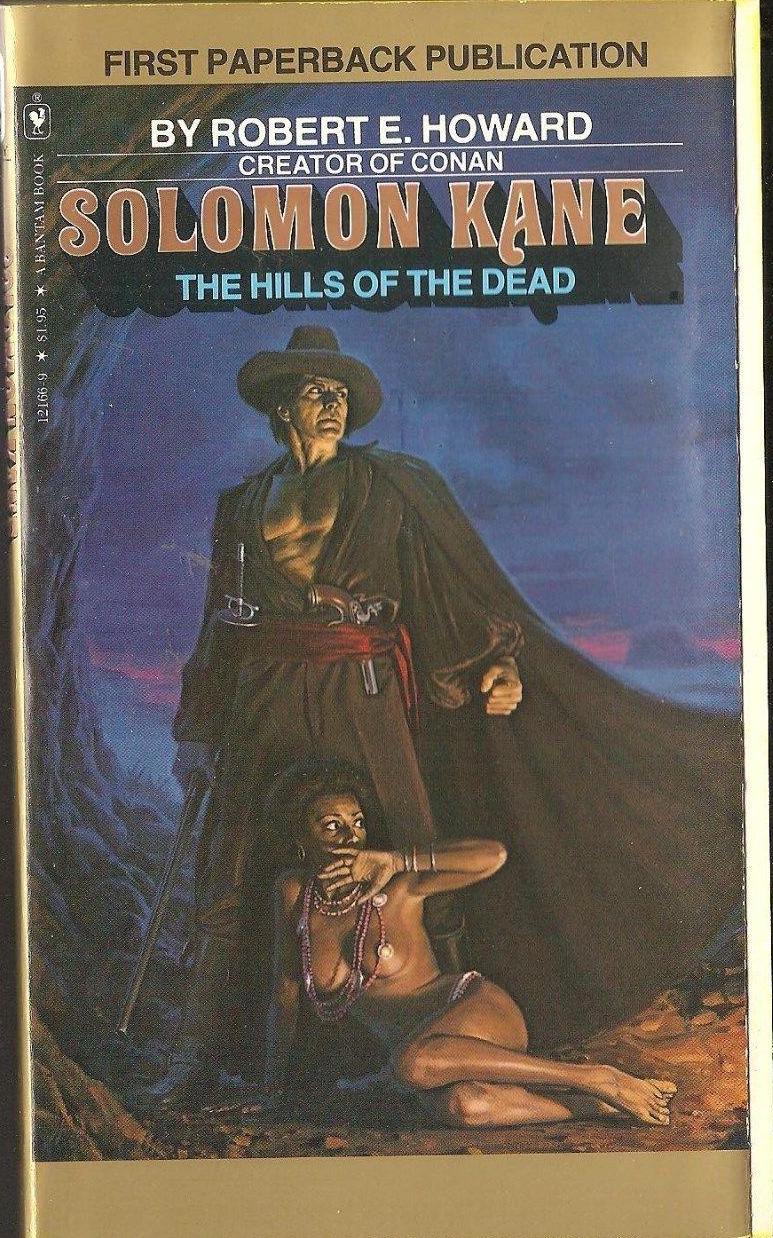
solomon-kane-the-hills-of-the-deadWith all the recent discussion around these parts about Conan and Robert E. Howard, I figured the best use of my time this week would be to sit back and enjoy some genuine Robert E. Howard.

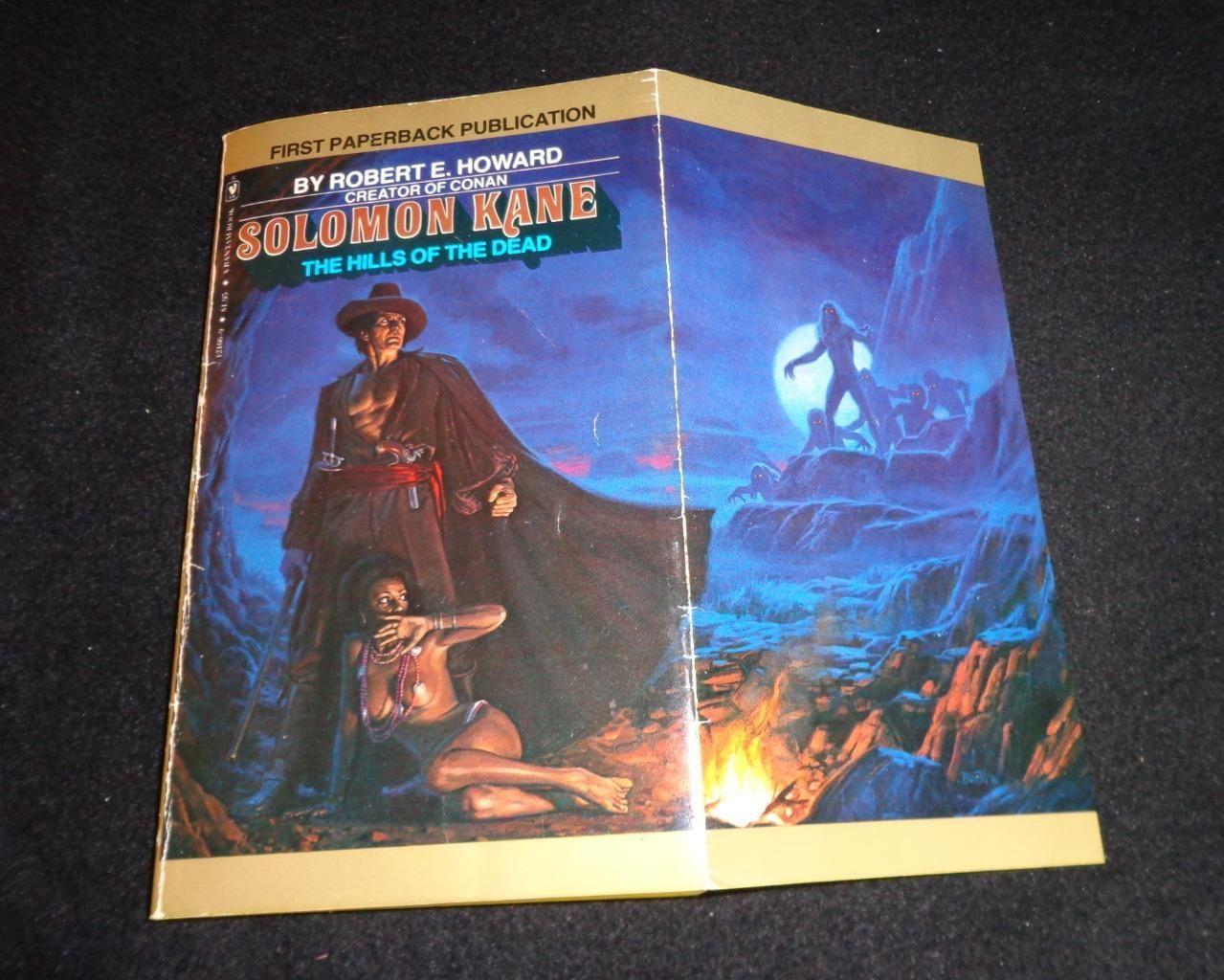
With output as vast as Howard’s, the biggest challenge was choosing what to read. One of my favorite Howard pieces is “Skulls in the Stars,” a genuinely creepy tale in which Solomon Kane investigates a moonlit moor trail haunted by a vindictive spirit, so I decided on Solomon Kane: The Hills of the Dead. It was the second Kane paperback published by Bantam Books (the first was Solomon Kane: Skulls in the Stars, in December, 1978). The striking cover is part of a fold-out poster by Bob Larkin.

In a world ruled by piracy, stalked by vampires, peopled by cities of the inhuman, he stood tall amid the terrors of the Dark Continent. Kane, a man of savage and unconquerable courage, strode deep into the jungles, forever slashing his diamond-edged rapier as evil guided the creatures of the night toward him. Wicked whispers of death touched him. Haunted horrors of the world beyond life reached for him. But Kane never halted his march, for he would never rest until the final, epic duel between light and dark was waged… and won.

Disappointingly, I discovered the contents are not pure Howard — in fact, two of the five stories within were completed by Ramsey Campbell, who also provides the introduction.

Introduction: The Mystery of Solomon Kane, by Ramsey Campbell
“The Hills of the Dead”
“Hawk of Basti” (completed by Ramsey Campbell)
“The Return of Sir Richard Grenville” (poem)
“Wings in the Night”
“The Footfalls Within”
“The Children of Asshur” (completed by Ramsey Campbell)
“Solomon Kane’s Homecoming” (poem)

Still, these’s lots here to enjoy. I’m especially pleased to see the poetry, and Campbell’s introduction, which as far as I know is unique to this volume.

Solomon Kane: The Hills of the Dead was published in paperback by Bantam Books in March, 1979. It is 141 pages, with a cover price of $1.95.

Black Gate Online Fiction: “A Phoenix in Darkness” by Donald S. Crankshaw, Part II

Black Gate Online Fiction: “A Phoenix in Darkness” by Donald S. Crankshaw, Part II

donald-crankshaw-smallThis week, we bring you Part II of Donald S. Crankshaw’s epic short novel, as young members of a secretive Order of wizards track a sinister group of Necromancers to their underground lair.

The corridor opened into a wide, circular room, the smooth, polished stone of the walls gleaming from the light that hung from the ceiling on a chain. It was like no lamp that Seth had ever seen; it appeared to be a sphere filled with an steady, harsh white light. Someone moved across the wide floor with a sluggish limp.

It took Seth a moment to realize what he was looking at. The man wore dark pants and a black, short-sleeved shirt, leaving pale skin visible. Unnaturally pale, even for someone who lived in this darkness. Patches of it showed through where clumps of his limp black hair had fallen out. His hands hung slack at his sides, and his feet dragged forward step by lurching step. His whole mode of movement hinted at some terrible deformity hidden just beneath the skin. The mouth was sewn shut, and the wide-open, glassy eyes stared straight ahead.

Seth tightened his grip on his sword. “What the Shol is that? We should kill it.”

“It’s already dead,” said Aulus.

Donald S. Crankshaw has published short stories in Daily Science Fiction, Aoife’s Kiss, and Coach’s Midnight Diner. He lives in Boston. Author photo by Kristin Janz.

You can see the complete catalog of Black Gate Online Fiction, including stories by Aaron Bradford Starr, Sean McLachlan, Harry Connolly, and Jason E. Thummel, here.

“A Phoenix in Darkness” is a complete 50,000-word short novel of dark fantasy offered free of charge. It will be published in three parts. The story began last week with Part One, here.

Read Part Two of “A Phoenix in Darkness” here.