Browsed by
Author: John ONeill

An Intro to Warhammer 40K: Explore the Horrors of the Jericho Reach in Deathwatch: The Achilus Assault
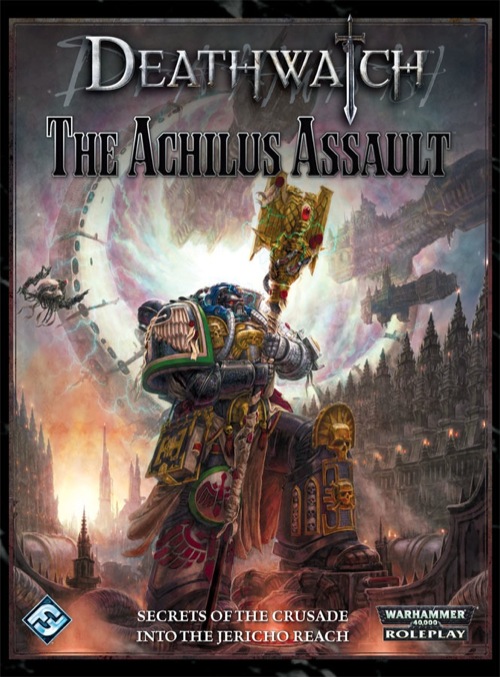
An Intro to Warhammer 40K: Explore the Horrors of the Jericho Reach in Deathwatch: The Achilus Assault

the-achilus-assault-smallI’ve mentioned a few times now that the modern game that has most captured my interest is Fantasy Flight’s Rogue Trader, set in the darkly fascinating Warhammer 40,000 universe.

Let’s back up a bit, because that was probably confusing. What is Warhammer 40,000? Back in 1983, British game company Games Workshop released Warhammer, a tabletop miniatures game which allowed fantasy fans to simulate massive battles between orcs, elves, humans, and the forces of Chaos using thousands of hand-painted lead miniatures.

The game was a major success, and in 1987 wargaming designer Rick Priestley asked the fateful question: “Hey lads — what would happen if we gave orcs space suits?”

Thus was born Warhammer 40,000, a tabletop miniatures game which allowed fantasy fans to simulate massive battles between orks, elves, humans, and the forces of Chaos — in space. And yes, it’s exactly as cool as it sounds.

Of course, a concept as powerful as Orks in Space couldn’t be contained in one genre for long. The tabletop game is currently in its sixth edition, and by 1999 Games Workshop was publishing Warhammer 40K novels and comics through its Black Library imprint. Over the last dozen years, it has produced well over 200 titles, including The New York Times bestselling Horus Heresy series.

The novels have vastly expanded the far-future setting of Warhammer 40,000, filling in the back story of the all-powerful Emperor of Mankind, who sits on his throne on Earth while his Space Marines sweep across the vast reaches of the galaxy, reclaiming the far-flung worlds of man lost in the dark millennia since the treasonous forces of Chaos brought an end to the Golden Age of Mankind. The loyal Marines — and the Rogue Traders who follow closely behind, powerful merchant princes of the stars — come face to face with strange mutant offshoots of humanity, ancient and sinister alien Xenos, gene-stealing Tyranids, and whole civilizations fallen to the corruption of Chaos.

And of course, space Orks.
Read More Read More

December Asimov’s Science Fiction Now on Sale

December Asimov’s Science Fiction Now on Sale

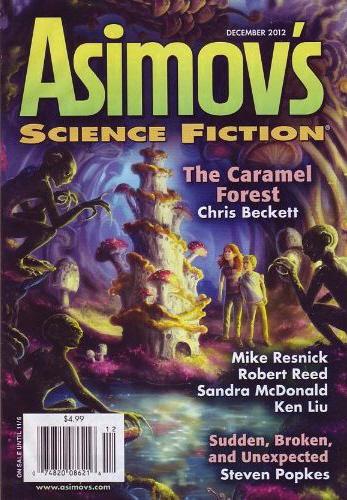
asimovs-december-2012-smallOkay, technically, it’s probably no longer on sale. And we usually don’t cover Asimov’s anyway, since it’s chiefly science fiction in content. But as I was putting this issue away, I was so struck by the moody and beautiful cover by Laura Diehl, illustrating Chris Beckett’s fairy-tale inspired “The Caramel Forest,” that I decided to make an exception and feature it here. So sue me.

I can’t just feature the cover, though, as that would be kinda weird, and make for a very short article. So I typed up the contents of the entire issue. You’re welcome.

NOVELLA

  • “Sudden, Broken and Unexpected” — Steven Popkes

NOVELETTE

  • “The Waves” — by Ken Liu

SHORT STORIES

  • “The Caramel Forest” — Chris Beckett
  • “The Wizard of West 34th Street” — Mike Resnick
  • “The Black Feminist’s Guide to Science Fiction Film Editing” — Sandra McDonald
  • “The Pipes of Pan” — Robert Reed

There’s also poetry by Bruce Boston, Karin L. Frank, and Robert Frazier, and the usual features, including “Merry Armageddon,” an editorial by Sheila Williams; a Reflections column by Robert Silverberg; book reviews by Peter Heck; and the SF Convention Calendar by Erwin S. Strauss.

Read More Read More

Carrie Vaughn Steals the Show

Carrie Vaughn Steals the Show

kitty-steals-the-show-smallI was reviewing science fiction magazines for SF Site when I first encountered Carrie Vaughn. It was in the Fall 1999 issue of Patrick Swenson’s Talebones, one of the best of the small-press magazines, that I read her story “The Girl With the Pre-Raphaelite Hair,” which I noted in my review “delivers a wallop… A tightly-written tale with a powerful ending.”

Not bad for her first science fiction story. Carrie published more than 50 over the next decade, carving out a name for herself. But it was her debut novel, Kitty and the Midnight Hour (2005), that truly catapulted her to stardom. Featuring late-night DJ (and secret werewolf) Kitty Norville — who hosts a Denver talk show about Werewolves, Vampires, and other supernatural creatures — the book was an instant success. The fourth in the series, Kitty and the Silver Bullet (2008), hit The New York Times Best Seller list, and she’s repeated that impressive feat with at least four subsequent volumes.

This industry is hard on new writers, and over the last ten years I’ve seen it defeat more than a few talented authors. So it’s a genuine pleasure to watch someone climb to the very top of the field, from her first short story to the tenth volume of her bestselling series, on nothing more than hard work and talent. If you haven’t tried Carrie Vaughn yet, her latest effort, Kitty Steals the Show, makes a good jumping-on point:

Kitty has been tapped as the keynote speaker for the First International Conference on Paranatural Studies, taking place in London. The conference brings together scientists, activists, protestors, and supernatural beings from all over the world — and Kitty, Ben, and Cormac are right in the middle of it.

Master vampires from dozens of cities have also gathered in London for a conference of their own. With the help of the Master of London, Kitty gets more of a glimpse into the Long Game — a power struggle among vampires that has been going on for centuries — than she ever has before. In her search for answers, Kitty has the help of some old allies, and meets some new ones, such as Caleb, the alpha werewolf of the British Isles. The conference has also attracted some old enemies, who’ve set their sights on her and her friends.

All the world’s a stage, and Kitty’s just stepped into the spotlight.

Kitty Steals the Show was published on July 31 by Tor Books. It is 342 pages, priced at $7.99 for both the digital version and the mass market paperback.

Black Gate Online Fiction: “Godmother Lizard” by C.S.E. Cooney

Black Gate Online Fiction: “Godmother Lizard” by C.S.E. Cooney

claire-254A young woman makes a dangerous journey across a fantastic desert landscape in a desperate attempt to save her childhood friend:

He heaped down beside me on the sharps of his knees and stared into the murky slime of the pool. “Do you have another lace?”

I felt him there beside me, all along my right side, every thin bone of him. Whenever he twitched, I expected him to rattle like verdy branches. I untied my other sandal and handed over the lace.

“I’m Ro,” I told him.

“Jaks.” He nodded at me. “Your parents are dead?”

“Pretty much dead, yeah,” I agreed. “Buried down in Paupers’ Grave on the corner of B’ihbrid and Nilzi. I live with Great Aunt Irlingard who hates me.”

“I live with my father and sisters,” he said, “in my Mother’s house.”

After a pause, he added, “My Mother is eating my father. Very slowly.”

C.S.E. Cooney’s fiction has been reprinted in Rich Horton’s Year’s Best Science Fiction and Fantasy (2011 and 2012 editions). Her poems and short stories have appeared in Clockwork Phoenix 3Apex, Subterranean, Strange Horizons, Podcastle, Pseudopod, Ideomancer, Goblin Fruit, and Mythic Delirium. Her collection How to Flirt in Faerieland and Other Wild Rhymes was released by Papaveria Press in May, and her fairytale-with-teeth novella, Jack o’ the Hills, was published by Papaveria in January. She was the recipient of the Rhysling Award in 2011 for “The Sea King’s Second Bride.”

You can see the complete catalog of Black Gate Online Fiction, including stories by Donald S. Crankshaw, Aaron Bradford Starr, Sean McLachlan, Harry Connolly, and Jason E. Thummel, here.

“Godmother Lizard” is a complete 16,000-word novella of weird fantasy offered at no cost.

Read the complete story here.

Vintage Treasures: Al Williamson Adventures

Vintage Treasures: Al Williamson Adventures

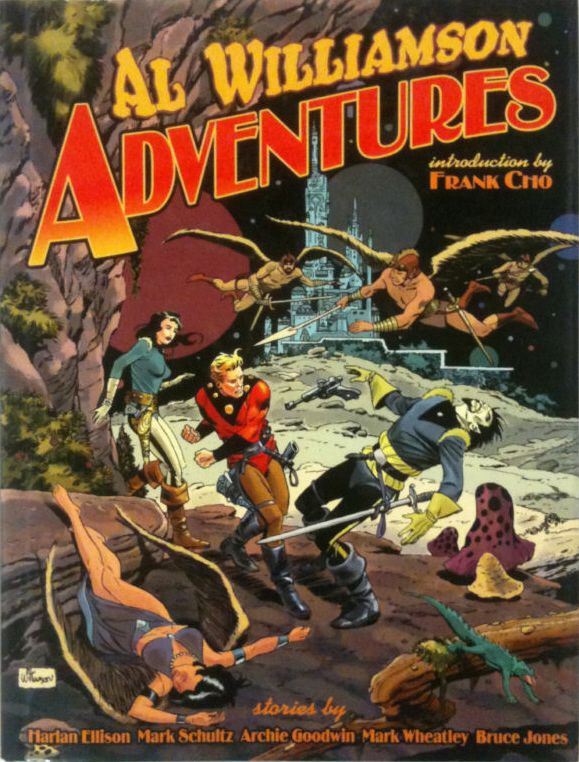
al-williamson-adventures-smallAl Williamson is one of my all-time favorite comic artists. His meticulously-detailed alien landscapes, boundless imagination and kinetic style combined to make him the perfect artist for SF adventure comics.

He started working for E.C. Comics in 1952, illustrating stories by Harlan Ellison, Ray Bradbury, and others, in titles including Valor, Weird Science, Weird Fantasy, and Incredible Science Fiction. I remember him chiefly for his later work, especially his famed Star Wars comic adaptations, and his 80’s art in Alien Worlds and Marvel’s Epic Illustrated. He passed away in 2010 (see the BG obit here).

Fortunately, you don’t have to hunt through expensive old comics to see his very best work. Over the years, a number of excellent retrospectives have appeared, including The Art of Al Williamson (1983), Al Williamson: Hidden Lands (2004), The Al Williamson Reader (2008), Al Williamson’s Flash Gordon (2009), and Al Williamson Archives (2010). One of my favorites is Al Williamson Adventures, a beautifully-produced collection of seven stories spanning his entire career, written by some of the best writers in the business:

“Along the Scenic Route” — Harlan Ellison
“Cliff Hanger” — Bruce Jones
“Relic” — Archie Goodwin
“The Few and the Far” — Bruce Jones
“One Last Job” — Mark Schultz
“Out of Phase” — Archie Goodwin
“Tracker” — Mark Wheatley

Al Williamson Adventures was published by Insight Studios Group in September, 2003. It is 96 pages in oversize hardcover, with an 8-page color section.

New Treasures: Jeffrey E. Barlough’s What I Found at Hoole

New Treasures: Jeffrey E. Barlough’s What I Found at Hoole

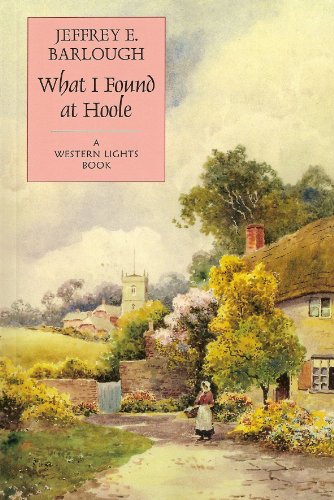
what-i-found-at-hoole-smallJeffrey E. Barlough’s Western Lights series may be the best fantasy books you don’t know about.

I didn’t know about them either, until Jackson Kuhl’s review of Strange Cargo in Black Gate 8. Jackson has called Barlough “a wonderful yet unappreciated fantasist… a talent I invite everyone to sample.” In his review of Anchorwick, the fifth novel in the series, he summarized the intriguing setting this way:

In a world where the Ice Age never ended, a cataclysm has reduced humanity to a slip of English civilization along North America’s western coastline. It’s neither steampunk nor weird western; the technology is early 19th century. It’s kinda-sorta gaslamp fantasy, except there doesn’t seem to be any natural gas. Barlough’s creation is best described as a Victorian Dying Earth — gothic and claustrophobic yet confronted by its inhabitants with upper lips held stiff. As the books are fantasy mysteries, the less said about their plots, the better… mastodons and mylodons mixed with ghosts and gorgons? Yes, please.

Now the seventh novel in the series, What I Found at Hoole, has arrived in a handsome trade paperback from Gresham & Doyle. It picks up at the end of the second volume, The House in the High Wood, which was a nominee for the 2002 Locus Award for Best Fantasy Novel.

Mr. Ingram Somervell has been called to the remote village of Hoole, in the uplands of Ayleshire, to inspect some property bequeathed to him by an uncle he had never met. Almost at once he finds himself plunged into mysteries that confound him. Why had Clement’s Mill, a dilapidated old mill that did no milling, been left to him… Why had his uncle ordered the old chapel on the fellside and its coffin-crypt sealed after the arrival of Miss Petra, his ward and heir? What was the ghostly yellow light that had been seen on Cowdrie Beacon? And what to make of the frightful dreams hinting at some unimaginable catastrophe plaguing young Somervell since he came into Ayleshire?

These novels, with their oddly pastoral cover art — the cover to this one, F.H.Tynsdale’s A Country Cottage and Church, is from the 19th Century — are an entertaining mix of genres, blending fantasy, gothic mystery, and even a dash of period comedy straight out of P.G. Wodehouse. Don’t miss them.

What I Found at Hoole was published by Gresham & Doyle on November 1st. It is 259 pages and priced at $14.95 in trade paperback. There is no digital edition.

Kevin O’Donnell Jr, November 29, 1950 – November 7, 2012

Kevin O’Donnell Jr, November 29, 1950 – November 7, 2012

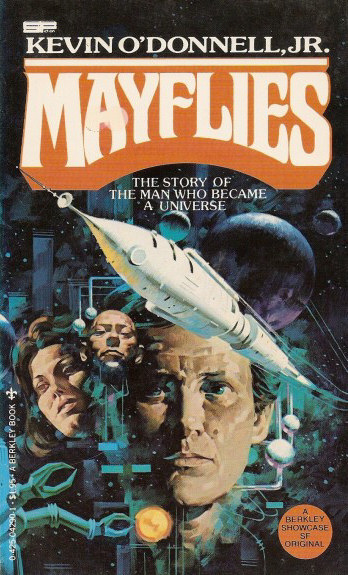
mayflies-smallAmerican science fiction writer Kevin O’Donnell Jr., who added “Jr.” to his byline to distinguish himself from his famous father Kevin O’Donnell, director of the Peace Corps, died this week.

O’Donnell graduated Yale University in 1972; his first short story “The Hand Is Quicker” appeared a year later in Analog. He published more than 70 short stories in a variety of genre publications, including Galaxy, Galileo, Isaac Asimov’s Science Fiction Magazine, Amazing/Fantastic, and Omni.

His first novel, Bander Snatch, appeared in paperback from Bantam Books in 1979. He published a total of ten over the next eleven years, including Mayflies (Berkley, 1979), War of Omission (Bantam, 1982), and ORA:CLE (Berkley, 1984).

Most of O’Donnell’s fiction was standalone, with the notable exception of his four-book series The Journeys of McGill Feighan for Berkley Books: Caverns (April 1981), Reefs (October 1981), Lava (April 1982), and Cliffs (February 1986).

His last novel was Fire on the Border from Roc Books, published in September 1990; he retired from writing fiction after his last short story, “The Boys from Bethlehem” (written with Denise Lee) appeared in the anthology The Darkness and the Fire in August, 1998.

O’Donnell was very active in the Science Fiction Writers of America, serving as chairman of the Nebula Award Novel Jury in 1990 and 1991, and chairing the Nebula Award Committee 1990-1998. He was the Business Manager of the quarterly SFWA Bulletin from 1994-1998, and in April 2005 he received the Service to SFWA Award.

The Top 40 Black Gate Posts in September

The Top 40 Black Gate Posts in September

robotechThey told us you can’t fill up the Internet, but in September, we thought we’d give it a shot. And so Scott Taylor wrote about his lifetime love of giant robots, Mark Rigney examined the genre ghetto, and Bradley Beaulieu told us about his surprise date with Amber Benson, Mary Robinette Kowal, Pat Rothfuss, and Terry Brooks.

Howard Andrew Jones commented on the World Science Fiction convention and Death and the Book Deal, Sarah Avery told us how to use our proud geek heritage to survive The Scarlet Letter, and Jason Thummel invited you to Self-Publishing 101. And that’s just the top seven articles.

Here the complete list of the Top 40 September blog entries at Black Gate according to you, our readers.

  1. Art of the Genre: The art of Robotech and a lifelong affair with Giant Robots
  2. Genre 2012: The Ghetto Remains the Same
  3. My surprise date with Amber Benson, Mary Robinette Kowal, Pat Rothfuss, and Terry Brooks
  4. Worldcon Wrap-up
  5. Teaching and fantasy literature: How to use your Proud Geek Heritage to Survive the Scarlet Letter
  6. Death and the book deal
  7. Self-publishing 101
  8. Boxed set of the year: American Science Fiction: Nine Classic Novels of the 1950s
  9. Dredd Movie Review
  10. John Myers Myers Silverlock and the Commonwealth of Letters
  11. Teaching and Fantasy Literature: Meeting them Halfway
  12. Dave Sim Announces He’s Ending Glamourpuss and Leaving Comics
  13. Genevieve Valentine Comments on Readercon Harassment in Things you Should Know About the Fallout
  14. Teaching and Fantasy Literature
  15. Black Gate to Publish Online Fiction Starting Sunday September 28
  16. Read More Read More

New Treasures: The Enterprise of Death by Jesse Bullington

New Treasures: The Enterprise of Death by Jesse Bullington

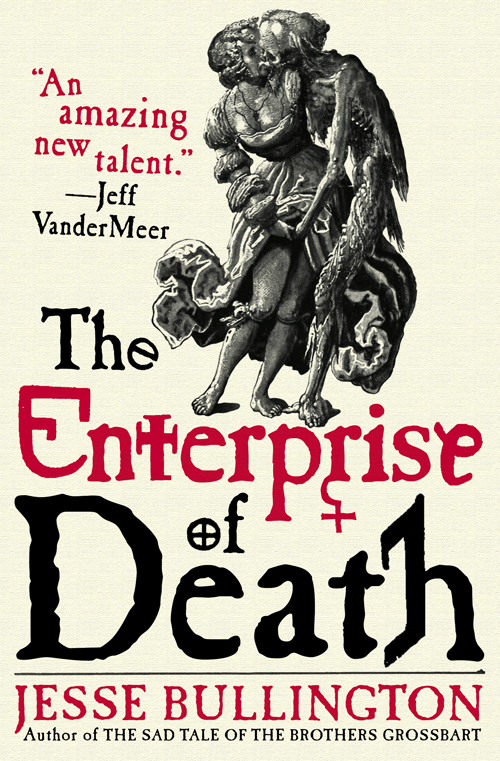
the-enterprise-of-death-smallJesse Bullington received a lot of attention for his first novel, the exceptionally dark fantasy The Sad Tale of the Brothers Grossbart, about which Booklist said, “Modeled after the grimmest of the Grimm tales, Bullington’s debut… [is] aiming instead at gross-out horror fans.”

That one seemed a bit too grim and gruesome for me. But Bullington’s second novel, The Enterprise of Death, looks more my speed.

As the witch-pyres of the Spanish Inquisition blanket Renaissance Europe in a moral haze, a young African slave finds herself the unwilling apprentice of an ancient necromancer. Unfortunately, quitting his company proves even more hazardous than remaining his pupil when she is afflicted with a terrible curse. Yet salvation may lie in a mysterious tome her tutor has hidden somewhere on the war-torn continent.

She sets out on a seemingly impossible journey to find the book, never suspecting her fate is tied to three strangers: the artist Niklaus Manuel Deutsch, the alchemist Dr. Paracelsus, and a gun-slinging Dutch mercenary. As Manuel paints her macabre story on canvas, plank, and church wall, the young apprentice becomes increasingly aware that death might be the least of her concerns.

I’ve been watching the reviews, and they are very impressive indeed. The Wall Street Journal called it “Macabre, gruesome, foul-mouthed and much more complex than the usual vampire-and-zombie routine,” and SF Revu said it was

Darkly comic… Bullington is one of those rare writers who come along once every so often with a truly original vision… this is an author capable of great and profound insight, often conveyed via his equally finely tuned sense of the ridiculous… Highly recommended.

The Enterprise of Death was published by Orbit in March, 2011. It is 464 pages in trade paperback, priced at $14.99 ($9.99 for the digital version). I bought my copy from Amazon as a bargain title for just six bucks.

Black Gate Online Fiction: “A Phoenix in Darkness” by Donald S. Crankshaw, Part III

Black Gate Online Fiction: “A Phoenix in Darkness” by Donald S. Crankshaw, Part III

donald-crankshaw-smallThis week, we present the epic conclusion of Donald S. Crankshaw’s short novel, A Phoenix in Darkness, as Seth, Aulus, and Nathan discover the breathtaking scope of the Necromancer’s plans, hidden for generations in their underground lair in the Hollow Hills.

Nathan shivered. He was trying to figure out whether it was the threat in Kulsin’s eyes or the chill air, when he realized it was neither. The chill came from inside, like an icicle impaling his chest. Aulus and Kulsin both looked around, feeling the same thing and searching for the source, but Nathan knew. He didn’t know how a sensation he’d never felt before could seem so familiar, or how he could understand its meaning so instinctively, but he did.

Nathan straightened up, trying to get their attention, and felt a weight slap against his chest. That thing the Necromancers had placed around his neck was still there. He could feel the chain now, but there were more urgent matters to worry about. “Wraiths!” he managed in a hoarse whisper.

They were coming.

Donald S. Crankshaw has published short stories in Daily Science Fiction, Aoife’s Kiss, and Coach’s Midnight Diner. He lives in Boston. Author photo by Kristin Janz.

You can see the complete catalog of Black Gate Online Fiction, including stories by Aaron Bradford Starr, Sean McLachlan, Harry Connolly, and Jason E. Thummel, here.

A Phoenix in Darkness is a complete 50,000-word short novel of dark fantasy offered free of charge, published in three parts. The story began with Part One, here.

Read Part Three of “A Phoenix in Darkness” here.