Browsed by
Author: Bob Byrne

Modular: Eye of the Beholder – The Art of Dungeons & Dragons

Modular: Eye of the Beholder – The Art of Dungeons & Dragons

Art is a HUGE part of Dungeons and Dragons (D&D). In fact, you can’t separate the amazing illustrations, (from black and white sketches to glorious color panoramas) from the actual playing of D&D. Of course, this applies to other role playing games. Wayne Reynolds’ illustrations were a big draw for me in trying Pathfinder. But there’s a reason I mentioned D&D.

Eye of the Beholder: The Art of Dungeons & Dragons, a documentary by X-Ray Films and Cavegirl Productions, is due out next year. And what a BRILLIANT idea! In addition to featuring artists and their work, it will also include interviews with game designers, authors, insiders and fans.


If this preview doesn’t grab you, I’m not sure you’re a D&D fan. If you read Part One of my history of Necromancer and Frog God Games (you did, didn’t you?), you saw those awesome Necromancer covers. I’ve loved D&D art since I started playing and I even had a puzzle with Larry Elmore’s drawing from the cover of the Red Box.

There’s a very short article about it in Format Magazine that has a bunch of wonderful D&D art from several of the greats. Makes me think of those great Dragon Magazine covers.


You can read Bob Byrne’s ‘The Public Life of Sherlock Holmes’ column here at Black Gate every Monday morning.

He founded www.SolarPons.com, the only website dedicated to the ‘Sherlock Holmes of Praed Street’ and blogs about Holmes and other mystery matters at Almost Holmes.

He is an ongoing contributor to The MX Book of New Sherlock Stories series of anthologies, with stories in Volumes III, IV and the upcoming V

Modular: Swords & Wizardry Complete Kickstarter Explodes

Modular: Swords & Wizardry Complete Kickstarter Explodes

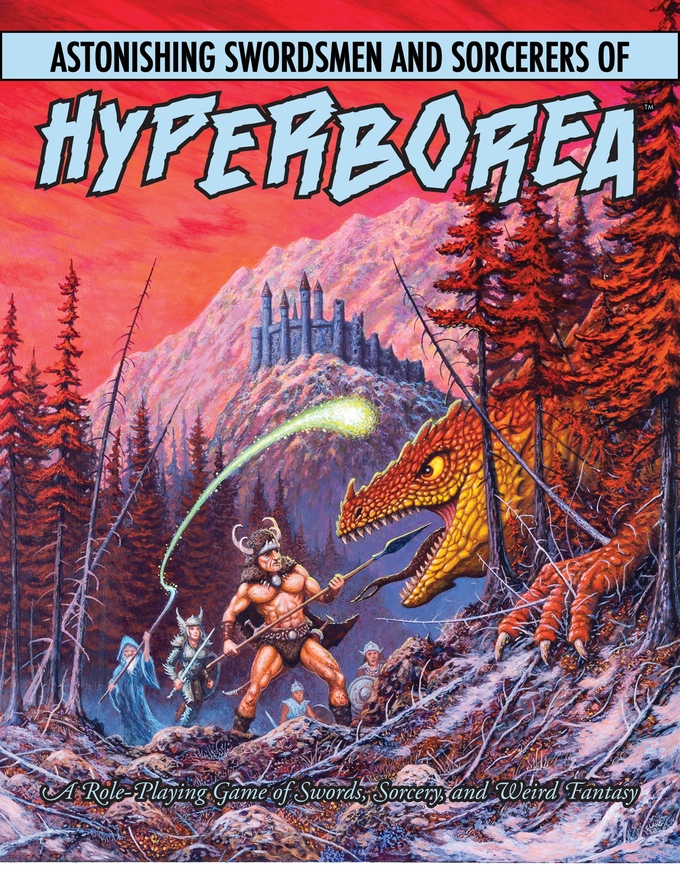
swords-and-wizardry-new-rules-smallLast month I wrote a post on why I chose to use the Swords and Wizardry (S&W) Complete Rules, instead of Pathfinder, for my latest campaign. S&W is a redesign of Original Dungeons and Dragons (pre-1st Edition), written by Matt Finch and put out by Frog God Games. Due to a stretch goal achieved in the Sword of Air Kickstarter, the S&W rules are permanently free in PDF format from Frog God. You can also buy a hardcopy with a cool Earl Otus cover.

On October 14, Frog God launched their thirteenth Kickstarter to fund a third printing of S&W Complete. But this is a little different than just a simple reprinting effort. Designer and RPGer Stacy Dellorfano had suggested to Finch that Frog God print a new version of the S&W rules, but with art and design done entirely by women. Within minutes, Finch and Bill Webb were on board and the project moved ahead.

There are minor revisions to some of the game play examples, but otherwise it’s a reprint of the second edition. However, there are two brand new adventures included: “The Five Maidens” and “Zaya’s Promise.”

Finch explained that the intent was for Dellorfano to come up with a design that was no less appealing to males, but more appealing to females. Webb has cited Lisa Stevens of Paizo as a huge influence on the role of women in the gaming community (as well as “saving the game industry when WotC cratered on 4th Edition”) and has said that his daughter will taking over Frog God from him some day. So, he was very much into the concept.

Read More Read More

The Public Life of Sherlock Holmes: Bogart’s The Caine Mutiny

The Public Life of Sherlock Holmes: Bogart’s The Caine Mutiny

caine_posterI’m fortunate in that the powers that be at Black Gate let me roam way off topic once in a while. The fantasy stuff isn’t really a stretch, since that’s at the heart of Black Gate itself. Other times, I’m just talking about something I really like. Such as, say, Humphrey Bogart.

The first two posts (The Return of Doctor X and The Maltese Falcon) about the greatest actor of all time actually fit within the Black Gate milieu. The third (about Bogie and George Raft), not really. Today’s has a military tie-in, which is a sometimes Black Gate subject.

Bogart had broken through in 1941 and was still a superstar in 1954, when he made three very different types of movies.  The second, Sabrina, was a light-hearted romantic comedy, costarring Audrey Hepburn and William Holden. I actually prefer the remake, with Harrison Ford, Julia Ormond and Gregory Kinnear.

The third, The Barefoot Contessa, was a ponderous, garish melodrama. Four-time Oscar winner Joseph Mankiewicz directed, with Ava Gardner and Edmond O’Brien co-starring. The movie collapses under its own weight.

Say it Again, Sam – Bogie only managed to secure one Oscar: for The African Queen. He certainly deserved more.

Read More Read More

The Public Life of Sherlock Holmes: Holmes & Watson (more from Otto Penzler’s SH Library)

The Public Life of Sherlock Holmes: Holmes & Watson (more from Otto Penzler’s SH Library)

roberts_holmeswatson(Third in a series of posts about the nine-volume Otto Penzler’s Sherlock Holmes Library)

So, I’ve done a post on Vincent Starrett’s two books in Otto Penzler’s Sherlock Holmes Library. And a second post looked at the two books from James Edward Holroyd. So, that covers four of the nine tiles in this series. As I wrote in the Starrett post:

“Bear in mind, every bit of anything you ever wanted to know wasn’t available on the internet back when Penzler republished these books. Heck, the Baker Street Journal wasn’t even available as a collection on CD yet. This collection of Sherlockiana was uncommon for the time.”

Sir Sidney Castle Roberts’ Holmes & Watson first saw the light of day in1953. He had already been Secretary of Cambridge University Press, Vice Chancellor of the University of Cambridge by that time and was at the time Master of Pembroke College, Cambridge, Chairman of the British Film Industry (BFI) and President of The Sherlock Holmes Society of London. Add in the many books he had authored and it is a pretty impressive resume.

Roberts opens the book with a long chapter featuring several Holmesian themes: his creation, his life, his temperament, his attitude to women, his music and his kinship with Doctor Johnson. There are far more through pieces of Sherlockiana out there on these topics, as well as full-blown biographies and memoirs of Sherlock Holmes. But this slender volume offers an enjoyable look at each of the topics.

Read More Read More

The Public Life of Sherlock Holmes: RPGing is Story Telling

The Public Life of Sherlock Holmes: RPGing is Story Telling

inspiration_tomblizardAs I recall, I began playing Dungeons and Dragons at the very end of 1st Edition. Most of my early memories are of playing AD&D and that’s still my favorite Role Playing Game (RPG) system. My buddy Chris and I used to ride our bikes to Hobbyland and he would get a shiny new TSR module, while I grabbed a color-bled, paper-bound supplement from Judges Guild.

I had read Moorcock and Lieber by then (though I didn’t get to Tolkien until early high school). I had acquired a love of Greek mythology (and to a lesser extent, Norse) earlier, and The Trojan War was probably my favorite subject matter (I rooted for Troy: that was disappointing: I mean, c’mon, tear apart the walls to drag in a giant horse your enemy left you???).

You know, The Iliad is like a game of Chainmail: a mass combat wargame with the fantasy supplement for individual heroes. Then  you’ve got The Odyssey, which is an overland (over-the-sea, mostly) D&D campaign. After you’ve played that one a time or two, you could switch to The Aeneid and you’ve got an overland campaign with a kingdom building mechanic. Huh – there’s fodder for another post…

My earliest fantasy gaming memories are of playing Adventure on an Atari 2600. That led to Temple of Apshai on an Atari 1200XL computer. I mapped out every room of that game (and The Upper Reaches sequel) on graph paper. Eventually I got an IBM-compatible PC and tore through the gold box games from SSI. I made the graphical leap to Dungeon Master from FTL (this preceded the more successful but derivative Eye of the Beholder by a few years). Even when I stopped playing pen and paper D&D, I continued on through Baldur’s Gate, Neverwinter Nights, Morrowwind and right up to Age of Conan.

Though I stopped playing, I still read a lot of 3rd Edition D&D stuff and began playing once again with Pathfinder. And as I wrote here at Black Gate just a few weeks ago, I’ve begun running a Swords & Wizardry game for some non-pen and paper fantasy players (it’s a good post. Really. You should go read it!).

And from Dungeon! to Wrath of Ashardalon to the Pathfinder Adventure Card Game, I’ve played fantasy board games for decades.

Read More Read More

The Public Life of Sherlock Holmes: Back to Otto Penzler’s SH Library

The Public Life of Sherlock Holmes: Back to Otto Penzler’s SH Library

holroyd_byways(Second in a series of posts about the nine-volume Otto Penzler’s Sherlock Holmes Library)

A couple of weeks ago, The Public Life of Sherlock Holmes looked at Vincent Starrett’s two entries in Otto Penzler’s Sherlock Holmes Library series. Another author provided two entries for the series: James Edward Holroyd.

Holroyd helped establish the Sherlock Holmes Society of London in 1951, the original London Sherlock Holmes Society having been disbanded some years earlier. He was also the first editor of the Society’s Sherlock Holmes Journal. This collection of essays reads as a combination of personal reminiscences and musings about a topic that was certainly dear to his heart.

Baker Street Byways

“Where it All Began” gives us a picture of how Holroyd came to become a Sherlockian and also states his claim that he provided the genesis for the popular Sherlock Holmes Exhibition of 1951. The Westminster Library has a page dedicated to the Exhibition on Sherlock Holmes.

Two essays discuss Sidney Paget, Frederic Dorr Steele and other illustrators of the Canon. It is easy to forget in this internet age that the average individual did not have access to thousands of pictures and nearly unlimited information with the click of a button. Holroyd helped provide illumination in a darker time. And may I recommend my own “The Illustrated Holmes” regarding this subject.

There is the seemingly obligatory pondering about the actual location of 221B Baker Street, a topic that most Sherlockians never seem to tire of (I exclude myself from this category and skip over such articles). “Fanciful Furnishings” includes some humorous asides indicating that Holroyd’s wife was less than supportive of his dream to someday construct a version of Holmes’ sitting room within his own establishment. The man who believes that he is king of his own castle should try telling the queen that he is going to build a Victorian-era sitting room, based on some fictional stories, in the basement.

Read More Read More

Why I Went Old School — or Swords & Wizardry vs. Pathfinder

Why I Went Old School — or Swords & Wizardry vs. Pathfinder

Swords&Wizardry_CoverWhen I got back into playing RPGs, I chose Pathfinder over 4th Edition D&D (as a whole lot of people seemed to do). I was familiar with 3rd Edition and the plethora of rules, skill checks, etc… I’m still pretty well versed in Pathfinder, which is a great product, and I’m a big fan both of Golarion, the campaign world, and of the company, Paizo.

Two members of my gaming group have never played an actual pen and paper RPG. One (she) is a hardcore World of Warcraft player, and the other (he) is a veteran PC gamer, with a lot of hours on Baldur’s Gate and Oblivion (among others). Both have also played the Pathfinder Adventure Card Game: Rise of the Runelords (which I LOVE!) with me. So, they get the skill check concept.

I decided to run them through a dice-rolling, paper mapping, minis on said paper, character-sheet adventure.

I initially considered Pathfinder. I have a lot of resources available, and I definitely know the system well enough to teach it to them. I even have a Beginner’s Box, still in the plastic (how about that, John O’Neill!).  But I quickly discarded that system.

Pathfinder is extremely rules heavy. I’ve seen it grow over the years and, as seems inevitable for any ongoing, lively edition, suffer from rules bloat and options bloat. The last game I ran, I limited players to the core rulebook just because I didn’t want to deal with so much “stuff.” Also, I’m not particularly interested in half-angel, half-goblin mammoth-riding gunslingers.

BTW – Gary Gygax had some very specific thoughts related to the expansion of the game (presumably through options), in his book, Role Playing Mastery:

Too often, new material purporting to add to a game system is nothing more than a veiled attempt to dominate the game milieu through power, not skill. Such creativity, if it can be called that, amounts to a perversion of the game. It is much like cheating at solitaire. Understanding the scope of opportunity offered to PCs by the game system will certainly discourage the intelligent player  from such useless activity.

Read More Read More

The Public Life of Sherlock Holmes: The Master Plot Formula (per Lester Dent)

The Public Life of Sherlock Holmes: The Master Plot Formula (per Lester Dent)

Dent1Lester Dent was a prolific pulp author, best remembered for creating the adventure hero, Doc Savage.

And speaking of Doc Savage, there is currently a Shane Black film project to star Dwayne ‘The Rock’ Johnson as The Man of Bronze. Hopefully it will introduce Savage and Dent to a new generation.

The Doc Savage stories were published under the house name of Kenneth Robeson, which is a reason Dent’s name isn’t as well-remembered as it should be.

Dent cranked out 159 Doc Savage novels, but he also wrote hundreds of short stories for the pulps across several genres, including war, westerns and mysteries. The John D. MacDonald fan (which should be everyone!) might want to check out his two Oscar Sail stories for a little hint of Travis McGee. “Sail” is included in the massive (over a thousand pages!) anthology from Otto Penzler, The Black Lizard Big Book of Black Mask Stories.

Will Murray (whose name you’re going to be seeing again here at Black Mask very soon) compiled a thorough bibliography, and it includes a very nice intro about Dent.

Dent, who died in 1959, a few weeks after suffering a heart attack, left behind a master plot formula for generating 6,000 word short stories. I’m going to let you read it below, in full, then give you some comments related to it from one of the top fantasy authors of all time.

This is a formula, a master plot, for any 6000 word pulp story. It has worked on adventure, detective, western and war-air. It tells exactly where to put everything. It shows definitely just what must happen in each successive thousand words. No yarn of mine written to the formula has yet failed to sell. The business of building stories seems not much different from the business of building anything else.

Here’s how it starts:

Read More Read More

Heavy Metal Lyrics, Sword & Sorcery Fantasy and Video Games: A Cultural Synergy by Dr. Fred Adams

Heavy Metal Lyrics, Sword & Sorcery Fantasy and Video Games: A Cultural Synergy by Dr. Fred Adams

Fred_SpaceInvadersLast year, Dr Fred C. Adams, Ph.D., joined our parade of writers in the Discovering Robert E. Howard series with an entry on Esau Cairn, REH’s classic science fiction character. Dr. Adams is back for another guest post here at Black Gate. Put on your headphones and go!


The parallel (and almost simultaneous) ascensions of heavy metal music, video game technology (which later migrated to personal computers), and sword and sorcery fantasy to mass popularity from the early 1970s forward are not coincidental. Rather, they are synergistic. All three draw from the late 20th century youth culture’s fatalism and nihilism, honed to a fine edge in the fin de siècle era of the 1990s.

Consider the aesthetic of the Ur-arcade-video game of the 1980s, Space Invaders: ranks of grotesque aliens march across the screen as space ships fly overhead firing missiles. You, represented by a screen icon, scuttle back and forth, trapped in a small area firing and dodging missiles while trying to destroy the oncoming ranks of invaders before they reach you and symbolically stomp you into the earth.

The more you destroy, the more ranks appear, starting closer and advancing more quickly. You can forestall death for a time, but the denouement is inevitable. You will lose; the programming foreordains that you will die no matter how well or how long you fight. Other games of the era, like Missile Command, and Asteroids followed suit.

An occasional arcade game like Dragonquest allowed victory, but most reduced play to a life-and-death struggle the player will never win. The kill tally represents the only satisfaction—how many of them do I take with me? As the Time Traveler of Wells’ famous novel says of fighting an impossible number of Morlocks in the darkened forest, “I will make them pay for their meat.”

Read More Read More

The Public Life of Sherlock Holmes: Vincent Starrett on the Great Detective

The Public Life of Sherlock Holmes: Vincent Starrett on the Great Detective

Starrett_PenzlerbooksOtto Penzler is a larger than life name in the mystery field. He is the man behind New York City’s ‘Mysterious Bookstore’ as well as the Mysterious Press (Nero Wolfe’s current imprint!). He’s a true mystery maven. You can read about his recent The Big Book of Sherlock Holmes Stories here.  From 1993 through 1995, under the Otto Penzler Books imprint, he reissued nine hard-to-find works of Sherlockiana.

The Otto Penzler Sherlock Holmes Library consists of the following books, originally published between 1906 and 1967:

221B: Studies in Sherlock Holmes — Vincent Starrett
Baker Street By-Ways — James Edward Holroyd
Baker Street Studies — Ed. By H.W. Bell
Holmes & Watson — S.C. Roberts
My Dear Holmes — Gavin Brend
The Private Life of Sherlock Holmes — Vincent Starrett
Holmes & Company — John Kendrick Bangs
Seventeen Steps to 221B — Ed. By James Edward Holroyd
Sherlock Holmes: Fact or Fiction? — T.S. Blakeney

Bear in mind, every bit of anything you ever wanted to know wasn’t available on the internet back when Penzler republished these books. Heck, the Baker Street Journal wasn’t even available as a collection on CD yet. This collection of Sherlockiana was uncommon for the time. Some entries are better than others, but they are all an affectionate part of my Sherlockian bookshelf (except, maybe for Bangs’ book).

Read on for reviews of the two Vincent Starrett entries in the series. You may remember reading his outstanding introduction to the first Solar Pons collection.

Read More Read More