Ken Rand’s Pax Dakota
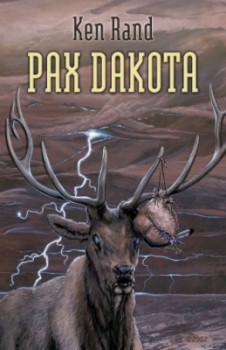 Pax Dakota
Ken Rand
Five Star (265 pp, $25.95, May 2008)
Reviewed by Bill Ward
In 1899 the United States shares an uneasy peace with its western neighbor, the Dakota, a confederated nation of Native American peoples that had joined forces to defeat the US in a war almost three decades earlier. The Pax Dakota, the peace that governs these two competing powers, is ever in danger of breaking as racism, ambition, and old animosities on both sides threaten to plunge the US and Dakota nations back into a bloody war. Into this mix steps the Old Enemy, a malignant spirit that seeks enough souls to power its return trip back to heaven — back to the side of Wakan Tanka, the Great Spirit that had exiled the Old Enemy to the Earth in the time of the First People.
In Pax Dakota Ken Rand gives us an immediately compelling alternate historical setting seasoned with a Native American flavor that gives it an exotic, unexpected quality. But primarily this is an action story, a Weird Western with horrific elements that quickly ratchets up the action and never lets up until the final scene.
The book opens with the death of Iron Shield in 1883, great war leader of the Dakota and architect of their new nation. Upon his death an entity known as the Watcher is released to find a new host — the benevolent Watcher is a guardian spirit of humanity, a being that imprinted Iron Shield with the idea for the Pax Dakota while still just a boy. The Watcher’s plan had always been to contain the prison housing the Old Enemy within Dakota territory so that the Dakota could maintain a vigil there. However, the prison of the Old Enemy, a region know as Devil’s Clay, remains in US territory after the peace, and the Watcher must quickly launch a plan that will bring about the final confrontation with the Old Enemy.
 Conan the Unconquered
 There are a lot of things to commend this book to an experienced gamer. The rules are fairly simple yet cover a lot of ground. I like how the abilities are not really tied into specific stats that are sometimes hard to justify - this system is much more fluid. It also is not conducive to rules lawyering and if there is one thing I hate, it is rules-lawyering, so this is a positive for me. I can see where the OCD crowd who wants a rule for everything could be irritated with it, but I game by the principle that story precedes rules, and this rule set is made for that mindset.
 Anyone familiar with the Mistborn series knows Sanderson is expert at spinning fantasy stories packed with memorable characters, crisply detailed settings, unique magic, and major helpings of intrigue. Lately he’s been feted as the writer continuing Robert Jordan’s Wheel of Time series. While I realize that from a purely professional standpoint, the deal was a no-brainer, I hope cleaning up the WoT‘s loose ends won’t keep this talented author from giving us more of his own marvelous work.
 Talebones, a so-called semi-prozine published twice a year, is calling it quits with issue #39 , some 14 years from its debut in 1995. Details as to why editor/owner Patrick Swenson is ending publication are scant, other than this terse
  Long-time reader and professional writer Brent Knowles recently posted a review of Black Gate 13:
 Creepy experience number one happened in New Orleans in
 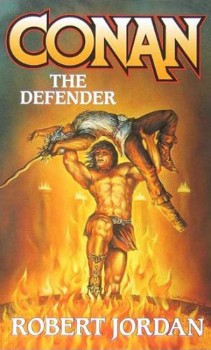 Conan the Defender
 What’s interesting about a collection of “interfictions,” aka “interstitial fictions,” is that this isn’t just another descriptor (e.g., new wave fabulism, new weird, slipstream, paraspheres, fill-in-the-blank) made up by an editor or a marketing department or critic that subsequently becomes blogosphere fodder about how inaccurate and/or stupid it is. Rather, interfictions is the self-proclaimed terminology of an actual
 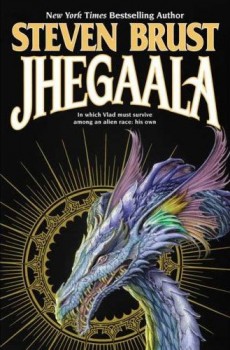 Jhegaala