Wandering the Worlds of C.S. Lewis, Part II: Spirits in Bondage
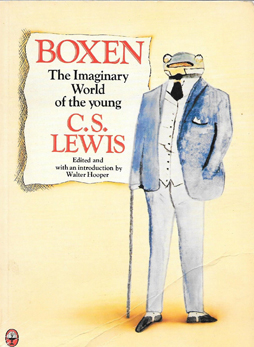
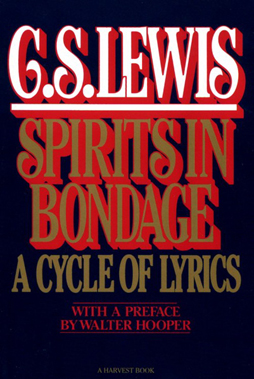 Yesterday I began a series of posts looking at the fiction of C.S. Lewis. Lewis has an unusually varied body of work, and I intend to wander through it chronologically and see what leaps out at me. I started with Lewis’ childhood tales of Boxen. Tomorrow I’ll take a look at his long poem Dymer. Today, I want to go through Lewis’ first book, a collection of lyric poems called Spirits in Bondage, published in 1919 when Lewis was still an atheist.
Yesterday I quoted Lewis’ judgement in his 1955 autobiography Surprised by Joy that the Boxen tales are novelistic and not poetic. If that’s so, what did the older Lewis think about the poetry he wrote in his youth? Did he find wonder and romance in the verse of Spirits in Bondage and Dymer? Hard to judge. Lewis doesn’t mention either volume in Surprised by Joy. Which strikes me as a little odd.
That book — again, published almost thirty years after Dymer, and twenty-five years after his conversion — describes his attempt to recapture a specific sense of imaginative joy. Lewis concludes that the emotion he felt was a kind of signpost directing him to God — that the ‘joy’ he felt and later sought came from feeling a specific kind of desire, of which God was the object. He also says that “I do not think the resemblance between the Christian and the merely imaginative experience is accidental,” and associates his experience of joy with myth and poetry as well as nature. Though Lewis states that his Boxen stories had nothing to do with that kind of inner experience, one might think his poetry at least would have a direct bearing on the subject. In fact, though, he mentions going through a kind of reaction against myth and the fantastic at about the time Spirits in Bondage was published and in the years after — “a retreat, almost a panic-stricken flight, from all that sort of romanticism which had hitherto been the chief concern of my life.” Given that, what does Spirits look like?

 C.S. Lewis loved walking, and in one letter to his friend Arthur Greaves he wrote of a fifty-mile three-day expedition he undertook alongside other friends: walking by day through woods and river valleys, at evenings stopping at local houses where the company might discuss the nature of the Good. Bearing this image in mind I’ve decided to begin wandering through the terrain of Lewis’ fiction. It is well-trodden ground, as many others have done this before me. But there’s a certain charm in seeing things for oneself. It is also just possible that another pair of eyes may spot something new in even the most familiar landscape, if the terrain is varied enough. And Lewis’ writing, as a whole, stands out as heterogeneous indeed.